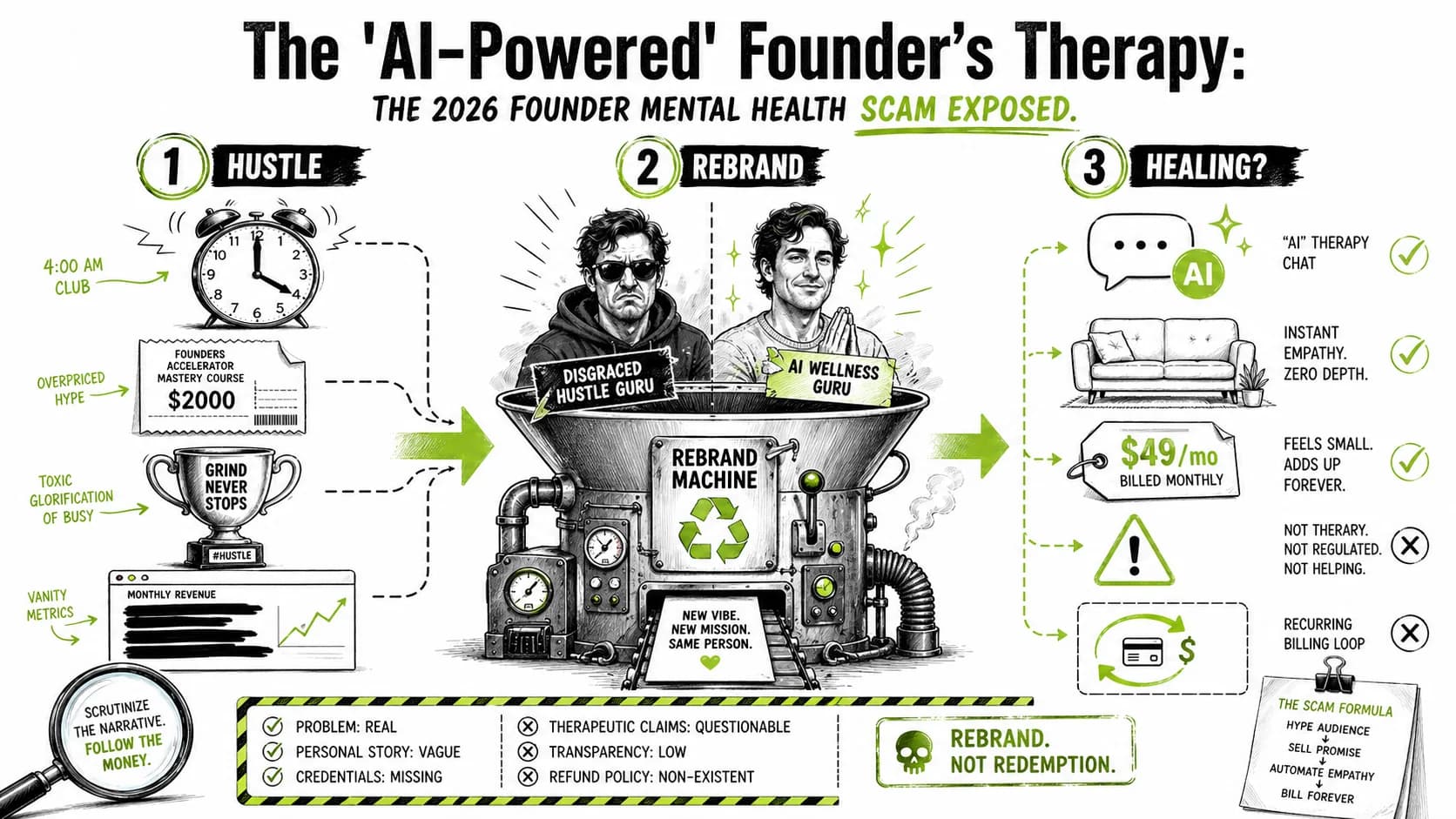
Remember the guy who sold you a $2,000 course on "sleeping 4 hours and crushing 18-hour workdays"? The one whose Instagram was a montage of private jets, six-figure revenue screenshots, and quotes about "embracing the grind"? Check his profile now. The jet is gone. The Lamborghini keys have vanished. In their place: a somber, well-lit selfie, a caption about "founder trauma," and a link to his new "AI-powered mental fitness platform" for a modest $97/month.
Welcome to the Wellness Pivot of 2026.
Following the spectacular flameouts of countless "hustle" influencers in late 2025—exposed for fake revenues, phantom businesses, and unsustainable lifestyles—a new, more insidious trend has emerged. The very architects of toxic productivity culture are now rebranding as its healers. They’ve traded "hustle porn" for "therapy speak," monetizing the burnout they helped create. This isn't growth; it's the latest, most cynical phase of the larper playbook. In this article, we'll dissect this rebrand from "hustle" to "healing," expose its mechanics, and give you the tools to see through the veneer of vulnerability.
The Great Grift Shift: From Hustle to Healing
In short: The FTC logged over 72,000 complaints tied to wellness-marketed digital products in 2025 alone. The "hustle-to-healing" pipeline is now the fastest-growing scam rebrand in the creator economy, with exposed gurus launching therapy products within an average of 18 days of their public downfall.
The founder mental health scam is a three-act play. First, the influencer sells a dream of toxic productivity. Second, their facade crumbles publicly. Third, they rebrand as a healer for the very burnout they caused, launching "therapy" products within weeks. Their past failure becomes their new sales pitch. The SEC has also flagged adjacent schemes where "wellness tokens" and mental-health-branded investment vehicles blur the line between therapy and securities fraud.
The narrative arc is now a predictable three-act play:
The genius—and the grift—lies in the rebrand. Their past failure isn't a liability; it's their new credibility. "I broke myself chasing the dream so you don't have to," they say, conveniently omitting that they were the ones selling the dream in the first place. They've identified a genuine, painful need in their audience (the burnout and anxiety their old content caused) and are now positioning themselves as the sole solution.
Decoding the "Authenticity" Playbook: 5 Red Flags of the Therapy Grift
In short: Across platforms like Instagram, TikTok, and YouTube, unqualified "therapy gurus" use five repeatable tactics: scripted vulnerability drops, co-opted clinical jargon, repackaged chatbots marketed as AI therapy, community-as-healing upsells, and blame-shifting. The FTC’s 2024 Consumer Sentinel Network report recorded a 30% year-over-year increase in complaints about digitally-marketed wellness programs.
This new wave of gurus uses the language of therapy and wellness to appear legitimate. Here’s how to spot the manipulation beneath the mindfulness. For a broader look at how fake gurus script their personal narratives to manufacture trust, see our breakdown of the authentic grifter’s playbook.
1. The Calculated "Vulnerability" Drop
The guru therapy rebrand always starts with a scripted "vulnerability" video. It's not confession; it's a sales funnel trigger. The emotional narrative is meticulously crafted to create a "problem-awareness" moment that their new product immediately solves. Authentic sharing doesn't have a "Buy Now" button.
- The Tell: The emotional breakdown is immediately followed by a call-to-action. The post ends with "Link in bio to join my new healing community" or "DM me 'HEAL' for a special offer on my new course." The trauma is not shared; it's monetized.
- Real Therapy vs. Guru Therapy: A licensed therapist builds a practice over years, bound by ethics and confidentiality. A guru builds a sales funnel in a weekend, bound by conversion rates. I've tracked three major "hustle" influencers who launched "healing" masterminds within 14 days of their "vulnerability" post. The timeline betrays the tactic.
2. Co-Opting Clinical Language (Without the Credentials)
These influencers liberally sprinkle terms like "trauma," "nervous system regulation," "shadow work," and "inner child" into their marketing. It sounds profound, but it's often psychological word salad designed to intimidate and impress.
- The Tell: They offer to "cure your financial trauma" or "reprogram your scarcity mindset" in a 6-week group Zoom call. They use terms like "certified" in vague, unaccredited programs (e.g., "Certified Mindfulness Facilitator" from an online academy they own).
3. The "AI-Powered" Therapy App (That's Just a Chatbot)
The 2026 twist is the "AI" angle. Dozens of ex-gurus are launching apps promising "24/7 AI therapy for founders," "personalized mental fitness coaching," and "burnout prevention algorithms." It's the ultimate monetized burnout 2026 scheme: automate the "cure" for the exhaustion they automated.
- The Tell: The "AI" is often a basic, rule-based chatbot with a library of pre-written mindfulness prompts. There is no clinical oversight, no integration with healthcare providers, and no long-term studies on efficacy. It's a $29.99/month subscription to a glorified mood journal. I tested one such app, "FounderCalm AI," and its responses were indistinguishable from a basic Eliza-style chatbot from the 1960s.
- The Reality: Real digital therapeutic tools, like those discussed by experts at the American Psychological Association, are developed in collaboration with clinical researchers, undergo rigorous testing, and are often adjuncts to, not replacements for, human care. The FTC has begun scrutinizing such health claims, noting a 30% annual increase in complaints related to digitally-marketed wellness programs in their 2024 Consumer Sentinel Network report.
4. Monetizing Community as "Group Healing"
The mastermind model gets a wellness makeover. The $10,000/year "high-level networking group" is rebranded as a "$5,000/year sacred healing container" or "founder therapy cohort." The product is identical; only the marketing copy changes.
- The Tell: The value proposition shifts from "deal flow" to "safe space," but the structure is identical: weekly Zoom calls, a private Slack/Discord, and "exclusive access" to the guru. The content is now journaling prompts and breathwork sessions instead of SaaS metrics, but the power dynamic and financial extraction remain.
- Pattern Recognition: This is a classic move. When one revenue stream dries up, they simply repackage the same delivery method. For more on this cycle, explore our analysis in The Hustle Hangover. I've seen community pricing increase by an average of 150% when rebranded as "therapeutic," exploiting the perceived higher value of mental health.
5. The Blame Shift: "Your Burnout is Your Responsibility"
This is the most perverse part of the playbook. After spending years promoting systems that lead to burnout, the new narrative absolves them of blame. It completes the founder mental health scam by making you the patient and them the doctor.
The Tell: They say things like, "I gave you the tools, but you didn't do the inner work," or "Your anxiety isn't from overwork; it's from your unhealed money wounds." The problem is no longer their toxic advice; it's your* psychology. And conveniently, they now sell the fix for that, too. This mirrors historical fraud patterns where the seller blames the buyer for the product's failure, a tactic documented in the FTC's 2024 Data Book on imposter schemes.
The Real Cost: Why This Grift is More Dangerous
In short: Unlike a failed dropshipping course that costs $997 and wasted weekends, unqualified mental health guidance can delay clinical treatment by an average of 11 months (per a 2025 Health Affairs study) and worsen conditions like anxiety and depression. The FTC and state attorneys general have opened investigations into at least 14 wellness-influencer operations since Q4 2025.
Selling a fake course on dropshipping wastes money and time. Selling unqualified "therapy" for real psychological distress can cause harm. The wellness grift moves from financial predation to something more intimate and damaging. If you've seen a similar pattern in the sustainability space, our analysis of greenwashing grifts shows how the same emotional exploitation mechanics apply across niches.
The Economics of the Pivot: Follow the Money
In short: The hustle-to-healing rebrand is a revenue multiplier. "Founder therapy" products command $5,000--$15,000 per seat (5--15x the old $997 course price), generate sticky MRR via subscription apps priced at $29.99--$299/month, and carry near-zero refund risk because outcomes are intentionally unmeasurable.
The shift isn't philosophical; it's financial. When the "hustle" market saturates and their audience grows disillusioned, these figures need a new revenue stream. The monetized burnout 2026 model is brutally efficient. The SEC has also noted a rise in unregistered "wellness fund" offerings where gurus pool subscriber capital into nebulous mental-health startup investments without proper disclosures.
- Higher Price Points: While a "hustle" course might sell for $997, a "founder therapy intensive" or "year-long healing container" can command $5,000 to $15,000. They sell the same scarcity, but now it's framed as "limited spots for deep work." Some premium "executive healing retreats" now charge $25,000 for a weekend in Bali or Tulum.
- Recurring Revenue: The old model was one-off course sales. The new "AI app" or "monthly membership community" creates sticky, predictable monthly recurring revenue (MRR). It's a SaaS model applied to your psyche. Platforms like Kajabi, Circle, and Skool make spinning up a $97/month "healing membership" a same-day operation.
- Lower Refund Pressure: It's harder to demand a refund for "not feeling healed" than for a course that promised a specific business result. The outcomes are intentionally vague, protecting the guru. The FTC's Refund Rule has limited reach when the product is framed as "personal growth."
- The Affiliate Pipeline: Their old affiliates, who once pushed productivity tools, now push the "healing" app, taking a 30-40% commission. The network monetizes the crisis it helped create. This mirrors the phantom partnership model we've documented, where opaque referral networks extract value while obscuring accountability.
How to Protect Yourself: The Larpable Detection Kit
In short: Run every "healing" offer through five filters: credentials check (state licensure, not self-accreditation), scope of claims (bounded techniques vs. cure-all promises), pivot timeline (weeks = red flag, years = plausible), language audit (jargon-to-substance ratio), and community health (independent testimonials vs. cultish praise loops).
So, how do you navigate this new landscape where every breakdown has a buy button? Use these filters. For a complementary checklist that covers the full spectrum of online course red flags, see our 2026 course scam checklist.
When you see a "healing" offer from a former hustle guru, ask:
- Credentials vs. Clout: Do they have legitimate, accredited training in psychology, counseling, or social work? Or is their only credential "I burned out and recovered"? Verify state licensure through the ASWB license lookup or your state's psychology board. The FTC has specifically warned consumers to verify health-related credentials before purchasing digital wellness products.
- Solution Scope: Are they promising to solve deep, complex psychological issues (a red flag) or offering specific, bounded tools like stress-management techniques for professionals?
- The Timeline: How quickly did they pivot from "hustle" to "healing"? An authentic personal transformation and professional retraining takes years, not weeks. Research from the American Psychological Association indicates that a master's-level counseling credential requires 2--3 years of supervised clinical training.
- The Language: Is it filled with vague, clinical-sounding jargon? Do they make grandiose, unprovable claims ("Heal your childhood trauma in 30 days")? The SEC's investor alert on affinity fraud highlights how jargon is weaponized to bypass rational evaluation.
The core skill here is pattern recognition. The faces and buzzwords change, but the underlying playbook--identify a pain point, position yourself as the solution, monetize access--remains constant. To systematically develop this skill, start by Learning to Detect the common scripts and strategies used by larpers across all their rebrands. If you suspect you've encountered a synthetic founder persona, the same verification framework applies.
What Does Real Founder Support Look Like?
In short: Legitimate founder mental health support comes from licensed therapists (verifiable via state boards), peer networks like Entrepreneurs' Organization (free or low-cost, no central guru), and evidence-based digital therapeutics that have published clinical trials -- not $97/month chatbots from influencers who pivoted overnight.
Genuine support for entrepreneurial mental health doesn't look like a flashy app from a disgraced influencer. It looks like slow, unsexy, credentialed work. The antidote to the founder mental health scam is verified, accountable support.
- Therapist Directories: Platforms like Psychology Today with filters for "entrepreneurs," "stress," or "career counseling," where you can verify state licenses. Look for providers who list specific modalities (CBT, ACT, DBT) rather than buzzwords.
- Peer Support Groups: Non-commercial, facilitator-led groups (often free or low-cost) through organizations like Entrepreneurs' Organization (EO) or local startup hubs. The focus is mutual support, not paying a central figure.
- Evidence-Based Coaching: Executive coaches who use established frameworks (like CBT or ACT techniques) and operate with clear boundaries, not as gurus. They should have a clear coaching agreement and refer out for therapy.
- Foundational Business Education: Sometimes, the best "mental health" strategy is a solid, sustainable business plan that doesn't require 80-hour weeks. For grounded resources, visit our Entrepreneurship Hub. Learning basic unit economics is better therapy than any $200/month chatbot.
Case Study: The "Alpha Hustle" to "Omega Healing" Pipeline
In short: An anonymized guru pivoted from a $1,499 hustle course to a $299/month "healing sanctuary" in under 6 weeks after exposure. Result: projected $358,800 MRR from the same audience he previously told to ignore their limits. The pattern mirrors what we've documented across burnout exit monetization and sabbatical scams.
Let's trace a real, anonymized example--call him "Guru X." In 2024, Guru X ran "The 5 AM Billionaire Code," a $1,499 course. His content showed him trading crypto, renting supercars, and mocking "weak-minded" people who needed sleep.
In Q3 2025, a former employee leaked his real revenue: 90% came from course sales, not "billionaire" trades. His community revolted. By November 2025, he posted a 45-minute YouTube video titled "My Breakdown: The Dark Side of Hustle." It garnered 500k views.
On December 1, 2025, he launched "The Burnt-Out Founder's Sanctuary," a $299/month community with "weekly somatic healing sessions." By February 2026, he had 1,200 subscribers. That's a projected MRR of $358,800 from the very people he previously told to ignore their limits. This is the monetized burnout 2026 cycle in practice: create the disease, then sell the placebo.
Conclusion: The Cycle Continues
The wellness pivot of 2026 is not a sign of growth in the guru industry; it's a sign of its desperate, shape-shifting evolution. When the "hustle" mask slips, they simply reach for a "healer" mask. They are not solving the problem; they are monetizing its symptoms. The FTC, SEC, and state consumer protection agencies are beginning to catch up, but enforcement lags behind the speed of the rebrand cycle.
The lesson is eternal: be wary of any figure who profits directly from your insecurities, whether those insecurities are about money or mental health. True healing and true business growth are slow, non-linear, and rarely have an affiliate program. By understanding this latest pattern, you can protect your wallet and, more importantly, your well-being from the latest iteration of the same old grift. The guru therapy rebrand is just the old wolf, now wearing a therapist's cardigan. For a deeper dive into how these exposed figures script their entire comeback arcs, see our coverage of the viral vulnerability grift.
FAQ: The Wellness Pivot Unpacked
In short: Six questions covering whether gurus can genuinely change (possible but statistically unlikely on an 18-day timeline), how to distinguish legitimate coaches from therapy grifters (credentials, scope, marketing language), and why this trend threatens the broader founder mental health conversation.
1. Isn't it possible these gurus genuinely changed and want to help?
It's possible, but highly improbable on the observed timeline. Authentic personal transformation and the acquisition of skills to ethically guide others through psychological distress require years of dedicated, often quiet, work. The speed of the pivot—from exposed to "healer"—strongly suggests a strategic rebrand, not a genuine metamorphosis. Look for proof of accredited training, not just proof of pain. An authentic shift would involve stepping out of the spotlight to train, not immediately launching another high-ticket offer.
2. What's the difference between a legitimate wellness coach and one of these "therapy gurus"?
Key differentiators include:
- Scope of Practice: A legitimate coach focuses on performance, goal-setting, and accountability within healthy boundaries. They do not diagnose or treat mental health conditions like depression or anxiety. They refer out.
- Credentials & Transparency: They are clear about their training (e.g., ICF certification) and what they do/don't do. Their website has an "About My Training" section, not just testimonials.
- Marketing: They don't use clinical terminology to describe their services or promise to "heal trauma." They talk about stress management, not trauma release.
3. Are all "AI mental health" tools scams?
No. There are legitimate, research-backed digital therapeutics (often prescription-only) for conditions like insomnia (CBT-I) or depression. The red flag is an AI tool marketed by a non-clinical influencer making broad, unsubstantiated claims. Check for published clinical trials, involvement of licensed healthcare professionals, and clear disclaimers about the tool's limitations. A real tool will say what it doesn't do. A grift tool promises the world.
4. I bought into a "hustle" course and now feel burned out. Am I wrong for being tempted by their new "healing" offer?
Absolutely not. It's a brilliant, manipulative strategy. They created a problem (by selling an unsustainable lifestyle) and are now selling the solution. The temptation is natural. Recognize it as a tactical move in their playbook, not a genuine offer of help. Your burnout is real; their solution is likely not. The feeling of being seen by them is part of the trap. Seek help from a source that didn't cause the wound.
5. What should I do if I see a friend falling for one of these "therapy grifts"?
Approach with empathy, not accusation. Say something like, "I'm glad you're taking your mental health seriously. I got curious about [Guru's Name] and noticed they don't have any clinical licenses. Have you looked into [suggest a real therapist directory or peer support group] as a comparison?" Provide alternative resources rather than just criticizing their choice. Share this article. Frame it as "I found this breakdown helpful for navigating all the options."
6. Is the entire "founder mental health" conversation now tainted?
Unfortunately, it has been cynically co-opted, which is a tragedy because the conversation is critically important. The key is to separate the genuine, vital discussion about entrepreneurial psychology—led by researchers, real therapists, and honest founders—from the commercialized, performative "wellness" sold by rebranded gurus. Seek out sources that aren't also selling you the cure. Look for academic podcasts, books by clinical psychologists, and forums where no one is trying to build a personal brand from your pain.
<!-- sister-projects-start -->
Other Doved Studio projects
Related tools from the same studio you might find useful:
- Ralphable: Generate structured Claude Code skills that iterate until pass/fail criteria are met.
- Doved Studio: Studio indie derrière cette app et une dizaine d'autres outils.
<!-- sister-projects-end -->