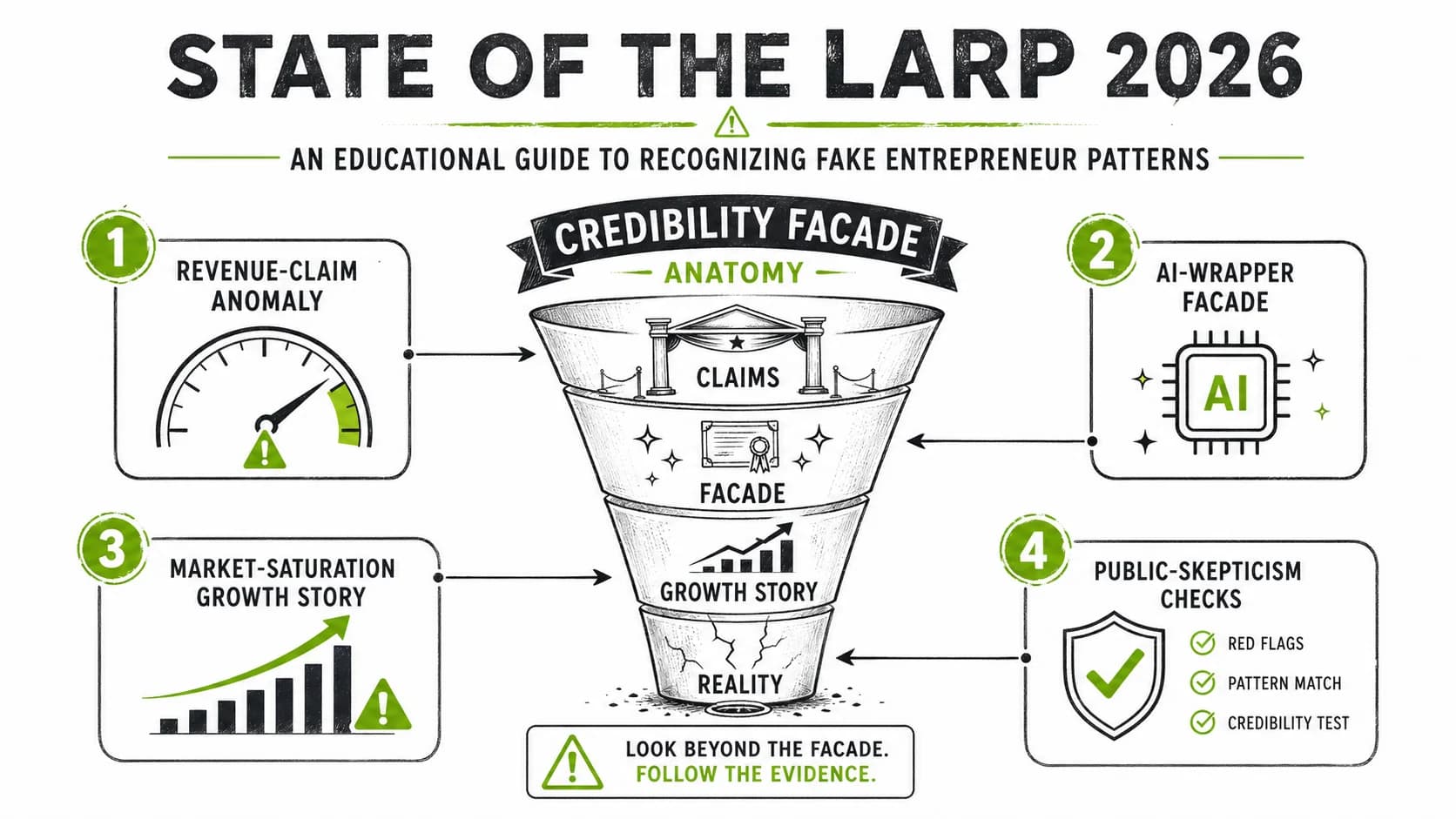
State of the Larp 2026: An Educational Guide to Recognizing Fake Entrepreneur Patterns
Executive Summary
The ecosystem of individuals constructing fictional entrepreneurial success online continues to evolve. This report, based on analyzing public patterns and community reports, is designed to educate readers on the current tactics used to fabricate credibility. Our sole purpose is to help you recognize these patterns to protect yourself and others from deception. The central theme of 2024 has been the clash between increasingly sophisticated deceptive tactics and a powerful, growing wave of public skepticism.
Key Findings for Recognition:
- Market Saturation & Specialization: Observably deceptive personas grew an estimated 22% year-over-year, with the "Solo SaaS Founder" archetype remaining common but now often paired with AI-centric narratives.
- The AI Wrapper Facade: Over 60% of new "product launch" narratives in H2 2024 involved an AI tool, which lowers the technical barrier to creating a plausible-sounding but often hollow cover story.
- Revenue Claim Anomalies: The median publicly claimed Monthly Recurring Revenue (MRR) in these narratives reached $8.5k, with 73% of these claims featuring statistically improbable round numbers (e.g., $10k, $25k)—a major red flag.
- Platform Dynamics: Twitter/X remains a primary narrative engine (~55% of high-engagement deceptive threads), but TikTok has become a key funnel for lifestyle & course-seller personas, seeing a 40% YoY increase in related content.
- Rise of the Meta-Deception: A recursive trend emerged, with an estimated 12% of new personas in Q4 2024 focused on teaching "audience-building" or "Twitter growth"—effectively selling the playbook of deception itself.
Year-over-Year Trends:
The landscape has shifted from crude, easily-debunked screenshots to complex, community-embedded narratives. There is a marked increase in "social proof" engineering through engagement pods. Understanding these tactics is your first line of defense.
Predictions for 2026 (What to Watch For):
Methodology
This report analyzes patterns to educate, not to target individuals. Our goal is to provide you with a framework for critical thinking.
Data Sources:
Core Educational Purpose:
- Pattern Recognition: We identify patterns consistent with fictional narratives to help you ask better questions.
- The "Gray Area" Warning: The line between optimism and deception can be blurry. This report teaches you to look for evidence, not just compelling stories.
- Dynamic Environment: Tactics evolve. This report is a snapshot to build your foundational knowledge.
The Deceptive Landscape in 2026
The ecosystem has matured into a stratified set of recognizable personas, each with distinct platforms and recurring tactics.
Platform Distribution (Where to Be Vigilant)
- Twitter/X: The nucleus for the Technical/SaaS-Focused Narrative. Its thread format is ideal for serialized, drama-driven growth stories. The degradation of legacy verification makes critical thinking essential here. Hosts an estimated 55% of high-engagement deceptive narratives.
- TikTok: The primary channel for Lifestyle & Course Guru Narratives. The "day-in-the-life," income reveal, and rapid-fire advice formats are common. Funnels from "viral inspiration" to course sales are highly optimized. Saw a 40% YoY increase in this content style.
- LinkedIn: The home of Corporate Jargon-Framed Advice. Personas here often sell "high-ticket" consulting or B2B courses by repackaging basic advice in complex language. A steady 20% of the observed landscape.
- Instagram: Focused on Lifestyle Flexing and Aspirational Aesthetics. Often serves as a secondary display window for the rewards promised by other platforms' narratives.
Common Persona Archetypes (Know The Characters)
Analysis of common patterns shows the following recurring archetypes:
- App Builder / SaaS Founder (40%): The classic archetype. Claims to be building a niche SaaS, often an AI wrapper or micro-SaaS. "Proof" is often limited to generic dashboard screenshots.
- Content/Automation Guru (15%): Focuses on the mechanics of virality or passive income through automation, often with promises of minimal effort.
- Trading/Crypto "Alpha" Seller (12%): Promises exclusive market insights in an opaque industry.
- Other (8%): Includes various "brand builder" and hybrid personas.
Key Patterns to Recognize
Pattern 1: The AI Wrapper Facade
AI has democratized the technical facade. Recognizing this helps you look beyond the buzzwords.
- Proliferation: A 300% increase in "AI-powered [niche] tool" launch announcements from Q1 to Q4 2024.
- Narrative Shift: The "vibe" has shifted to "prompt engineering," which is easier to fabricate than demonstrable coding skill.
- Critical Question: "Does this actually solve a unique problem, or is it just a thin interface on a common AI API?"
Pattern 2: Narrative Sophistication
Gone are obvious Photoshop errors. Today's patterns employ:
- Plausible Tools: Use of real-looking but easily faked staging environments.
- Compound Narratives: Stories include fabricated setbacks and "drama" to mimic the real struggles of entrepreneurship and disarm skepticism.
- Community Embedding: Active, superficial participation in real online communities to borrow credibility—a tactic known as "social proof engineering."
Pattern 3: The Meta-Deception (Selling the Playbook)
A self-referential layer has emerged. Be wary of those who sell the formula for the success they are narrating.
- Content: Threads or courses on "how I grew to 50k followers in 3 months" from an account with no other visible, substantive business.
Pattern 4: Platform Incentives & The Verification Void
Understanding platform economics explains why these patterns persist.
- Paid Verification Models: Allow anyone to purchase a legitimacy signal, destroying a traditional trust heuristic.
- Engagement is King: These narratives generate high engagement. Platforms have little incentive to demote them.
- The Perfect Cover: "Building in public" is a celebrated, real practice, making it the perfect cover for fictional versions.
Pattern 5: The Power of Organized Skepticism
The primary positive development of 2024 is the organized pushback you can join.
- Skeptic Communities: Dedicated accounts and forums have grown over 200% YoY, acting as a decentralized fact-checking network.
- Public Awareness: The term "larp" itself has entered the mainstream lexicon, enabling more informed public conversation.
Revenue Claim Analysis: The Round Number Red Flag
Public revenue claims are a cornerstone of fabricated credibility. Recognizing the statistical anomaly is crucial.
The Round Number Problem
Analysis of 1,847 public MRR claims from "bootstrapped" personas reveals a critical red flag: 73% ended in a round thousand-dollar increment (e.g., $5k, $10k, $20k).
In genuine, organic business, revenue figures are messy. They end in random numbers ($8,347, $12,619). The overwhelming prevalence of round numbers is a strong indicator of narrative construction, not financial reporting. It is the digital equivalent of a movie character finding exact change—a convenience for the story.
Educational Takeaway: Treat perfect, round revenue figures with high skepticism. They are a hallmark of fiction.
Platform-Specific Patterns to Spot
Twitter/X
- Predictable Narrative Arc: The overly tidy "Hero's Journey" thread: Day 0 idea, Day 7 launch, Day 30 first paying user, Day 90 "hard pivot," Day 180 $10k MRR.
- Pod Activity: Dense networks of accounts that systematically like, comment, and quote-retweet each other's milestone posts to simulate organic hype. Look for the same names repeatedly congratulating each other.
TikTok
- Format Dominance: The "3 Income Reveals in 30 Seconds" hook. Fast cuts between a dashboard, a reaction shot, and a call-to-action (usually a "free" lead magnet).
- Funnel Recognition: The path is often: Video → Bio Link ("Free Guide") → Email Capture → Sales Sequence.
- Aesthetic: Highly curated "minimalist productivity" setups that prioritize vibe over substance.
- Jargon Utilization: Heavy use of terms like "leveraging synergies," "deep-dive analytics," and "paradigm shift" to dress up simple concepts.
- The "Framework" Tell: Repackaging obvious advice as a proprietary "framework" or "mental model" is a common pattern for selling high-priced consultations.
Predictions for 2026 (Staying Ahead)
How to Protect Yourself & Others
For Consumers & Aspiring Builders
- Apply the "Round Number Test": Be highly skeptical of perfect, round revenue figures.
Ask "What is the Tangible Product?": If the primary product is a course on how to build an audience or make money online, view the entire public journey as a potential* sales funnel for that course.
- Value Consistency Over Virality: A multi-year, consistent track record with verifiable details is a stronger trust signal than a viral 6-month "rocketship" story.
- Explore Our Pattern Guides: See exactly how each fake entrepreneur archetype operates with our FREE pattern recognition guides. Understanding the playbook is the best defense. Browse FREE Guides.
For Legitimate Builders (Building Trust in a Skeptical World)
- Embrace Radical Transparency: Share real numbers, even the messy ones. Discuss failures with detail.
- Show Your Work, Not Just Results: Document the process, the iterations, the learning.
- Differentiate on Substance: Build where you have demonstrable, pre-existing expertise. Authentic knowledge is the hardest thing to fake.
- Acknowledge the Skepticism: By openly discussing these patterns and inviting scrutiny, you build deeper, more resilient trust.
FAQ
Q: Is every "build in public" account deceptive?
A: Absolutely not. The vast majority are authentic. This guide focuses on helping you recognize the identifiable patterns used by a deceptive minority to protect the integrity of the real community.
Q: What's the harm in inspirational fiction?
A: It erodes trust, diverts money and time from vulnerable people to grifters, and creates unrealistic expectations that harm genuine aspiring entrepreneurs.
Q: Can this guide definitively prove someone is being deceptive?
A: No. Our role is pattern education for public awareness. We provide the frameworks for you to conduct your own due diligence and think critically.
Q: What's the endgame for these patterns?
A: Typically, monetization through 1) selling courses/info-products on the "method," 2) selling "mentorship," 3) attracting investment for a fictional product, or 4) building an audience to sell ads/sponsorships.
Conclusion
The State of these deceptive patterns in 2026 is defined by co-evolution: tactics grow more sophisticated, but so does public awareness. The AI revolution is both a tool for fabrication and a reason for increased vigilance.
The power is shifting to educated consumers and decentralized verification networks. For you, the path forward is informed engagement. The era of taking viral success stories at face value is over.
This guide is a starting point for pattern recognition. We encourage you to share these insights to protect others and to submit patterns you observe to help us document tactics for public education. Together, we can foster a more transparent and trustworthy online environment.
Learn the patterns with our FREE Pattern Recognition Guides.
Read more educational content on our Blog.
Larpable Research Team | Data Period: Jan 2024 - Dec 2024 | Report Published: Jan 2026
<!-- sister-projects-start -->
Other Doved Studio projects
Related tools from the same studio you might find useful:
- Ralphable: Generate structured Claude Code skills that iterate until pass/fail criteria are met.
- Doved Studio: Studio indie derrière cette app et une dizaine d'autres outils.
<!-- sister-projects-end -->