Fake Passive Income Courses in 2026: How the "Gurus" Actually Make Their Money
There's a specific genre of Instagram Reel that you've seen a hundred times by now. A person in their late twenties sits in a rented penthouse, laptop open, ocean view behind them. They say something like: "I made $47,000 last month in passive income. I'm going to show you exactly how." The implication is clear: follow their system, buy their course, and you too can earn money while sleeping on a beach.
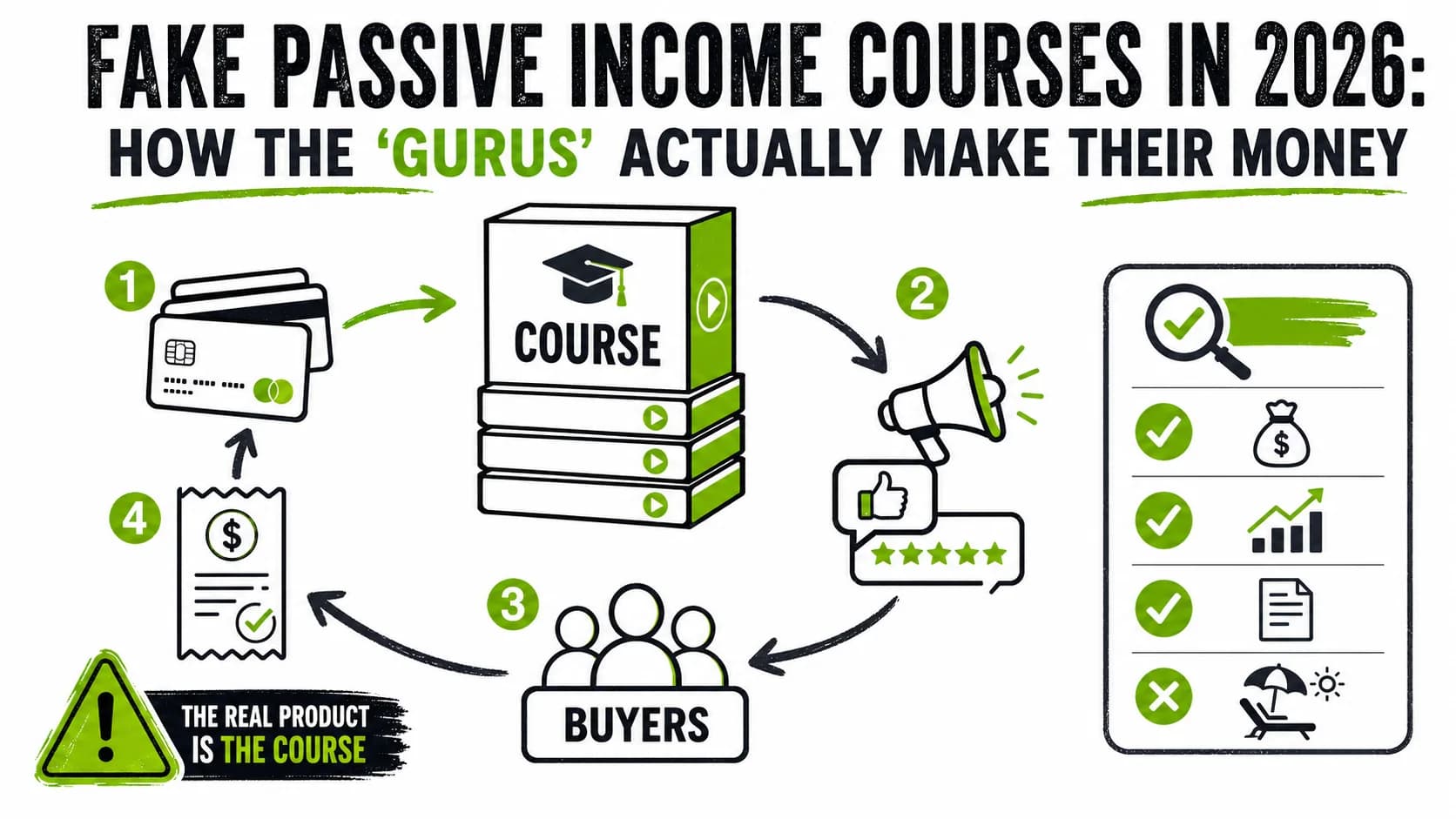
Here's the part they leave out. That $47,000 came from selling the course you're about to buy. The "passive income" is you. Your credit card. Your hope that there's a shortcut.
This isn't a new scam. But in 2026, it has matured into a sophisticated, multi-layered industry with its own supply chain, technology stack, and psychological playbook. The old dropshipping guru has been replaced by the "digital freedom" mentor. The Lamborghini has been traded for a minimalist co-working space. The pitch is smoother. The funnel is tighter. And the money flowing through it is staggering.
I spent four months investigating this ecosystem. I bought three courses, joined seven Discord communities, attended two "free masterclass" webinars, and tracked the revenue claims of fourteen self-proclaimed passive income experts. What I found is an industry where nearly every dollar of "passive income" comes from one source: convincing other people to pursue passive income.
The Circular Revenue Model: Courses About Courses
The core mechanic of the fake passive income industry is elegant in its simplicity. A person creates a course teaching people how to make passive income. The course teaches students to create courses teaching people how to make passive income. Those students then become affiliates who sell the original course. The "passive income" everyone earns is just money cycling between participants, with each layer taking a cut.
This is not an exaggeration or a simplification. It is the literal business model.
Take a typical example. A guru sells a course called "The Digital Freedom Blueprint" for $997. Inside the course, the primary module teaches students to create their own "digital products." The recommended digital product is, of course, a course. The guru provides templates, scripts, and funnel pages. But the fastest path to revenue, the one highlighted in every testimonial and success story, is joining the affiliate program for the guru's own course. Students earn a 40-50% commission on every sale they generate.
So student A buys the course for $997. Student A then promotes the course to their social media audience. Student B buys through student A's link. Student A earns $498. The guru earns $499. Student B then joins the affiliate program and repeats the cycle. At no point does anyone create a product that serves an external market. The entire economy is internal.
According to data compiled by the Federal Trade Commission in their 2025 annual report on business opportunity fraud, complaints related to "digital education" and "online business systems" increased 68% year-over-year, with median reported losses of $2,400 per victim. The FTC specifically flagged the "course-about-courses" model as a growing concern, noting that it shares structural characteristics with multi-level marketing schemes.
The Income Screenshot Industry
Every passive income guru needs proof. Screenshots of Stripe dashboards, Shopify revenue graphs, and bank account balances are the currency of credibility in this space. Without them, the pitch falls apart. With them, skepticism melts.
The problem is that these screenshots are either fabricated, misleading, or both.
There are three primary methods gurus use to generate impressive-looking income proof.
Method 1: Stripe and PayPal screenshot generators. These are web tools, some free, some sold for $20-50, that let you input any revenue number and generate a pixel-perfect replica of a Stripe dashboard, PayPal balance, or bank statement. They match fonts, colors, layouts, and even transaction IDs. I found four such tools with a ten-minute search. One had over 15,000 users.
Method 2: Gross revenue without context. A guru shows $150,000 in Stripe revenue over 90 days. What they don't show is the $60,000 in affiliate payouts, the $25,000 in ad spend, the $15,000 in payment processing and refunds, and the $12,000 in software and contractor costs. The actual profit is $38,000 over three months, or about $12,600 per month. Still decent. But it's not "$150K in passive income," and it required 60-hour weeks of active content creation, sales calls, and funnel optimization. There is nothing passive about it.
Method 3: Revenue cycling. This is the most insidious technique. A guru with two business entities transfers money between them. Entity A pays Entity B for "consulting services." Entity B's Stripe dashboard now shows incoming revenue. The guru screenshots Entity B's dashboard and posts it as proof of their "new passive income stream." The money never left their control. It's an accounting illusion.
The Better Business Bureau's 2025 Scam Tracker received over 4,200 reports related to fake income claims in online business education, making it the fastest-growing scam category outside of cryptocurrency fraud. The BBB noted that "income proof" is now the single most effective persuasion tool in fraudulent course marketing, more effective than celebrity endorsements or media appearances.
The Affiliate Pyramid: How the Real Money Flows
The affiliate structure of these courses is where the business model reveals its true nature. It's not technically a pyramid scheme in the legal sense because there is a product being sold (the course). But the economics function identically.
Here's how a typical affiliate pyramid works in the passive income course world.
The guru creates a course priced at $997. They offer a 50% affiliate commission. They recruit 20 initial students, who become affiliates. Each of those 20 affiliates is taught to recruit more buyers using the guru's provided marketing templates, email swipes, and social media scripts. If each affiliate generates just 5 sales, that's 100 new students, generating $99,700 in gross revenue. The guru keeps $49,850. The 20 affiliates split $49,850, earning an average of $2,492 each.
Now those 100 new students are encouraged to become affiliates. If each generates 3 sales (the average drops as the audience pool thins), that's 300 more students. $299,100 in gross revenue. The guru keeps $149,550. The 100 second-tier affiliates split $149,550, averaging $1,495 each.
Notice the pattern. The guru's income scales with every tier. The affiliates' average income drops with every tier. By the third or fourth tier, most affiliates are earning less than $200, which doesn't even cover the cost of the course they bought to get access to the affiliate program.
This is why the guru can truthfully say "I made $200,000 this month in passive income." They did. But 95% of that revenue came from people buying a course about making passive income, and the vast majority of those buyers will never earn back their investment.
Research from the AARP Fraud Watch Network found that in multi-tier affiliate education programs, 87% of participants earn less than their initial investment. Only the top 3% of participants, those who joined earliest and have the largest existing audiences, generate meaningful returns. This mirrors the income distribution patterns the FTC has documented in MLM structures.
The Fake Testimonial Factory
Testimonials are the social proof that keeps the machine running. When you see a course sales page with 50 glowing video testimonials from students who "quit their 9-to-5" and "now make $10K/month from their laptop," you're looking at a carefully manufactured narrative.
Here's how testimonial factories operate.
Incentivized reviews. Students are offered bonus modules, one-on-one coaching calls, or direct cash payments ($50-200) for recording a positive video testimonial. The testimonial doesn't need to reflect their actual results. It needs to reflect their excitement about the potential results. "I just started the course and I can already see how this is going to change my life" is technically an honest statement. It is also completely meaningless as evidence of the course's efficacy.
Curated success stories. Out of 1,000 students, statistically 20-30 will have some success, often because they had existing audiences, prior business experience, or complementary skills. These 20-30 students are highlighted aggressively. They get featured in webinars, podcast interviews, and sales page spotlights. The other 970 students who saw no results are invisible.
Manufactured urgency through testimonials. Testimonials are timed to coincide with launch cycles. A new cohort opening? Suddenly, five fresh success stories drop on Instagram. A price increase coming? Three students post about how "this price is about to go up and I'm so glad I got in when I did." This coordination isn't organic. It's orchestrated in private Slack channels and Telegram groups where the guru's team provides posting schedules, suggested captions, and even pre-written scripts.
The "Day One" testimonial. This is a particularly manipulative variant. A student records a testimonial on the day they buy the course, before they've completed any modules or implemented anything. The testimonial focuses on how "amazing" the community is, how "comprehensive" the content looks, and how "excited" they are. These testimonials get mixed in with long-term success stories, creating the false impression that everyone in the program is thriving.
I joined three course communities and tracked testimonial patterns over eight weeks. In one community of 1,200 members, the same 14 people produced all of the public testimonials. Seven of those 14 were affiliates earning commissions. Three were personal friends of the creator. The remaining four had legitimate but modest results ($500-1,500/month) that were framed as "life-changing passive income."
The "High-Ticket" Coaching Upsell Funnel
The $997 course is never the real product. It's the front end of a funnel designed to extract progressively larger payments from the most committed (and most vulnerable) buyers.
Here's the standard upsell ladder in the 2026 passive income space.
Tier 1: The flagship course ($497-$1,997). This is the entry point. The content is generic enough to apply to anyone and specific enough to sound actionable. Students learn basic concepts about digital products, email marketing, and social media content. The real purpose of this tier is to identify who is willing to spend money on self-improvement.
Tier 2: The "mastermind" group ($3,000-$5,000/year). Students who complete the course are told that the "real breakthroughs" happen in the mastermind. This is typically a private Discord or Circle community with weekly group calls. The calls are usually the guru answering questions for 60 minutes. The perceived value comes from proximity to the guru and access to a "serious" peer group. In practice, mastermind communities I observed had a 15-25% active participation rate. Most members joined, posted a few times, and went silent.
Tier 3: One-on-one coaching ($5,000-$15,000 for 3-6 months). This is where the margins get enormous. A guru with 10 coaching clients at $10,000 each earns $100,000 in semi-annual revenue from 10 hours of weekly calls. The coaching is presented as the "fast track" and the "shortcut that successful people take." In reality, the coaching sessions I observed (through leaked recordings shared by disillusioned former clients) consisted primarily of motivational conversation, generic business advice, and redirection back to the course content.
Tier 4: The "inner circle" or "partner program" ($15,000-$50,000). The apex of the funnel. This tier promises direct collaboration with the guru, revenue-sharing on joint ventures, or access to the guru's personal network. At this level, the product being sold is aspiration itself. The client is buying the fantasy of being peers with the guru. These tiers are rarely advertised publicly. They're offered during private calls after a client has already spent $5,000-$10,000 and has demonstrated a willingness to invest at scale.
The total lifetime value of a single customer who ascends the full ladder can exceed $50,000. The guru's cost of fulfillment for that customer is near zero because every tier is built on group content, templates, and brief calls. This is why the passive income course industry is so profitable for those at the top, and why they defend it so aggressively. A single high-ticket client is worth more than 50 course sales.
The Real Cost Structure: What It Takes to Run the Machine
One piece of context the gurus never share is how much it costs to operate their business. The "passive income" narrative requires the illusion of minimal effort and minimal overhead. The reality is starkly different.
Here is a realistic monthly cost breakdown for a mid-tier passive income guru generating $100,000/month in gross revenue.
- Paid advertising (Facebook, Instagram, YouTube): $25,000-$40,000/month. This is the single largest expense. Every "free webinar" and "free masterclass" is backed by thousands of dollars in ad spend to drive registrations. Customer acquisition costs in the education space range from $50-200 per lead, with only 2-5% of leads converting to buyers.
- Affiliate commissions: $15,000-$25,000/month. At 40-50% commission rates, affiliates take a massive chunk of revenue. This is acceptable to the guru because affiliates are essentially a free sales force with zero base salary.
- Software and tools: $2,000-$5,000/month. Course hosting (Kajabi, Teachable, or Thinkific), email marketing (ConvertKit, ActiveCampaign), funnel builders (ClickFunnels, GoHighLevel), webinar platforms (WebinarJam, Demio), CRM, analytics, and a dozen other SaaS subscriptions.
- Team: $8,000-$20,000/month. Video editors, copywriters, virtual assistants, community managers, sales closers (for high-ticket offers), and a media buyer to manage ad campaigns. The guru is rarely a one-person operation, despite the "I did it all from my laptop" narrative.
- Payment processing and refunds: $5,000-$8,000/month. Stripe takes 2.9% + $0.30 per transaction. Refund rates in the online course industry average 10-15%, and some gurus see rates as high as 25%.
- Content production: $2,000-$5,000/month. Professional video, photography for social media, podcast production, and graphic design for ads and sales pages.
Add it all up and the guru netting $100,000 in gross revenue is spending $57,000-$103,000 on operations. In a good month, they clear $40,000. In a bad month, they break even or lose money. And every dollar of that profit requires active, daily work: creating content, running ads, managing a team, closing sales calls, and maintaining community engagement.
There is nothing passive about it. The "passive income" is a marketing message, not a financial reality.
Seven Verification Methods to Check Any Guru's Claims
If you're evaluating a passive income course or any online business education program, here are seven concrete methods to verify whether the person selling it is legitimate.
1. Check Their Revenue Sources Outside the Course
Ask directly: "What percentage of your income comes from selling this course versus from the passive income method you teach?" If the answer is vague, evasive, or anything above 50%, the course is the product, not the method. Legitimate educators have primary businesses that generate revenue independently of their educational content. A real estate investor who teaches real estate should be making money from real estate deals, not just from course sales.
2. Reverse Search Their Income Screenshots
Take any income screenshot and run it through reverse image search on Google Images and TinEye. Check if the same image appears on stock photo sites, other gurus' sales pages, or screenshot generator tool demos. Also check the metadata. Screenshots taken from actual dashboards contain device-specific metadata. Fabricated screenshots often have inconsistent or missing metadata.
3. Verify Business Registration and History
Every legitimate business has a paper trail. Search for the guru's business name in your country's business registry. In the US, check the SEC's EDGAR database for any filings, the state's Secretary of State website for LLC or corporation registrations, and the BBB for any complaints. A guru claiming seven figures with no registered business entity is a red flag the size of a billboard.
4. Analyze Their Free Content-to-Sales Ratio
Legitimate educators provide substantial free value. Their YouTube channels, blogs, and podcasts teach real, implementable skills without requiring a purchase. Scam gurus' free content is 90% motivation, 5% vague strategies, and 5% direct pitch for their paid product. Watch or read ten pieces of their free content. If you can't implement a single actionable takeaway without buying something, the free content is just an advertisement.
5. Search for Refund Complaints and Legal Actions
Search "[guru name] refund," "[guru name] scam," and "[course name] complaint" on Google, Reddit, Twitter, and the BBB. Check Trustpilot and Sitejabber for reviews. Look for patterns. One or two negative reviews are normal. Dozens of people reporting the same issues (no refund, misleading claims, inaccessible support) constitute a pattern.
6. Evaluate the Affiliate Structure
If the course has an affiliate program, examine the commission structure and the marketing materials provided to affiliates. If affiliates are given scripts that make specific income claims, if the commission rate is above 40%, or if the affiliate training focuses more on recruitment than product quality, you're looking at a distribution model optimized for viral sales, not student outcomes.
7. Talk to Non-Testimonial Students
The testimonials on the sales page are curated. You need unfiltered opinions. Find the guru's community (Facebook group, Discord, subreddit) and directly message 5-10 members who have not posted testimonials. Ask them: "What did you actually learn? Have you made your investment back? Would you buy again knowing what you know now?" The responses will tell you more than any sales page ever could.
What Legitimate Online Education Actually Looks Like
Not every online course is a scam. Legitimate digital education exists and can be genuinely transformative. The difference between a real course and a fake passive income scheme is identifiable if you know what to look for.
Legitimate courses teach a specific, verifiable skill. They don't promise "financial freedom" or "passive income." They promise to teach you Python, or copywriting, or financial modeling, or UX design. The outcome is a skill, not a lifestyle. Platforms like Coursera, edX, and MIT OpenCourseWare provide world-class education at a fraction of the cost of guru courses.
Legitimate courses have transparent instructors. The instructor's credentials are verifiable. They have a professional history that predates their course. Their LinkedIn profile shows a career trajectory in the subject they teach. They've published research, built companies, or held relevant positions. Their authority comes from their work, not from their income claims.
Legitimate courses price based on content, not aspiration. A 40-hour comprehensive web development bootcamp charging $500 is pricing based on instructional value. A 12-hour "digital freedom" course charging $2,997 is pricing based on the buyer's desperation and the perceived value of the lifestyle being sold.
Legitimate courses measure success by student outcomes. They publish completion rates, employment statistics, skill assessment results, and alumni surveys. They track whether students actually learned the material and applied it. Scam courses measure success by revenue generated and testimonials collected.
Legitimate courses don't need high-pressure sales tactics. No countdown timers. No "only 7 spots left." No setter-closer DM funnels. No "the price goes up at midnight." Good education markets itself through quality, word of mouth, and verifiable results. If a course needs a team of commissioned sales closers to convince you to buy, ask yourself why the product can't speak for itself.
The Psychological Hooks: Why Smart People Still Fall for It
Understanding why intelligent, skeptical people buy fake passive income courses is essential to protecting yourself. These operations are engineered by people who understand human psychology deeply.
The aspiration gap. The course doesn't sell education. It sells a future version of yourself: financially free, location independent, working four hours a week. The gap between where you are and where you want to be creates emotional urgency that bypasses rational evaluation. You're not buying a course. You're buying relief from the anxiety of your current situation.
Social proof cascade. When you see 50 testimonials, your brain doesn't evaluate each one individually. It processes the volume as evidence. "Fifty people can't all be wrong." But they can all be incentivized, curated, or filmed on day one before results existed.
Sunk cost acceleration. Once you've bought the $997 course and it hasn't delivered results, the $5,000 mastermind feels like the logical next step. "The course alone wasn't enough, but with personal coaching, I'll finally get the results." Each tier exploits the investment you've already made to justify the next expenditure.
Community identity. The Discord server and the Facebook group create a tribe. Leaving the program doesn't just mean losing access to content. It means leaving a community of people who share your goals and validate your decisions. Criticizing the course means criticizing the group. This social pressure keeps people enrolled long after they've stopped seeing value.
The survivorship spotlight. Every webinar features the 3% who succeeded. The 97% who didn't are invisible. Your brain naturally identifies with the success stories, not the silent majority. "If they can do it, so can I" is a powerful narrative, even when the odds are overwhelmingly against it.
The 2026 Evolution: AI-Generated Courses and Synthetic Gurus
The fake passive income industry has entered a new phase in 2026, one that makes the problem significantly worse.
AI-generated course content. Gurus are now using large language models to generate entire course curricula in days rather than months. A person with no expertise in any field can produce a professional-looking 20-module course on any topic in a week. The content reads well, covers the right surface-level talking points, and is packaged with polished slide decks generated by AI presentation tools. The quality is indistinguishable from legitimate content to a non-expert buyer. But it lacks depth, nuance, and the practical wisdom that comes from actual experience.
Synthetic testimonials. AI video tools can now generate realistic testimonial videos using synthetic faces and voices. While major platforms are developing detection tools, the technology is advancing faster than the safeguards. A report from the MIT Media Lab found that consumers correctly identified AI-generated testimonials only 38% of the time in controlled studies.
Automated funnel operations. The setter-closer model is being augmented with AI chatbots that handle initial qualification. A potential buyer who comments "INFO" on a video now interacts with an AI that qualifies them, books a call, and sends personalized follow-up sequences. This reduces the guru's labor costs while maintaining the illusion of personal attention.
Micro-niche course proliferation. AI enables gurus to produce dozens of niche-specific courses simultaneously. Instead of one "passive income" course, a single operation can sell courses on "passive income through Etsy printables," "passive income through Amazon KDP," "passive income through AI automation," and "passive income through newsletter monetization." Each targets a different keyword, a different audience segment, and a different aspiration. All use the same underlying circular revenue model.
What You Should Do Instead
If you genuinely want to build income that requires less active work over time, here's what the evidence actually supports.
Invest in assets, not courses about assets. Index funds, rental property, dividend stocks, and small business equity are proven wealth-building vehicles. They're boring. They're slow. They don't make for exciting Instagram content. They work. The Bogleheads community and resources from Investopedia provide free, high-quality financial education.
Build a real skill first. Pick one marketable skill. Learn it from a credible source. Practice it professionally for two to three years. Then, if you want to teach it, you'll have the authority, the portfolio, and the genuine results to build an education business that actually serves students. This path takes years, not weeks, which is exactly why the gurus don't recommend it.
Evaluate any opportunity by its external revenue. Before buying any course, ask: does this business model generate revenue from people who are not also trying to make money? A course on graphic design serves an external market (businesses need designers). A course on "how to make money online" serves only other people who want to make money online. The former is education. The latter is a circular economy.
Talk to people three years ahead of you, not thirty. The guru with $10 million and a yacht lives in a different reality. The person who started freelancing two years ago and now earns $5,000/month can give you actionable, relevant advice. Find them in communities like Indie Hackers, Hacker News, or professional Slack groups. Their guidance is free and grounded in recent, replicable experience.
The Bottom Line
The passive income course industry in 2026 is a $2+ billion ecosystem built on a single, recursive business model: selling the dream of passive income to people who will then sell the dream of passive income to others. The gurus at the top of this chain earn real money. Everyone else pays for the privilege of learning that the game was rigged from the start.
This doesn't mean online income is fake. It doesn't mean digital products are scams. It means that anyone promising you "passive income" through a course that costs $1,000+ and primarily teaches you to sell courses deserves extreme skepticism.
Verify everything. Check the revenue sources. Talk to the silent majority. And remember the oldest rule of the internet economy: if you can't identify the product being sold, you are the product.
<!-- sister-projects-start -->
Other Doved Studio projects
Related tools from the same studio you might find useful:
- Ralphable: Generate structured Claude Code skills that iterate until pass/fail criteria are met.
- Doved Studio: Studio indie derrière cette app et une dizaine d'autres outils.
<!-- sister-projects-end -->