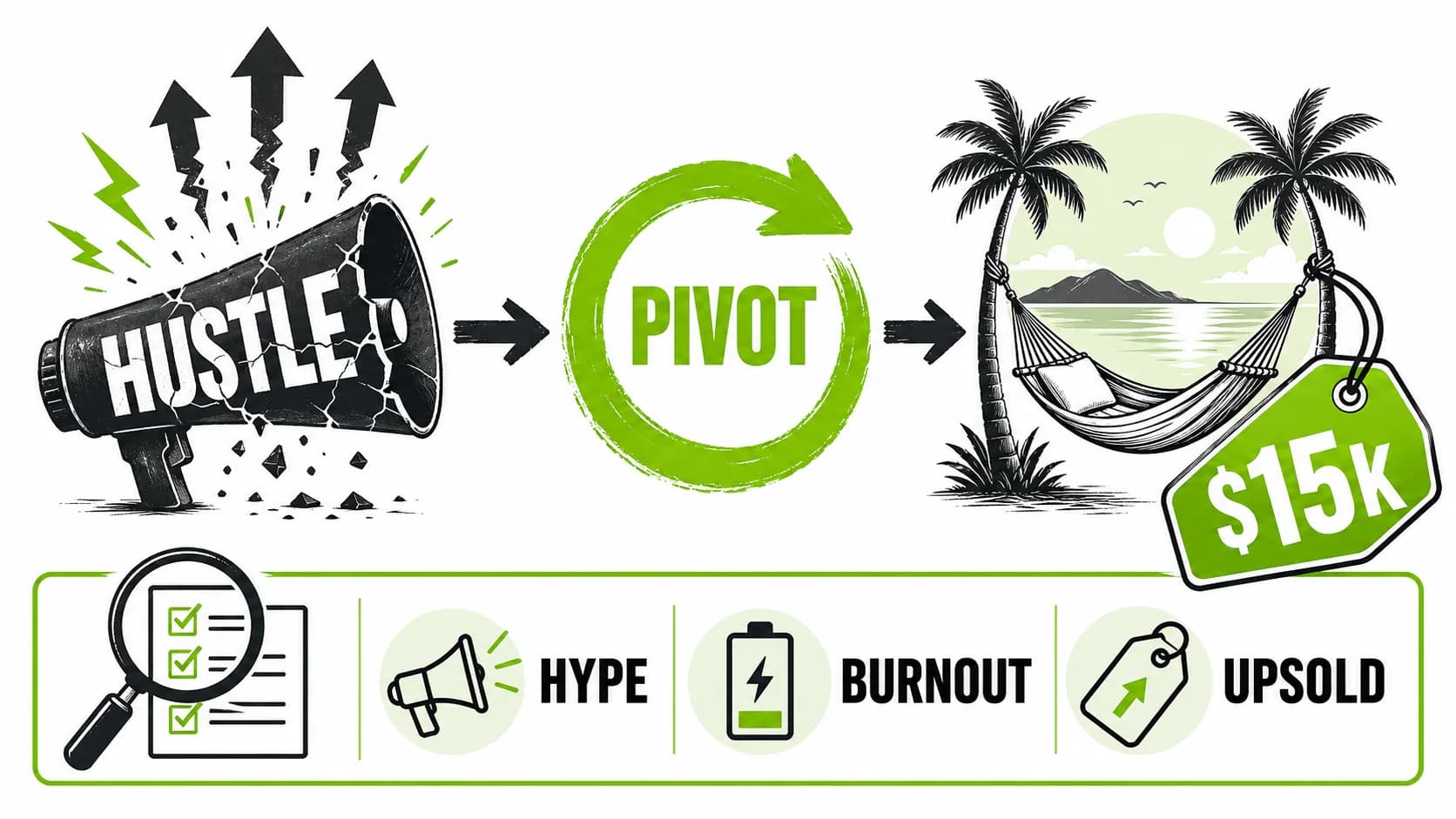
In January 2026, a curious pattern emerged across the feeds of aspiring founders. The same "AI-powered" gurus who, for the last 18 months, had been screaming about 5 AM routines, "crushing it," and "aggressive scaling" suddenly began posting serene photos from mountain retreats. Their captions had pivoted from "MRR is the only metric" to "The real wealth is in stillness." The product they were hawking? No longer a $997 "Scale to $100k" course, but a $15,000 "Founder's Strategic Sabbatical" retreat in Bali or Tulum.
This isn't a collective awakening. It's a coordinated pivot—a masterclass in rebranding failure, legal pressure, or a dried-up hype cycle as enlightened consciousness. The 2026 guru playbook has a new chapter: monetizing the burnout they helped create. This article deconstructs the "strategic sabbatical" scam, the telltale signs of a guru in retreat mode, and how to protect yourself from paying a premium for their problems.
The Pivot Playbook: From "Hustle" to "Hammock"
The sabbatical scam follows a five-stage playbook: post a vague burnout confession, rebrand with Stoic philosophy, announce a "strategic step back," launch a $10,000-$25,000 retreat, then monetize both the original hustle anxiety and its cure. The FTC's Consumer Sentinel Network recorded over 5.4 million fraud reports in 2024, with business opportunity scams ranking among the top categories — and these luxury retreat schemes increasingly populate those filings.
The lifecycle of a modern guru is predictable. They ride a wave (AI, Web3, "creator economy"), build an audience on aspirational, often fabricated, success, and monetize with courses and coaching. When the wave crashes, the scrutiny arrives, or the revenue dries up, they need an exit strategy that doesn't look like failure.
Enter the "Strategic Sabbatical" or "Conscious Uncoupling from Hustle Culture." The pivot follows a clear, five-stage script:
Deconstructing the "Sabbatical" Sales Pitch
Behind the marketing language sits a simple margin play: charge $10,000 per head for a rented villa experience that costs $1,500, with 20 participants yielding $200,000 in gross revenue per cohort. Platforms like Kajabi and Circle make the infrastructure trivially cheap. The "Strategic Sabbatical" label is just rebranded luxury tourism with a slide deck — the same playbook detailed in our analysis of founders retreat grifts.
Let's translate the glossy marketing language of these retreats into the underlying reality.
| Guru Marketing Speak | Probable Translation |
|---|---|
| "Strategic Sabbatical" | "My last business model failed / is under investigation, and I need time to figure out the next grift." |
| "Reconnecting with Purpose" | "The purpose of my previous venture was making money, and it stopped. I need a new purpose (that also makes money)." |
| "Luxury, All-Inclusive Retreat" | "High margin, experiential product with minimal overhead. You pay for villas and yoga while I bank the difference." |
| "Small, Intimate Cohort of 20" | "I need at least $200k in revenue quickly to cover my runway/lifestyle. 20 x $10k = problem solved." |
| "Tools for Sustainable Success" | "The same basic business principles repackaged with mindfulness jargon, because you didn't buy them the first time." |
| "A Life-Changing Experience" | "A potent mix of group psychology, beautiful scenery, and FOMO designed to trigger a large financial decision." |
The genius—and the cruelty—of this scam is its emotional resonance. Real burnout is an epidemic. The desire for meaning beyond revenue is genuine. The grifters are simply weaponizing these very real human needs, offering a placebo priced as a panacea.
How to Spot a "Retreat-Ready" Guru (Before You Book Your Flight)
The five tells are: a sudden 4-8 week content pivot, timing that coincides with a failed launch or exposure thread, unverifiable past revenue claims, an immediate expensive "solution," and scarcity language like "only 5 spots left." The SEC's Office of Investor Education has repeatedly warned about high-pressure scarcity tactics in investment-adjacent coaching programs. A Stanford Graduate School of Business study on entrepreneurial narrative reconstruction confirms that founders routinely reframe failures as strategic decisions.
Not every founder talking about burnout is a scammer. The key is pattern recognition. Here are the red flags that suggest a "sabbatical" is a strategic retreat from accountability, not to it.
- The Sudden Pivot: Their content and persona change dramatically over 4-8 weeks. The shift from "hustle" to "harmony" feels less like an evolution and more like a corporate rebrand.
- The Coincidental Timing: The "burnout" announcement often coincides with observable business events: a failed product launch that went quiet, a wave of critical threads from industry watchdogs, or the end of a hype cycle for their niche (e.g., "AI agent" tools in late 2025).
- The Unverifiable "Success": Their previous claims of massive revenue or impact were always hazy. They excelled at spotting fake revenue screenshots because they were creating them. If their past is a house of cards, their present "wisdom" is built on the same foundation.
- The Solution Is Immediate and Expensive: There's no period of genuine, quiet reflection. The problem (burnout) and the proprietary solution (their retreat) are presented in quick succession. The urgency to apply is high ("only 5 spots left!").
- The Language of Exclusivity and Scarcity: It's always a "limited cohort," for "select founders," who are "ready to do the deep work." This is classic manipulation, designed to bypass logical evaluation and trigger a fear of missing out (FOMO).
If you're seeing these patterns, you're likely witnessing a survival tactic, not a spiritual awakening. For a broader framework on identifying these characters, our 2026 Guide to Spotting Fake Gurus breaks down their common tactics and playbooks.
The Real Cost: Beyond the $15,000 Price Tag
Beyond the $15,000 ticket price, victims fund the guru's next hustle cycle, delay seeking legitimate therapy or executive coaching, and get locked into group dynamics that suppress critical thinking. The FTC's 2024 Data Book shows consumers lost over $10 billion to fraud that year — a 14% year-over-year increase. The luxury retreat model thrives in this poorly policed gap between "coaching" and consumer fraud, similar to the patterns we documented in the hustle hangover grift.
The financial loss is just the beginning. The real damage of buying into this scam is multifaceted:
What to Do Instead: An Antidote to the Sabbatical Scam
Skip the $15,000 retreat. Unfollow accounts that trigger inadequacy, take two weeks of genuine offline rest (cost: $0), join a vetted peer mastermind, and invest in a concrete skill like accounting or public speaking. If you suspect you have been defrauded, the FTC's ReportFraud.ftc.gov portal accepts complaints, and the viral vulnerability playbook explains how these comeback narratives are pre-scripted.
If you're feeling burnt out, questioning your path, or seeking more meaningful growth, congratulations — you're human. Here are actionable, non-grifty steps to take that don't involve wiring money to a "conscious" guru in Bali.
- Audit Your Inputs: Unfollow every account that makes you feel anxious, inadequate, or that is currently pivoting to sell you serenity. Curate a feed of practitioners who quietly build things, not personas.
- Define "Wealth" for Yourself: Is it revenue? Time freedom? Impact? Mental health? Write it down. Most guru content is designed to keep you chasing a goalpost they control.
- Seek Peer Support, Not a Guru: Join a vetted, non-promotional mastermind or community of like-level founders. The best advice often comes from peers in the trenches, not self-appointed experts on stages.
- Invest in Foundational Skills: Instead of another "mindset" course, invest in a concrete skill: copywriting, basic finance, public speaking, or technical literacy. These are assets no market shift can take from you.
For founders looking to build real, sustainable ventures, focusing on fundamentals is key. Explore our Startup Hub for resources that focus on building substance over hype.
The Bigger Picture: Why This Scam Works Now
The sabbatical scam works because hustle culture created real burnout, the $15 billion US business coaching industry (Zippia, 2023) is nearly unregulated, and outcomes are self-reported and unfalsifiable. A 2025 University of Cambridge report on digital wellbeing explicitly warned about "wellness-washing" — reframing systemic burnout as an individual consumer problem. The same founder who sold you the quiet quitting anti-hustle scam is now selling the luxury antidote.
This pivot is a symptom of a larger cultural moment. The "hustle porn" of the late 2010s/early 2020s has led to a widespread, legitimate backlash. People are exhausted. The gurus, being excellent trend-spotters, have simply moved to monetize the backlash.
A 2025 report from the University of Cambridge on digital wellbeing trends highlighted the rise of "wellness-washing" in tech, where burnout is framed as an individual problem to be solved with consumer products, rather than a systemic issue. Furthermore, research from the Stanford Graduate School of Business on entrepreneurial failure has long shown that founders often engage in "face-saving" narrative reconstruction—exactly what the "strategic sabbatical" pitch provides.
The grifters are co-opting the language of recovery and wisdom, creating a dangerous feedback loop where the most manipulative voices position themselves as the guides out of the chaos they helped create.
Conclusion: The Cycle Continues
The "AI-powered" founder's sabbatical scam is the latest evolution in a long game. It demonstrates the agility of the modern larping entrepreneur: when one identity becomes unsustainable, they shed it and emerge with a new, more "evolved" one, ready to monetize the next wave of collective anxiety.
The ultimate defense is not cynicism, but discernment. It's the ability to separate genuine human experience from manufactured narrative, to value slow, quiet building over loud, flashy pivots. It's about learning to see the pattern before you become the mark.
The first step to breaking the cycle is learning to see it clearly. If you want to develop the skills to detect these patterns, assess claims, and protect your time and capital from the endless pivot of the online guru, the most strategic move you can make is to Apprendre à Détecter.
FAQ: The Founder Sabbatical Scam
1. Isn't it possible these gurus are genuinely burnt out and want to help others?
It's possible, but highly improbable given the pattern. Genuine burnout typically leads to withdrawal and quiet recovery, not the immediate launch of a high-ticket, meticulously marketed group program. The speed and commercial precision of the pivot are the hallmarks of a business strategy, not a personal recovery journey.
2. What if the retreat actually provides good value and connections?
Even a broken clock is right twice a day. A luxury retreat in a beautiful location with curated people will almost certainly have enjoyable moments and potentially useful contacts. The scam isn't that the experience is 100% terrible; it's that you are paying an extreme premium (often 500-1000% markup) for what is essentially a packaged vacation with some group discussions. You could achieve similar networking and relaxation for a fraction of the cost by organizing it yourself.
3. How can I tell the difference between a legitimate executive retreat and one of these scams?
Legitimate retreats are usually hosted by established institutions (e.g., business schools, known professional associations), have transparent faculty with verifiable credentials, and focus on tangible skill development or peer learning. Scam retreats are hosted by individual influencers, focus heavily on "mindset" and "energy," use vague transformational language, and rely on scarcity ("only 3 spots left!") and social proof from past attendees (who are often incentivized).
4. Why is the price so high if it's a scam?
The high price serves multiple purposes: 1) It creates an aura of exclusivity and value. 2) It acts as a pain point that the sales call must overcome, making committed buyers more susceptible to post-purchase rationalization. 3) It ensures high revenue with low participant numbers, which is essential if the guru's primary audience is dwindling. 4) It mirrors the luxury wellness industry, lending an air of legitimacy.
5. What usually happens to these gurus after the "sabbatical" retreat phase?
The cycle often continues. After 6-12 months of selling "stillness," the market saturates, or they need a new influx of cash. The narrative then pivots again: "My sabbatical gave me CLARITY, and now I've discovered the NEXT BIG THING (Web4, Quantum Computing for Wellness, etc.)." They then launch a new course about this "next big thing," effectively returning to the "hustle" phase, having bankrolled the transition with retreat money.
6. I think I've been scammed by one of these. What should I do?
First, acknowledge it without harsh self-judgment. These schemes are designed by expert manipulators. If possible, document everything and request a refund, citing the lack of delivered value (though success is unlikely). Most importantly, view it as an expensive lesson in pattern recognition. Share your story (anonymously if needed) to warn others, and direct your energy towards the real, foundational work of building your business or recovering your well-being through credible, non-commercial means.
<!-- sister-projects-start -->
Other Doved Studio projects
Related tools from the same studio you might find useful:
- Ralphable: Generate structured Claude Code skills that iterate until pass/fail criteria are met.
- Doved Studio: Studio indie derrière cette app et une dizaine d'autres outils.
<!-- sister-projects-end -->