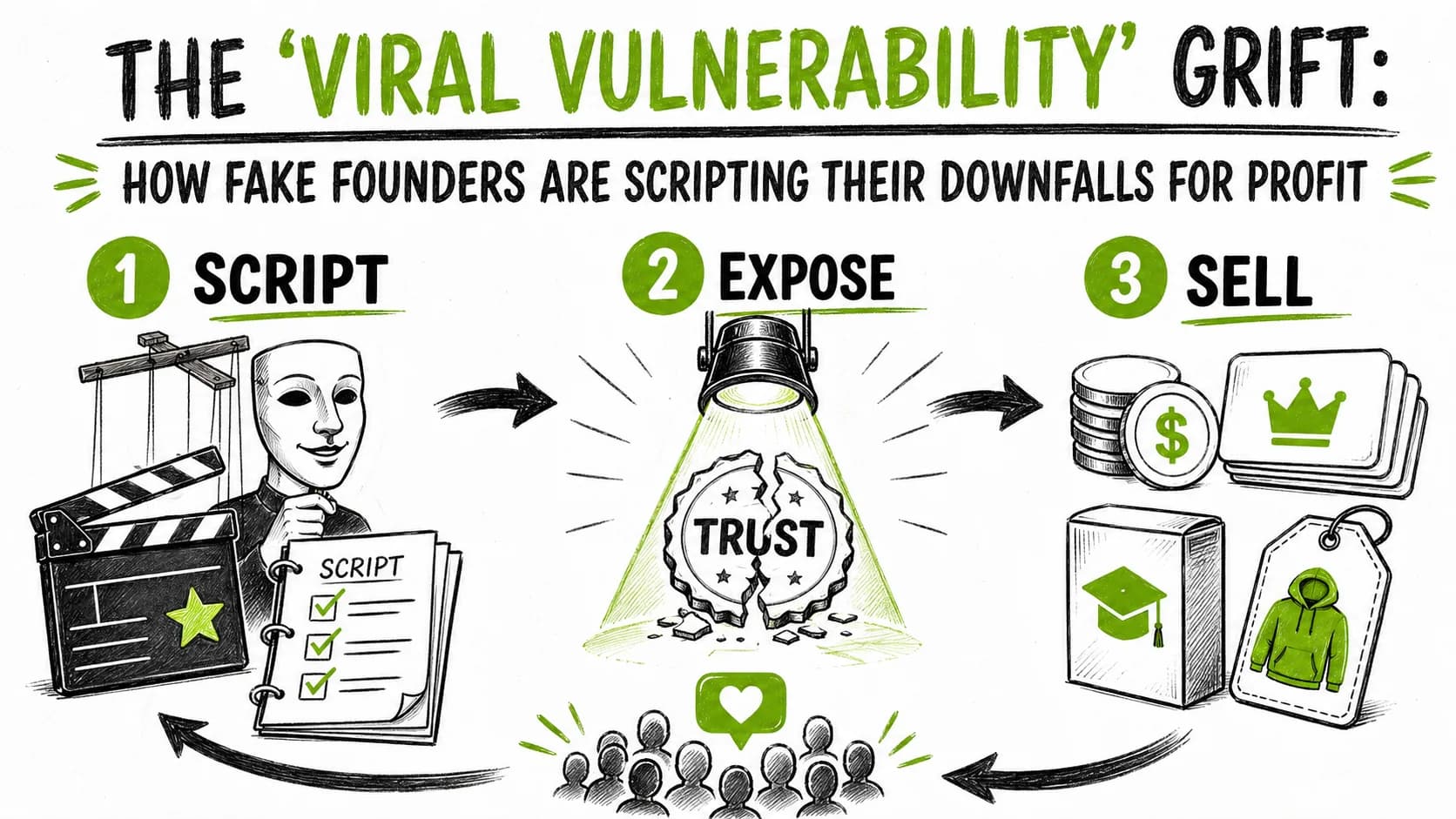
In the high-stakes theater of online entrepreneurship, the final act used to be the same: the grift is exposed, the revenue screenshots are debunked, and the guru vanishes into the digital ether, leaving a trail of angry customers and a cautionary tale in their wake. But in 2026, the script has been flipped. The new breed of fake founder isn’t running from the downfall—they’re directing it. They’re not just building in public; they’re collapsing in public, with a pre-written script, a multi-camera setup, and a product launch calendar synced to their own demise.
Welcome to the era of the viral vulnerability grift. It’s the latest, most cynical pivot in the guru playbook: preemptively scripting your public failure, monetizing the narrative of your collapse, and turning accountability into a subscription service before the dust even settles. This isn't an accident; it's a business model. And if you can't spot the patterns, you're not just watching a train wreck—you're being sold a ticket to the conductor's "Post-Crash Masterclass."
The Anatomy of a Scripted Downfall
A scripted collapse follows a five-act funnel: seed a vague "struggle" post, drop a dramatic "I lost everything" thread, announce a vulnerable "reflection" period, launch a $997 masterclass within 7 days, then rebuild as a "resilience expert." The FTC’s 2024 Data Book recorded $10 billion in total consumer fraud losses — a 14% jump from 2023 — and the business coaching sector is one of the fastest-growing categories. Platforms like Gumroad, Kajabi, and ConvertKit make the comeback product launch nearly frictionless.
The performative collapse follows a remarkably consistent five-act structure. It’s less Shakespearean tragedy and more infomercial, complete with a call-to-action before the final curtain.
Act 1: The Foreshadowing Post
It begins with a subtle, "raw" post. A founder shares a "hard truth" about feeling overwhelmed, a "tough decision" looming, or vague "industry headwinds." The language is crafted to feel authentic but is deliberately non-specific. Engagement is high—support pours in. This post serves two purposes: it seeds the narrative and creates an audience emotionally invested in the "journey."
Act 2: The Dramatic Revelation
The bomb drops. A long-form thread or video titled "My Company is Dead" or "I Lost Everything" floods the timeline. The story is detailed, emotional, and perfectly packaged. It might involve:
- A last-minute investor pullout ("The term sheet was signed!").
- A catastrophic, previously unmentioned technical debt.
- A "mutiny" from a key team member (always framed as a betrayal).
- An unforeseen regulatory hurdle that "no one could have predicted."
The key is that the failure is always externalized. The founder is the brave protagonist battling forces beyond their control.
Act 3: The Vulnerable Pivot
Within 24-72 hours, the tone shifts. "The outpouring of love has been humbling," they say. They announce they’re taking a week to reflect and will share "everything I learned so you don't make my mistakes." This is the hook. The comments fill with "Can't wait for the post-mortem!" and "You should teach this!"
Act 4: The Monetized Comeback
The "reflection" period ends precisely as scheduled. The comeback is announced: not a new company, but a new offering derived from the failure.
- The "Scar Tissue" Masterclass: A $997 course on "Navigating Startup Failure."
- The "Rebound Blueprint" Subscription: A $99/month community for founders "in the trenches."
- Vulnerability Coaching: 1-on-1 sessions where they coach others on "authentic leadership" through crisis.
- The "Post-Mortem" E-Book: Launched on Gumroad within a week.
The monetized downfall is complete. The collapse wasn’t an end; it was a lead magnet.
Act 5: The Legacy Rebuild
With the new revenue stream flowing, the narrative softens. The founder is now a "resilience expert." Podcast interviews pour in. They speak at (virtual) conferences about the "gift of failure." The original business is quietly forgotten, but the personal brand, built on the ashes, is more profitable than ever.
Why This Grift Works: The Psychology of Manufactured Authenticity
Four psychological levers make this scam nearly criticism-proof: pre-emptive confession inoculates against exposure, Brene Brown's vulnerability research is weaponized as marketing cover, audience sunk-cost fallacy drives purchases, and the grift mimics legitimate pivots so precisely that even experienced investors struggle to distinguish them. A 2024 Harvard Business Review analysis found that public apologies increase consumer trust by up to 30% — exactly the lift these founders exploit to price their comeback courses at $997-$2,997.
This strategy is diabolically effective because it hijacks our genuine desire for human connection and learning from failure.
The Red Flags: How to Spot a Scripted Collapse
Six tells expose a scripted collapse: an impeccably timed narrative arc (Day 1 bad news, Day 7 masterclass), externalized blame with zero self-critique, a pre-built landing page (check the Wayback Machine for registration dates that predate the "collapse"), monetization within days, vague unverifiable details, and a founder history of repeated dramatic pivots. The SEC's Investor.gov portal flags identical high-pressure, emotional-urgency tactics in investment fraud alerts. See also our analysis of how authentic ghostwriters script these narratives for guru clients.
Not every founder sharing a hard time is a fraud. But a confluence of these patterns should set off alarm bells.
| Red Flag | What It Looks Like | The Real vs. The Grift |
|---|---|---|
| The Impeccable Timeline | Collapse announcement → Emotional support period → Product launch happens on a predictable, tight schedule (e.g., Day 1: Bad news, Day 3: "Healing," Day 7: Masterclass). | Real Failure is messy and unpredictable. A genuine founder needs real time to grieve and regroup, with no clear roadmap back. |
| The Externalized Blame | The cause of failure is always outside the founder's direct control: "the market," "a bad actor," "investor greed," "unseen tech debt." Introspection is absent. | Authentic Post-Mortem involves serious self-critique, specific personal mistakes, and lessons about their own judgment. |
| The Pre-Built Landing Page | The website for the "Failure to Founder" course or the "Scar Tissue" community often has a registration date that predates the public collapse announcement. Check the Wayback Machine. | A legitimate new venture is built after the fallout, not concurrently with the failure it's based on. |
| The Monetization of Pain | The offer is made too quickly and is directly, literally about the failure itself ("Pay me to explain why I failed"). | Real Value comes from applied lessons over time. A genuine expert might later teach on broader topics informed by failure, not sell the autopsy as the product. |
| The Absence of Concrete Details | Vague references to "millions" lost, "betrayals," or "legal threats" without verifiable specifics, names, or documentation. | Credible Stories can share specific, non-defamatory details (e.g., "We misforecasted CAC by 300% because we trusted Source X"). |
| The Symmetry with Past Behavior | Does this founder have a history of dramatic, public pivots that always lead to a new course? Check their history. A pattern of scripted failure is the biggest tell. |
If you're seeing these patterns in the revenue claims of a "successful" guru, our deep dive into The 2026 Guide to Spotting Fake Revenue Screenshots is essential reading.
The Real-World Damage: Why This Isn't Harmless
The scripted-collapse playbook devalues genuine founder vulnerability, blueprints accountability evasion, preys on empathetic audiences, and pollutes failure archives like Failory with fabricated post-mortems. The FTC's Consumer Sentinel Network shows that imposter scams and business opportunity fraud account for the largest share of reported losses, and the "viral vulnerability" model fits squarely in that category. For the broader ecosystem damage, see how scamfluencer-to-hunter pipelines perpetuate the same cycle.
This isn't a victimless meta-commentary. The viral vulnerability grift causes tangible harm.
- It Devalues Real Vulnerability: It makes it harder for genuine leaders to share struggles without being met with cynical skepticism.
- It Creates a Blueprint for Avoidance: It teaches aspiring entrepreneurs that accountability is optional; you can just rebrand failure as content.
- It Preys on the Empathetic: It monetizes the goodwill of an audience that wants to support someone going through a hard time.
- It Pollutes the Data Pool: For every real post-mortem on platforms like Failory (an external link to a legitimate failure archive), there are now ten scripted ones, making it harder for real founders to find authentic lessons.
As discussed in our broader framework for understanding this ecosystem, The 2026 Guide to Spotting Fake Gurus, the grift constantly evolves to exploit new cultural sentiments.
How to Protect Yourself: The Detector's Mindset
Your defense is a five-step protocol: screenshot and timestamp the collapse narrative, demand verifiable specifics (names, numbers, filings), trace the emotional arc to its sales page, check the founder's full pivot history, and judge by shipped products over years rather than quarterly content arcs. If you suspect fraud, file a report at ReportFraud.ftc.gov and consider the SEC's EDGAR company search for verifying any claimed corporate entities or filings. For a framework on evaluating the metrics gurus claim, our fake revenue screenshot guide remains essential.
For a comprehensive look at the tactics, trends, and terminology of this world, bookmark our central resource, the Startup Larping Hub.
The Irony and The Endgame
The ultimate irony of the viral vulnerability grift is that it requires a deep, cynical understanding of human psychology to execute — the very skill set that could be used to build a legitimate, empathetic business. Instead, it's deployed to manufacture an emotional connection for profit. The founder's furlough scam uses the exact same 90-day cycle: disappear, restructure, return with a repackaged product at 300% markup.
The endgame? We risk creating an entrepreneurial landscape where perception management is more valuable than product building, where the meta-commentary on the game is more lucrative than playing it well. The only defense is a community of skeptics who can spot the script, no matter how compelling the performance.
The call to action is no longer "buy my dream." It's "buy my nightmare." Make sure you're not funding the director.
FAQ: The Viral Vulnerability Grift
What's the difference between a founder being honestly vulnerable and scripting a downfall?
The core difference is purpose and timing. Honest vulnerability is reactive, messy, and has no immediate commercial agenda. The founder is sharing to process, connect, or warn. A scripted downfall is proactive, neatly packaged, and follows a rapid timeline that leads directly to a new paid offering. The emotional beat is a plotted step in a sales funnel.
Aren't some of these founders actually failing? Can't they monetize their experience?
Absolutely. Many legitimate experts build careers on hard-won lessons from failure. The distinction is in the substance and the integrity of the timeline. A true expert monetizes solutions and frameworks developed after deep reflection, not the raw story of the failure itself as the primary product. They teach "how to avoid common pitfalls," not "here's exactly how I blew it, send $997."
How can I verify if a founder's collapse story is real?
Look for verifiable evidence. Did a tech blog report the shutdown? Are there LinkedIn posts from former employees (not just the founder)? Can any financial or user number claims be cross-referenced? A complete lack of third-party validation is a major red flag. Also, use tools like the Wayback Machine to see if the "post-failure" course website was registered before the collapse was announced.
Is "building in public" now a red flag?
Not inherently. "Building in public" is a powerful tool for accountability and community. The red flag is "collapsing in public" as a coordinated, rapid-rebound content strategy. The issue isn't transparency; it's the theatrical, revenue-driven orchestration of failure as a plot point. Genuine builders share ups and downs without a preset monetization path for the downs.
What should I do if I've already bought a course from a founder I now suspect of this grift?
First, audit what you actually received. Does the content provide generic, motivational advice, or concrete, actionable frameworks? If it's the former, you've likely paid for a story, not a skill. Use it as a very expensive lesson in pattern recognition. Report your experience (factually) in reviews. Most importantly, apply this new skepticism to future purchases. Consider investing in learning how to DETECT these patterns to immunize yourself against the next iteration of the grift.
Will this trend continue, or will audiences catch on?
Like all grifts, it will evolve. As awareness of scripted failure grows, the performances will become more sophisticated—more "imperfect," with longer timelines and more convincing "plot twists." The core audience will catch on slowly, but new audiences will always emerge. The grift doesn't die; it just finds new costumes and new scripts. Permanent vigilance, shared knowledge, and a focus on tangible outcomes over compelling narratives are the only defenses.
<!-- sister-projects-start -->
Other Doved Studio projects
Related tools from the same studio you might find useful:
- Ralphable: Generate structured Claude Code skills that iterate until pass/fail criteria are met.
- Doved Studio: Studio indie derrière cette app et une dizaine d'autres outils.
<!-- sister-projects-end -->