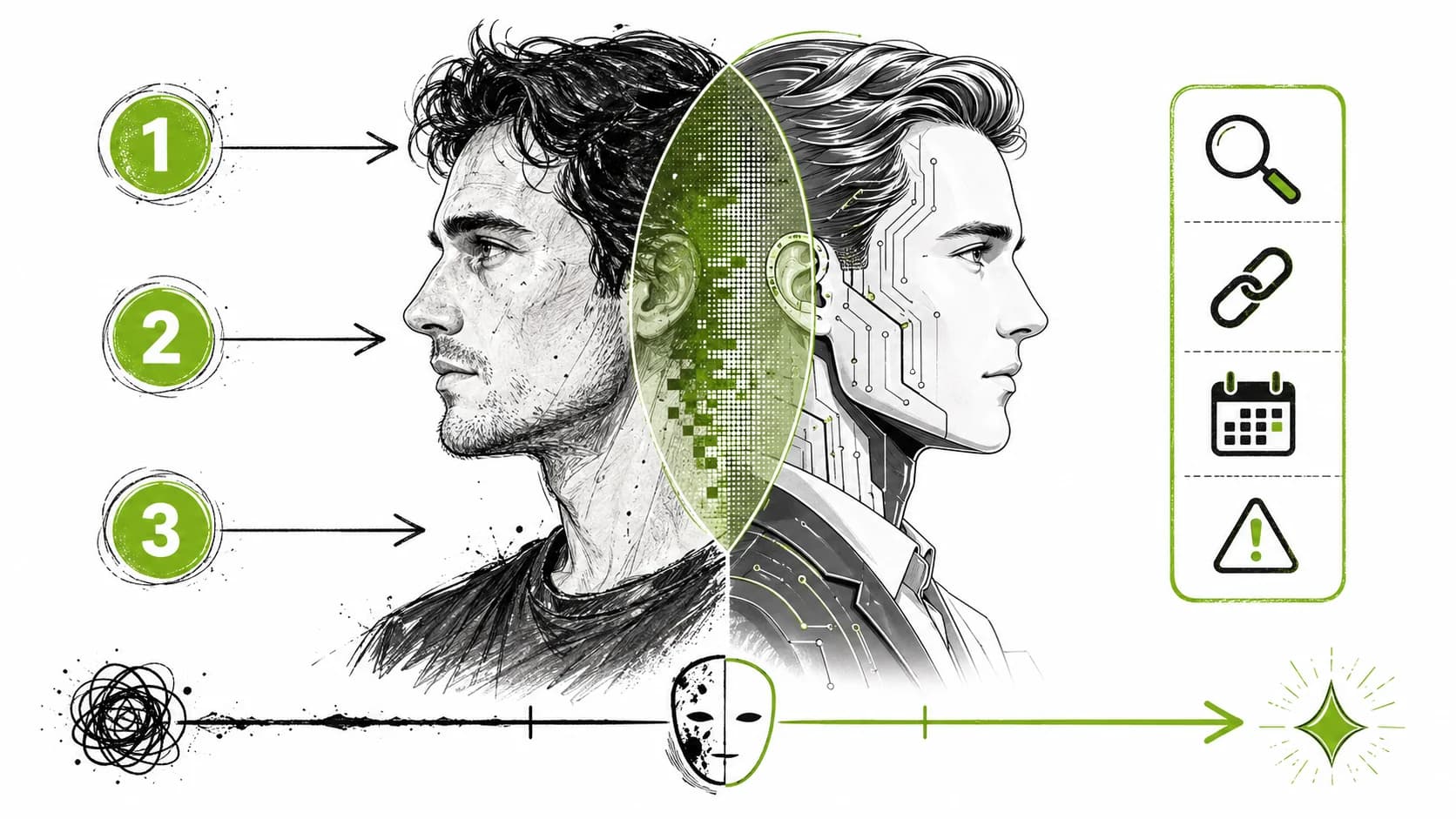
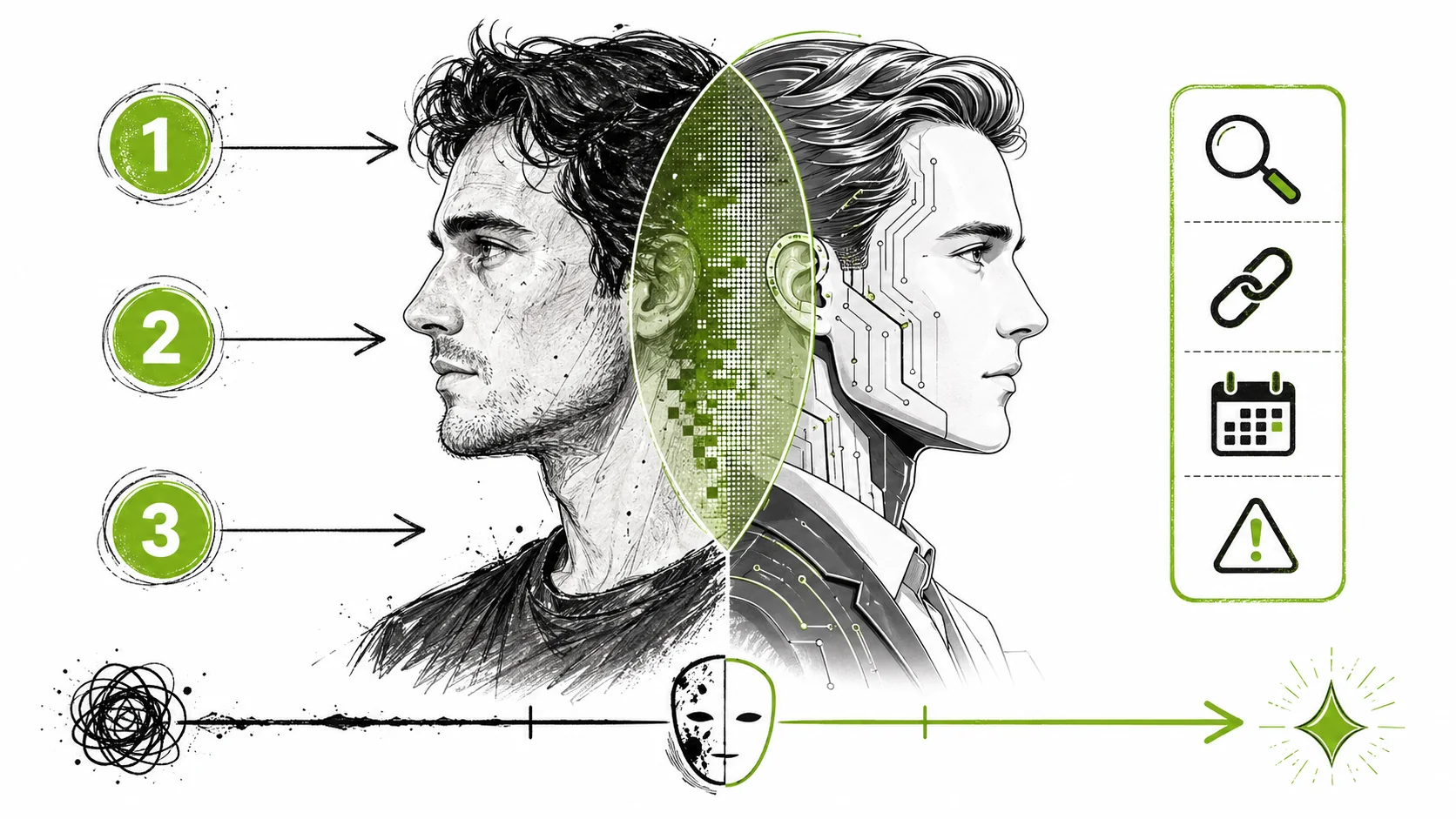
You’re scrolling through your feed and see a new founder. Their story is perfect. They pivoted from a failed startup to a multi-million dollar exit in 18 months. Their LinkedIn posts are profound, their tweets are witty, and their "day-in-the-life" videos are flawlessly aspirational. You feel a pang of inadequacy, then a flicker of suspicion. Something is off. The story is too clean, the insights too generic, the consistency too… robotic.
You might be looking at a synthetic founder. This isn't just a founder who uses AI tools; it's an online persona where the core identity—the backstory, the expertise, the social proof—is fabricated, maintained, or significantly amplified by algorithms. As AI tools for text, image, video, and audio generation become indistinguishable from reality, a new, scalable form of digital grift has emerged. These synthetic entities are designed to build trust, attract investment, and sell courses, all while the "founder" behind them might be a complete fiction or a heavily augmented facade. This guide will teach you to spot the uncanny valley of AI-generated credibility before you waste time, money, or emotional energy on a ghost.
What Is a Synthetic Founder?
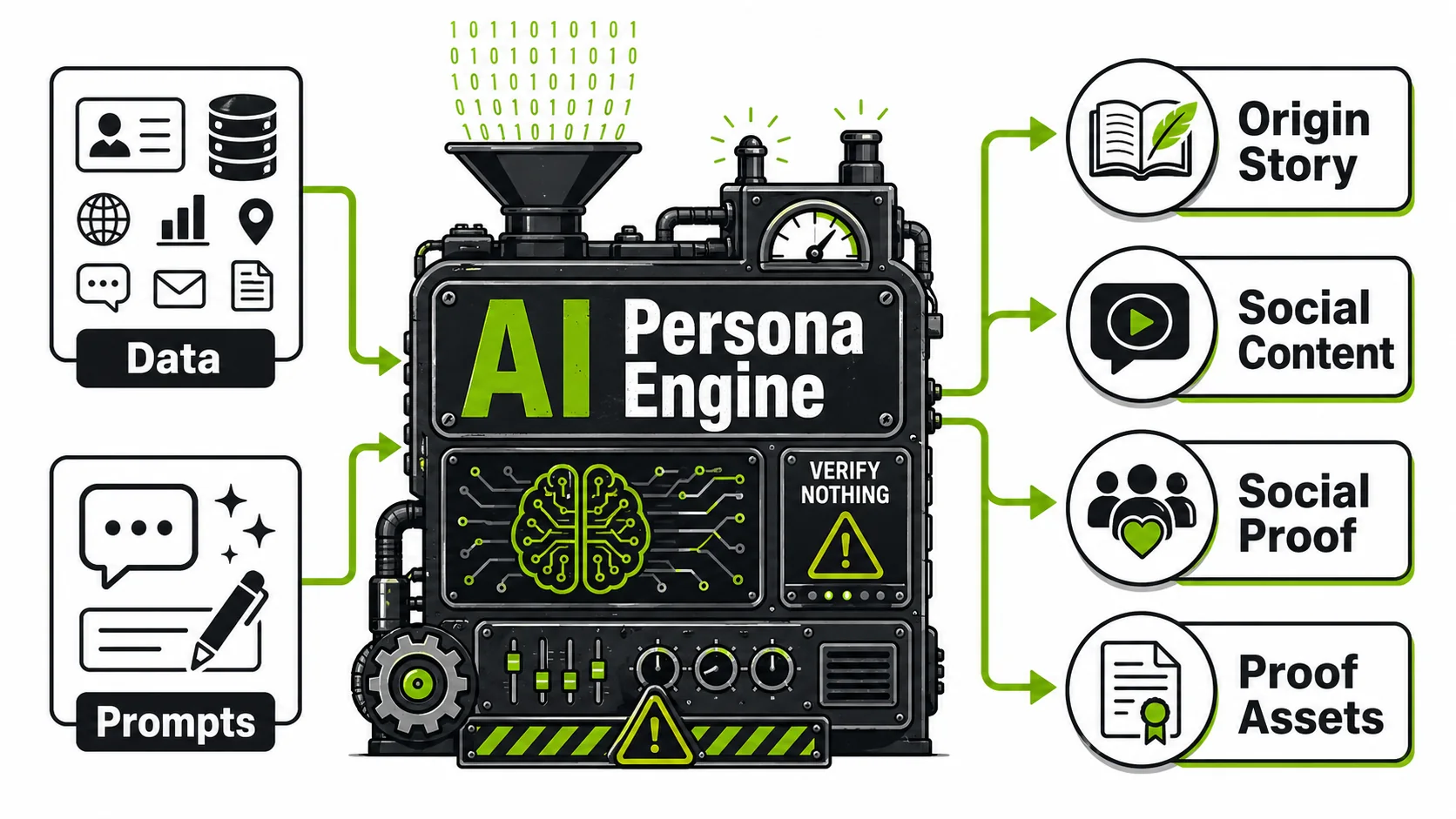
A synthetic founder is an entrepreneurial identity constructed or heavily reliant on artificial intelligence to generate its marketable traits. Think of it as larping—live-action role-playing—but for the digital business world, with algorithms as the dungeon master. The goal isn't to build a real company but to simulate the appearance of a successful founder to extract value: selling courses, securing "angel" investments for a phantom product, or building a personal brand that can be monetized through sponsorships and speaking fees.
The key differentiator from a founder who merely uses ChatGPT for email drafts is the depth of the fabrication. A synthetic founder's foundational narrative is often AI-generated, their thought leadership content is mass-produced by large language models, and their "proof of work"—like code snippets, business book manuscripts, or even technical interview answers—can be entirely synthetic.
| Trait | Traditional Founder | Synthetic Founder |
|---|---|---|
| Origin Story | Messy, personal, specific, sometimes contradictory. | Archetypal, follows a "hero's journey" template, overly polished. |
| Content Output | Variable quality, reflects real-time learning, occasional typos or off-days. | Superhuman consistency, perfectly templated (e.g., "3 lessons from my failure every Tuesday"), grammatically flawless. |
| Expertise Depth | Deep, narrow knowledge with clear boundaries; can get technical. | Broad, surface-level "insights" that sound profound but are non-falsifiable and avoid specifics. |
| Social Proof | Genuine, if sometimes sparse, connections; verifiable past employment. | Suspiciously perfect testimonials, endorsements from other low-verifiability personas, "featured in" generic AI news sites. |
| Response to Pressure | Human. May get flustered, give imperfect answers, or need time to think. | Scripted. Falls back on pre-generated talking points; struggles with truly novel or deeply technical challenges. |
The Three Layers of Synthesis
Synthetic founders exist on a spectrum. Not all are 100% fake; many are human-AI hybrids, which makes detection trickier.
The Tools of the Trade
The rise of synthetic founders is directly tied to accessible, high-quality generative AI. Key tools in their stack include:
- Large Language Models (ChatGPT, Claude, Gemini): For generating biographies, social posts, long-form articles, email sequences, and even book manuscripts.
- Generative Image AI (Midjourney, Stable Diffusion): For creating realistic profile pictures, "team photos," office shots, and fake product demos.
- Generative Video & Audio (Synthesia, HeyGen, ElevenLabs): For creating fake interview clips, tutorial videos, and personalized audio messages. A report from the AI Forensics Institute noted a 300% increase in deepfake business content in 2025.
- Automation Platforms (Zapier, Make): To stitch these tools together, auto-post content, and simulate human engagement patterns.
Why Synthetic Founders Are Your Problem
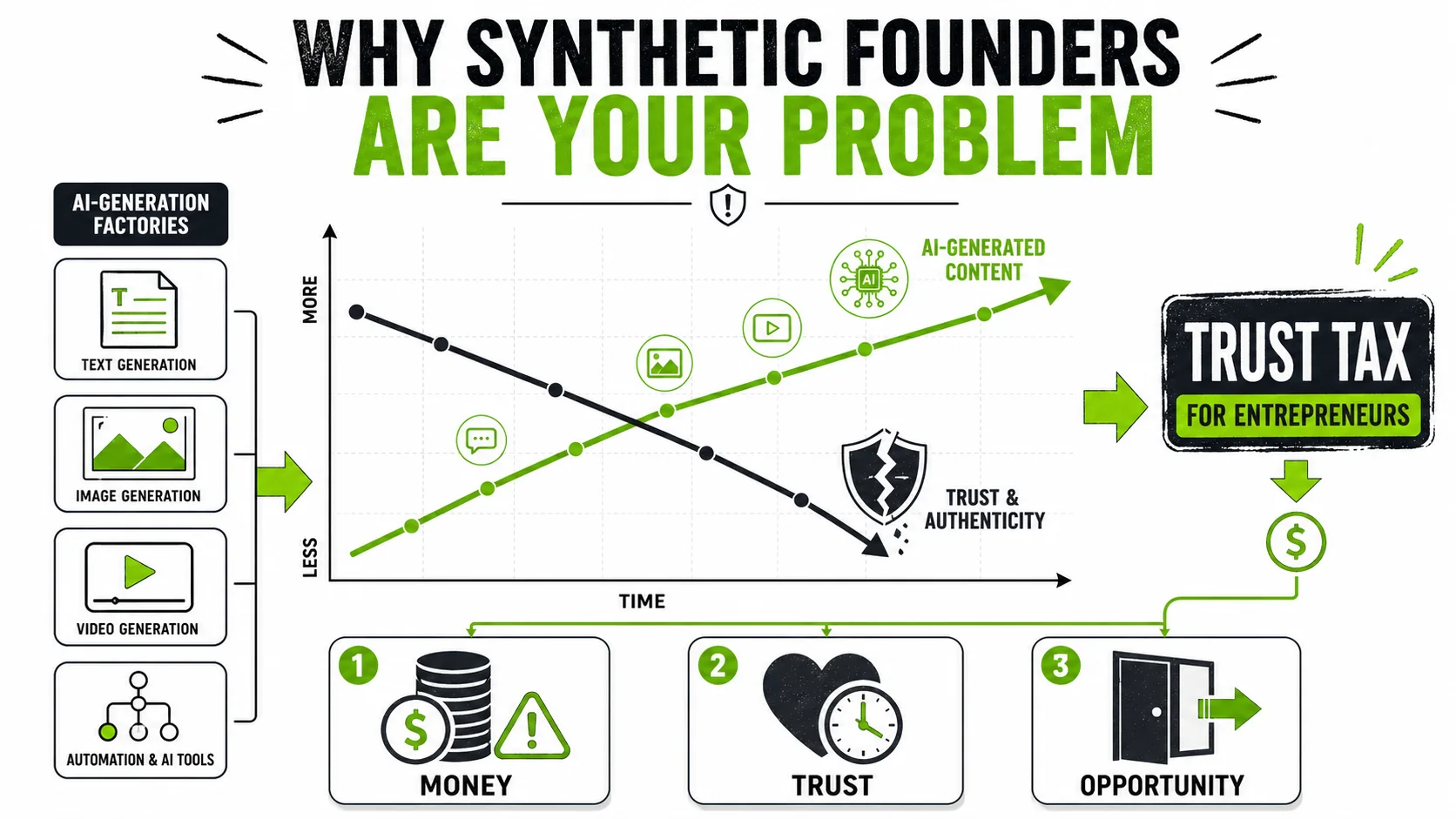
This isn't a niche issue for tech journalists to debate. It's a practical problem that corrupts the information ecosystem every entrepreneur relies on. If you can't tell the difference between real insight and AI-generated platitudes, you're operating with a broken compass.
The Trust Tax on Everyone
When synthetic founders flood the market with convincing, empty content, they impose a "trust tax" on the entire community. Every piece of advice, every inspirational story, and every connection request now requires extra vetting. This mental overhead slows down genuine networking and learning. You spend your time decoding personas instead of building products. The signal-to-noise ratio plummets, making it harder for authentic founders to be heard. This erosion of trust is perhaps the most damaging long-term effect, creating a cynical, isolated environment where no one believes anyone's success is real—a phenomenon we detailed in our broader 2026 guide to spotting fake gurus.
Financial and Emotional Drain
The direct costs are obvious. People buy $2,000 "mastermind" access from a founder whose entire business is a Figma prototype and an AI-generated waitlist. "Angel investors" get scammed by pitch decks for non-existent AI startups, complete with fake technical co-founder profiles and AI-generated code repositories on GitHub. But the emotional cost is subtler and more pervasive. Constantly comparing your messy, difficult, real journey to someone's flawless, AI-curated highlight reel leads to burnout, imposter syndrome, and poor decision-making. You might abandon a solid, slow-growing idea because a synthetic founder's fake metrics make yours look inadequate.
The Normalization of Fabrication
As these tactics become more common, they risk becoming normalized. What starts as a blatant scam—a completely fake person—evolves into an "acceptable" gray area: "Everyone uses AI to write their posts, what's the difference?" The line between tool use and identity fabrication blurs. This creates a race to the bottom where authenticity becomes a competitive disadvantage. Why struggle to articulate a genuine, nuanced thought when an LLM can produce ten perfectly polished, engagement-optimized platitudes in seconds? This normalization is the endgame for the grift, and understanding its mechanics is key, as explored in our piece on the AI-powered founder's journey.
How to Spot a Synthetic Founder: A Step-by-Step Audit
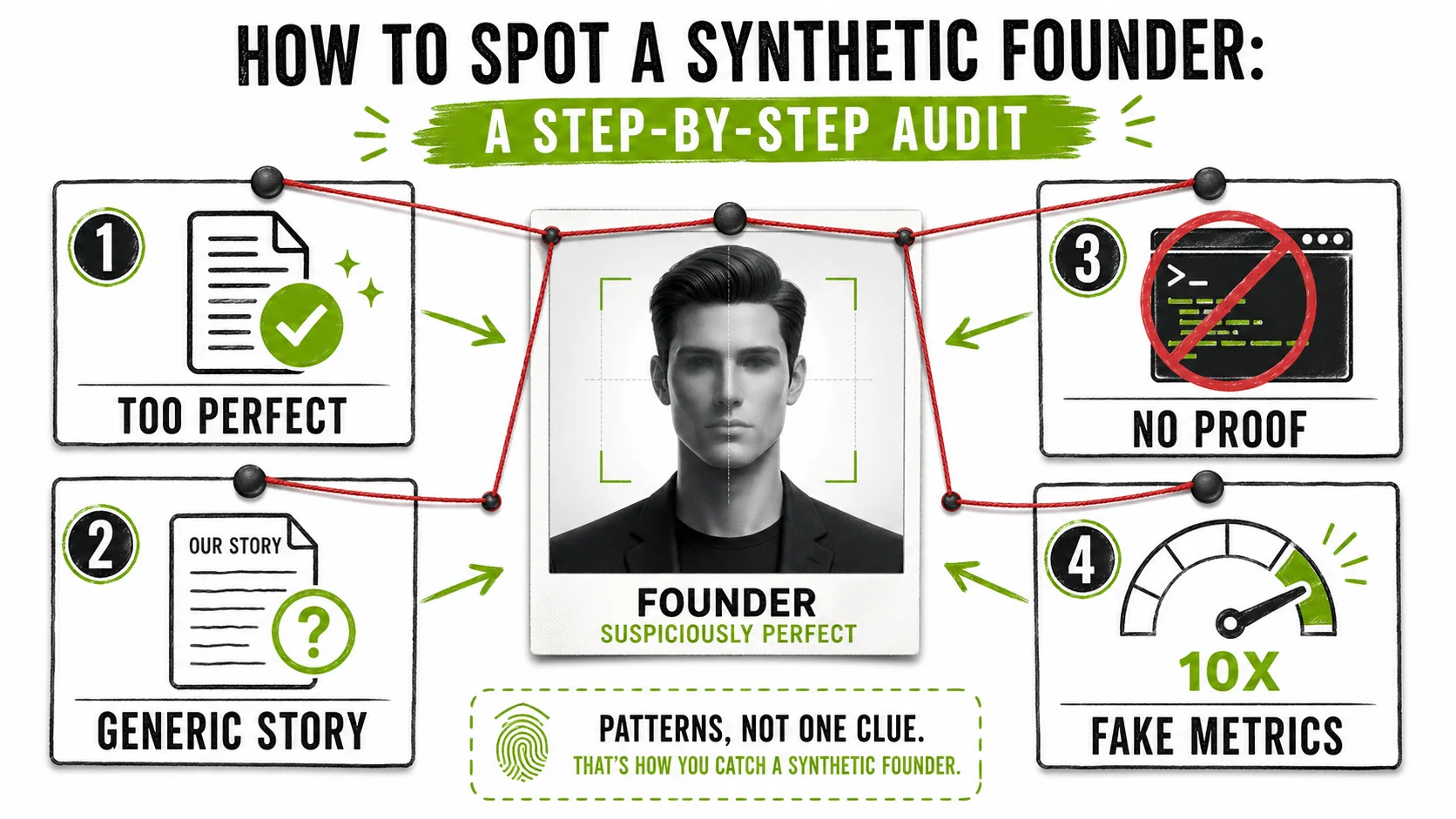
Spotting a synthetic founder requires moving beyond gut feeling to a systematic audit. You're not looking for one smoking gun, but for a pattern of unnatural consistency, emotional flatness, and strategic vagueness. Here is your field guide.
Step 1: Interrogate the Origin Story
The origin story is the foundational myth of any founder. For a synthetic founder, it's often the first and most carefully crafted piece of fiction.
- Look for the Template: Does their story hit every beat of the Silicon Valley hero's journey? "I was a depressed corporate drone. I had a lightning-bolt moment in a shower/on a beach. I built an MVP in a weekend. I got rejected by 100 investors. Then I had a breakthrough and now I'm helping others." Real stories are messier. They involve false starts, co-founder fallouts, stupid mistakes, and lucky breaks they're sometimes embarrassed to admit.
- Check for Specific, Verifiable Details: A real founder can usually name the coffee shop where they had the first meeting, the specific bug that almost killed the launch, or the odd part-time job they had while bootstrapping. Synthetic stories are often vague on spatial and temporal details. "I spent years in finance" is weak. "I worked in FX arbitrage at Credit Suisse in London from 2017 to 2019" is specific and checkable.
- The "Failure" Test: Pay close attention to how they describe failure. In a synthetic story, failures are always noble, clean, and perfectly timed learning experiences that directly lead to success. Real failure is often ugly, emotionally messy, and sometimes completely pointless. If their "biggest failure" sounds like a parable designed to teach you one of their current course modules, be skeptical. This performative vulnerability is a key tactic, decoded in the authentic grifter's playbook.
Tool Recommendation: Use a simple text analyzer like Hemingway App. Paste their "About Me" or origin story text. An unusually low "Grade" score (indicating very simple, readable prose) combined with zero adverbs and perfect sentence structure can be a sign of LLM-generated text, which often defaults to very clean, grade-school-level writing.
Step 2: Analyze the Content Engine
This is where synthetic founders often betray themselves. Their content output has the unnatural consistency of a factory.
- The Consistency Uncanny Valley: Do they post profound business insights at exactly 8:17 AM, 12:03 PM, and 6:45 PM every single day, across all platforms? Real founders have bursts of creativity and periods of radio silence when they're in the weeds. Superhuman, robotic consistency is a hallmark of automation.
- Templated Thought Leadership: Look at their post structures. Is every LinkedIn post "3 lessons from [vague event]"? Every tweet thread "Why everyone is wrong about [trendy topic]"? Every carousel "The 5 frameworks for [success]"? LLMs excel at this templated, list-based content. Scroll back months. If the structure never varies, the voice never wavers, and the insights never get more specific, you're likely looking at a content mill, not a mind.
Step 3: Pressure-Test the Expertise
Anyone can parrot high-level concepts. True expertise reveals itself under pressure and in the details.
- The "Explain It Simply" Test: Ask a specific, slightly technical question in their domain, but frame it as a request for a simple explanation. For example, if they're an "AI startup founder," ask: "Can you explain how your product handles fine-tuning vs. RAG in simple terms for a non-technical user?" A real founder with technical knowledge can bridge that gap. A synthetic founder (or their human operator) will either give a vague, buzzword-laden answer, deflect ("That's a great question for my CTO!"), or ignore you.
- Demand Live, Unedited Proof: Be wary of founders who only exist in pre-recorded videos, polished podcasts, or written text. Suggest a quick, informal live chat on Twitter Spaces, Clubhouse, or even a video call. Observe how they handle spontaneous questions. Do they need to "think for a moment" and return with a perfectly formed paragraph? That's a red flag. The hesitation, the "umms," the reformulations—these are human trademarks.
- Check for Artifacts of Real Work: A real founder building a tech product might have a semi-active, slightly messy GitHub (even if it's just issues and READMEs). They might share screenshots of their analytics that show real user behavior (odd spikes, strange referrers). A synthetic founder's "proof" is often too clean: mockups instead of functional demos, stock analytics dashboards, or fake revenue screenshots that don't match industry patterns.
Step 4: Vet the Social Proof & Network
Credibility is often borrowed. Synthetic founders excel at fabricating or simulating social proof.
- Reverse Image Search Everything: Use Google Reverse Image Search or TinEye on their profile picture, team photos, and office shots. AI-generated images, while realistic, are often reused or have tell-tale artifacts (mangled text on fake magazine covers, weird hands, illogical lighting).
- Investigate the "Featured In" Logos: Hover over them. Do they link to actual articles on Forbes, TechCrunch, or Inc., or do they link to a generic "press" page on their own site? A common trick is to get "featured" on AI-generated news sites that look legitimate but have no editorial staff. Check the domain authority of these sites using a tool like Ahrefs' Free Backlink Checker or Moz's Link Explorer.
- Examine Their Network: Look at who follows them, who endorses them, and who they interact with. Is their network full of other profiles with similar, overly polished bios and the same "featured in" logos? Do their most vocal supporters have accounts that are only a few months old? This could indicate a franchise model or a bot network.
Step 5: Listen for Emotional Authenticity
This is the hardest to fake. LLMs are getting better at simulating emotion, but they still struggle with the chaotic, contradictory, and irrational nature of human feeling in a business context.
- The Humor Test: Do they ever make a joke that falls flat? Or a sarcastic remark that could be misinterpreted? Do they share a funny, embarrassing moment that doesn't serve a "lesson"? AI-generated content is notoriously bad at humor and nuanced sarcasm because it's risky—it might not land. Synthetic personas are usually programmed to be safe and inspirational.
- Contradiction and Growth: Does their current view ever contradict something they said six months ago? And do they acknowledge it? A real person learns and changes their mind. A synthetic persona's "views" are generated from a static or updated dataset; they might suddenly pivot without acknowledging past statements, or they might never evolve at all.
- The Fatigue Factor: In long-form, unedited content (like a recorded live workshop or a rambling podcast appearance), do you ever hear genuine fatigue, frustration, or irritation in their voice? Not performative passion, but the real tiredness of someone who has been answering questions for an hour. AI-generated speech or heavily scripted performances lack this human texture.
Proven Strategies to Protect Your Time and Capital
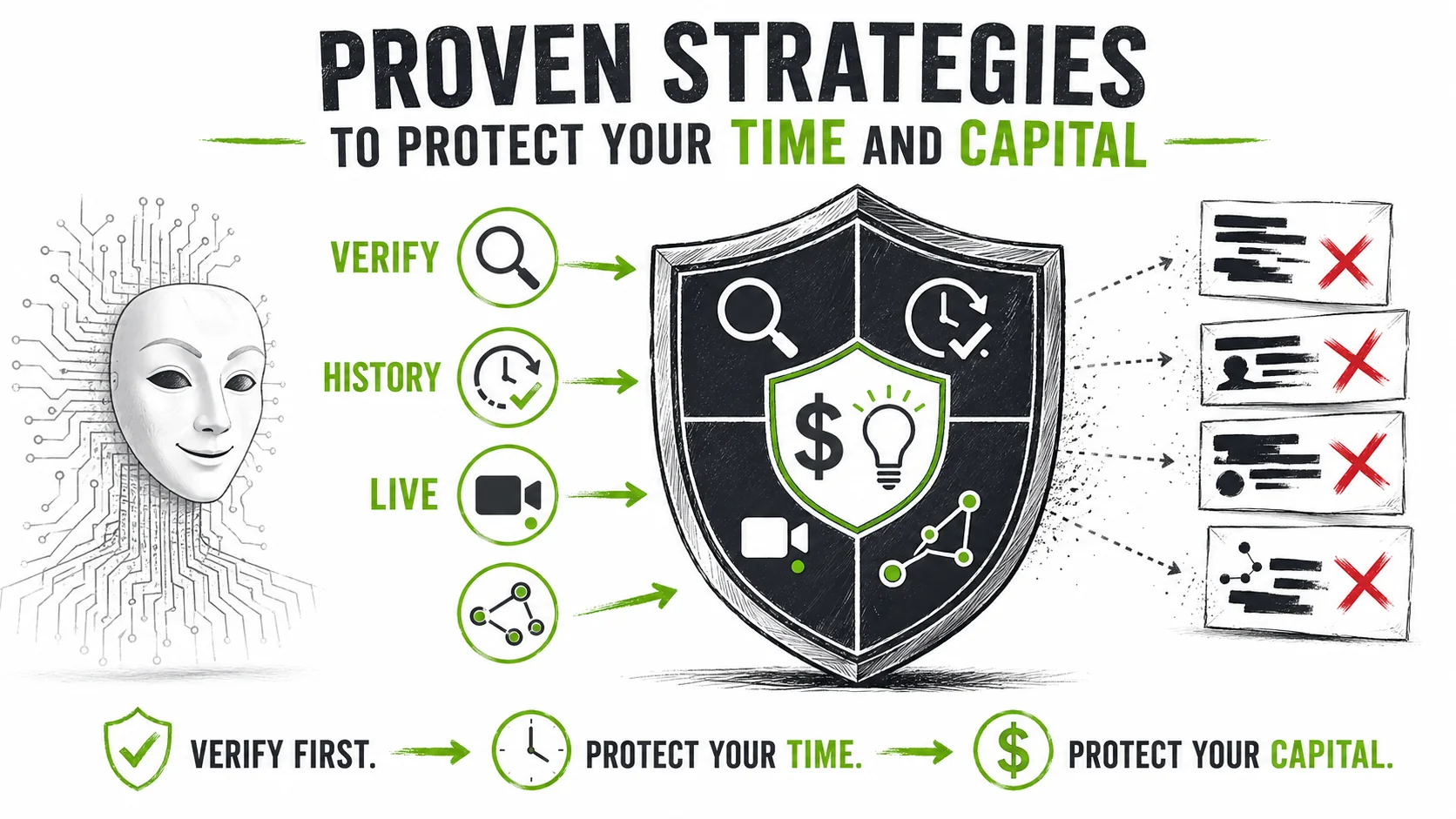
Knowing the signs is step one. Building habits that automatically filter out synthetic noise is step two. Here’s how to operationalize your skepticism.
Adopt a "Verify, Then Trust" Default
Invert the old model. Assume a new, impressive persona is synthetic until proven otherwise. This doesn't mean being cynical, but being deliberately curious. Your first response to a perfect founder story should be a search, not a follow. Use the audit steps above as a quick mental checklist before you engage deeply, invest emotionally, or open your wallet. This mindset is your first and most important defense, a core principle we apply across all our startup and entrepreneurship analysis.
Create Friction for Transaction
Synthetic grifts are designed for scale and low-friction conversion. They want you to click "Buy Now" after a 90-second hype video. Introduce deliberate friction.
- For Courses/Masterminds: Email them with a specific, technical question about the curriculum before buying. Ask for one example student result you can verify (e.g., a public project link, a LinkedIn profile).
- For Consulting/Coaching: Propose a small, paid pilot project instead of a long-term contract. Their performance on a real, contained task will reveal more than any testimonial.
Cultivate a Network of Real Humans
The best antidote to synthetic noise is a strong network of genuine, trusted relationships. Invest time in small, focused communities (like serious Slack groups or offline meetups) where people know each other by real work, not just profiles. In these spaces, reputation is built through contribution, not content output. A recommendation from someone in this network carries infinitely more weight than 1,000 LinkedIn endorsements from unknown "CEOs."
Support and Amplify Authentic Voices
When you find a founder who is genuinely sharing their messy process, admitting gaps in knowledge, and showing real work—support them. Share their content, pay for their product if it's good, and give them constructive feedback. By raising the signal of authentic voices, you help drown out the synthetic noise and make the ecosystem more valuable for everyone. This active curation is part of rebuilding a healthier foundation for entrepreneurship.
Got Questions About Synthetic Founders? We've Got Answers.
How can a synthetic founder do live video if they're fake?
The most common setup involves a real human "actor" serving as the face and voice for a synthetic persona. This actor is fed lines, answers, and talking points in real-time via an earpiece or a teleprompter from an LLM. The persona's knowledge, history, and opinions are all generated, but a human performs them. Other times, the "live" video is a sophisticated deepfake or a pre-recorded simulation of a live Q&A. The key is to ask spontaneous, specific questions that break the script.
What's the biggest mistake people make when evaluating a founder?
They confuse production quality with substance. A slick website, a professionally produced trailer, and perfect grammar are cheap to generate with AI. People often mistake this polish for competence. They assume the effort required to create such a clean facade must correlate with a real business underneath. In the age of AI, the opposite is often true. The most authentic builders are often too busy to have a perfect Instagram aesthetic.
Should I completely avoid founders who use AI tools?
No, and that's not the point. Using AI to draft an email, brainstorm ideas, or edit code is like using a calculator or a spell-checker—it's a productivity tool. The red flag is when AI is used to generate the founder's core identity, expertise, or proof of work. The line is between using a tool to enhance your work and using a tool to invent your capability. A founder who says "I used GPT to help me structure this blog post" is being transparent. One who passes off entirely AI-generated thoughts as their own profound wisdom is being synthetic.
Can platforms like LinkedIn or Twitter detect and remove these personas?
They are trying, but it's an arms race. Platforms can detect bot-like behavior (posting at exact intervals) and some AI-generated images, but the hybrid human-AI personas are extremely difficult to flag automatically. They behave like real users in many ways. Ultimately, platform policies often focus on explicit harm (harassment, financial fraud) rather than philosophical debates about authenticity. The responsibility for detection currently falls more on the user community than on algorithms.
Ready to stop guessing and start knowing?
Larpable - Detect or Create helps you move beyond suspicion to clear-eyed analysis. We give you the frameworks to separate the real builders from the algorithmic performers, protecting your time, money, and sanity. Stop wondering if that guru is legit—learn to detect the patterns yourself.
<!-- sister-projects-start -->
Other Doved Studio projects
Related tools from the same studio you might find useful:
- Ralphable: Generate structured Claude Code skills that iterate until pass/fail criteria are met.
- Doved Studio: Studio indie derrière cette app et une dizaine d'autres outils.
<!-- sister-projects-end -->