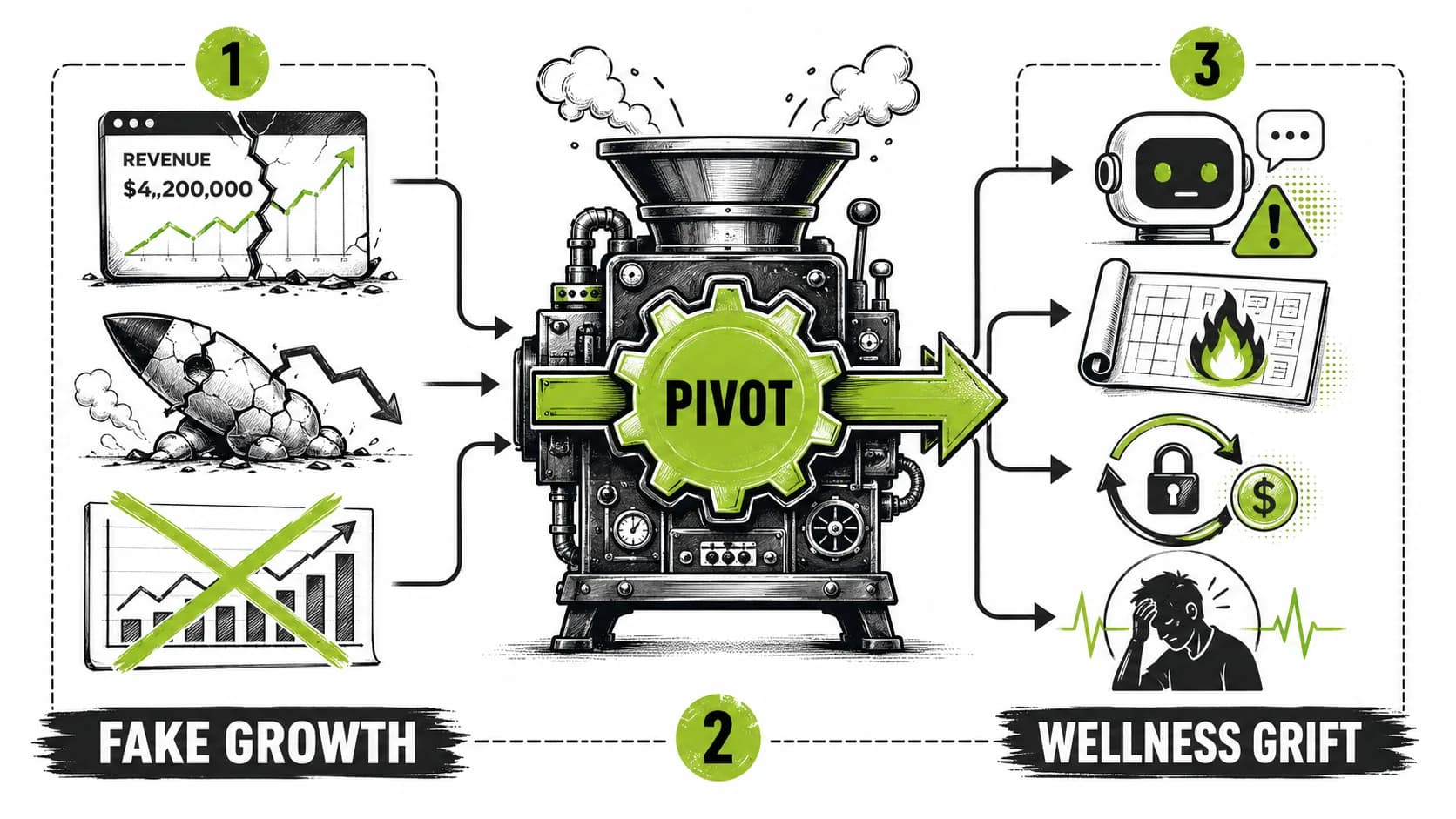
It’s February 2026. The crypto bros have pivoted to climate tech. The “7-figure agency” gurus have been exposed for using fake revenue screenshots. And a new, more insidious grift has emerged from the ashes of their failed SaaS tools and dropshipping courses.
Suddenly, your LinkedIn feed is flooded with former “growth hackers” and “scaling experts” who now sport titles like “Founder Resilience Coach,” “Mental Performance Architect,” or “AI-Powered Wellness Strategist.” Their content has shifted from Lamborghinis to lotus flowers, from revenue graphs to heart-rate variability charts. They’re selling “burnout blueprints,” “neuro-hacking frameworks,” and subscription-based AI therapy bots that promise to cure the very anxiety their previous “hustle 24/7” rhetoric helped create.
Welcome to the great guru pivot of 2026. Having monetized your ambition, they’re now here to monetize your despair. This article is your guide to spotting this cynical new mental health scam, understanding the playbook, and protecting yourself from predators selling snake oil for the soul.
The Anatomy of a Pivot: From Grindset to “Healing”
The pattern is as predictable as it is grotesque. Let’s trace the lifecycle of a typical larper-turned-wellness-guru:
They’ve identified a real pain point—founder mental health is a crisis—and are exploiting it with the same manipulative tactics they used to sell get-rich-quick schemes.
The 2026 “Founder Wellness” Toolkit: Spotting the Red Flags
The new grift is sophisticated, wrapped in the language of therapy, neuroscience, and AI. Here’s how to decode their sales pitch.
Red Flag #1: The “AI-Powered” Therapy Bot That’s Just a ChatGPT Wrapper
The hottest product in this space is the subscription-based AI companion. It has a calming name like “SerenityAI” or “FounderMind.” The sales page is a masterpiece of exploitation:
- The Hook: “Founders can’t afford therapy? Can’t find the time? I’ve built an AI that understands the unique pressure you’re under.”
- The “Tech”: It’s almost certainly a fine-tuned instance of a large language model (like GPT-4o or Claude 3) with a custom frontend. There is no proprietary “neural emotional matrix.” It’s a chatbot.
- The Danger: These bots provide unregulated, potentially harmful advice. When a user expresses serious depressive or suicidal thoughts, the bot’s response is a crapshoot. One might offer a generic crisis hotline number; another might hallucinate dangerous advice.
- How to Spot It: Ask for clinical validation. Which therapeutic framework does it use (CBT, DBT, ACT)? Who are the licensed psychologists on their advisory board? If the answer is vague or cites “years of coaching experience,” run.
Red Flag #2: The “Burnout Blueprint” That Causes More Burnout
This is the digital course reborn. For $5,000, you get a 6-module video series and a 200-page PDF.
- The Content: It’s a pastiche of generic advice you can find for free: “Practice mindfulness,” “Set boundaries,” “Sleep 8 hours,” “Eat healthy.” It’s then repackaged with buzzwords: “Implement quantum-leap boundary protocols” and “synergize your circadian bio-hacking.”
- How to Spot It: Look at the creator’s public schedule. Do they still post at 2 AM? Do they brag about “deep work” 12-hour days? If their lifestyle doesn’t reflect their product’s core message, they’re selling fiction.
Red Flag #3: The “High-Ticket” Resilience Mastermind
When the course isn’t exclusive enough, they create a mastermind. Price: $25,000 - $100,000 per year.
- The Promise: “Small-group access to me and other elite founders. We’ll rebuild your nervous system and design a life of flow and abundance.”
- The Reality: It’s a monthly Zoom call with 20 other desperate people, where the “coach” talks vaguely about energy for 90 minutes. The real “value” is the perceived status of being in the room.
- The Psychological Play: They use the same scarcity tactics (“Only 2 spots left!”) and social proof (“Here’s a CEO who joined and finally found peace”) as they did selling agency masterminds. The currency has changed from revenue to resilience, but the manipulation is identical.
Why This Pivot is So Effective (And Dangerous)
This isn’t just a new marketing angle. It’s a predatory evolution that preys on genuine vulnerability.
The Real Alternatives: How to Actually Protect Your Mental Health
You don’t need a $10,000 AI bot or a guru’s blueprint. Here are actual, evidence-based steps to take:
- Seek Licensed Professionals: A therapist (PsyD, LCSW, LMHC) or a coach with legitimate, accredited certification (like from the International Coach Federation) is trained to help. They work under ethical guidelines. Your first port of call should be a professional, not a prompt.
- Build Real Community: Join peer support groups for founders where no one is selling anything. Organizations like Startup Grind (external link) often host genuine community events, and Founders Network (external link) provides vetted, peer-only forums.
- Practice Fundamentals (For Free): Use free apps like Insight Timer for meditation. Read books by established experts like “Burnout” by Emily and Amelia Nagoski or “The Body Keeps the Score” by Bessel van der Kolk. The tools for managing stress are largely low-tech and low-cost.
- Audit Your Inputs: Unfollow anyone who makes you feel inadequate or sells quick fixes. Your social media feed is your digital environment. Clean it up.
The core skill here is the same one we teach for spotting financial scams: pattern recognition and critical thinking. Learning to detect the underlying playbook is your best defense, whether the grift is about your wallet or your well-being.
Case Study: From “Agency King” to “Zen Master”
Let’s look at a hypothetical (but painfully familiar) example, “Alex.”
- 2023: Alex’s LinkedIn is all about “Closing $20K deals in your DMs.” He sells the “Outbound Engine” course. His tagline: “Sleep is for losers.”
- 2025: Investigative threads reveal Alex’s “client case studies” were fabricated. His “agency” has no real clients. He goes quiet for 3 months.
- 2026, January: Alex returns. A long post details his “collapse”—anxiety, adrenal fatigue, a sense of emptiness. He writes, “I was the hamster in the wheel I built.” The engagement is massive.
- 2026, February: Alex launches “The Grounded Founder,” a “membership community” featuring a custom AI bot, “Samantha,” who provides “empathetic, real-time support.” Price: $299/month. He’s pre-sold 500 spots. The grift has recycled, greener than before.
Alex never fixed a business; he fixed his narrative. And now he’s profiting from the pathology he once glorified.
Conclusion: The Only Sustainable Pivot is Integrity
The 2026 mental health pivot reveals the ultimate truth about these gurus: they are not experts in business, wellness, or AI. They are experts in attention arbitrage. They identify cultural anxieties (making money, then losing sanity), mirror them with a curated personal story, and sell a product that promises resolution.
Protecting yourself starts with skepticism. When you see a dramatic pivot, ask:
The entrepreneurial journey is hard enough without being sold a cure for the poison these same characters marketed last year. Your mental health is not a trend to be monetized. It’s the foundation of everything. Guard it with more scrutiny than you’d give a term sheet.
Ready to see through the narrative? Start by learning the fundamental patterns of deception with our guide, Apprendre à Détecter. It’s the first step to building a career—and a life—that’s resilient for the right reasons.
FAQ: The Founder Mental Health Scam
1. Isn't it good that people are talking about founder mental health, even if they're new to it?
Talking about it is good. Monetizing it without competence is malpractice. There’s a vast difference between a licensed therapist with a decade of experience and a failed SaaS founder who read a book on mindfulness and now sells a $10,000 “healing journey.” The former is a professional; the latter is a profiteer exploiting a crisis. Support the conversation, but vet the “guides” with extreme prejudice.
2. How can I tell a legitimate mental health coach from a pivoted guru?
Ask for credentials and structure.
- Legitimate Coach: Will have accredited coach training (ICF, EMCC), a clear coaching agreement, ethical boundaries, and will often encourage therapy for clinical issues. They focus on process and goals, not selling a one-size-fits-all “system.”
- Pivoted Guru: Relies on personal “story” as their primary credential. Sells a standardized, expensive package (blueprint, system, bot). Uses high-pressure sales tactics (“transformational results require investment”). Their past is a trail of abandoned, unrelated business ventures.
3. Are all AI mental health tools scams?
No. There are legitimate digital therapeutics undergoing clinical trials and seeking FDA clearance. The key differentiators are transparency and clinical oversight.
- Legitimate Tool: Will clearly state the therapeutic method (e.g., CBT-based), list the clinical team involved, have published research, and include clear risk protocols for crisis situations.
- Scam Tool: Vaguely claims to be “AI-powered,” cites no clinical research, is built and sold by a single influencer, and has disclaimers absolving them of all responsibility for the advice given.
4. What should I do if I've already paid for one of these "burnout blueprint" programs?
First, be kind to yourself. You were seeking help for a real problem. Then:
5. This all feels cynical. Is there any real help for founders?
Absolutely. The real help is less sexy and doesn’t have a flashy sales page. It’s found in:
- Therapy: The gold standard.
- Peer Groups: Vetted, non-commercial communities of founders.
- Basic Health: Regular sleep, nutrition, exercise, and time offline.
- Realistic Expectations: Understanding that building something meaningful is a marathon, not a sprint, and that struggle is normal.
The hub for startup founders can point you towards some of these genuine resources. The goal isn’t to become a “burnout-proof superhuman” sold by a guru. It’s to become a sustainably human founder.
<!-- sister-projects-start -->
Other Doved Studio projects
Related tools from the same studio you might find useful:
- Ralphable: Generate structured Claude Code skills that iterate until pass/fail criteria are met.
- Doved Studio: Studio indie derrière cette app et une dizaine d'autres outils.
<!-- sister-projects-end -->