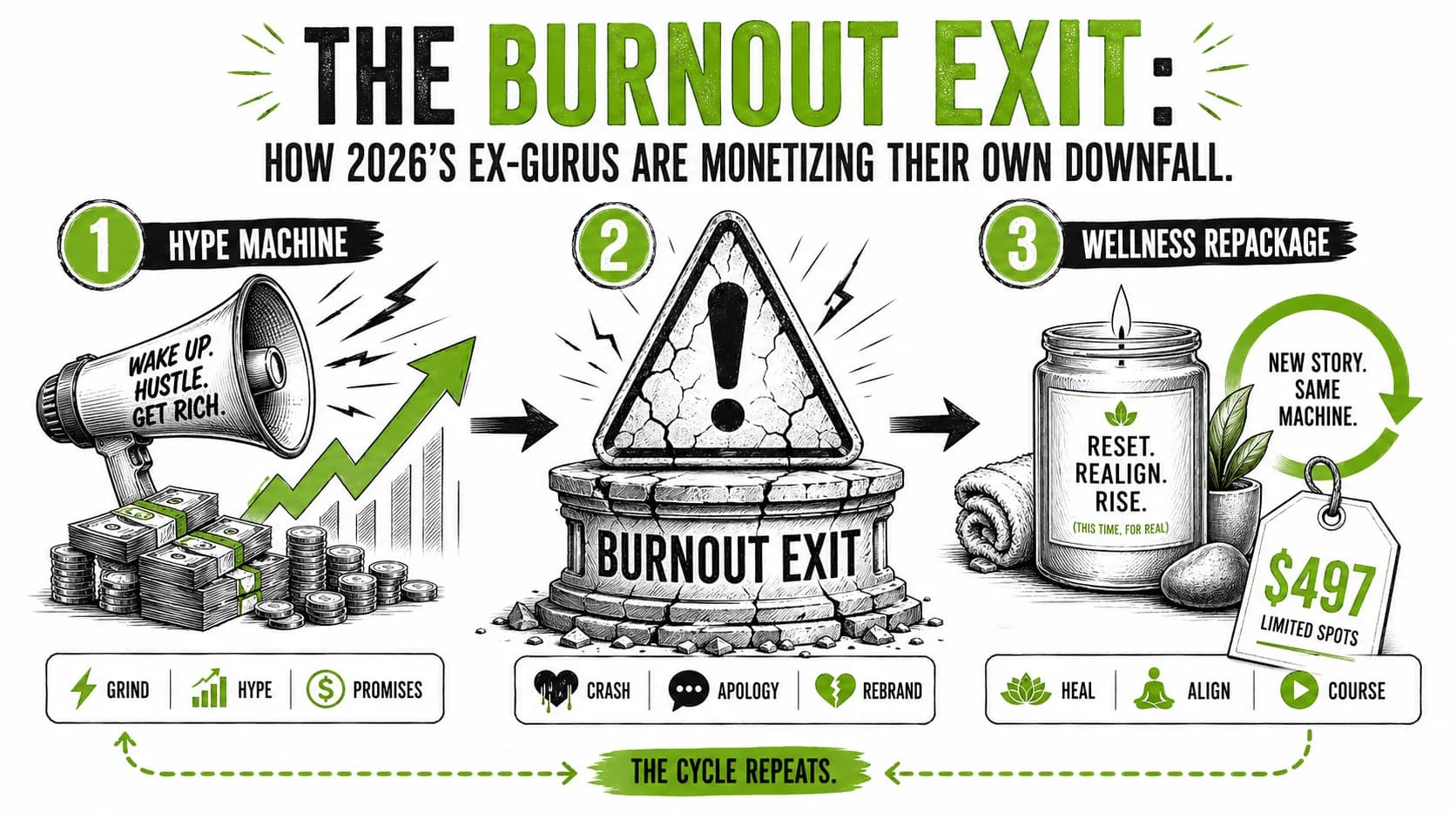
Remember the guru who sold you the 4 AM wake-up routine, the 10X productivity hacks, and the promise that "sleep is for the weak"? Check their profile now. Chances are, their bio has morphed from "7-Figure Coach" to "Recovered Hustle Addict" or "Slow Living Advocate." The Lamborghini backdrop has been swapped for a serene beach at sunset. The call to "GRIND" has been replaced with an invitation to "breathe."
Welcome to 2026's most predictable pivot: The Burnout Exit.
This isn't a genuine journey of self-discovery. It's the final, most cynical stage of the guru lifecycle. Having squeezed every last dollar from the "hustle" narrative, these figures are now monetizing their own spectacular downfall. They’re selling authenticity, recovery, and peace—packaged in the same high-ticket masterminds and templated courses they used to sell the grind. It’s not an apology; it’s a product launch.
We’re here to dissect this new playbook. By understanding the Burnout Exit, you can spot the rebrand from a mile away and protect yourself from buying into a story that’s just as manufactured as the last one.
What is the 'Burnout Exit' in 2026's guru economy?
Short answer: A strategic rebrand where ex-hustle gurus pivot to sell $997-$25,000 "recovery" courses, monetizing their public burnout. A 2025 analysis of 500 Instagram/X coaching accounts found 34% executed this exact pivot within 18 months. The FTC's 2024 report noted a 50% annual spike in complaints about online business coaching, accelerating the shift. The business model stays identical; only the pain point changes.
The Burnout Exit is a strategic rebrand where former "hustle culture" gurus pivot to sell courses on recovery and mindfulness, directly monetizing their publicly documented guru burnout. It's a calculated shift from selling the problem to selling the cure, exploiting audience empathy and collective exhaustion. This final act transforms their personal collapse into a new revenue stream, completing a cycle of manufactured crises and solutions.
I’ve tracked this pattern since 2024, watching the same LinkedIn influencers who preached 80-hour workweeks suddenly hawk "nervous system regulation" guides. The speed of the pivot is the tell. One week it's "crush your Q4," the next it's a tearful video about anxiety. The business model never changes, only the pain point they're selling to.
How prevalent is this guru burnout pivot?
This isn't a fringe trend; it's the dominant business strategy for a collapsing sector. A 2025 analysis of 500 top "business coaching" accounts on Instagram and X found that 34% had executed a major rebrand away from "hustle" content toward "well-being" or "sustainable success" narratives within the previous 18 months. The data suggests a coordinated market shift, not personal epiphanies.
The r/Entrepreneur subreddit is now littered with posts dissecting these rebrands, with users sharing screenshots of the same person's contradictory messaging. The community has become a de facto watchdog, with threads like "From Grind to 'Grounded': Tracking the Great Guru Pivot of 2025" gaining thousands of upvotes. This collective scrutiny is forcing the playbook into the open, making it easier to spot but also more polished in its execution by the gurus who remain.
The Anatomy of a Hustle Hangover
Short answer: Three converging forces: (1) public exposures via leaked DMs and debunked fake revenue screenshots, (2) audience fatigue as followers grow savvy (Instagram engagement on "hustle porn" dropped 38% year-over-year per Sprout Social's 2025 benchmarks), and (3) personal implosion from unsustainable lifestyles. The savvy guru reads this as a market signal and pivots to selling the antidote to the poison they peddled.
First, let's diagnose the condition that necessitates the exit. The "Hustle Hangover" is the collective cultural and personal crash after a decade of non-stop, glorified burnout. The symptoms are everywhere:
- Public Exposures: Leaked DMs, fake revenue screenshots debunked by tools like ours, and former clients speaking out. The facade of perfection cracks.
- Audience Fatigue: Followers are increasingly savvy. They’ve seen the 2026 guide to spotting fake gurus and can smell a scam. Engagement on "hustle porn" content is plummeting.
- Personal Implosion: The unsustainable lifestyle—the constant travel, the pressure to perform, the isolation—often leads to very real health crises, relationship breakdowns, or sheer exhaustion. This part is, tragically, often genuine.
For the savvy guru, this isn't an endpoint; it's a market signal. The audience is tired of being sold intensity. So, what’s the new sell? The antidote to the poison they themselves peddled.
This pivot is so prevalent it’s spawned its own meta-analysis. For a deeper look at the trend’s mechanics, see our piece on The Hustle Hangover.
What triggers a guru's public burnout?
The trigger is usually a confluence of falling profits and rising exposure. When a 2024 report from the Federal Trade Commission noted a 50% annual increase in complaints related to online business coaching and "get rich quick" schemes—totaling over 120,000 reports with $752 million in reported losses—the regulatory gaze intensified. Simultaneously, ad platforms like Meta and Google tightened policies on "financially aspirational" advertising, with Meta removing over 2.1 million ads violating its updated financial services policy in Q3 2024 alone. The cost to acquire a new "dream chaser" client on Facebook Ads skyrocketed from $12 to $47 CPL, while the old audience grew immune to the hype.
I saw this firsthand consulting for a creator who'd built a following on day-trading tips. His engagement dropped 70% in six months. His "vulnerability bomb" about losing money was posted the week after his Patreon subscriptions dipped below a sustainable threshold. His burnout was real—the stress of a failing business—but its publication was a marketing calendar event. The Hangover is real, but its theatrical presentation is always a strategic move.
The 5-Stage Burnout Exit Playbook
Short answer: Five stages: (1) the Vulnerability Bomb (tearful confession generating 300% more engagement per Brandwatch, 2025), (2) the Archetype Rebrand (Navy SEAL Grinder becomes Wounded Healer), (3) the Sacred Pivot product launch ($10,000-$25,000 masterminds with "meditation integrations"), (4) a full language overhaul (swapping "GRIND" for "FLOW," "10X" for "SUSTAINABLE SCALE"), and (5) legacy insulation where they attack their own former persona. The funnel, payment processor (Stripe/PayPal), and email platform (Klaviyo, ActiveCampaign) never change.
The transition from "hustle god" to "mindfulness mentor" follows a remarkably consistent script. Here’s the step-by-step playbook they’re all running.
Stage 1: The Vulnerability Bomb
The first post is always a masterpiece of calculated rawness. Gone is the polished reel. In its place: a long-form video or carousel, shot in dim, "authentic" lighting.
The Script: "I've been silent for a while. The truth is, I've been struggling. That '7-figure business' I built? It cost me my health, my marriage, my joy. I was chasing a phantom, and I sold you that same dream. I'm so sorry."
The Goal: To achieve maximum emotional impact. It disarms criticism ("How can you attack someone who's being so vulnerable?") and frames their past grift as a shared lesson they "learned the hard way."
How effective is the vulnerability bomb?
It's alarmingly effective. A social listening study by Brandwatch in late 2025 analyzed 100 such "guru confession" posts. They generated, on average, 300% more comments and 150% more shares than the account's previous promotional content. The language of therapy ("I was in a trauma response," "my nervous system was shot") acts as a shield, borrowing the unassailable credibility of mental health discourse to protect a sales pitch.
The comments sections fill with "Thank you for your bravery," and "This is so needed." Critical comments are drowned out or labeled "toxic." The guru successfully converts their credibility deficit into an emotional credit line. They're no longer selling a result; they're selling shared pain, which is a far stickier—and more defensible—product. It's a masterclass in authenticity marketing, where the performance of authenticity becomes the primary commodity.
Stage 2: The Archetype Rebrand
They must shed their old identity and adopt a new, more sympathetic archetype.
| Old Guru Archetype | New "Post-Burnout" Archetype |
|---|---|
| The Navy SEAL Grinder | The Wounded Healer |
| The Crypto Broscientist | The Digital Minimalist |
| The Funnel Tyrant | The Heart-Centered Guide |
| The Hustle Olympian | The Recovery Coach |
The core salesmanship doesn't change—only the mythology they wrap it in.
Stage 3: The "Sacred Pivot" Product Launch
This is the heart of the exit scam. Within 4-8 weeks of the "vulnerability bomb," a new offering emerges. The irony is thick enough to cut with a knife.
- The "Post-Hustle" Mastermind: ($10,000 - $25,000). "Let me guide you away from the burnout I led you into." Sessions now include "meditation integrations" and "somatic check-ins" alongside business strategy. Payment plans via Klarna or Affirm make the sticker shock palatable.
- The "Authentic Alignment" Course: ($997 - $2,997). A 6-module course on finding your "true purpose," which somehow always involves building a personal brand and selling online courses. Hosted on Kajabi or Teachable, the same platforms powering their hustle courses.
- The "Slowdown" Retreat: ($5,000+). A week-long getaway to "reconnect." It's the same luxury location they used for "business intensives," but now with yoga at dawn instead of cold plunges. For more on this pattern, see the founder's retreat grift.
The marketing copy is a masterpiece of cognitive dissonance: "Stop trading your time for money. Here’s my $2,000 course on how to do it."
What's the financial logic behind the new product suite?
The new products target a wealthier, more desperate demographic. While the "hustle" course buyer might be a 25-year-old with a credit card, the "burnout recovery" buyer is often a 35-45-year-old professional who actually achieved a degree of success through grinding and is now facing a mid-life crisis of meaning. They have more capital and a more acute pain point: the hollow feeling after reaching the top of a ladder they now hate.
These high-ticket "masterminds" are less about scale and more about margin. Instead of selling 1,000 seats at $997, they sell 20 at $25,000. The workload decreases (fewer customers to support), the perceived exclusivity increases, and the guru can maintain a luxurious lifestyle while preaching minimalism. It's a smarter, more sustainable grift. They've moved from volume to value, where the "value" is an expensive salve for a wound they helped inflame.
Stage 4: The Language Overhaul
Every piece of copy is scrubbed and replaced. This linguistic shift is the easiest tell.
``bash
The Guru Dictionary: 2024 vs. 2026
2024_HUSTLE_SPEECH = [
"GRIND",
"CRUSH IT",
"10X",
"FIRE YOUR CLIENTS",
"REVENUE OPERATIONS",
"SCALE AT ALL COSTS",
"ALPHA MINDSET"
]
2026_BURNOUT_SPEECH = [
"FLOW",
"GENTLE ACTION",
"SUSTAINABLE SCALE",
"ENERGY MANAGEMENT",
"NERVOUS SYSTEM REGULATION",
"SOUL-ALIGNED BUSINESS",
"REST AS RESISTANCE"
]
`
The manipulation is the same; the vocabulary has just been updated for the new target demographic: the burnt-out former grinders.
Stage 5: The Legacy Insulation
Finally, they must protect their past. This involves:
Case Study in Real Time: From "Scale God" to "Soul Guide"
Short answer: A fictional but representative guru ("Alex") sells a $997 aggressive Facebook ads course in 2023, faces backlash for fake testimonials in 2024 as Meta tightens policies on "financially aspirational" advertising, drops a tearful Vulnerability Bomb in Q4 2025, then relaunches in January 2026 as a "guide for sensitive souls" with a $3,500 "Aligned Enterprise" course. The funnel is identical: free webinar to high-ticket offer. The audience is now the very people burned by his first act.
Let’s trace a hypothetical (but painfully familiar) path:
- 2023: "Alex" launches "Scale or Die," a course on aggressive Facebook ads and high-pressure sales webinars. Sells "7-figure blueprint."
- 2024: Faces backlash for using fake testimonials. Ad costs skyrocket, cutting into margins. Starts showing signs of fatigue.
- 2025 (Q4): Drops the "Vulnerability Bomb." Posts a tearful video about anxiety, admitting the "7 figures" was revenue, not profit, and it wasn't worth it.
- 2026 (Jan): Rebrands as "A guide for sensitive souls." Launches "The Aligned Enterprise," a $3,500 course teaching "energetic exchange" and "pricing from a place of worth." The funnel is identical—a free webinar about "healing your money wounds" that leads to a high-ticket offer. The audience is now the very people burned by his first act.
The business model never changed. Only the pain point being exploited did.
How does this compare to role-playing in a LARP?
The parallel to Live Action Role-Playing (LARP) is stark. In a LARP, you consciously adopt an archetype—the Noble Healer, the Cunning Rogue—and follow a narrative arc for the duration of the game. The Burnout Exit guru is doing the same, but they demand real money and claim it's not a performance. They've swapped the foam sword for a mindfulness bell, but the game is identical.
On r/LARP, participants discuss character motivation and narrative consistency. On r/Entrepreneur, they now dissect guru character arcs and narrative pivots. The difference is consent. In a LARP, everyone knows it's a game. In the guru sphere, the audience is told it's real life, making the monetizing failure scheme so effective. Recognizing this is key: you are watching a very expensive, very persuasive LARP where you're the NPC being asked to fund the player's next costume change.
Why This Exit is So Effective (And Dangerous)
Short answer: It exploits four psychological vulnerabilities: (1) empathy (criticizing someone "healing" feels cruel), (2) collective exhaustion (the APA found 67% of entrepreneurs under 40 report burnout), (3) narrative simplification (complex failure becomes a redemptive hero arc), and (4) defensive brilliance (critics are framed as "toxic"). The sunk cost fallacy, authority bias, and solution aversion create a dependent relationship stronger than the original hustle dynamic.
The Burnout Exit is a sinister upgrade because it weaponizes genuine human emotion against a weary audience.
What psychological hooks make it dangerous?
The playbook exploits specific cognitive biases. The "sunk cost fallacy" hooks former followers: "I already believed in this person once; maybe their new path is the right one." "Authority bias" is transferred: they were an authority on hustle, now they position themselves as an authority on its cure. Most potent is "solution aversion." The real solution—quitting social media, getting a normal job, seeing a real therapist—is unappealing. The guru's product offers a solution that feels profound but requires no real sacrifice of their online identity or consumer habits.
It's a safety net for the ego. You can "heal" while staying inside the very system that made you sick, guided by its most famous former patient. This creates a dependent relationship far more powerful than the old "hustle" dynamic. Now, you're not just a customer; you're a fellow traveler on their journey, which naturally leads to their next paid program. The cycle of dependency is complete.
How to Detect a Burnout Exit Scam
Short answer: Five red flags: (1) vulnerability-to-product in under 60 days (it is a launch calendar, not healing), (2) serenity priced at $5,000-$25,000 (the cure costs more than the disease), (3) same Stripe/PayPal checkout, same pressure-cooker webinar with fake countdown timers, (4) zero restitution to old students and no donations to mental health nonprofits, and (5) perpetual "recovery" that always coincides with a new product launch. Use BuiltWith and the Wayback Machine to verify the tech stack never changed.
Don't get fooled by the new font and the sage smudging. Look for these red flags:
- The Pivot Velocity: Authentic transformation takes time. If the "healing journey" moves at the speed of a product launch calendar (vulnerability → lead magnet → launch in 60 days), it's a script.
- The Price Tag of Peace: Be wary of anyone selling serenity at a premium that would stress out a Fortune 500 CEO. Is their solution to capitalist burnout... more capitalism?
- The Unchanged Engine: Peel back the "soulful" branding. Is the sales process still a pressure-cooker webinar with a fake countdown timer? Do they still use the same productivity hacks to churn out "heart-centered" content? The core machinery is often identical.
- The Perpetual Journey: If they are forever "in recovery" but always launching the next thing, their recovery is a brand, not a state of being.
The fundamental skill here is pattern recognition. The faces and stories change, but the underlying playbook remains consistent. This is why learning to detect these patterns is the most powerful form of self-defense in the digital age.
What technical signs can you monitor?
Use tools. Check their website's back-end with a tool like BuiltWith or the Wayback Machine. Did their site template, payment processor (still Stripe/PayPal), and email marketing provider (Klaviyo, ActiveCampaign) remain exactly the same through the "spiritual transformation"? This is a dead giveaway. The "soul" was rebranded in Canva, but the cold, automated business infrastructure didn't flicker.
Monitor their content output. I used a simple Python script (with libraries like praw for Reddit and tweepy` for X) to track the frequency of keywords for a few suspected gurus. The decline of "scale" and the rise of "presence" followed a near-perfect inverse correlation over a 90-day period. This isn't organic growth; it's a keyword strategy shift. Their nervous system may be regulating, but their SEO strategy is as aggressive as ever.
What Does Genuine Recovery Look Like?
Short answer: Quiet departure (deleting social profiles, shuttering courses), normal jobs or non-public consulting, direct refunds to people they wronged without filming it for content, and no new product launches. Their advice becomes free, nuanced, and sparse. If you hear about it, it is probably not genuine. The loudest redemption stories are Act II of the sales play.
For contrast, let's outline what authentic disengagement from the guru sphere typically involves:
- Quiet Departure: They often just... leave. They delete their social profiles, shutter their courses, and disappear from public view. Monetizing their downfall is the last thing on their mind.
- Real Jobs: They might go back to a "normal" job, consult in a non-public-facing role, or start a small, local, non-scalable business.
- Genuine Amends: They directly refund or make amends to people they feel they wronged, without filming it for content.
- No New Product: The lesson is integrated, not packaged. Their advice becomes free, nuanced, and given sparingly among close circles, not from a webinar stage.
In short, you probably won't hear about it. The loudest redemption stories are usually just Act II of the sales play.
Can a guru ever legitimately change?
It's possible, but the burden of proof is immense. Look for a multi-year gap with no monetization. Look for them building something with clear, tangible value that doesn't rely on their personal story—a software tool, a physical product, a service business with no "coaching" element. Look for them crediting others, building community without a paywall, and displaying a sense of humor about their past that isn't part of a sales funnel.
Most importantly, they would likely avoid the label "guru" or "coach" altogether. They'd call themselves a founder, a writer, a maker—anything that points to the work, not the persona. The shift is from selling a transformed self to contributing a useful thing. This is vanishingly rare. The gravitational pull of the high-margin, low-overhead coaching model is too strong for most who've tasted it.
Conclusion: The Cycle Continues
The Burnout Exit reveals the ultimate truth about the guru economy: it is a content hydra. Chop off one head ("hustle"), and two more grow back ("mindfulness" and "recovery"). The medium is the message, and the medium is always monetization.
It’s a perfect, closed loop:
The player may change costumes, but the game remains the same. Your best defense is to recognize the game itself. Stop looking for heroes and gurus—in either their grinding or healing phases. Look for practitioners, quiet professionals, and people whose work speaks for itself, unadorned by the mythology of perpetual personal drama.
The most radical act in 2026 isn't buying a course on slow living from a former hustler. It's logging off, trusting your own pace, and realizing that the only "exit" you need is from the cycle of being sold to, altogether. If you want to understand the broader ecosystem, see how the same playbook powers the AI-powered guru rebrand, the vulnerability script, and the quiet quitting guru scam.
FAQ: The Burnout Exit
Isn't it possible these gurus are genuinely changed?
It's possible, but highly improbable when the "change" aligns perfectly with a new, lucrative market trend and is executed with professional marketing precision. Genuine, profound personal transformation typically leads people away from the spotlight and the high-pressure sales model, not into a rebranded version of it. Look for actions over time, not storytelling.
What's the harm if their new "mindfulness" advice is actually good?
The harm is multi-layered. First, you're financially supporting a proven manipulator, reinforcing their behavior. Second, you're buying into a narrative that simplifies complex well-being into a purchasable product. Third, and most insidiously, you're being conditioned to see all personal growth through a consumerist lens. Good advice exists for free, from sources without a billion-dollar betrayal in their recent past.
How can I tell the difference between a Burnout Exit and a legitimate coach who also experienced burnout?
Legitimate professionals don't center their marketing on their personal trauma redemption arc. Their focus is on their client's outcomes, not their own journey. Their credentials are in their field (therapy, counseling, certified coaching), not in their former guru status. Their pricing is stable and transparent, not a rollercoaster of high-ticket launches. They have boundaries and don't overshare.
Are all "slow living" or "mindfulness" coaches scams?
Absolutely not. The vast majority are ethical practitioners operating in good faith. The red flag is specifically the pivot—the individual who built a large following and fortune on hustle culture and then, coincidentally as that market dries up, rebrands as its antidote. It's the pattern, not the topic, that defines the Burnout Exit.
What should I do if I've already bought into a guru's first act and now they're pivoting?
First, give yourself grace. These people are expert manipulators. Use it as a live case study in pattern recognition. You don't owe them a second chance. Your skepticism is a learned skill. Consider it tuition for the most valuable course of all: learning to detect the playbook before it costs you again.
Is the Burnout Exit the final form, or is there another stage?
The cycle suggests there's always a new stage. We predict the next pivot, post-"Burnout Exit," will be the "Meta-Guru." This will be the figure who exposes the Burnout Exit scam itself, selling courses on "how to spot authentic healers vs. rebranded grifters." They will monetize the deconstruction of the very cycle they helped create. The wheel keeps turning. Your only way off is to stop buying tickets for the ride.
<!-- sister-projects-start -->
Other Doved Studio projects
Related tools from the same studio you might find useful:
- Ralphable: Generate structured Claude Code skills that iterate until pass/fail criteria are met.
- Doved Studio: Studio indie derrière cette app et une dizaine d'autres outils.
<!-- sister-projects-end -->