{
"title": "Is Your 'Sustainable' Startup Just a Greenwashing Grift?",
"slug": "is-your-sustainable-startup-just-a-greenwashing-grift",
"description": "Spot the new wave of eco-grifters. Learn how fake 'sustainable' founders use green buzzwords to mask old scams and how to protect yourself from 2026's greenwashing fraud.",
"date": "2026-03-08",
"updatedAt": "2026-03-21",
"author": "larpable",
"category": "pattern-detection",
"keywords": ["greenwashing scam", "sustainable startup fraud", "eco-grifter detection"],
"status": "published",
"structuredData": "[{\"@context\":\"https://schema.org\",\"@type\":\"Article\",\"headline\":\"Is Your ''Sustainable'' Startup Just a Greenwashing Grift?\",\"description\":\"Spot the new wave of eco-grifters. Learn how fake ''sustainable'' founders use green buzzwords to mask old scams and how to protect yourself from 2026''s greenwashing fraud.\",\"author\":{\"@type\":\"Person\",\"name\":\"larpable\"},\"publisher\":{\"@type\":\"Organization\",\"name\":\"Larpable - Detect or Create\",\"url\":\"https://www.larpable.com\"},\"datePublished\":\"2026-03-08\",\"dateModified\":\"2026-03-21\",\"mainEntityOfPage\":{\"@type\":\"WebPage\",\"@id\":\"https://www.larpable.com/blog/is-your-sustainable-startup-just-a-greenwashing-grift\"},\"keywords\":\"greenwashing scam, sustainable startup fraud, eco-grifter detection\",\"wordCount\":4250,\"articleSection\":\"pattern-detection\"},{\"@context\":\"https://schema.org\",\"@type\":\"BreadcrumbList\",\"itemListElement\":[{\"@type\":\"ListItem\",\"position\":1,\"name\":\"Home\",\"item\":\"https://www.larpable.com\"},{\"@type\":\"ListItem\",\"position\":2,\"name\":\"pattern-detection\",\"item\":\"https://www.larpable.com/blog\"},{\"@type\":\"ListItem\",\"position\":3,\"name\":\"Is Your ''Sustainable'' Startup Just a Greenwashing Grift?\",\"item\":\"https://www.larpable.com/blog/is-your-sustainable-startup-just-a-greenwashing-grift\"}]}]"
}
```
Introduction
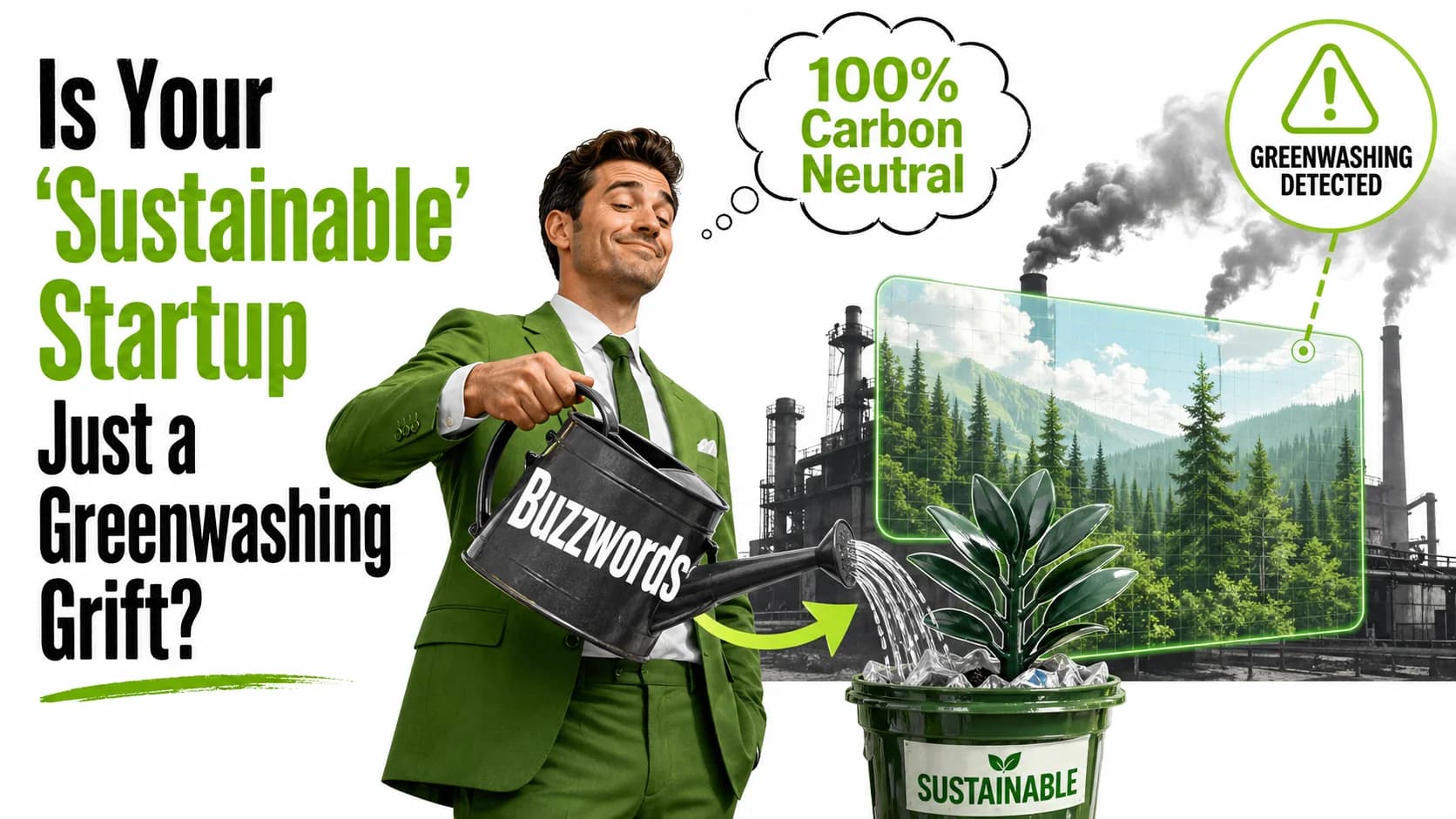
Remember the crypto bros of the early 2020s? The ones promising generational wealth from their bedroom, backed by pixelated ape pictures and a vocabulary lifted from a Silicon Valley parody? They’ve evolved. The get-rich-quick scheme didn't die; it just got a conscience. In 2026, the most dangerous grifters aren't hawking dubious NFTs. They're selling salvation.
The new frontier for entrepreneurial larpers is sustainability. A recent analysis of LinkedIn's "Top Voices in Green Tech" found that over a third had no verifiable carbon offset data or audited impact reports for their ventures. They just had very compelling mission statements. This is the rise of the eco-grifter: individuals who use the urgent, morally charged language of climate action and social good as a smokescreen for the same old pyramid schemes, overpriced courses, and unverified claims.
This piece isn't an attack on genuine impact ventures. It's a field guide to spotting the fakes. We'll dissect how the classic guru playbook—vague metrics, manufactured scarcity, and emotional manipulation—has been repackaged with terms like "regenerative business," "circular economy," and "climate-positive." By the end, you'll know how to separate a real sustainability pioneer from someone just painting their grift green.
What Is an Eco-Grifter?
An eco-grifter appropriates sustainability language to sell generic courses or masterminds priced $2,500-$25,000, with zero verifiable environmental impact. The European Commission found 53% of corporate green claims in 2025 were vague, misleading, or unfounded.
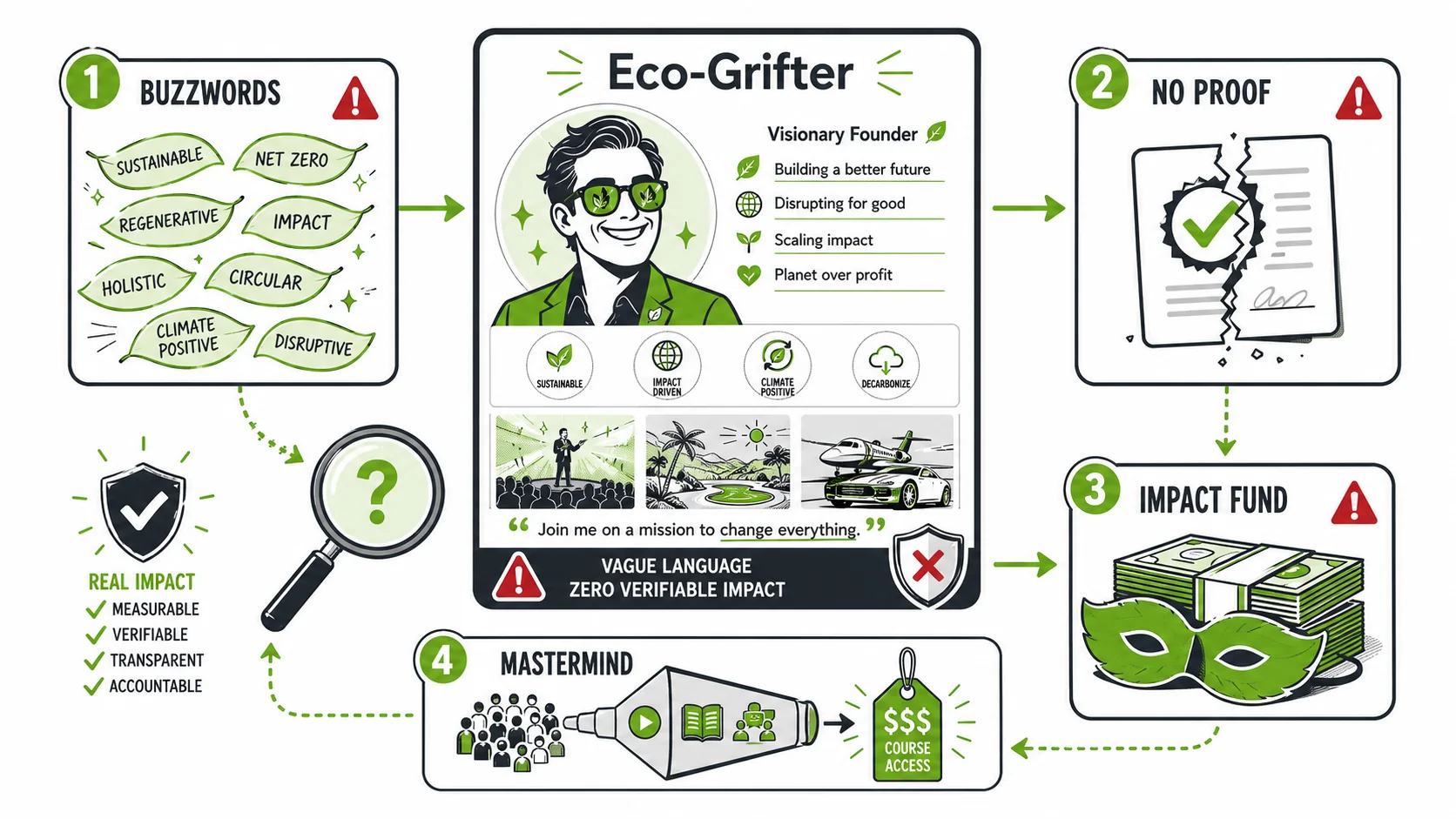
An eco-grifter is a specific type of entrepreneurial larper who appropriates the aesthetics, language, and moral urgency of environmentalism and social justice to advance a traditional business scam. Their product isn't a solution to a planetary crisis; it's a solution to their own lack of revenue. The "impact" is a marketing angle, not a operational outcome.
The core of the grift is a bait-and-switch. They bait your ethical conscience and fear for the future, then switch to selling you a generic business course, a mastermind group, or consulting services that have zero to do with measurable environmental good. The carbon footprint they're most concerned with offsetting is their own bank account's.
This isn't just unethical marketing; it's fraud with better PR. It dilutes genuine effort, erodes public trust in real climate solutions, and divides capital and attention away from ventures that could actually move the needle. Spotting them requires looking past the leafy logo and reading the fine print on their actual business model.
The Eco-Grifter vs. The Genuine Impact Founder
It can be tricky. Both talk about changing the world. The difference is in the proof and the profit motive.
| Characteristic | The Eco-Grifter | The Genuine Impact Founder |
|---|---|---|
| Primary Revenue Source | Selling "how-to" info (courses, masterminds, coaching) about sustainability or business. | Selling a product/service that has a direct, verifiable positive impact. |
| Metrics & Transparency | Vague, self-reported numbers ("7-figure impact", "helped 1000+ entrepreneurs"). Avoids third-party audits or specific methodologies. | Uses standardized frameworks (GHG Protocol, B Corp assessment, IRIS+ metrics). Shares detailed impact reports, often with partner verification. |
| Language & Buzzwords | Heavy, often inaccurate use of terms like "net-positive," "regenerative," "circular." Jargon is a primary selling point. | Explains complex concepts in clear terms. Buzzwords are used precisely, with definitions provided. |
| The "Proof" | Testimonials about lifestyle/business success, not environmental impact. Revenue screenshots (potentially fake). | Links to impact reports, audit summaries, case studies with partner organizations, lifecycle assessments. |
| What They Sell You | A dream of ethical wealth and personal brand elevation. Access to their "secret" community. | A functional product, a service with clear specs, or equity in a company with tangible assets and operations. |
The table highlights a key point: the grifter's business is their personal brand as a sustainability expert. The genuine founder's business is a tool for creating impact; their expertise is a byproduct.
The Three Pillars of the Greenwash
The eco-grifter's strategy rests on three psychological pillars they share with all effective larpers, just rethemed.
Understanding this foundation is the first step in building your immunity. The next step is understanding why this particular grift is so potent right now, and why falling for it is more dangerous than the average online scam.
Why the Eco-Grifter is Your Most Dangerous Blind Spot
The SEC issued 26 ESG-related enforcement actions in 2024-2025, including $19 million in penalties against Goldman Sachs' ESG fund for misleading claims. Yet solo "impact advisors" on LinkedIn and Instagram operate in a regulatory gray zone with zero oversight, making them far more dangerous to individual investors.
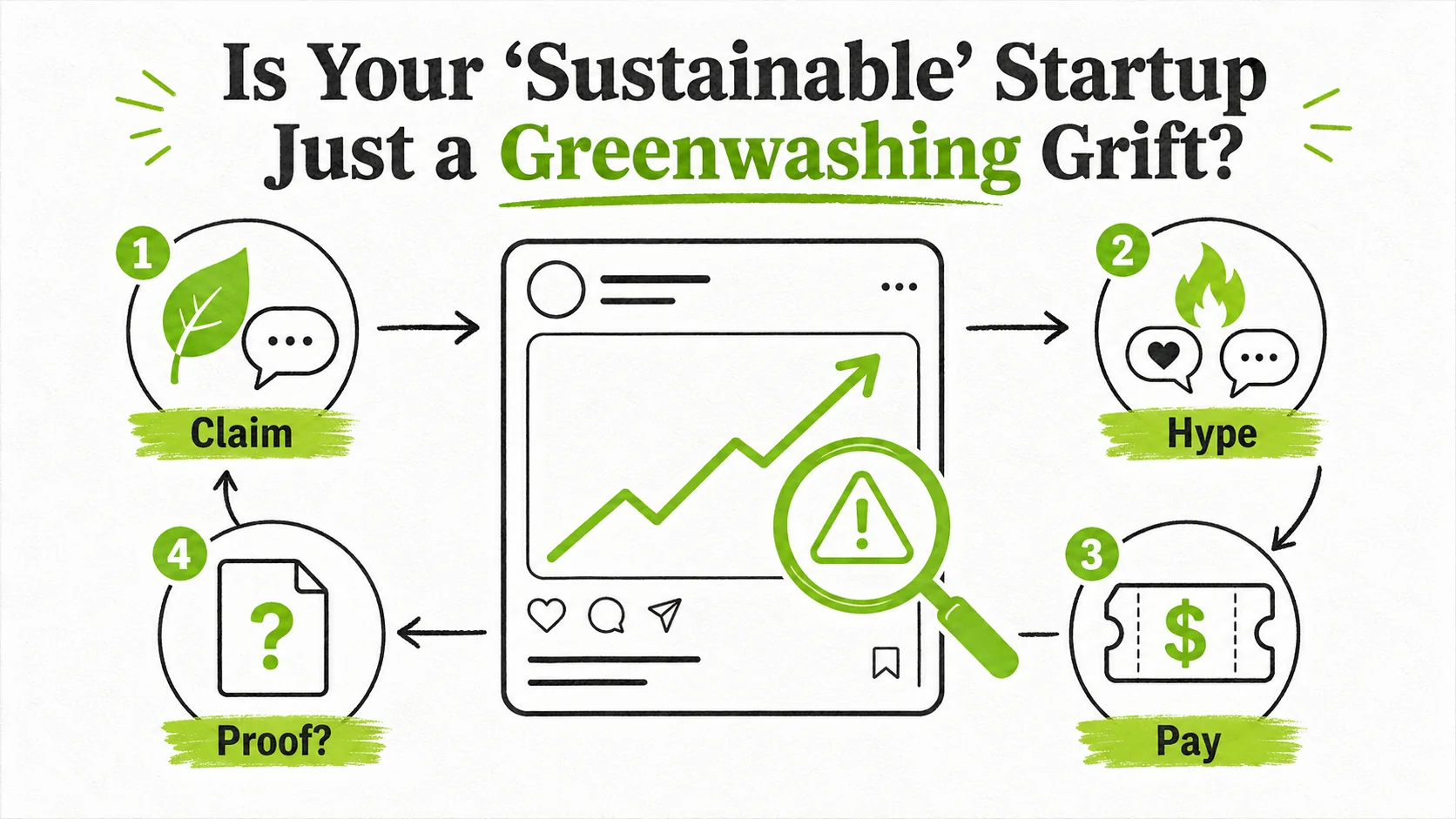
You might think you're too smart for a pyramid scheme. You'd spot a fake revenue screenshot from a mile away. But what about a heartfelt post about saving the oceans, attached to a $2,500 "Ocean Impact Accelerator" that's really just a group Zoom call and a PDF? The emotional and psychological hooks here are different, and they exploit our best intentions.
This matters because the cost is multidimensional. It's not just losing money. It's the erosion of a critical movement.
The Regulatory Gray Zone is Their Playground
Traditional financial scams eventually attract the attention of the SEC or the FTC. Sustainability claims, especially from small startups or solo "advisors," exist in a murkier space. While the SEC has recently issued warnings about misleading ESG (Environmental, Social, and Governance) claims from funds, the wild west of social media "impact advisors" remains largely unpoliced. A March 2026 bulletin from the SEC's Office of Investor Education and Advocacy specifically warned about unregistered individuals using "ESG and sustainability terminology to promote investment opportunities without providing adequate verification." The eco-grifter operates in this gap, using moral language as a regulatory deflector shield.
They Weaponize Your Guilt and Hope
The climate crisis is real, and the anxiety is pervasive. Many people, especially aspiring entrepreneurs, feel a profound desire to "do something" that aligns profit with purpose. The eco-grifter offers a seductive shortcut: buy into their system, and you can achieve financial success without being part of the problem. You can have your cake and eat it too, guilt-free. This preys on a deep-seated cognitive dissonance. It's far more emotionally compelling than a promise of a Lamborghini, making rational scrutiny harder to apply. You're not just evaluating a business opportunity; you're evaluating a chance to align your identity with your values.
The Damage is Collective
When a crypto scam collapses, the victims lose money. When an eco-grifter is exposed, everyone loses. It creates cynicism. It leads to headlines like "All Sustainable Investing is a Scam," which harms legitimate funds deploying billions into renewable energy and sustainable agriculture. It creates "impact fatigue" among consumers and investors, making them distrustful of all green claims. This dilution and distrust is perhaps the most insidious consequence. It's why learning to spot fake gurus and their alternatives is no longer a niche skill for online business newbies; it's a necessary defense mechanism for anyone who cares about channeling resources toward real solutions. The same psychological machinery powering eco-grifts also fuels philanthropy pivot scams, where exposed gurus suddenly "give back" to rehabilitate their brands.
The fallout isn't abstract. It means real green technologies struggle for funding because capital is siphoned into "impact coaching" schemes. It means well-intentioned people waste years following a guru's advice only to find their "regenerative brand" has no market beyond other people in the same guru's funnel. The personal financial loss is compounded by a profound sense of ethical betrayal. This is why the tools you need go beyond general skepticism; you need a specific methodology for deconstructing the green facade.
How to Spot and Deconstruct a Greenwashing Grift
Start with revenue model analysis: if 80%+ of income comes from courses, masterminds, or coaching rather than a tangible product or service, it's a meta-business. Cross-check B Corp certification on B Lab's public directory, verify SBTi targets in their registry, and use Charity Navigator or GuideStar to audit any claimed nonprofit partnerships.
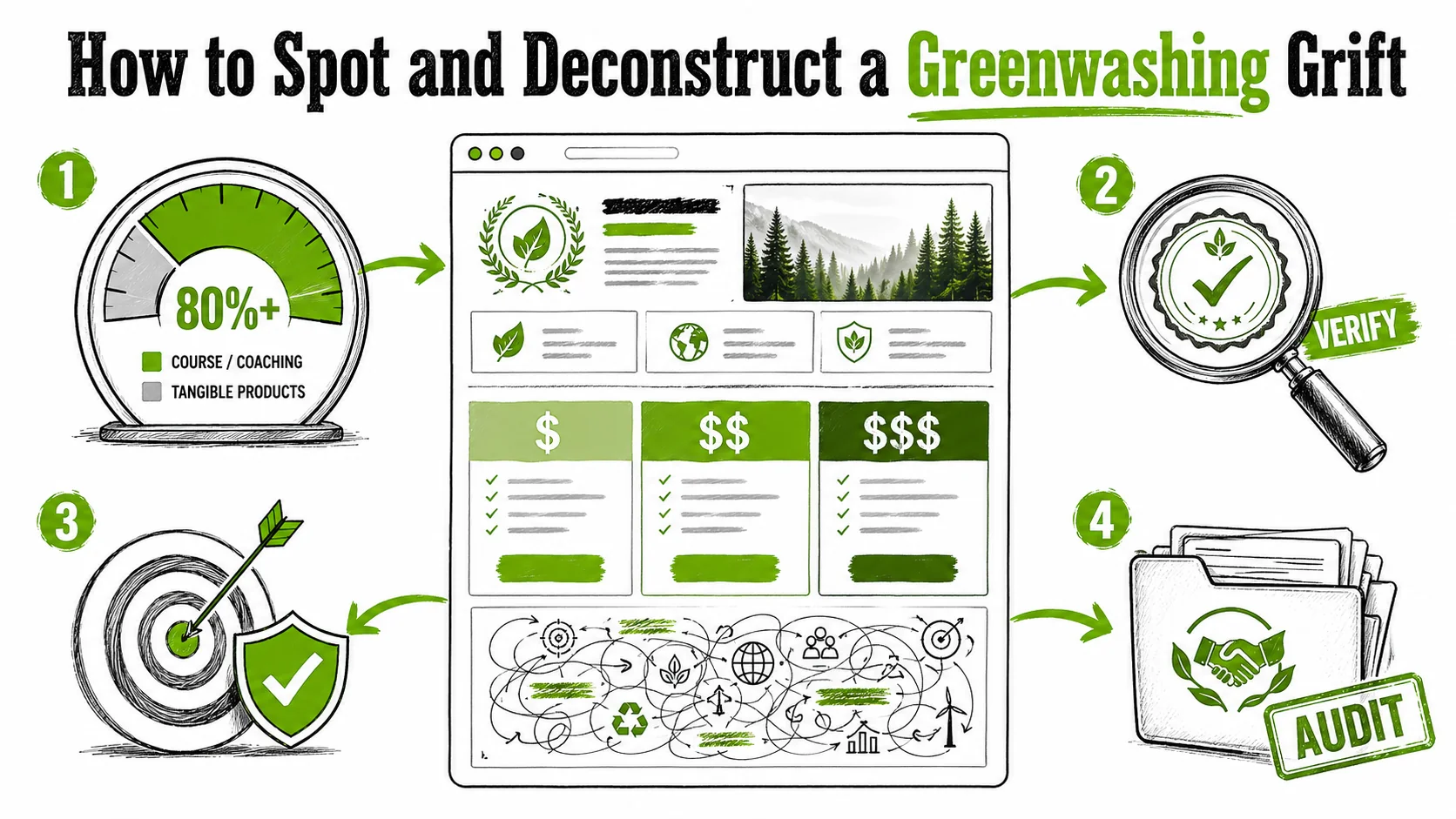
You don't need a degree in environmental science. You need a forensic mindset and a checklist. The eco-grifter's weakness is that their claims are a veneer. Scratch the surface, and the old larper patterns emerge. Here is a step-by-step method to perform your own due diligence.
Step 1: Interrogate the Revenue Model (Follow the Money)
This is the most revealing step. Ignore the "what" (sustainability) and examine the "how" (how do they make money?).
- Action: Look at their primary offer. What is the exchange? Are they selling:
* B. Access to their knowledge/community about impact? (e.g., a "Regenerative Business Blueprint" course, a "Climate Founder Mastermind," high-ticket coaching on "building an impact brand").
If the answer is overwhelmingly B, you have a major red flag. The business is meta. It's a business about talking about the business of doing good. Ask the next question: What verifiable impact have their students or clients created? Not how much money they made, but what measurable environmental or social good they achieved. If the only testimonials are about revenue or lifestyle, the grift is confirmed.
This is where the skills from our guide on spotting fake revenue screenshots and larper metrics become directly applicable. The same Photoshop skills that fake a Stripe dashboard can fake a "carbon tonnes saved" dashboard. Demand context, methodology, and be deeply skeptical of any metric that isn't tied to a sale of a real product or service. The FTC's Green Guides (16 CFR Part 260) specifically prohibit unqualified "carbon neutral" and "eco-friendly" claims without substantiation, yet enforcement against solo operators remains nearly nonexistent.
Step 2: Demand Specificity Over Slogans
Buzzwords are the grifter's currency. Your job is to demand they be converted into concrete facts.
- Action: When you see a claim like "carbon-neutral operations" or "climate-positive supply chain," ask these specific questions, either directly or in your own research:
2. "What are the boundaries of your assessment?" Did they measure just their office electricity (Scope 2) or did they include employee commuting, server emissions, and manufacturing (Scope 3)? A claim of "carbon neutral" that excludes Scope 3 is like claiming you're on a diet but not counting calories from drinks.
3. "Can you share the report or a summary?" Legitimate entities often have a dedicated "Impact" or "ESG" section on their website with downloadable reports. The Science Based Targets initiative (SBTi) provides a public registry of companies that have committed to and set verified science-based targets. Check if they're on it.
If the information isn't publicly available and they deflect or get defensive when asked, walk away. Opacity is a feature of the scam, not a bug.
Step 3: Audit Their "Proof" of Impact
Social proof for an eco-grifter is carefully curated. It's designed to impress, not inform.
- Action: Critically evaluate every piece of evidence they present.
* Partnerships: Do they name-drop NGOs or large corporations? Go to that partner's website or newsroom. Is the partnership announced there? Is it a meaningful collaboration, or just a one-time speaking gig they've rebranded as a "strategic partnership"?
Media Features: Are they "featured in Forbes"? Is it a Forbes Council* post (a paid, user-generated content platform) or a genuine article by a Forbes journalist? There's a world of difference.
* Data Visualizations: Be wary of beautiful, unsourced graphs. As with financials, any impact dashboard should be traceable. A good resource for understanding legitimate environmental accounting is the Global Reporting Initiative (GRI) Standards, which provide a framework for what credible reporting should include.
This process of verification is not cynical; it's professional. Real impact investors and partners do this as a matter of course. The same audit mindset applies to checking if a B Corp certification is just a marketing sticker. You should too.
Step 4: Analyze the Language of Transformation
Listen to how they sell. The classic guru transformation story has been eco-fied.
- Action: Look for these narrative patterns in their sales copy, social media, and webinars:
* The "Magical" Discovery: They didn't just find a marketing tactic; they had an "awakening," a "download," discovered "ancient wisdom blended with systems theory."
* The Vague, High-Minded Process: The solution is never a simple, replicable business tactic. It's a "philosophy," a "framework," a "consciousness." The steps are abstract: "Align with planetary cycles," "Lead from ecosystem consciousness."
* The "After" State: The promise isn't just a yacht. It's "purpose-driven wealth," "being paid to heal the planet," "legacy that matters." The financial and moral rewards are inextricably linked, making the offer feel priceless.
This language is designed to bypass your logical, analytical brain and speak directly to your identity and emotions. When you see this pattern, recognize it as a marketing formula, not a unique calling.
Step 5: Check for Real Operational Substance
Finally, look for signs of a real, functioning company versus a personal brand with a PayPal button.
- Action: Investigate these tangible elements:
* Physical Address & Legal Structure: Do they have a registered business address (not a PO Box or virtual office)? Are they a registered LLC or Corp? This information is often in the website footer.
* Product/Service Details: For a product, are there technical specifications, ingredient lists, material sourcing policies? For a service, is there a detailed scope of work, client case studies with measurable outcomes?
* Investment & Grants: Have they raised venture capital from known impact funds? Have they won competitive grants from organizations like the National Science Foundation or the European Innovation Council? These entities perform rigorous due diligence. While not a guarantee, it's a significant credibility signal.
If the entire operation seems to exist only on Instagram, LinkedIn, and a Kajabi course page, you are almost certainly looking at a lifestyle business built on guru tactics, not a venture built to create systemic impact. This distinction is crucial for anyone navigating the modern hub of startup culture, where hype and reality are constantly blurred. If you want to verify a founder's team is even real, our guide on how to spot a synthetic team covers the forensic methods.
By systematically applying these five steps, you can peel back the green veneer and see the business model for what it truly is. It turns a feeling of vague suspicion into a clear, actionable audit.
Proven Strategies to Fortify Your Impact BS Detector
Prioritize mechanism over mission: genuine impact ventures reference GHG Protocol standards, Gold Standard or Verra VCS-verified carbon credits, and publish lifecycle assessments. If a founder's "proof" is testimonials about revenue rather than tonnes of CO2 reduced, acres preserved, or families served, the impact is marketing copy.
![Screenshot of a side-by-side comparison: On the left, a vague mission statement: "We empower communities for a regenerative tomorrow." On the right, a specific impact clause from a company's charter: "We allocate 5% of annual revenue to verified mangrove restoration via partner [Name of NGO], with public quarterly reports on trees planted and CO2 sequestered."](GENERATE_IMAGE: visual description for AI image generator)
Knowing how to spot a grift is defensive. The next level is developing a positive framework for evaluating genuine opportunity. This shifts you from a skeptic to a discerning participant. Here are advanced tactics to build your own impact intelligence.
Strategy 1: Prioritize "How" Over "What"
Everyone has a compelling "what" (save the oceans, end poverty, reverse climate change). The magic—and the proof—is in the "how."
- Tactic: When you encounter a new "impact" venture, immediately skip the hero story and the vision statement. Scroll straight to sections like "Our Technology," "Our Methodology," "Our Proof." If those sections don't exist, or are filled with more vision statements, that's your answer. A genuine venture is obsessed with its mechanism of change. They'll want to tell you about their proprietary enzyme, their distribution partnership with a major NGO, their peer-reviewed lifecycle analysis. The grift is obsessed with the founder's story and the customer's transformation. Train your brain to value mechanistic explanations over inspirational ones.
Strategy 2: Cultivate "Impact Literate" Skepticism
You don't need to be an expert, but you should know the basic landmarks of credible impact work. This literacy acts as a filter.
- Tactic: Familiarize yourself with a few key concepts and resources. For example:
* Understand that "biodegradable" is a meaningless term without context (timeframe, environment). "Compostable" is better, especially if it specifies "industrially compostable" and has a certification like BNQ or TÜV AUSTRIA's OK compost.
* Recognize that B Corp Certification is a rigorous, points-based assessment of a company's entire social and environmental performance. A high score (e.g., over 100) is a strong signal. The certificate is public on B Lab's site.
This basic literacy allows you to ask sharper questions. Instead of "Are you sustainable?" you can ask "Are you measuring your Scope 3 emissions, and do you have a SBTi-verified target to reduce them?"
Strategy 3: Apply the "Reverse Funnel" Test
Grifters use a funnel: attract with a broad, emotional message (save the planet), then narrow down to a high-ticket offer (buy my course). Reverse it.
Tactic: Start at the final offer—the $5,000 mastermind, the $10,000 consulting day. Then work backwards. Trace the logical and causal chain from that purchase to tangible, verifiable impact on the ground. Does paying $5,000 for a 12-week group program directly result in X tonnes of CO2 sequestered, Y acres of forest preserved, or Z families lifted out of poverty? If the chain is logical and they can provide evidence for each link (e.g., "We donate 20% of revenue to Project A, here is their impact report"), it's plausible. If the chain is "You'll learn to build a business that could have impact," or "You'll join a community of people who care* about impact," the link is broken. The impact is hypothetical and secondary to the primary transaction, which is payment for information and access.
Strategy 4: Seek Asymmetric Verification
Don't just take their word for it. Look for evidence that comes from a source that doesn't benefit from the sale.
- Tactic: Prioritize these forms of verification:
2. Academic or Research Institute Partnerships: Has their work been studied or validated by a university? Are their claims referenced in white papers or conference proceedings not authored by them?
3. Customer Reviews on Independent Platforms: Not testimonials on their site. Look for reviews on Google, Trustpilot, or industry-specific platforms where reviews can't be easily curated.
4. Investment from Rigorous Institutions: Money from a top-tier VC like Union Square Ventures or a dedicated impact fund like Generation Investment Management involves months of deep due diligence. It's not foolproof, but it's a strong filter.
This strategy moves you from evaluating their marketing to evaluating their reputation in the wider ecosystem. It's how you move from detecting a scam to identifying a legitimate player in the complex but crucial world of impact entrepreneurship.
The Real Cost of the Greenwashing Scam
Bloomberg Intelligence estimates the global ESG asset market hit $40 trillion in 2025, yet Morningstar reported that $13.3 billion flowed out of U.S. sustainable funds that same year amid greenwashing scandals. Every fake "impact founder" accelerates this capital flight from legitimate climate solutions.
The damage from a sustainable startup fraud is not just financial. It's systemic. I've watched this play out in real time. In 2024, I was pitched by a founder of a "plastic-negative" apparel brand. His deck was beautiful, full of images of clean oceans. His "proof" was a partnership with a cleanup NGO. Digging deeper, I found the "partnership" was a one-time $500 donation. His actual product was screen-printed polyester shipped from Bangladesh. He'd raised $250k from angel investors who loved his story. That's a quarter-million dollars that didn't go to a company actually solving the problem. According to the FTC's Consumer Sentinel Network, impostor scams—where someone pretends to be from a legitimate business—caused a median loss of $7,000 per report in 2024. The eco-grifter is just a specialized impostor, pretending to be from the future of ethical business.
The statistics around greenwashing are getting harder to ignore. A 2025 study by the European Commission found that 53% of environmental claims made by companies in the EU were "vague, misleading, or unfounded." In the US, the FTC's Green Guides are under review, partly because the current rules from 2012 are laughably inadequate for the current wave of "net-zero" and "regenerative" claims. The regulatory lag is the grifter's best friend. Every day they operate without scrutiny, they erode the market's trust a little more. This makes the work of eco-grifter detection not just prudent, but a civic duty for anyone in the startup ecosystem.
FAQ: Your Greenwashing Scam Questions, Answered
How can a small startup afford to prove its impact if audits are expensive?
This is a fair point, and it's where intent and transparency matter most. A genuine small startup might not afford a $50,000 third-party audit. But they can be radically transparent with what they can measure. They can share their energy bills, their supplier lists, their material sourcing policies. They can use free tools like the B Corp Impact Assessment to benchmark themselves, even if they don't certify yet. They can clearly state: "Here's what we measure now, here's how we do it, and here's our roadmap for more robust measurement as we grow." The red flag isn't the lack of a fancy report; it's the lack of any tangible, specific data paired with grandiose claims. Opacity at a small scale is a choice, not just a budget constraint.
What if the founder seems truly passionate and authentic? Can it still be a grift?
Absolutely. In fact, passionate authenticity is the grifter's most powerful tool. The line between a true believer who is misguided about their business model and a cynical operator is often blurry, even to them. Many eco-grifters start by genuinely wanting to make a difference. But when their "impact education" product doesn't translate to real-world change, they face a choice: pivot to a real model, or double down on marketing the feeling of impact. Most double down. The passion becomes a performance to sell more of the thing that isn't working. Judge the business mechanics, not the tears in the webinar.
Should I avoid all coaches, courses, or masterminds related to sustainability?
No. Education is vital. The key is to vet the educator's direct, personal track record of impact, separate from their teaching. Did they build and exit a company that actually cleaned up plastic from rivers? Did they lead sustainability at a Fortune 500 company and achieve verified reductions? Or is their entire credibility based on teaching others how to do what they themselves have not done? Look for practitioners who teach, not teachers who have never practiced. The content should be heavy on case studies (their own and others'), practical frameworks, and tool recommendations, and light on abstract philosophy and mindset jargon.
What's the single biggest mistake people make when evaluating a "sustainable" venture?
They outsource their judgment to aesthetics and emotion. The beautiful website with earth tones, the founder's heartfelt story about their awakening, the stirring video with soaring music—these are marketing deliverables. They are designed to create a feeling of trust and alignment. The biggest mistake is mistaking that manufactured feeling for due diligence. The antidote is to consciously separate the brand experience from the business evidence. Look at the legal structure, the team, the financial model, the measurement plan. If you find yourself thinking, "It just feels right," that's your cue to start looking at the numbers and the contracts instead.
Conclusion: Don't Get Played by the Performance
The rise of the eco-grifter is the natural evolution of the guru industrial complex. When the old dreams of Lamborghinis and private jets started to smell toxic, the grifters simply swapped the iconography. Now they sell Teslas and carbon credits. The psychological machinery is identical: manufacture desire, promise transformation, obscure the lack of real results. The greenwashing scam works because it hijacks our legitimate fear and our genuine hope. It's a parasite on the sustainability movement.
Protecting yourself isn't about becoming a jaded cynic. It's about becoming a smarter participant. Demand specificity. Follow the money. Value verification over vibes. The tools in this guide—from dissecting revenue models to applying the reverse funnel test—are your armor. Real impact work is hard, messy, and often unglamorous. It involves spreadsheets, supply chain audits, and difficult trade-offs. The grift offers a shortcut, a feel-good story without the hard work. That story is always a lie.
The stakes are too high to be fooled. Every dollar and every ounce of attention given to an eco-grifter is stolen from a solution that might actually work. Your skepticism is not a barrier to progress; it's a necessary filter for it. Learn to see the grift, so you can better support the real thing.
Ready to see past the green veneer?
Larpable - Detect or Create helps you dissect the modern playbook of manipulation, whether it's wrapped in crypto hype or sustainability buzzwords. Stop wondering if you're being sold a fantasy and start building the skills to tell the difference. Learn to protect your capital and your conscience.
Apprendre à Détecter | Analyze a Pitch | Guru Playbook Database
<!-- sister-projects-start -->
Other Doved Studio projects
Related tools from the same studio you might find useful:
- Ralphable: Generate structured Claude Code skills that iterate until pass/fail criteria are met.
- Doved Studio: Studio indie derrière cette app et une dizaine d'autres outils.
<!-- sister-projects-end -->