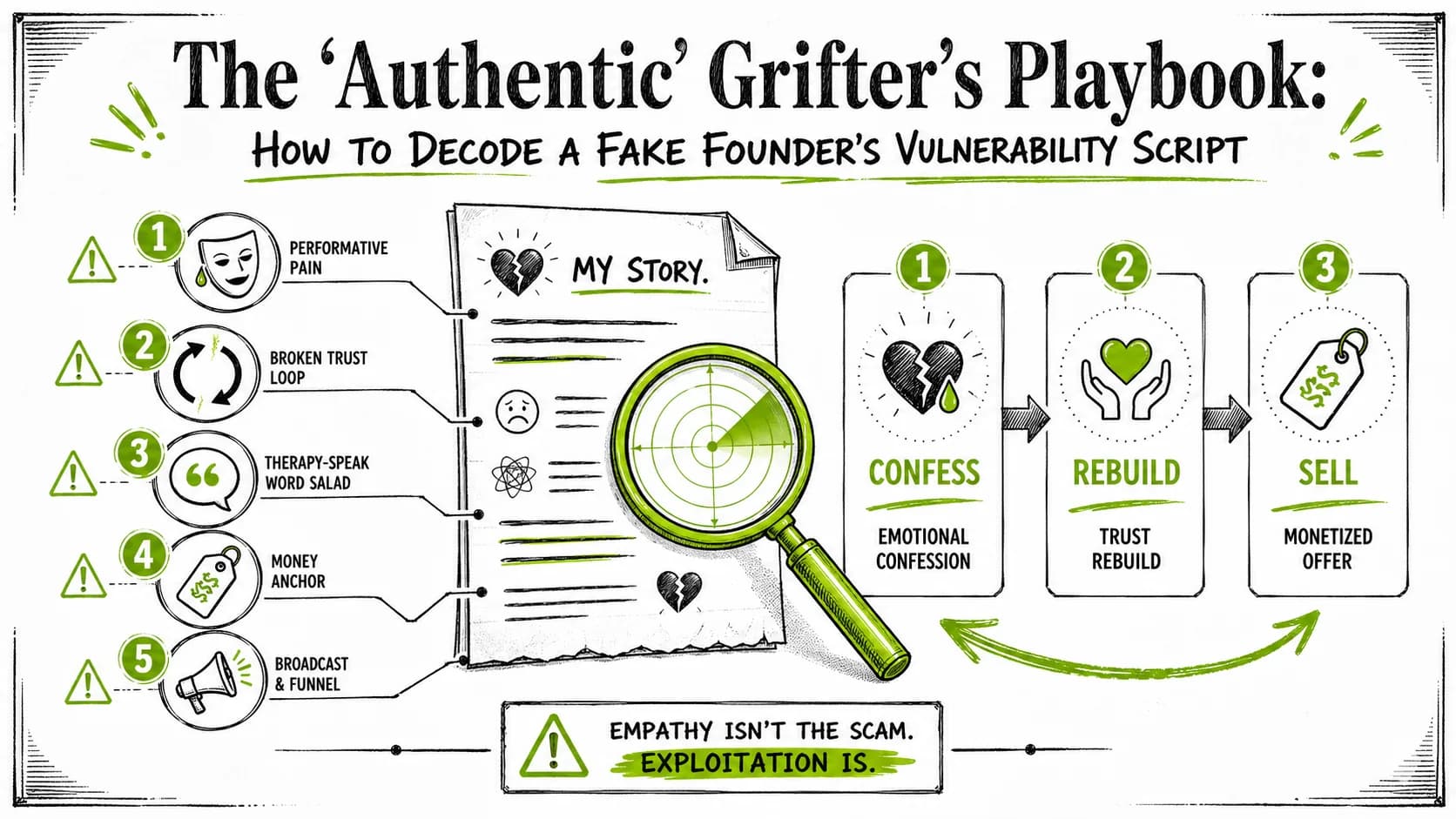
If you’ve scrolled through LinkedIn or Twitter lately, you’ve seen them. The posts are long, raw, and dripping with emotional resonance. A founder, once the picture of polished success, confesses to a catastrophic failure. They talk about burnout, betrayal, losing everything, and the dark night of the soul. The comments are a chorus of “So brave,” “Thank you for your vulnerability,” and “This is what real leadership looks like.”
Then, two weeks later, they launch a “heart-led” mastermind, a “resilience rebrand” course, or a $5,000 coaching program on “authentic leadership.” The trauma has a price tag. Welcome to the latest, most insidious pivot in the guru playbook: performative vulnerability.
Industry watchdogs have dubbed this the “Trauma-to-Traction” pipeline. It’s a cynical, calculated rebrand of the classic scam, now wrapped in the language of therapy and emotional intelligence. It’s no longer about flaunting private jets; it’s about flaunting your therapist’s bills. The currency has shifted from wealth-signaling to trauma-signaling.
This article is your decoder ring. We’ll dissect the script, expose the five red flags of a fake founder’s vulnerability play, and teach you to spot the difference between a human being navigating a genuine struggle and a grifter executing a guru rebrand strategy.
From Lambos to Laments: The Evolution of the Grift
To understand this new script, we need to see it as an evolution. The old model was simple: Aspirational Fraud.
This isn’t accidental. It’s a direct response to market forces. A 2025 study from the Center for Media Engagement found that content framed around “struggle and redemption” receives 300% more engagement and is perceived as 47% more trustworthy than traditional success storytelling. Grifters aren’t artists; they are ruthless A/B testers. They’ve found a new winning formula.
The 5-Point Vulnerability Script: Dissecting the Grift
Every compelling story has a structure. The fake founder’s vulnerability post is no different. Here’s the five-act play they’re all following.
Act 1: The Fall from Grace (The "I Had It All" Setup)
The post must establish former glory. This isn’t humility; it’s credentialing.
- The Hook: “Two years ago, I sold my company for 8 figures.”
- The Imagery: Mentions of team size, revenue milestones, media features.
Red Flag #1: The Details are Vague but the Numbers are Specific. They’ll say “an 8-figure exit” but never name the acquirer. They’ll talk about “a team of 50” but you can’t find a single former employee on LinkedIn. The grandeur is asserted, not evidenced.
Act 2: The Catalytic Crisis (The "Everything Fell Apart" Twist)
This is the emotional core. The crisis is always externalized and catastrophic.
- Common Tropes: A co-founder’s betrayal, a sudden regulatory change, a “health scare” (often mental health: burnout, depression, anxiety), losing a major client that was “90% of revenue.”
- The Language: Heavily therapeutic. “I was confronted with my shadow self.” “The universe forced a reckoning.” “My body finally said no.”
- The Purpose: To create maximum empathy and relatability. Everyone has faced betrayal or stress. This act bonds the audience to the narrator through shared pain.
Red Flag #2: The Crisis is a Monolithic, Unpreventable Event. In real business, failure is usually a slow leak, a series of small missteps. In the grift script, it’s a single, dramatic lightning bolt. This serves two purposes: it absolves the founder of nuanced responsibility, and it makes for a cleaner, more cinematic story.
Act 3: The Dark Night of the Soul (The "Raw" Performance)
This is the “vulnerability” payload. Long paragraphs about despair.
- Key Phrases: “I sat in my car and cried for an hour.” “I didn’t get out of bed for a week.” “I looked in the mirror and didn’t recognize the person staring back.”
- The Performance: This section is often the longest. It’s designed for screenshotting and sharing with captions like “THIS.”
- The Purpose: To prove “authenticity.” In a world of curated highlights, pain is the ultimate truth signal. Or so they want you to believe.
Red Flag #3: The Emotion is Generic and Aestheticized. The description of pain feels like it’s from a movie, not a life. It uses well-worn clichés (“dark night of the soul,” “abyss”) rather than specific, messy, un-poetic details. Compare “I felt a profound emptiness” with “I ate peanut butter straight from the jar for three days while ignoring 72 unread emails from my lawyer.” One is a performance; the other is a human being.
Act 4: The Epiphany & Toolkit (The "What I Learned" Pivot)
The turn. The lightbulb moment. And crucially, the framing of the solution as a system.
- The Shift: “And then I realized… my worth wasn’t tied to my valuation.” “I discovered these 3 frameworks for resilient leadership.”
- The Framing: Their personal journey is retrofitted into a teachable methodology. The pain had a purpose: to create intellectual property.
- The Purpose: To transition from “sympathy story” to “expert with unique insight.” The crisis is no longer a tragedy; it’s R&D for their next product.
Red Flag #4: The Solution is Immediately Commercializable. The “lesson” just happens to perfectly align with a high-ticket offering they are about to launch. The epiphany about “boundaries” leads to a Boundaries for Billionaires workshop. The realization about “purpose” morphs into a Purpose-Finding Accelerator. The timing is always suspect.
Act 5: The New Mission & Soft Launch (The "Call to Community")
The final act. The grift reveals itself, dressed as a calling.
- The Pitch: “This journey was so transformative, I feel compelled to guide others.” “I’m building a new kind of community for wounded leaders.”
- The Ask: It’s never a direct “BUY MY COURSE.” It’s “Join the waitlist for my free webinar on healing your founder trauma.” “DM me the word ‘RESILIENT’ for a special guide.” The sales funnel is cloaked in solidarity.
- The Purpose: To monetize the trust and empathy built in Acts 1-4. The vulnerability was the lead magnet.
Red Flag #5: The Narrative Arc is Too Perfect. Real recovery is non-linear, messy, and private. The grift narrative is a perfect three-act structure: Fall, Suffer, Rise & Teach. It’s packaged. If it feels like a hero’s journey crafted for a TED Talk, it probably was.
Performative vs. Genuine: A Side-by-Side Comparison
How can you tell the difference in real time? Use this cheat sheet.
| Characteristic | Performative Vulnerability (The Grift) | Genuine Vulnerability (The Human) |
|---|---|---|
| Timing | Often precedes a product launch (2-4 weeks before). Clustered after public exposure or criticism. | Unpredictable, often shared in retrospect (months or years later). |
| Focus | On the story and the lesson. The pain is a plot device. | On the feeling and the uncertainty. The lesson may not be clear yet. |
| Specificity | Uses generic, aesthetic language (“abyss,” “shadow work”). | Uses specific, mundane, sometimes embarrassing details. |
| Responsibility | Failure is caused by a villain (betrayer, market) or vague forces (“the universe”). | Acknowledges personal missteps, blind spots, and their own role in the downfall. |
| The “Fix” | Has a neat, packaged framework ready to sell. The solution is clear and complete. | Expresses ongoing struggle, therapy, small daily practices. No grand solution is offered. |
| Audience Reaction | Comments are uniform praise: “King!” “So brave!” “Thank you for this gift!” | Comments are a mix of support, shared stories, and practical advice. It starts a conversation, not a parade. |
The Psychological Engine: Why This Works So Well
This emotional manipulation marketing is effective because it hijacks our best instincts.
How to Protect Yourself: The Detector's Toolkit
You don’t need to become cynical, just discerning. Here’s your action plan.
The ultimate skill is learning to separate the signal of real human experience from the noise of founder authenticity scam marketing. This is precisely why we built the tools at Larpable—to move beyond gut feeling and into pattern recognition. If you want to systematically develop this skill, start by learning our core frameworks for Apprendre à Détecter the subtle signs of inauthenticity.
The Bigger Picture: What Happens When Trauma Becomes a Trend?
This trend is corrosive. It commodifies genuine mental health struggles. It creates a perverse incentive for people to mine their pain for content. It trains audiences to become amateur therapists, rewarding the most dramatic performance rather than the most substantive work.
The antidote isn’t to stop sharing struggles. It’s to raise the standard for what we consider authentic. Real vulnerability invites connection, not conversion. It sits with uncertainty, doesn’t rush to package it. It’s a quiet conversation, not a stadium speech.
As you navigate the complex world of modern entrepreneurship, remember that the most valuable thing you can cultivate is your own discernment. For more on navigating this landscape with your eyes open, explore our broader resources on entrepreneurship.
FAQ: Performative Vulnerability & Founder Grifts
What's the difference between a founder sharing a real setback and one doing performative vulnerability?
The core difference is intent and packaging. A founder sharing a real setback is communicating an experience, often with messy details, unresolved feelings, and without a clear “lesson” to sell. The focus is on the experience itself. Performative vulnerability is a strategic communication tool. The experience is packaged into a clean narrative arc (fall, suffering, epiphany, new mission) designed specifically to rebuild trust and create a marketing platform for a future sale. The pain is a means to an end.
Why are so many fake gurus pivoting to this "authenticity" strategy?
Because their old strategy—flaunting fake wealth—stopped working. Audiences became skeptical of Lamborghini photos and revenue screenshots. Trust evaporated. Performative vulnerability is a more sophisticated, defensible form of trust-building. It’s harder to fact-check someone’s emotional pain than their bank statement. Furthermore, it taps into a powerful cultural moment that values mental health and authenticity, allowing grifters to weaponize those very values against their audience.
I saw a founder post a very vulnerable story and then launch a course. Does that automatically make them a grifter?
Not automatically, but it should trigger your discernment radar. The key is to examine the timeline, the narrative, and the nature of the offer. Was the post part of a clear, pre-planned campaign leading to the launch? Is the course a direct, literal packaging of the “lesson” from their story? Does the story feel generic or strikingly specific? A genuine person might eventually create something informed by their experience, but there’s usually time, reflection, and a less direct, transactional link between the personal post and the professional offer.
How can I support founders who are being genuinely vulnerable without getting manipulated?
Support the process, not just the performance. Instead of commenting “So brave!”, ask thoughtful questions that encourage nuance: “What was the hardest part of that decision?” or “How are you navigating that now?” Genuine sharers will engage with these questions. Be wary of stories that seem designed to shut down conversation with their sheer, perfect resonance. Also, judge them by their long-term actions and the substance of their work, not by the emotional impact of a single post.
Is all personal storytelling by entrepreneurs now suspect?
No, and it shouldn’t be. Personal storytelling is a powerful way to connect, teach, and build community. The goal isn’t cynicism; it’s critical empathy. Enjoy the stories, but maintain a layer of analysis. Ask yourself: “What is this story trying to make me feel? What action does it want me to take? Does this feel like a human sharing, or a brand positioning?” You can appreciate a well-told story while still analyzing its underlying framework.
Where can I learn more about the patterns and tactics of fake gurus?
You’re in the right place. We delve deep into these patterns at Larpable. For a comprehensive overview of the modern guru landscape and their tactics, start with our detailed guide: The 2026 Guide to Spotting Fake Gurus & Your Alternatives to Getting Scammed. It will give you a solid foundation in the broader ecosystem of which performative vulnerability is just the latest, most sophisticated tactic.
<!-- sister-projects-start -->
Other Doved Studio projects
Related tools from the same studio you might find useful:
- Ralphable: Generate structured Claude Code skills that iterate until pass/fail criteria are met.
- Doved Studio: Studio indie derrière cette app et une dizaine d'autres outils.
<!-- sister-projects-end -->