How to Spot a Fake Revenue Screenshot (Complete Guide 2026)
Introduction
In the digital economy, the revenue screenshot has become a powerful symbol of legitimacy. These images, shared across social media, are used to sell dreams, build authority, and attract followers. But a dangerous parallel has emerged: the widespread fabrication of this "proof."
This guide is your protective manual. It exists for one purpose: to help you recognize deception so you don't fall for it. We analyze the common patterns used by individuals creating false narratives of success, often to sell courses, coaching, or a lifestyle. By understanding their tactics, you inoculate yourself against them.
At Larpable, our mission is purely educational. We run a free demo tool that shows, in under 30 seconds, how trivially easy it is to create a fake but convincing revenue screenshot. It features a permanent watermark—a constant reminder that if you can generate this, so can anyone trying to impress you online.
In this guide, you will learn:
- The seven most common patterns that expose a fabricated revenue claim.
- How to question the context surrounding a screenshot, not just the image.
- The narrative red flags that often accompany these fakes.
- A practical checklist to safeguard your trust and your wallet.
This isn't about cynicism; it's about developing critical literacy in an online world where perception is often carefully manufactured.
The 7 Telltale Signs of a Fake Revenue Screenshot
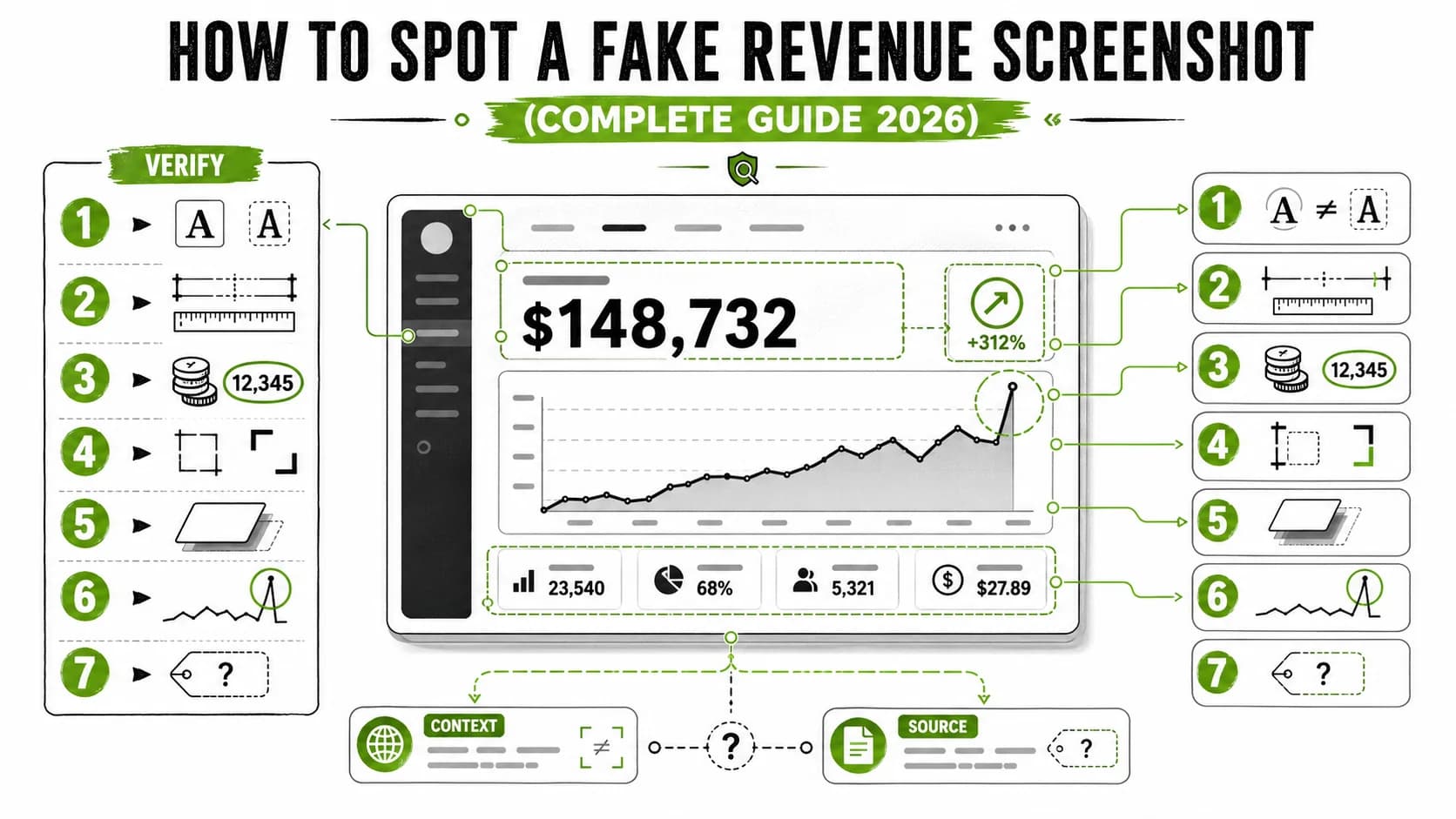
Modern fabrications are designed to pass a casual glance. However, consistent, recognizable patterns betray their artificial nature. Learn these signs to protect yourself.
Sign 1: Suspiciously Round Numbers
What to Look For: Revenue figures that are improbably neat, like "$10,000.00" or "$50,000 MRR."
Why It's a Red Flag: Real business revenue is messy. It includes refunds for odd amounts, prorated subscriptions, taxes, and failed payments. The result is almost never a perfect, round number. Fabricators use round numbers because they are symbolic milestones—clean, memorable, and aspirational. They serve a narrative, not reality.
Protective Question: "Is this number a clean symbol for a story, or does it look like the result of actual, messy transactions?"
Sign 2: The Impossibly Perfect Growth Curve
What to Look For: A growth chart that is a perfectly smooth, exponential line from zero to hero, with no dips, plateaus, or weekly fluctuations.
Why It's a Red Flag: No real business grows in a flawless, straight line. Real growth has wiggles, pauses, and setbacks. This pattern reveals a fundamental misunderstanding of business—or a deliberate fabrication of an ideal. It's a projection of hope, not a record of experience.
Protective Question: "Does this graph look like a real, chaotic business journey, or a calculated fantasy?"
Sign 3: Missing or Incorrect Platform Details
What to Look For: A generic-looking "dashboard" that lacks the specific quirks of the platform it claims to be from (Stripe, Shopify, etc.).
Why It's a Red Flag: Each platform has a distinct fingerprint. Fabricators often create a generic idea of a dashboard. Key things to notice:
- Stripe always shows a specific date range (like "Last 7 days"), not just a huge "All Time" total.
- Currency is formatted in a platform-specific way.
- Real dashboards show related metrics (payouts, active customers), not just one big, isolated number.
- The fonts, spacing, and colors should match the real platform's design.
Protective Action: Familiarize yourself with what real dashboards look like. A quick Google Image search for "real Stripe dashboard" can be enlightening.
Sign 4: The Overly Convenient Timing
What to Look For: The screenshot is published at a moment of maximum narrative impact, perfectly timed with a product launch, a viral thread, or a "I quit my job" announcement.
Why It's a Red Flag: In these schemes, the screenshot is a plot device, not a transparent update. Its publication is a piece of content marketing designed to build authority or sell something else. The timing feels too perfect, too aligned with a personal or promotional milestone.
Protective Question: "What is this person trying to sell or promote right now? Is this screenshot being used as a prop for that sale?"
Sign 5: The Ghost Product
What to Look For: Constant revenue claims paired with a complete absence of a demonstrable, tangible product or service.
Why It's a Red Flag: This is the ultimate decoupling. The individual talks endlessly about their "success" but never shows the actual thing that supposedly generates it. There's no live website, no demo video, no independent user reviews, no evidence of development. Often, the real product is the course, coaching, or community built on the back of the fabricated success story.
Protective Action: Ask, "Can I see, try, or independently verify the actual product?" If the answer is vague or leads to another sales page, be extremely skeptical.
Sign 6: The Engagement Discrepancy
What to Look For: A massive claim ("$100k MRR") that doesn't match the observable digital footprint of the business.
Why It's a Red Flag: Real traction leaves traces. A business of that size would have some correlating evidence. Look for mismatches like:
- Massive revenue claims but only a handful of likes/comments on product-related posts.
- Thousands of "customers" but no verifiable testimonials.
- A huge Twitter following that only engages with their motivational content, not their product.
- Minimal web traffic or app store reviews.
Protective Analysis: Cross-reference. The claim should be supported by other public, observable data. If it exists in a vacuum, it likely is a vacuum.
Sign 7: Visual & Contextual Inconsistencies
What to Look For: Subtle visual glitches in the image, or a story that doesn't add up when you think about it.
Why It's a Red Flag: Even good fakes can have tells. These can be technical (weird pixelation around numbers, font mismatches) or logical.
- Logical Tells: Claiming a B2B SaaS has no revenue dip over the holidays, or that a brand-new product got 100 enterprise signups in a week.
- Narrative Tells: The story changes, dates don't line up, or the "how" is always vague and non-replicable.
Protective Mindset: Adopt a detective's curiosity. Does everything fit together, or does it only work if you don't think too hard?
Why This Matters: Protecting Aspiring Entrepreneurs
Believing fabricated claims can be harmful. It sets impossible expectations, leads to wasted time and money chasing fictional strategies, and can foster disillusionment. The goal of this guide is to empower you with pattern recognition, so you can:
- Invest wisely: Spend your money on real education, not fairy tales.
- Manage expectations: Understand that real business is messy and hard.
- Identify true mentors: Find genuine guides, not performers.
How to Verify Claims (A Skeptic's Toolkit)
When you see an impressive claim, don't just admire it—investigate it.
Case Studies: Recognizing the Patterns
Pattern A: The "I Just Hit [Round Number]" Launch
- The Story: "After 3 months, we just hit $10,000 MRR! Here's what we did..."
- The Tells: The screenshot shows exactly $10,000.00. The product link leads to a vague landing page. The user's previous posts are all about "mindset," not product development. The primary call-to-action is to join their "founder's circle" Discord.
- The Protection: Recognize the round number, the ghost product, and the pivot to selling community access.
Pattern B: The Viral Thread Coincidence
- The Story: A thread on marketing goes viral. Two days later, the author posts a revenue graph with a massive, immediate spike.
- The Tells: The spike is vertical, implying instant paid conversions. In reality, sales cycles and trial periods create a lag. The timing is too perfect, using the thread's virality to add false credibility to the revenue claim.
- The Protection: Understand business basics. Real revenue from content takes time to materialize. Instant spikes are narrative devices.
Your Red Flag Checklist
Use this list when you encounter impressive claims:
- [ ] Is the revenue number a suspiciously perfect, round figure?
- [ ] Is the growth graph impossibly smooth?
- [ ] Does the screenshot look generic, missing key platform UI elements?
- [ ] Was it posted at a "perfect" time for a personal or promotional narrative?
- [ ] Can I easily find, see, or try the actual product being discussed?
- [ ] Is there a mismatch between the huge claim and the social/web traction?
- [ ] Does the overall story feel too good to be true?
FAQ
Why do people create fake revenue screenshots?
Primarily for financial gain and social authority. A compelling success story is used to build an audience that can then be monetized through courses, coaching, paid communities, and sponsorships. The performance of success becomes the business model.
How do I learn more about spotting fake entrepreneurs?
Explore our FREE Pattern Recognition Guides to see detailed breakdowns of each fake entrepreneur archetype. Understanding their playbooks helps you spot the patterns instantly.
What should I do if I think someone is using fakes to scam people?
Do not engage publicly, as this often leads to unproductive drama. Instead, protect yourself and others by muting/unfollowing the source. Share educational resources (like this guide) to help friends recognize the patterns. You can also anonymously submit patterns to our research archive to help us document tactics.
Has AI made this worse?
Yes. AI can now generate flawless, photorealistic fake dashboards in seconds. This makes our mission more critical. Since you can no longer trust the image itself, you must become an expert in trusting the context: the product, the timeline, the corroborating evidence, and the person's overall behavior.
How can I learn more?
Explore our free library of resources breaking down common online deception patterns. Knowledge is your best defense.
Conclusion: Building Your Immunity
The ability to spot a fake revenue screenshot is a form of digital self-defense. The patterns are now clear: the symbolic round numbers, the fantasy growth charts, the missing products, and the perfectly timed narratives.
The most powerful realization is that creating the illusion of success is often easier than building the reality of it. That's why these patterns are so prevalent.
Call to Action: We invite you to experience this firsthand. Visit Larpable.com and use our free educational demo. Create a fake "$50,000 MRR" screenshot in 30 seconds and see the permanent watermark applied. Let that experience be your vaccination. The next time you see a dazzling revenue claim, you'll have the critical skills to ask the right questions and protect yourself from deception.
Share this guide to help others build their immunity. In the modern digital landscape, healthy skepticism isn't negativity—it's essential armor.
<!-- sister-projects-start -->
Other Doved Studio projects
Related tools from the same studio you might find useful:
- Ralphable: Generate structured Claude Code skills that iterate until pass/fail criteria are met.
- Doved Studio: Studio indie derrière cette app et une dizaine d'autres outils.
<!-- sister-projects-end -->