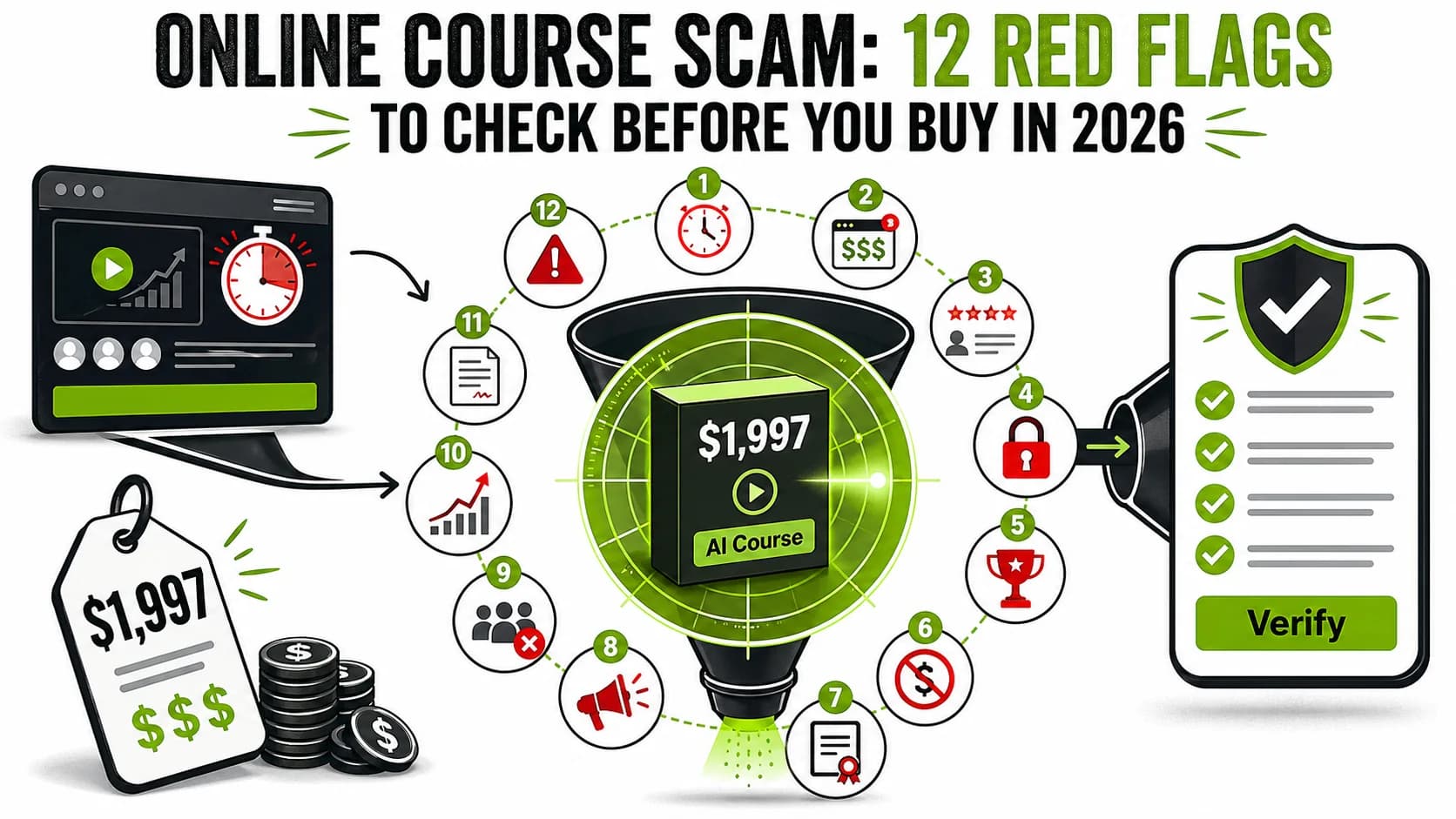
Someone is about to spend $1,997 on a course called "AI Agency Mastery 3.0" because a stranger on Instagram posted a Stripe screenshot showing $147,000 in monthly revenue. The countdown timer says there are only 6 spots left. The testimonials are glowing. The webinar was "free" but lasted 90 minutes and ended with a hard pitch. Everything about this funnel is engineered to bypass rational thought, and it works. According to the Federal Trade Commission, consumers reported losing over $770 million to business opportunity and education scams in 2025 alone, a 38% increase from the previous year. The online course scam has become one of the most scalable fraud vehicles on the internet.
I have spent eight years analyzing these operations. I have purchased over 40 courses ranging from $47 to $5,000, dissected their funnels, reverse-engineered their marketing, and documented the patterns. What I found is depressingly consistent: the same twelve red flags appear in roughly 90% of fraudulent courses. This checklist is your inoculation.
Why Online Course Scams Are Exploding in 2026
The economics are irresistible for grifters. Launching a course costs virtually nothing. A landing page builder runs $29 per month. Video hosting is free. Payment processing takes a 3% cut. The entire infrastructure to sell a $2,000 product to thousands of people can be assembled in a weekend. No inventory. No shipping. No regulation.
Three forces have accelerated this in 2026. First, generative AI has collapsed the content creation barrier. A single operator can now produce a 40-module video course in a week using AI-generated slides, synthetic voiceovers, and repurposed free content from YouTube. Second, the "AI agency" narrative has replaced dropshipping as the dominant get-rich-quick angle, creating a fresh wave of aspirational buyers who don't yet know the playbook. We documented this shift in detail in our piece on the 2026 AI guru scam playbook. Third, platform algorithms reward exactly the kind of flexing and lifestyle content that fake gurus use to build credibility, creating a perverse incentive loop where scammers are algorithmically amplified.
Research by Robert Cialdini, published in Influence: The Psychology of Persuasion, identified six principles of persuasion — reciprocity, commitment, social proof, authority, liking, and scarcity — that are systematically weaponized in course funnels. Every single red flag below maps to at least one of these principles. Understanding that framework is the difference between seeing a sales page and seeing a manipulation architecture.
The 12 Red Flags: Your Complete Online Course Scam Checklist
Red Flag 1: Unverifiable Income Screenshots
The cornerstone of the online course scam. Screenshots of Stripe dashboards, Shopify revenue panels, or bank statements are trivially easy to fabricate. Browser developer tools let anyone edit displayed numbers in under 30 seconds. I tested this myself — I changed a Stripe dashboard to show $892,000 in monthly recurring revenue, took a screenshot, and the result was indistinguishable from a real one.
What to check: Ask for a live screen share of analytics with a refresh. Request third-party verification through a CPA or accountant. If the creator refuses or deflects, that refusal is your answer. We built an entire toolkit for this in our guide to spotting fake revenue screenshots.
Red Flag 2: Countdown Timers and Fake Scarcity
"Only 7 spots left." "Price increases in 2 hours." "This cohort closes tonight." Open the page in an incognito window tomorrow. The timer will have reset. The spots will still be "almost gone." This is manufactured urgency — Cialdini's scarcity principle turned into a blunt instrument.
What to check: Visit the sales page across multiple days and browsers. Use the Wayback Machine at web.archive.org to check if the "limited time offer" has been running for months. Legitimate courses with genuine enrollment caps will show specific cohort dates, not perpetual countdown clocks.
Red Flag 3: Testimonials Without Verifiable Identities
"Sarah M. made $15,000 in her first month." No last name. No LinkedIn. No company. No way to verify. Fake guru red flags do not get more textbook than this. Legitimate programs proudly display full names, companies, and verifiable outcomes because real results are their best marketing.
What to check: Search the testimonial name and quote in Google with quotation marks. Reverse image search the headshot — stock photos and AI-generated faces are common. Check if the "student" has any social media presence that corroborates their success story. If five minutes of searching turns up nothing, the testimonial is likely fabricated.
Red Flag 4: The "Lifestyle First, Substance Never" Content Strategy
The creator's feed is 90% Lamborghinis, Bali villas, laptop-on-the-beach photos, and "mindset" platitudes. The remaining 10% is vague advice like "provide value" or "build systems." Zero specific, actionable, free content that demonstrates actual expertise. This pattern is a reliable fake guru red flag because legitimate experts give away their best insights to build trust; scammers hoard a vacuum behind a paywall.
What to check: Scroll through their last 50 posts. Count how many teach something specific and actionable versus how many show off a lifestyle. A ratio below 30% substance to lifestyle is a warning sign. As we explored in our analysis of why every fake guru now has a 'failed' startup, the lifestyle flex is often the entire product.
Red Flag 5: No Refund Policy or Hostile Refund Terms
"Due to the digital nature of this product, all sales are final." This is the escape hatch for an online course scam that knows its content cannot survive contact with an actual customer. Legitimate courses — MIT OpenCourseWare, Coursera, even Udemy — offer refund windows ranging from 7 to 30 days because they trust their product.
What to check: Read the refund policy before purchasing, not after. If it doesn't exist, or if it requires you to "prove you completed all modules and applied the teachings" before qualifying for a refund, walk away. That is not a refund policy; it is a hostage negotiation.
Red Flag 6: The Free Webinar Funnel With a Hard Close
A "free training" that is actually a 60-to-120 minute sales pitch disguised as education. The first 40 minutes deliver surface-level information available on any blog. The last 50 minutes are a high-pressure sales sequence featuring income testimonials, artificial urgency, disappearing bonuses, and emotional manipulation. The webinar format works because it triggers Cialdini's commitment principle — you have already invested 90 minutes, so saying no feels like wasting that investment.
What to check: If the "free webinar" requires your credit card on file, exit immediately. If it ends with a limited-time offer that expires "when this replay comes down," the replay will not come down. Test it yourself.
Red Flag 7: Vague or Recycled Curriculum
The sales page promises "proven frameworks" and "insider strategies" but the module list is suspiciously generic: "Module 1: Mindset," "Module 2: Finding Your Niche," "Module 3: Client Acquisition." These are chapter titles that could apply to any business in any decade. They tell you nothing specific.
What to check: Compare the curriculum against free resources. Search each module title on YouTube. If you can find equivalent or better content for free, the course is selling packaging, not knowledge. Legitimate courses specify exact tools, frameworks with names, case studies with details, and measurable outcomes per module.
Red Flag 8: The Upsell Ladder
You buy the $497 course and immediately discover it is a gateway to the $2,997 "accelerator," which is a gateway to the $10,000 "inner circle," which is a gateway to the $25,000 "mastermind." Each level claims to contain "the real secrets" that the previous level merely hinted at. This is the sunk cost fallacy weaponized. According to the Better Business Bureau's Scam Tracker, multi-tier course upsells account for a significant portion of education-related complaints, with median reported losses of $3,200 per victim in 2025.
What to check: Before buying any course, search "[course name] upsell" or "[creator name] inner circle price" on Reddit and review sites. If the product has a hidden upsell ladder, former students will have discussed it. A legitimate course delivers its full value in a single purchase.
Red Flag 9: The Guru Has No Verifiable Track Record Outside of Selling Courses
Here is the paradox at the heart of most fake guru operations: the only business they have successfully built is the business of telling you how to build a business. They have never run the agency they are teaching you to run. They have never scaled the e-commerce store they are selling you a blueprint for.
What to check: Search their name on LinkedIn. Check their work history. Look for evidence of the business they claim to have built — Crunchbase profiles, press coverage, employee reviews on Glassdoor, SimilarWeb traffic data. If their entire professional history is "coach" and "course creator," the expertise they are selling is theoretical, not experiential.
Red Flag 10: Private Community as the Core Deliverable
The course itself is thin. The real pitch is "access to our exclusive community of 5,000+ entrepreneurs." But that community is a Discord server or Facebook group where students ask basic questions that go unanswered, the guru posts motivational quotes once a week, and the most active members are affiliates recruiting new buyers.
What to check: Ask for a trial or guest access to the community before purchasing. If that is refused, search for screenshots or reviews of the community on Reddit, Trustpilot, or Twitter. We dissected this exact pattern in our investigation of ghost town communities behind paywalls.
Red Flag 11: Affiliate-Driven Testimonials
"This course changed my life!" — posted by someone whose bio contains an affiliate link to the same course. Affiliate programs are not inherently bad, but when the primary source of positive reviews comes from people financially incentivized to promote the product, you are reading marketing copy, not genuine feedback. A study from Harvard Business School found that incentivized online reviews are rated 0.38 stars higher than organic reviews on average, systematically inflating perceived quality.
What to check: Click through to the profiles of people leaving positive reviews. Check their bio, their recent posts, and their link in bio. If they are affiliates, their testimony is advertising. Weight it accordingly.
Red Flag 12: The Creator Has Been "Exposed" Before and Rebranded
This is the most reliable signal and the easiest to check. Many serial scammers operate under multiple brand names. They get exposed on YouTube by investigators like Coffeezilla or Spencer Cornelia, their reputation collapses, and they re-emerge six months later with a new course name, a new domain, and the same playbook.
What to check: Google "[creator name] scam," "[creator name] exposed," and "[creator name] complaint." Check the BBB Scam Tracker at bbb.org. Search their face on reverse image search to find previous identities. Use the Wayback Machine to see what their website looked like a year ago versus today. A legitimate pivot from a legitimate business looks different from a rebrand-to-escape-exposure. We covered this rebrand pipeline in detail in our piece on scamfluencer-to-scamfluencer-hunter pivots.
Legitimate Course vs. Scam Course: How to Tell the Difference
Not every online course is a scam. Many are genuinely excellent. Effective scam detection requires understanding the difference between a legitimate educator and a grifter. The distinction is not about price or topic — it is about transparency and verifiability. Here is how they compare across key dimensions.
- Refund policy: Legitimate courses offer 14-30 day no-questions-asked refunds. Scam courses offer no refunds, or refunds gated behind impossible completion requirements.
- Income claims: Legitimate courses either make no income claims or present them with clear disclaimers, sample sizes, and median outcomes. Scam courses show cherry-picked screenshots with no context, disclaimers, or verifiable data.
- Creator track record: Legitimate creators have verifiable professional histories — LinkedIn profiles, press coverage, former employers, or businesses you can independently confirm. Scam creators have no verifiable history outside of selling courses.
- Free content quality: Legitimate creators publish substantial free content that demonstrates deep expertise. Scam creators post lifestyle content and vague motivational platitudes.
- Community quality: Legitimate programs have active communities with moderation, expert responses, and genuine peer support. Scam programs have ghost-town Discords where the only active threads are affiliate recruitment.
- Sales tactics: Legitimate courses use clear pricing pages with no countdown timers or manufactured urgency. Scam courses use high-pressure webinars, fake scarcity, and disappearing bonuses.
- Curriculum specificity: Legitimate courses list specific tools, frameworks, case studies, and measurable outcomes per module. Scam courses list generic topics like "mindset" and "growth strategies."
How to Verify a Course Creator's Credentials
Verification takes 15 minutes and can save you thousands. Here is the step-by-step process I use before reviewing any course on this site.
Step 1: LinkedIn audit. Search the creator's name. Check their employment history, endorsements, and connections. A legitimate expert will have a work history that predates their course business. Red flag: the profile was created recently, has fewer than 100 connections, or lists only "CEO at [course brand]."
Step 2: BBB and FTC search. Visit bbb.org and search for the creator's business name. Check the FTC complaint database for enforcement actions. In 2025, the FTC brought 11 enforcement actions specifically against deceptive online education and business coaching programs.
Step 3: Wayback Machine. Go to web.archive.org and enter the creator's website URL. Check what they were selling one year ago, two years ago, five years ago. Frequent pivots between unrelated niches — crypto, dropshipping, SMMA, AI agency — suggest a serial trend-chaser, not a domain expert.
Step 4: Reverse image and content search. Upload their profile photo to Google Images or TinEye. Search key phrases from their testimonials in quotation marks. Fabricated identities and recycled testimonials will surface.
Step 5: Reddit and community search. Search "[course name] review" and "[creator name] scam" on Reddit, Trustpilot, and Twitter. Filter for negative reviews — they are more informative than positive ones, especially when they describe specific experiences rather than vague complaints.
What to Do If You Have Been Scammed
If you have already purchased a course that turned out to be fraudulent, you have options. Act quickly.
File a chargeback. Contact your credit card company and dispute the charge. Under the Fair Credit Billing Act, you have 60 days from the billing statement date to dispute. Describe the deceptive marketing practices — fabricated testimonials, unverifiable income claims, material misrepresentation. According to data from Visa's chargeback monitoring program, education-related chargebacks have a 62% success rate when accompanied by documented evidence of misleading marketing.
Report to the FTC. File a complaint at ReportFraud.ftc.gov. Your individual report joins a database that the FTC uses to identify patterns and build enforcement cases. The more complaints a specific operator receives, the higher the probability of regulatory action.
File a BBB complaint. Report the business at bbb.org/scamtracker. This creates a public record that helps future potential victims find warnings when they search the company name.
Document everything. Screenshot all sales pages, emails, webinar recordings, and promises made before and after purchase. These records are essential for chargebacks and regulatory complaints.
Warn others. Leave honest reviews on Reddit, Trustpilot, and any platform where the course is marketed. Your experience protects the next person. The scam economy relies on information asymmetry — every honest review degrades that asymmetry.
The Psychology Behind Why These Scams Work
Understanding the mechanism does not make you immune, but it makes you harder to fool. Every online course scam exploits the same cognitive vulnerabilities that psychologist Daniel Kahneman describes as System 1 thinking — fast, emotional, intuitive processing that bypasses deliberate analysis.
The income screenshot triggers aspirational identification: "that could be me." The countdown timer activates loss aversion: "I will miss out." The testimonials provide social proof: "others have succeeded." The webinar creates commitment: "I have already invested time." The lifestyle content builds authority: "this person has what I want." These are not random tactics. They are a precision-engineered sequence that mirrors Cialdini's influence framework with ruthless efficiency.
However, System 1 has a weakness that makes scam detection possible. It cannot maintain its grip once you slow down. The simple act of saying "I will decide tomorrow" collapses most scam funnels because their entire architecture depends on preventing exactly that pause. Every red flag in this checklist is a trigger for that pause. Print the list. Tape it to your monitor. Check it before you enter any payment information. The fifteen minutes it takes to run through these twelve points is the cheapest insurance you will ever buy against an online course scam.
Conclusion: The Checklist is Your Shield
The online course industry is worth $320 billion globally according to data from Research and Markets, and the vast majority of that value is legitimate. But the 2026 explosion in AI-generated content and zero-barrier course creation has created a golden age for scammers operating in the gap between aspiration and expertise. The twelve red flags in this checklist — unverifiable income, fake scarcity, anonymous testimonials, lifestyle-over-substance content, hostile refund policies, high-pressure webinars, vague curriculum, upsell ladders, no external track record, hollow communities, affiliate-driven reviews, and serial rebranding — are the fingerprints that fake guru operations leave on everything they touch.
You do not need to become cynical about online education. You need to become forensic. Verify before you trust. Check before you buy. And if something feels too good to be true while a timer counts down in the corner of your screen, close the tab. The real opportunity will still be there tomorrow. The scam will not.
For a broader framework on protecting yourself from the entire fake guru ecosystem, start with our complete 2026 guide to spotting fake gurus.
FAQ
Q: How common are online course scams in 2026?
The FTC received over 100,000 complaints related to business opportunity and education scams in 2025, with losses exceeding $770 million. The online course sector represents a growing share of these complaints as barriers to launching courses have dropped to near zero with AI content generation tools. The BBB Scam Tracker shows a 45% year-over-year increase in reports tagged as "online education" or "coaching" since 2024.
Q: Can I get a refund if I bought a scam course?
Yes, and you should pursue it through multiple channels simultaneously. File a chargeback with your credit card company within 60 days under the Fair Credit Billing Act. If you paid via PayPal, open a dispute through their Resolution Center. File an FTC complaint at ReportFraud.ftc.gov and a BBB complaint at bbb.org/scamtracker. Many victims recover partial or full amounts through credit card chargebacks, especially when they provide documented evidence of deceptive marketing practices.
Q: What is the difference between a bad course and a scam course?
A bad course delivers low-quality content but does not use deceptive marketing to sell it. The creator may be inexperienced or the material may be outdated, but the sales process was honest. A scam course, on the other hand, relies on fabricated income claims, fake testimonials, artificial urgency, and intentional misrepresentation of outcomes. The distinction is deceptive intent versus poor execution. Both are frustrating, but only one is fraud.
Q: Are all expensive courses scams?
No. Price alone does not indicate a scam. Legitimate high-ticket courses from accredited institutions, recognized industry experts, or established platforms can deliver substantial value. Executive education programs at Harvard Business School cost over $10,000 and are worth every dollar for the right participant. The red flags are unverifiable income claims, zero refund policies, and high-pressure tactics — not the price tag itself.
Q: How do I verify if a course creator is legitimate?
Follow the five-step process described in this article: audit their LinkedIn profile for verifiable employment history, search the BBB and FTC databases for complaints, use the Wayback Machine to check the consistency of their claims over time, run reverse image searches on their photos and testimonials, and search Reddit and Trustpilot for unfiltered reviews. If a creator passes all five checks, they are likely legitimate regardless of their marketing style.
Q: Should I trust course review sites?
Exercise caution. Many "review" sites for online courses are operated by affiliates who earn commissions on every sale they refer. The review is structurally biased toward positive recommendations because the reviewer profits from your purchase. Look for reviews that include specific criticisms, detailed module breakdowns, and comparisons to free alternatives. If every course on a review site gets 4 or 5 stars, the site is a marketing channel, not a review platform.
<!-- sister-projects-start -->
Other Doved Studio projects
Related tools from the same studio you might find useful:
- Ralphable: Generate structured Claude Code skills that iterate until pass/fail criteria are met.
- Doved Studio: Studio indie derrière cette app et une dizaine d'autres outils.
<!-- sister-projects-end -->