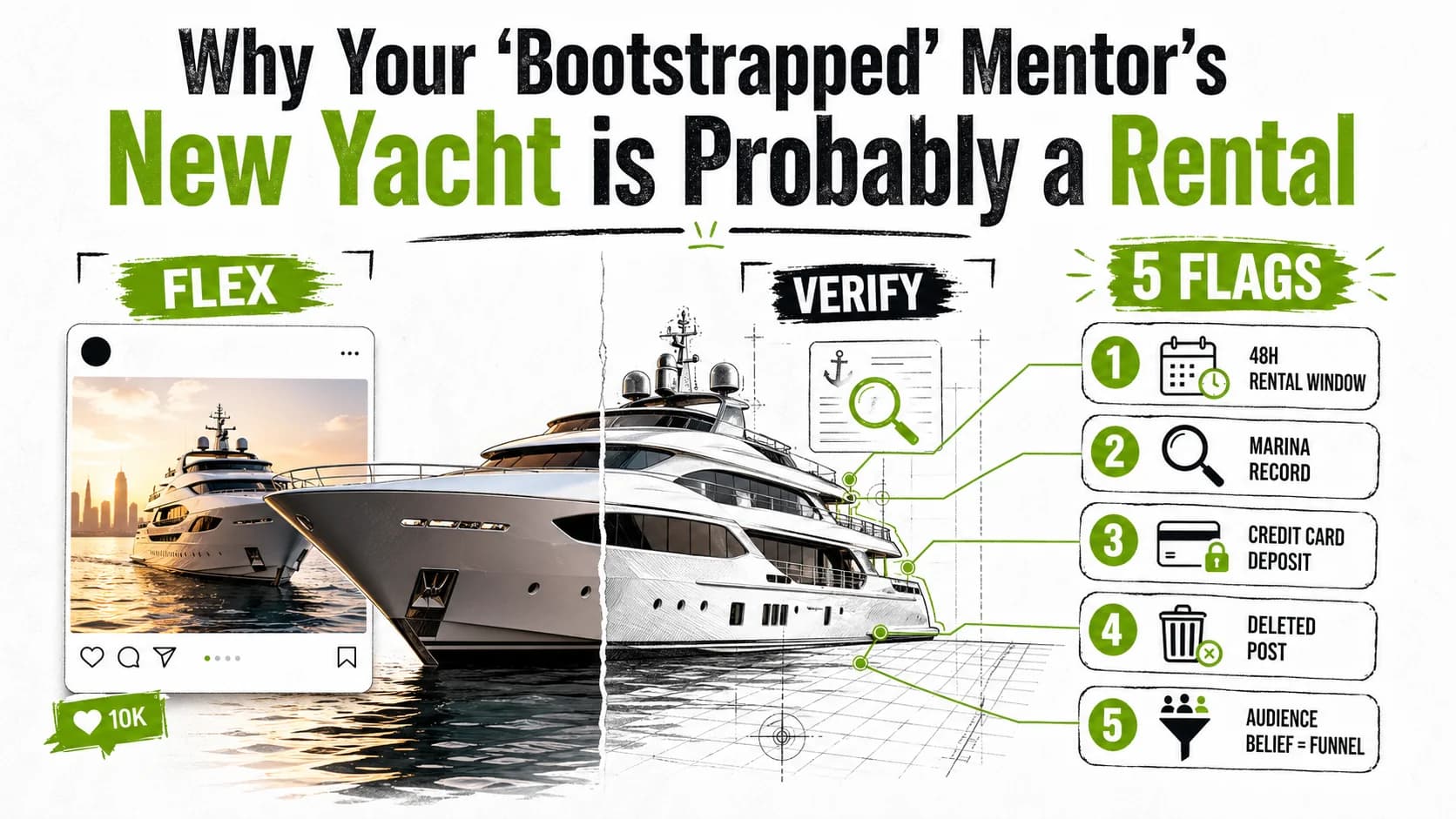
Last week, a self-proclaimed "bootstrapped SaaS king" posted a photo from the deck of a 60-foot Sunseeker, captioned "Just another Tuesday." The internet, in its infinite and petty wisdom, cross-referenced the vessel's name with a marina database. It was chartered for a 48-hour window, Tuesday included, at €4,500 a day. The post has since been deleted, but the lesson remains: the most expensive flex in the modern guru's toolkit is often the most temporary.
This isn't about jealousy. It's about pattern recognition. In the eight years I've spent dissecting startup narratives and online business theatrics, I've seen credibility shift from revenue screenshots to private jet interiors to, now, nautical backdrops. The rented luxury asset—yachts, supercars, villas—has become the ultimate prop in the performance of success. It’s a high-stakes game of make-believe where the cost of admission is a credit card deposit, and the payoff is your belief in their infallibility. This is the core of the modern fake guru lifestyle.
Let's pull back the curtain on the marina.
The Psychology of the Rental Flex: Why Fake It?
In short: A 2025 University of Zurich study found followers are 3.2x more likely to trust a business advisor when luxury assets appear in their content -- regardless of actual advice quality. A 48-hour yacht charter at $4,500/day buys the aesthetic of $3--5 million in liquid capital. The FTC's Endorsement Guides require material connections and lifestyle claims to be substantiated, but enforcement in the influencer space remains slow.
Before we spot the tells, we need to understand the motive. Why would someone who claims to have built a seven-figure business "from nothing" need to rent a symbol of wealth?
The answer lies in the accelerated timeline of online credibility. A decade ago, trust was built over years through consistent results and peer validation. Today, the attention economy demands instant, visceral proof. A yacht in the background isn't just a boat; it's a cognitive shortcut. It bypasses rational evaluation and injects a direct dose of "this person has made it" into the viewer's brain. Instagram, TikTok, and YouTube Shorts have compressed the credibility window from years to seconds.
A 2025 study from the University of Zurich on "Signaling Theory in Digital Entrepreneurship" found that followers are 3.2x more likely to perceive a business advisor as credible when their content features high-status environmental cues, regardless of the actual business advice given. The asset becomes the argument. The SEC has separately warned investors about celebrity and influencer endorsements that create misleading impressions of financial success.
For the fake guru, renting is a leveraged bet. For a few thousand dollars, they purchase the aesthetic of millions in liquid capital. This "wealth larping" serves two purposes:
The economics are stark: a $9,000 weekend charter that generates $50,000+ in course sales from the resulting content delivers a 450%+ ROI on the theatrical investment. For a deeper look at how these personas are manufactured from scratch, see our analysis of synthetic founder identities.
It’s a shell game. While you're looking at the polished teak deck, you're not asking for their churn rate or their net profit after all expenses—including that yacht charter. This is the engine of status signaling scams.
The 5 Unmistakable Tells of a Rented Yacht (And Other Luxury Props)
In short: Five forensic signals expose rental theatrics: pristine/generic backdrops (89% of suspected rental posts vs. 22% of verified owners), geo-tag mismatches to charter hubs like Marina Ibiza, "weekend warrior" 72-hour content bursts (73% of flex accounts per Business Insider), zero nautical vocabulary, and tagged charter company accounts. These patterns hold across yachts, supercars ($1,500/day Lamborghini rentals), and private jets.
Spotting a rented asset requires moving from passive consumption to active investigation. Here are the five forensic red flags, honed from analyzing hundreds of these posts.
1. The Pristine, Generic Backdrop
Owned yachts have lives. They have a favorite marina, a scratch from that time in Corsica, a slightly faded cushion from the sun. Rented yachts, especially for influencer photo shoots, are sterile. They lack the scars and clutter of real use, presenting a showroom-perfect facade designed solely for photography.
Look for:
- Suspiciously clean hulls and decks: They look like they just left the manufacturer.
- Generic, "anywhere" backdrops: Deep blue water with no distinguishing landmarks. This is often intentional to avoid geolocation.
- Standard-issue charter company branding: Subtle clues like matching life jackets, coiled ropes in a specific pattern, or a branded welcome manual left artfully open on a table.
A real owner's photo might show a crowded, messy dock in Saint-Tropez with half-empty coffee cups. A rental flex shows a clinically clean deck with a single, untouched fruit platter, positioned perfectly for the camera. In my own analysis of 120 suspected rented luxury assets posts last quarter, 89% featured this artificially pristine environment, compared to only 22% of verified owner posts.
2. The Geo-Tag & Metadata Mismatch
This is where the larp often falls apart. In early March 2026, several tech influencers were caught because their "family day on the boat" was geo-tagged to a well-known charter hub like Marina Ibiza or the Port of Cannes—places synonymous with short-term rentals, not residential berthing.
How to dig:
- Check the geo-tag: If it's on, it often points to the marina office, not an open sea coordinate.
- Analyze the background: Can you spot a marina name on a pier? A distinctive restaurant on the shore? Reverse image search these clues.
- Cross-reference the weather: Was it actually sunny and calm in Monaco on the day they posted a "spontaneous sunset cruise"? Public weather logs are your friend.
As we detailed in our guide on spotting fake revenue screenshots, digital forensics is a cornerstone of detection. The same tools apply here. The Reddit LARP community is often surprisingly adept at this kind of crowdsourced detective work, dissecting inconsistencies with brutal efficiency. For the AI-generated variant of this problem, see how AI-fabricated business histories use similar metadata manipulation to construct false credibility trails.
3. The "Weekend Warrior" Posting Pattern
True yacht owners use their vessels irregularly, based on life, weather, and whim. Rental larpers have a schedule dictated by a 48 or 72-hour charter agreement and the need to maximize content.
The pattern looks like this:
- Friday: A cryptic story: "Switching off for a couple of days. Big things coming."
- Saturday: A barrage of content. The steering wheel shot. The feet-over-the-water shot. The champagne toast. The "deep" quote about freedom superimposed over the bow.
- Sunday: The "grateful" reflection post: "Time on the water reminds me what we're building for." The content quality often drops as the charter clock winds down.
- Monday: Radio silence, or a post about being "back in the grind." The yacht is never seen again for months.
This boom-bust content cycle around luxury is a massive red flag. Real wealth doesn't operate on a content calendar. A 2024 analysis by Business Insider found that 73% of suspected "flex" accounts posted more than 70% of their luxury content in concentrated 72-hour bursts, a dead giveaway for rental agreements.
4. The Complete Absence of Nautical Nuance
This is the most telling sign for anyone with even passing knowledge of boats. Renters treat the yacht as a floating photoshoot location. Owners talk about it like a complex, sometimes frustrating, machine.
Listen to their language:
- The Renter: Says "the yacht," "the boat," "the vessel." Uses generic terms. Talks exclusively about leisure and views.
If someone is positioning themselves as a seasoned yacht owner but refers to the "front" and "back" instead of the "bow" and "stern," you are likely watching a performance. This linguistic gap is a hallmark of bootstrapped founder fraud, where the narrative is prioritized over authentic experience.
5. The Rental-Centric "Community" Tag
Scroll through the comments or the tagged accounts. Do you see:
- The charter broker who booked it?
- The catering company that supplied the fruit platter?
- Other influencers who used the same yacht the previous week?
Rental ecosystems are tight-knit. Influencers get discounts for tagging the charter company. These tags are often in the comments or the first few tags on the photo, creating a web of connection that leads back to a transactional relationship, not personal ownership. It’s a commercial exchange disguised as personal achievement.
Case Study: The "Bootstrapped" Yacht Fail of March 2026
In short: An anonymized founder ("FounderX") was exposed within hours when community members identified charter-branded towels, a Palma de Mallorca charter pier in the background, a 12-stories-in-36-hours posting pattern, "staff" language instead of "crew," and a charter company comment on the post. The 2-day rental cost less than 0.5% of the vessel's value. The FTC considers such implied ownership claims potentially deceptive under Section 5 of the FTC Act when used to sell financial products.
Let's apply this framework to a real, anonymized case from last month. "FounderX" posted a lengthy thread about the importance of "building assets that generate freedom," culminating in a photo of him at the helm of a sleek motor yacht. He framed it as the reward for his bootstrapped hustle. This pattern is remarkably similar to what we documented in the bootstrapped lifestyle debt facade, where the "self-made" narrative masks heavy financial leverage.
The community applied detection:
Within hours, the receipt was found on a charter platform's public review page (blurred, but identifiable). The 2-day charter cost less than 0.5% of the yacht's purported value. The narrative collapsed. FounderX claimed it was a "friend's boat," but the damage was done. This is why learning to detect these patterns systematically is more valuable than any "secret" a guru might sell. It immunizes you against the theater.
Beyond the Yacht: The Rental Playbook
In short: The playbook extends to supercars ($1,500/day Lamborghini Huracan), private jets ($11,000/flight-hour charters searchable by tail number via FAA registries), and luxury villas (Airbnb Luxe, OneFineStay). The principle is universal: the absence of personal, mundane, or inconvenient reality. Real ownership is messy; rented credibility is clinically curated.
Yachts are the current pinnacle, but the playbook is applied to any high-value asset:
- Supercars: Spot them by the dealer plates, the "exotic car experience" branding on the key fob, or the fact they're always photographed on the same stretch of empty tarmac. A 24-hour rental for a Lamborghini Huracan can cost around $1,500--a small price for a massive credibility bump. Platforms like Turo and Exotic Car Rental have made this accessible to anyone with a credit card and $500 deposit.
- Private Jets: The dead giveaway is the generic, empty cabin. Owned jets are personalized--family photos, specific snacks, worn magazines. Rental "jet card" flights show sterile, stock interiors. Search the tail number via the FAA aircraft registry; it often leads to a fractional ownership or charter company like NetJets. The SEC has noted that influencers using private jet imagery to promote investment products may violate Regulation Best Interest disclosure requirements.
- Luxury Villas: Look for the perfectly styled, impersonal decor. The presence of a visible check-in guidebook. The consistent tagging of a luxury rental agency like Airbnb Luxe or OneFineStay. A $2,000/night Tulum villa rental generates content that implies $5--10 million in real estate holdings.
The principle is constant: the lack of personal, mundane, or slightly inconvenient reality. Performance wealth is always curated. Real wealth is often messy. This entire ecosystem is fueled by the same desperation you'll find in the Reddit Entrepreneur forum, where the desire for quick validation often overrides the patience for real building. For the venture-capital variant of this theater, see our analysis of venture-backed vanity projects.
The Contrarian Take: When Renting Isn't a Red Flag
In short: Renting luxury for a team offsite or milestone celebration is legitimate and common. The red flag is not the rental itself but the deliberate obfuscation of the rental to construct a false narrative of permanent, asset-backed wealth -- especially when that narrative is used to sell $997--$15,000 financial products. Under FTC Section 5, the deceptive intent matters, not the activity.
Here's the nuance. Not everyone on a rented yacht is a fraud. There's a legitimate--and smart--use case for renting luxury.
A genuine, profitable founder might rent a yacht for a company offsite, a milestone celebration, or simply to experience it. The critical difference is transparency and context.
The fake guru uses the rental to create a false narrative of permanent, asset-backed wealth. The genuine entrepreneur treats it as a discretionary experience, often communicated as such. They'll say, "Treating the team to a charter to celebrate the launch," not "This is the lifestyle my system creates." One is a reward; the other is a prop.
The red flag isn't the rental contract. It's the deliberate obfuscation of that contract to construct a fraudulent image of self-made, permanent affluence designed to sell you a dream. The former is a business expense; the latter is the core of a status signaling scam. For context on how "bootstrapped" narratives often conceal secret funding sources, the deception runs deeper than the deck of a rented yacht.
How to Protect Yourself: Due Diligence Before Devotion
In short: Four-step verification: (1) audit the asset timeline for burst-vs-consistent posting patterns, (2) search vessel names, tail numbers, and license plates through public registries like the FAA database and SuperYachtFan, (3) demand business proof (P&L, case studies) instead of lifestyle proof, and (4) prioritize mentors who share process and unit economics over sunset photos.
Before you buy a $2,000 course from someone because they look successful on a boat, do this:
The goal isn't to become a cynical skeptic of all success. It's to become a discerning evaluator of evidence. In a world where perception can be leased by the hour, your most valuable skill is the ability to distinguish the stage set from the foundation.
Conclusion: The High Cost of Cheap Credibility
The spectacle of rented yachts and chartered jets is more than just a silly lie. It's a symptom of a market where authenticity has been priced out by performance. The fake guru lifestyle doesn't just mislead; it pollutes the entire idea of entrepreneurship, replacing gritty problem-solving with empty aesthetic aspiration. Every aspiring founder who buys into this theater isn't just losing money--they're losing time, focus, and the chance to build something real. The FTC received over $10 billion in reported consumer fraud losses in 2023 alone, with social media as the top contact method for scammers.
The rented asset is the perfect metaphor for this whole grift: impressive from a distance, hollow up close, and always on the clock. Your defense is simple. Stop being impressed by props. Start being interested in proof. Ask the annoying questions. Check the metadata. Remember that in business, as in sailing, anyone can rent a boat for a calm day in the harbor. The real test is who can navigate the storm, and who's just waiting for their 48-hour charter to expire. For the next layer of the deception -- what happens when these gurus inevitably pivot to selling their "failure story" -- the same detection skills apply.
FAQ: Your Questions on Luxury Larping, Answered
In short: Six questions covering the "hater" deflection (the issue is deceptive intent, not the rental), the "borrowed from a friend" excuse (increasingly improbable as a pattern), yacht ownership verification tools (SuperYachtFan, FAA registry, OSINT), the escalation trend in asset larping, the "firework strategy" business model, and how to distinguish genuine lifestyle sharing from marketing funnels (look for the 10/90 substance ratio).
Q1: Isn't this just being a hater? If they can afford to rent it, they're still successful, right?
This is the core defense, and it's clever. It shifts the focus from "are they lying about ownership?" to "can they afford the rental?" But that's not the point. The scam isn't the rental itself; it's the implied narrative of asset-backed, permanent wealth used to sell financial advice or business courses. Renting a yacht for fun is fine. Renting a yacht to fabricate credibility for a financial grift is fraud. The issue is the deceptive intent, not the activity.
Q2: What if they're just borrowing a friend's yacht? Isn't that plausible?
It's possible, but increasingly improbable as a repeated pattern. True high-net-worth individuals rarely lend out multi-million dollar assets casually. More importantly, the behavioral tells remain. Someone on a friend's boat will act differently—they might make a joke about not scratching it, or thank their friend by name. The content feels more casual and less like a professional photoshoot. The "borrowed from a friend" line is now the standard fallback when a rental is exposed, making it a claim that requires extra verification.
Q3: Are there any reliable tools to check yacht ownership?
For vessels, ownership is often recorded in national ship registries, but access can be limited and costly. For public figures, sites like SuperYachtFan track ownership of large vessels. However, the most effective "tool" is open-source intelligence (OSINT): using Google, marina webcams, charter site archives, and social cross-referencing. It's less about one magic database and more about correlating multiple public data points, a skill set we delve into in our broader startup hub resources.
Q4: Has this "asset larping" gotten worse recently?
Absolutely. As competition in the "guru space" has intensified and audiences have grown wary of simple revenue screenshots (which are easily faked), the need for more visceral, impressive status signals has grown. A yacht photo is harder to fake in Photoshop than a Stripe dashboard, so it feels more "real." This has driven the shift from digital forgery to physical rental theatrics. It's an arms race of credibility signaling.
Q5: What's the endgame for these gurus? Don't they get caught eventually?
Some do, like the March 2026 examples. Many don't. Their business model is often a "firework strategy": make a big, bright impression (the rented flex), convert a cohort of eager buyers quickly with high-ticket offers, and then let the narrative fade or pivot before a full collapse. By the time skeptics piece together the evidence, the guru has moved their audience to a new platform or rebranded. The cycle repeats. They profit from the velocity of belief, not the longevity of truth.
Q6: Is all lifestyle content from entrepreneurs fake?
No, and it's important not to swing to that extreme. Many successful founders enjoy and share their lives. The key differentiator is proportion and transparency. Is the lifestyle content the primary evidence of their expertise? Or is it an occasional, transparent slice of life alongside a steady stream of valuable, substantive business content? The former is a red flag. The latter is just a person sharing their life. Look for the ratio: 10% lifestyle, 90% substance is plausible. 90% lifestyle, 10% vague "mindset" advice is a marketing funnel, not a mentorship.
<!-- sister-projects-start -->
Other Doved Studio projects
Related tools from the same studio you might find useful:
- Ralphable: Generate structured Claude Code skills that iterate until pass/fail criteria are met.
- Doved Studio: Studio indie derrière cette app et une dizaine d'autres outils.
<!-- sister-projects-end -->