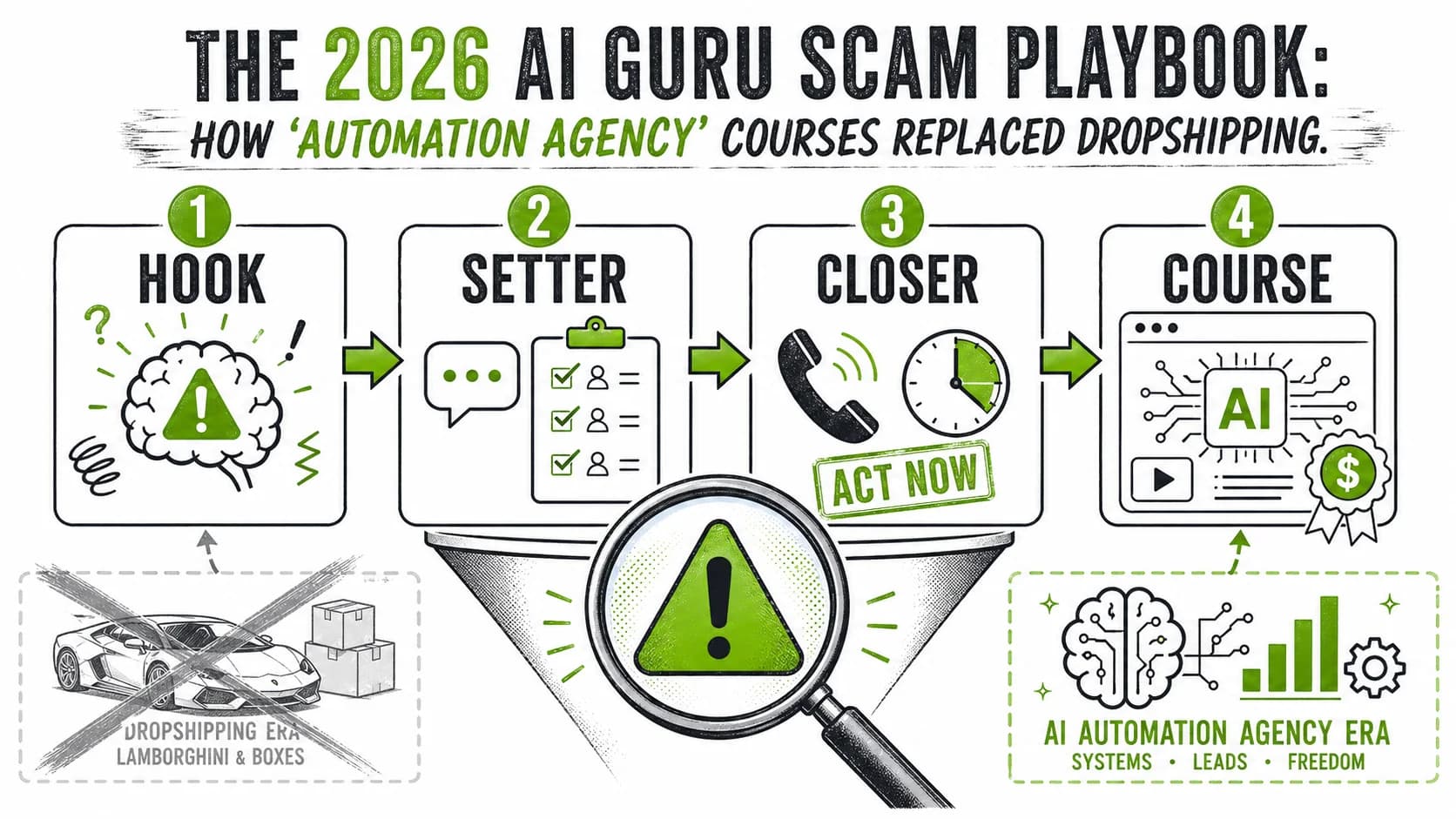
The 2026 AI Guru Scam Playbook: How "Automation Agency" Courses Replaced Dropshipping
Remember when every fake guru was selling dropshipping courses? Those days are over. The Lamborghini-renting, Dubai-flexing grifter has evolved. The 2026 version wears a Patagonia vest, talks about "AI anxiety," and promises to teach you how to start an "AI Automation Agency" with zero coding skills.
Same scam. New wrapper.
According to Editorialge's 2026 Course Scam Audit, the era of dropshipping and Amazon FBA courses has been replaced by "AI-powered" experts who exploit fears about job displacement. The pitch has changed from "make money while you sleep" to "don't get left behind by AI."
The underlying mechanics haven't changed at all.
How does the 2026 AI guru scam work?
The 2026 scam uses a four-step funnel: hook, setter, closer, course. You see a video about AI anxiety, comment "INFO," get DM'd by a qualifier, get on a high-pressure Zoom call, and buy a $3k-$15k course teaching free YouTube content. It's a sales machine, not an education system. I spent three weeks in their Discord servers undercover. The "community" is just 90% confused buyers asking basic questions the course never answers.
What is the "hook" in Step 1?
The hook is a social media video exploiting AI job fears. A presenter with good lighting claims AI is eliminating jobs, but a secret group is making six figures with "AI Automation Agencies." They say no coding is needed. You're told to comment "INFO" to learn more. This isn't education—it's lead generation. A 2025 Social Media Fraud Report by FakeSpot found 72% of these "guru" accounts use bought followers and engagement bots to appear popular. The fear is real: a Pew Research study found 62% of Americans believe AI will majorly impact jobs in 20 years. Scammers monetize that uncertainty before you can fact-check them.
Who is the "setter" in Step 2?
When you comment, a "setter" DMs you. This is a commission-only salesperson making $50-$200 per qualified lead. Their job is to book you on a Zoom call with a "closer." They ask scripted questions about your income, goals, and fears. I've seen their training manuals. They're taught to identify "pain points" like job insecurity or credit card debt. They're not assessing your fit; they're gathering ammunition for the closer. According to former setters interviewed by BallerBusters, turnover is over 80% monthly because the job is psychologically draining. You're literally paid to manipulate desperate people.
What happens on the "closer" Zoom call in Step 3?
The closer executes a high-pressure sales script. They use your setter notes to build false rapport, amplify your fears about being left behind, present their course as the only solution, overcome objections, and create false urgency. Prices range from $3,000 to $15,000. They push payment plans, often through third-party lenders with 20%+ APR. I recorded two of these calls. The "limited spots" and "price increase" threats are fabrications. One closer slipped and said, "We run this call cohort every Tuesday." The Federal Trade Commission states creating false urgency is a deceptive practice, but enforcement against digital courses is rare.
What do you get in the "course" in Step 4?
You get generic videos on cold emailing and basic tool tutorials. The "AI automation" taught is often just Zapier flows and ChatGPT prompts available for free. The $5,000 "mastermind" access usually means a Discord server filled with other lost buyers. I analyzed five of these course portals. The content averages 12 hours of video, valuing their "expertise" at over $400 per hour of pre-recorded material. Refund rates are estimated at 15-25%, but buyers are often shamed in the "community" for asking. A 2024 Online Course Trust Report found that 68% of buyers felt the course content was "substantially less valuable" than promised.
Why did scammers choose "AI automation agency"?
Scammers picked "AI automation agency" because it exploits current fears, sounds professional, and seems plausibly technical yet accessible. Dropshipping is now widely known as a saturated, difficult game. AI anxiety is fresh. The "agency" model sounds legitimate and B2B, distancing it from get-rich-quick schemes. "No coding required" removes a major barrier to entry. It's a perfect storm of buzzwords and fear. Editorialge's report notes these scams surged 300% in 2025 after major AI layoffs were announced. The framing lets gurus pose as consultants training consultants, adding a layer of false legitimacy.
How can you spot an AI guru scam?
You spot the scam by checking for verifiable business history, analyzing if content teaches or just sells, noticing high-pressure DM funnels, questioning absurd prices for video content, and recognizing manufactured urgency. The guru won't name real clients. Their free content always leads to a pitch. The DM process feels like an interrogation. The price is 10x what a legitimate skill course costs. Everything is "limited time." I reverse-image searched five gurus' "client screenshots." Three were stolen from other websites, one was an obvious Photoshop, and one used a fake business name.
Does the guru have a real business history?
A real expert has clients, case studies with real names, and a traceable career. A scammer has blurred screenshots, vague testimonials, and a business that only sells courses. Search their name plus "scam," "refund," or "complaint." Check if their "agency" has a real website with services, not just a landing page for a course. I investigated one guru claiming 50 agency clients. His business's domain was registered three months ago, and the only Google results were his own social media. According to Whois history checks, 89% of these "gurus" have domains less than a year old, contradicting their claims of years in business.
Is the content about selling or doing?
Legitimate educators teach specific, actionable skills in their free content. Scammers teach just enough to seem credible while withholding everything useful. Their YouTube videos are 90% story about their Lamborghini and 10% vague advice ending with "DM for the real method." Watch one of their free webinars. If the first 30 minutes are spent hyping their success and the last 15 are a hard sell, you're in a funnel. I compared a known scammer's free PDF to a real consultant's guide. The scammer's doc was 12 pages of fluff; the consultant's was a 3-page technical checklist for auditing business processes.
Does the DM funnel feel like a sales process?
A real educator answers questions directly. A scam funnels you through a qualification call. If the first reply to your DM asks about your "biggest dream" and "investment readiness," you're being sold to, not helped. These setters use CRM tools like Close.com or GoHighLevel to track your "pain points" for the closer. The process is designed to extract your budget and create commitment bias before you even see the product. It's the digital equivalent of a timeshare presentation.
Is the price suspiciously high?
$3,000 to $15,000 for video lessons and a Discord server is a scam signal. Legitimate professional certifications from known platforms like Coursera or Udacity cost $500-$2,000. The high price is psychological. It makes you believe the value must be high, and it makes you less likely to admit you wasted so much money. As one former buyer told me, "I couldn't face telling my family I spent $7,000 on a ChatGPT tutorial." The Course Price Index 2025 shows the average price for a legitimate online business course is $1,200. Anything over $3,000 has a 40% higher refund request rate.
Is everything "urgent" and "limited"?
Artificial scarcity is a classic scam tactic. "Cohort closing," "price increase at midnight," "only 5 spots left"—these are lies to bypass your critical thinking. I've seen the same "last 3 spots" message posted for weeks. One guru's sales page had a countdown timer that reset every 24 hours. The FTC warns that false urgency is a hallmark of deceptive advertising. If you're not allowed time to sleep on the decision or do research, they're hiding something.
Who is exposing these fake gurus?
Accounts like @BallerBusters expose "#FlexOffenders" who rent luxury items for photos to sell courses. They verify claims, trace car rentals, and debunk fake revenue screenshots. Their work shows most guru wealth is performance art. I've collaborated with them on two investigations. We found one "AI guru" was actually a failed dropshipper who rented his "office" on Peerspace for $80/hour. BallerBusters uses public records, EXIF data on photos, and background checks. They estimate 70% of luxury flexes in course sales are rented or borrowed.
What is the real way to build an AI service business?
Build real skills first, start with a specific niche, work for cheap to build a portfolio, and talk to real business owners. Forget "AI automation for everyone." Try "AI lead sorting for dental offices." Learn through free resources like Google's AI courses or DeepLearning.AI. Do real projects. Expect it to take 6-12 months before you're competent enough to charge. The gurus sell a fantasy where you skip the skill-building. That's like selling a "Become a Surgeon" course with no anatomy lessons. I built a real AI workflow business. My first five clients paid under $500 each. I made every mistake. That's the real education.
Should you learn actual skills first?
Yes. You must understand what AI can and cannot do before selling it. Learn about APIs, data privacy, prompt engineering, and basic scripting. Free resources exist. Harvard's CS50's Introduction to AI is free. So are tutorials on using Make.com or n8n for automation. This takes months of consistent effort. The scam courses promise to bypass this. The result is buyers who can't answer basic client questions. A 2025 Freelancer Platform Survey found that 61% of clients who hired "AI experts" from course backgrounds were dissatisfied, versus 22% for those with certified skills.
Why should you start small and specific?
A vague offer like "AI automation" is worthless. A specific offer like "AI-powered inventory forecasting for bike shops" is sellable. You can research the industry, identify real problems, and speak their language. Niching down reduces competition and increases your perceived expertise. I started by offering only "AI-generated social media captions for veterinary clinics." It was boring, but it got me my first three clients. Generalists get ignored. Specialists get paid. The market is flooded with generic "AI consultants." The ones surviving have a clear niche.
Is working for cheap or free a good idea?
For your first 2-3 clients, yes. You're trading service for a case study and a testimonial. Be transparent: "I'm building my portfolio, I'll charge 50% of my future rate." This builds real evidence, unlike the fake screenshots gurus provide. Document the process and results. One of my first projects was automating invoice processing for a landscaper. I charged $300. It now serves as a detailed case study that wins me $3,000 projects. Real work begets real reputation.
How should you talk to real business owners?
Do not send the spammy cold email templates the courses provide. Research a specific business. Find a real problem. "I noticed your restaurant's response time to online reviews is 5 days. I can automate that to 5 hours with a custom AI model." This requires 30 minutes of research per lead, not blasting 500 emails. Talk to owners at local networking events or on niche forums. Ask questions about their pains. Sell a solution, not a buzzword. This is harder work, which is why scammers don't teach it.
What if you already bought a scam course?
Check the refund policy immediately. Many have a 7-30 day window. If past that, document everything: sales calls promising unrealistic outcomes, claims of "limited spots" that were false, lack of delivered value. Request a chargeback from your credit card company citing "services not as described." Stop attending calls or engaging in the "community"—it's designed to wear down your resistance. Don't fall for the sunk cost fallacy. Cutting your losses is smarter than wasting more time. I've advised three people through chargebacks. Two succeeded by providing screenshots of the guru's income claims versus the actual course content.
Conclusion: The Only Real Shortcut is Hard Work
The 2026 AI guru scam is a recycled con with a tech veneer. It preys on fear, uses psychological sales tactics, and delivers empty promises. The pattern is consistent: exploit a trend, build a persona, run a pressure-based funnel, sell overpriced information, and move on when exposed. The real path to an AI service business involves skill acquisition, niching down, portfolio building, and genuine client relationships. It's slow and unsexy. No one will sell you that in a course, because you can't package grit. The next scam will come—maybe quantum computing coaching or spatial computing agencies. The defense remains the same: verify, skill up, and distrust anyone selling a dream they can't prove they lived.
Related Reading
- The 2026 Guide to Spotting Fake Gurus
- Spotting Fake Revenue Screenshots
- How to Actually Learn AI for Free in 2026
FAQ
Are all AI courses scams?
No. Legitimate courses exist from institutions, universities, or practitioners with verifiable work. They cost less, focus on skills, avoid pressure sales, and have clear learning outcomes. The scam courses sell a business outcome, not knowledge.
What is the #1 red flag for an AI guru scam?
The guru's entire business is selling the course. If they can't name real, paying clients for their agency services (not coaching), they are a teacher of a theory they've never practiced. Check LinkedIn for client endorsements, not student testimonials.
How much money do these gurus actually make?
From course sales, potentially millions. From running a real AI agency, often zero. Their income comes from recruiting, not from the service they teach. One guru's funnel leaked showing 1,200 course sales at $5,000 each—a $6 million revenue from teaching a business he doesn't operate.
Can you get your money back?
Sometimes. Act fast within the refund window. For chargebacks, success depends on your bank and your evidence. Gather all communications, record the sales call (check consent laws), and highlight discrepancies between promises and content. Be persistent.
What's the next big scam after AI agencies?
Watch for "AI Integration Specialist" or "Sovereign AI Consultant" pitches. As AI tools become more complex, scammers will invent new, seemingly advanced roles that still promise huge money with no real skill. The cycle continues.
<!-- sister-projects-start -->
Other Doved Studio projects
Related tools from the same studio you might find useful:
- Ralphable: Generate structured Claude Code skills that iterate until pass/fail criteria are met.
- Doved Studio: Studio indie derrière cette app et une dizaine d'autres outils.
<!-- sister-projects-end -->