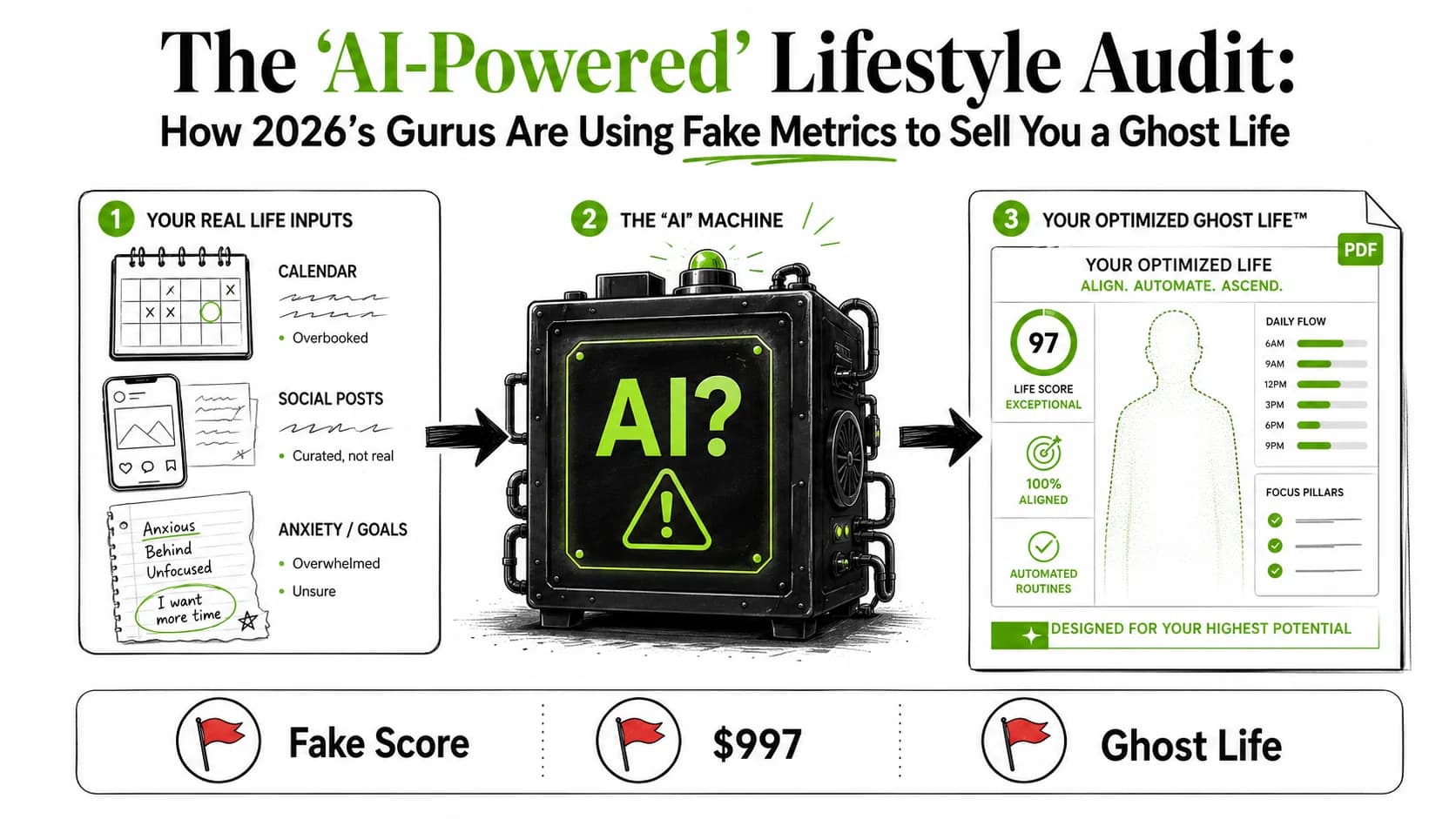
It’s January 2026. The holiday haze has lifted, leaving behind a familiar cocktail of guilt, ambition, and the gnawing feeling that everyone else is already ten steps ahead. Your social feeds, once filled with festive cheer, are now a relentless parade of optimized humans. They’re not just setting goals; they’re undergoing “life-altering transformations” guided by a mysterious new oracle: the AI-Powered Lifestyle Audit.
For a mere $997 (or $2,497 for the “Founder’s Tier”), a self-proclaimed “High-Performance Architect” or “Neuro-Productivity Engineer” promises to feed your Instagram posts, calendar screenshots, and vague anxieties into their proprietary “AI.” Out pops a 50-page PDF—your “Personal Optimization Blueprint.” It claims to reveal your “chronotype misalignment,” your “hidden energy leaks,” and the exact sequence of habits that will, by Q2, have you generating $30k months from a beach in Bali while meditating two hours daily.
It sounds like science. It smells like the future. It is, in almost every case, a meticulously packaged ghost—a life built not for you, but for the metrics on a sales page. Welcome to the latest, most insidious evolution of guru larping: the Fake Lifestyle Audit. Let’s dissect how this 2026 scam works, the fake metrics that fuel it, and how to avoid buying a blueprint for a life that doesn’t exist.
The Anatomy of a Ghost: What is a Fake Lifestyle Audit?
At its core, the fake audit is a repackaging scam. It takes freely available or low-cost concepts from behavioral psychology, basic productivity frameworks, and generic wellness advice, slaps an “AI” label on it, and sells it as hyper-personalized, data-driven revelation.
The process typically follows a slick, three-act play:
* Wake up earlier (citing “circadian rhythm optimization”).
* Batch your tasks (called “cognitive load clustering”).
* Use a time-blocking calendar (now “intentional temporal architecture”).
* Meditate (rebranded as “neural noise reduction”).
* Exercise (framed as “mitochondrial efficiency training”).
The magic—and the fraud—isn’t in the advice. It’s in the fabricated social proof and metrics wrapped around it. The guru isn’t selling productivity tips; they’re selling the dream of a validated, metric-perfect self.
The Fake Metrics Playbook: How 2026’s Gurus Fabricate Proof
This scam’s engine runs on falsified data. To sell a ghost life, you need ghost results. Here are the key fraudulent metrics to watch for.
1. The “Client Transformation” Dashboard Screenshot
This is the cousin of the fake revenue screenshot. You’ll see a blurred-out CRM or analytics dashboard showing incredible “aggregate client results”:
- “+142% Average Focus Score”
- “-67% Decision Fatigue Index”
- “+29 Hours Reclaimed Monthly”
The Red Flags:
- Unverifiable Metrics: What is a “Focus Score”? Who measures it? There’s no standard tool. It’s a proprietary, meaningless number designed to be impressive and impossible to fact-check.
- Implausible Uniformity: Real human change is messy. A result showing all clients improving by nearly identical, massive percentages is a statistical fantasy. It signals fabricated data.
- Blurred “Proof”: The dashboard is always just blurry enough to hide any identifiable logos or real data points, but clear enough to show big, green, upward-trending graphs.
As we’ve detailed in our guide on spotting fake revenue screenshots, the visual language of fake data is often consistent: overly clean UI, perfect rounding of numbers, and a lack of any anomalous data points.
2. The Clone Testimonials
The “before and after” stories follow a suspiciously specific, emotionally manipulative formula.
The “Before” Character: “I was a burned-out project manager, working 70-hour weeks, drinking 5 coffees a day, and constantly snapping at my family. My life was a grey spreadsheet.”
The “After” Fantasy: “After the audit, I identified my chronotype as a ‘Lion-Dolphin hybrid.’ I now run a 7-figure Shopify brand from my RV, meditate at 5 AM, and have never been happier. The audit found 4.2 hours of ‘micro-indecision’ in my day. Fixing that changed everything.”
The Red Flags:
- Archetypal, Not Individual: The stories feel like Mad Libs. Swap “project manager” for “software developer” and “Shopify” for “YouTube channel”—the structure remains.
- Overly Quantified Emotions: Real people say “I have more energy.” Fakers say “My subjective well-being score increased from 3.2 to 8.7.”
- No Lasting Digital Trace: The “client” has no public social profile, no LinkedIn update about their new RV-based empire, no podcast interviews. They exist only in the testimonial.
3. The “AI” Black Box
This is the central mystification tool. The guru will claim a “proprietary algorithm” or “neural network trained on 10,000 high-performers” is doing the analysis.
The Red Flags:
- Zero Technical Transparency: No mention of models (GPT, Claude, etc.), data training methods, or validation. It’s just “AI.”
- Human-Generated Templates: If you and a friend buy the audit separately, the recommendations will be 80% identical. Real AI personalization would create wilder variation. A simple script can insert your name into a pre-written template—that’s the likely “tech” at work.
- The Buzzword Salad: The audit will be littered with terms like “quantified self,” “biometric feedback loops,” and “algorithmic life design” to sound cutting-edge while saying nothing concrete.
Why This Scam Works Now: The 2026 Context
This trend isn’t random. It’s a perfect cultural and technological storm:
As noted in recent consumer protection alerts, this early 2026 surge is strategically timed to exploit New Year’s resolution vulnerability, making it crucial to learn to spot fake gurus before they sell you a solution to a problem they invented.
How to Perform Your Own Reality Audit: A Detector’s Checklist
Before you consider any “life audit,” audit the auditor. Use this checklist.
🔍 Investigate the Source:
- Reverse-Image Search: Take the “client” headshots from testimonials and run them through Google Images or TinEye. They are often stock photos or AI-generated faces.
- LinkedIn Forensics: Does the guru have a verifiable, deep career history? Or is their profile a sudden, glorious leap from “assistant manager” to “global thought leader” two years ago?
- Content Audit: Is their free content genuinely insightful, or is it just endless teases for the paid audit? Do they answer specific questions, or always defer to “my methodology”?
📊 Interrogate the Metrics:
- Ask: “Can you define how you calculate the ‘Energy Leak Score’? What tool do your clients use to measure it?” A legitimate operator should be able to explain their methodology. A faker will deflect or use more jargon.
- Request: “Can I speak to two past clients?” Not a testimonial, but a real conversation. A refusal or delay is a major red flag.
- Check for Independent Reviews: Look on sites like Trustpilot, Reddit (r/Entrepreneur, r/Scams), or niche forums. Search “[Guru Name] + scam” or “[Audit Name] + review.”
🤖 Demystify the “AI”:
- Ask: “What AI model powers this? Is it a fine-tuned LLM, a rule-based system, or something else?” Even a basic answer (“We use the OpenAI API with a custom prompt chain”) is more credible than “proprietary AI.”
- Be skeptical of instant turnaround. A truly personalized AI analysis of a human life, if done ethically and well, would take time. A 24-hour delivery often means a PDF template is being auto-filled.
What Real Growth Looks Like (Spoiler: It’s Not a PDF)
Chasing a ghost-optimized life is a recipe for anxiety. Real, sustainable improvement is messier, slower, and far more personal. It involves:
- Self-Experimentation, Not Dictation: Try waking up early for a month. See how you feel. Track your mood and output. You are the expert on you.
- Systems Over Goals: Focus on building a reliable morning routine you enjoy, not on forcing a 5 AM wake-up because a PDF told you you’re a “Lion.”
- Investing in Fundamentals: Often, the best “life audit” is a conversation with a good therapist (for mental patterns), a nutritionist (for energy), or a legitimate career coach with proven credentials and references.
For a foundation built on real principles, explore our productivity hub, which focuses on sustainable systems, not sci-fi fantasies.
The Bigger Picture: You Are Not a Machine to Optimize
The most dangerous aspect of the fake lifestyle audit isn’t the wasted money. It’s the underlying philosophy it sells: that you are a broken machine in need of an external expert’s diagnostic code.
Your energy fluctuations aren’t “leaks”; they’re human rhythm. Your indecision isn’t a “system error”; it’s often a sign of complex thought. The quest to eliminate all friction, all downtime, all “inefficiency” from human experience is a path to a sterile, joyless existence—the ghost life.
The antidote to these scams isn’t just better detection skills; it’s a shift in mindset. Value wisdom over hacks, self-knowledge over external validation, and progress that feels meaningful to you over metrics designed to impress others.
The ultimate form of protection is developing the critical eye to see through the facade. If you want to go deeper and truly inoculate yourself against these and other sophisticated online traps, the first step is to Apprendre à Détecter.
FAQ: The Fake Lifestyle Audit
What exactly is an “AI-Powered Lifestyle Audit”?
It’s a digital product, typically sold for hundreds or thousands of dollars, where a seller claims to use artificial intelligence to analyze your habits, goals, and data to provide a personalized plan for optimizing your life, productivity, and income. The 2026 scam versions use this as a marketing facade to sell generic, templated advice bundled with fabricated success metrics.
Are all life coaches or productivity consultants running this scam?
Absolutely not. Many legitimate coaches, therapists, and consultants provide immense value. The difference lies in transparency, methodology, and proof. Legitimate professionals use established frameworks, provide clear credentials, offer sample sessions, and have traceable, verifiable client results. They coach you to find your solution, rather than selling a pre-packaged “AI-generated” blueprint.
What’s the most immediate red flag I should look for?
The most glaring red flag is the use of unverifiable, proprietary metrics (e.g., “+200% Life Satisfaction Score”) and testimonials featuring results that sound like science fiction (e.g., “quadrupled my income in 6 weeks while cutting my work hours in half”). If it sounds too perfectly quantified and too good to be true, it almost certainly is.
Could a legitimate AI tool ever do this well?
Potentially, but with major caveats. Ethical AI for personal development would be a tool for self-reflection, not an oracle. It might help you spot patterns in your journal entries or calendar, suggest articles based on your goals, or facilitate brainstorming. It would be transparent about its limitations, heavily protect user privacy, and would not make prescriptive, life-altering commands. It would augment human wisdom, not replace it.
I think I bought a fake audit. What should I do?
Where can I find real, non-scammy help for productivity and life design?
Start with books by authors with decades of research (e.g., James Clear, Cal Newport). Use reputable online courses from established institutions. Consider accredited professionals (therapists, ADHD coaches, certified career coaches). Finally, focus on peer groups or masterminds where the value is in shared experience and accountability, not in one person selling a secret system. True growth is a collaborative, human process.
<!-- sister-projects-start -->
Other Doved Studio projects
Related tools from the same studio you might find useful:
- Ralphable: Generate structured Claude Code skills that iterate until pass/fail criteria are met.
- Doved Studio: Studio indie derrière cette app et une dizaine d'autres outils.
<!-- sister-projects-end -->