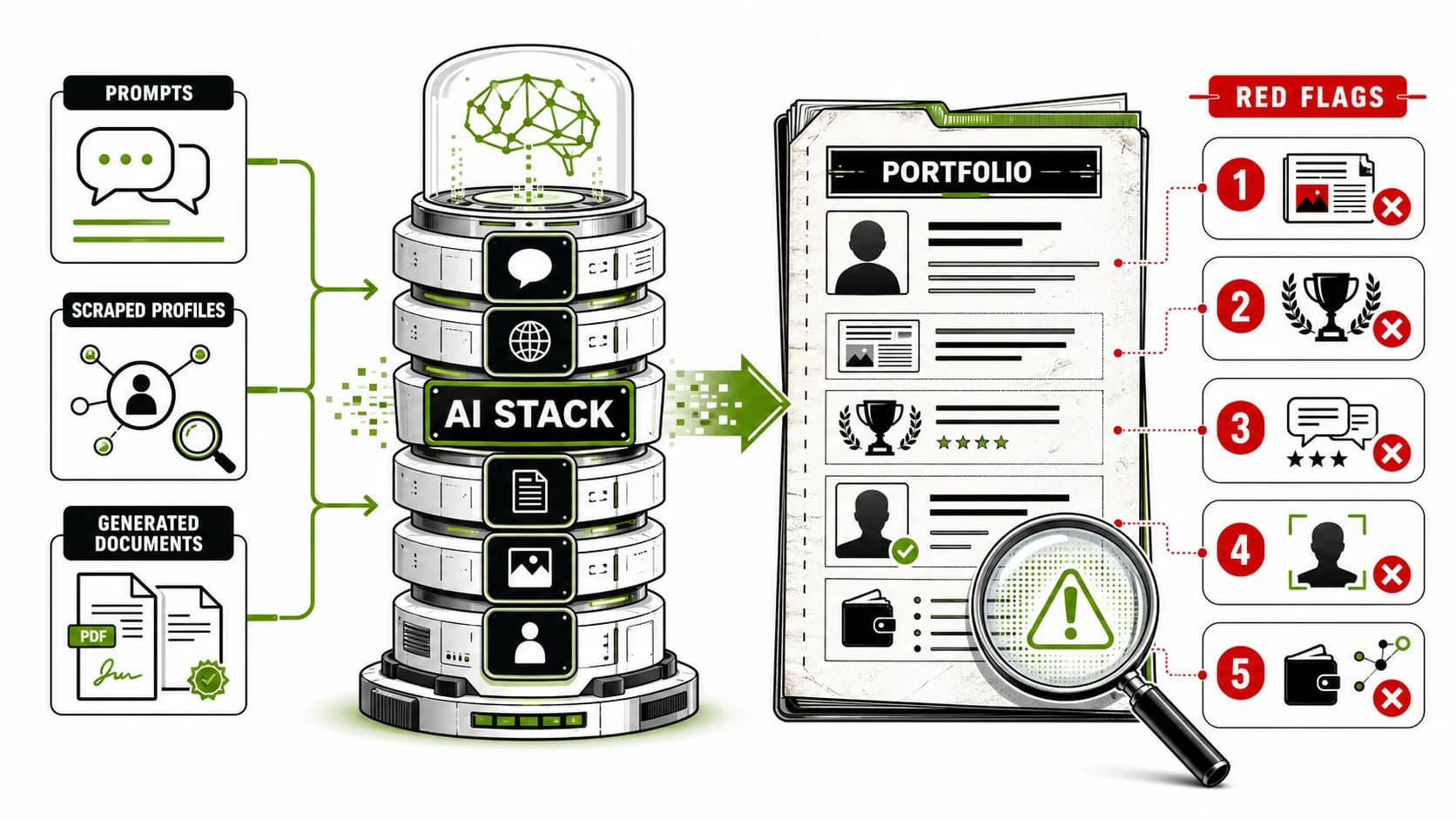
Last week, a promising AI startup secured a $2.1 million seed round. The founder, "Alex Vance," presented a compelling narrative: a serial entrepreneur with two previous exits, glowing testimonials from top-tier VCs, and a portfolio of angel investments. The pitch deck was flawless, the media coverage from "Forbes" and "TechCrunch" looked authentic, and the LinkedIn endorsements were from seemingly legitimate industry leaders. There was just one problem: Alex Vance, his previous companies, his exits, and the journalists who wrote about him were all entirely fabricated by a sophisticated stack of generative AI models. By the time the fraud was uncovered, the funds had vanished into a labyrinth of crypto wallets.
Welcome to the era of the synthetic entrepreneur. We've moved beyond gurus exaggerating real revenue or repackaging free content. The 2026 grift involves using AI not just to create content, but to construct an entire, verifiable-seeming past. This is the "Synthetic Success" stack—a dangerous new toolkit that allows larper-entrepreneurs to generate fake press coverage, forge investor testimonials, and invent a legacy of non-existent ventures overnight. The recent high-profile exposés, covered by TechCrunch and The Verge, aren't anomalies; they are the first tremors of a seismic shift in entrepreneurial fraud.
This article will dissect this new stack, teach you the forensic red flags, and provide you with the tools to separate the real builders from the AI-generated fiction. Because in 2026, due diligence isn't just about checking references—it's about running digital forensics on a founder's entire history.
From Embellishment to Invention: The Evolution of the Fake Founder
The fake guru playbook has always evolved. A decade ago, it was selling "make money online" eBooks. Then came the era of the fake revenue screenshot—a tactic we detailed in our guide on spotting fake revenue metrics. This was followed by the "personal brand" guru, selling a lifestyle funded by credit, not profit.
The current evolution is fundamentally different. It’s no longer about inflating a real $10k MRR to look like $100k. It’s about inventing the $10k MRR—and the company that generated it—from whole cloth. The goal is to build narrative legitimacy to unlock real-world assets: investor capital, partnership deals, media credibility, and a top-tier professional network.
The "Synthetic Success" stack makes this possible through a terrifyingly simple workflow:
* Visuals: AI image generators create "team photos," "office spaces," and even fake product UIs for the non-existent past ventures.
* Document Forgery: Tools generate fake pitch decks, cap tables, and acquisition term sheets with convincing legal and financial jargon.
* Audio/Video: Deepfake audio creates fake podcast interviews or congratulatory messages from "investors." Video synthesis tools can place the founder on a fake conference panel.
The output is a dense, self-referential web of "proof" that can withstand a casual Google search. This is the new baseline for high-stakes entrepreneurial larping.
Deconstructing the Stack: The 5-Point Fabrication Toolkit
Let's break down the specific tools and techniques in the modern grifter's arsenal. Understanding how it's done is the first step to detecting it.
1. The Phantom Portfolio & AI-Generated Business History
The cornerstone of the synthetic founder is a portfolio of past successes. The grifter isn't a first-time founder; they're a "seasoned operator."
- The Technique: Using an LLM, the grifter invents 2-3 company names with plausible domains (e.g., "FlowMetrics.ai," "NexusLogix.io"). The AI generates a detailed history: founded in 2020, reached $50k MRR, acquired by a "strategic buyer" (often a private equity firm or larger tech company that doesn't do small acquisitions) in 2024 for an undisclosed sum (typically "low eight figures").
- The Red Flag: A complete lack of human digital dust. Real companies, even failed ones, leave traces: former employees on LinkedIn complaining about the CEO, forgotten blog posts, outdated Crunchbase profiles, domain registration history, and maybe a stray tweet from a real user. A synthetic company has only the pristine, recently created "artifacts" the founder provides. Use the Wayback Machine to check if the company's website ever had organic, evolving content, or if it only appears as a single, perfect snapshot.
2. Forged Press & Synthetic Media Coverage
A Forbes or TechCrunch article is social gold. Now, it can be forged.
- The Technique: An LLM is prompted: "Write a 500-word TechCrunch article from June 2023 announcing the acquisition of [Phantom Company] by [Acquirer]. Quote the founder, [Fake Investor Name], and include realistic TC jargon." This text is then either published on a spammy "news" site with a similar-looking URL (e.g., techcrunch-news.io) or, in more sophisticated schemes, used in a PDF designed to look like a print article.
techcrunch.com/2023/06/...)? Check the publication's official archive. As we explore in our broader guide on spotting fake gurus, credential verification is paramount.
3. Deepfake Testimonials & Investor Ghosts
A testimonial from a partner at Sequoia or a16z can close a round. What if that partner is a deepfake?
- The Technique: Using a few minutes of publicly available conference footage, a grifter can clone a famous investor's voice. They generate a short audio clip: "Alex was one of the most driven founders I worked with at [Phantom Company]." This clip is presented as a "voicemail" or embedded in a video. Similarly, AI-generated LinkedIn profiles with stock photos are created to act as "co-founders" or "early employees" who endorse the founder's skills.
4. The Digital Tomb: AI-Crafted Defunct Websites
A real company that shut down leaves a digital corpse—an expired Squarespace site, a broken WordPress theme. A synthetic one gets a perfectly preserved, AI-built mausoleum.
- The Technique: Tools like GitHub Copilot or specialized website builders are prompted to create a fully functional, static website for the phantom company. It will have an "About Us," a "Press" page linking to the fake articles, and even a "Blog" with 10-15 generic, SEO-optimized posts about the industry—all AI-written. The site is then hosted and backdated.
5. The Network of Illusions: Bot-Generated Social Proof
Social media validation is the final layer of the illusion.
- The Technique: The founder's LinkedIn profile will suddenly be endorsed for 15+ skills by a swarm of "connections" who all have sparse profiles, stock photos, and jobs at other non-existent companies. On Twitter/X, a thread celebrating the founder's "new chapter" will be flooded with replies from accounts created in the last 3 months, all using similar, slightly unnatural praise language.
The Forensic Audit: Your 7-Step Due Diligence Checklist
Before you invest, partner with, or hire a "serial entrepreneur," run this checklist. Consider it a digital forensics protocol.
| Step | Action | What to Look For |
|---|---|---|
| 1. Timeline Analysis | Map all claimed ventures, roles, and exits on a chronological timeline. | Gaps, overlapping full-time roles, exits that don't align with market conditions of the era. |
| 2. Artifact Verification | Demand primary documents: signed cap tables, acquisition agreements, bank statements (redacted). | Refusal to provide any docs, documents that look templated, inconsistent fonts/formatting in "scanned" PDFs. |
| 3. Human Trace Search | Search for co-founders, employee #1, early customers by name on LinkedIn, Twitter, GitHub. | No trace, or profiles that were created recently and only reference the phantom company. |
| 4. Media Autopsy | Investigate every press mention. Find the original article on the publication's own site. | Articles only exist on syndication sites or PDFs; the named journalist has never written for that outlet. |
| 5. Digital Archaeology | Use whois lookup for old company domains. Scour the Wayback Machine for historical site snapshots. | Domain was registered last month but claims a 5-year history. Wayback Machine shows only one, recent snapshot. |
| 6. Social Graph Audit | Analyze the founder's key endorsers and celebrators. Check account creation dates and post history. | A cluster of endorsers all created accounts within days of each other and post only generic content. |
| 7. The "Coffee Test" | Have a detailed, spontaneous conversation about the old business. Ask granular, operational questions. | Answers are vague, buzzword-laden, or textbook-perfect. They can't recall specific, messy, human anecdotes. |
This process isn't paranoid; it's professional. In the age of synthetic success, trusting but verifying has been upgraded to auditing and authenticating.
The Bigger Picture: Why This Matters Beyond Your Wallet
This trend isn't just about losing money. It erodes the foundational trust of the startup ecosystem.
The solution isn't to retreat from innovation or AI. It's to develop a new literacy—a skeptical literacy—that matches the sophistication of the tools used to deceive us. This is precisely the mission of our platform: to equip you with the mindset and the methods to Apprendre à Détecter the larp from the legitimate.
Fighting Fire with Fire: Detection Tools and the Future
The same AI that creates these forgeries can be tuned to detect them. Emerging tools in the AI forgery detection space are looking for:
- Statistical Artifacts in Media: AI image generators often leave subtle, consistent patterns in pixel arrangement or frequency domains that differ from real photographs.
- LLM "Watermarks": Advanced LLMs can be prompted to embed statistical watermarks in their text that are invisible to humans but detectable by other models.
- Temporal Inconsistency Scanners: Tools that cross-reference claimed events with massive databases of public records, domain registrations, and social media posts to find anachronisms.
However, technology alone won't save us. It will be an arms race. The ultimate defense is a cultural shift: valuing substance over narrative, proof over pedigree, and rewarding the courage to show a real, flawed journey over a synthetic, perfect one. For a deeper dive into building real, substantive entrepreneurial skills, explore our resources at the Entrepreneurship Hub.
FAQ: Synthetic Success & AI-Generated Histories
1. What's the difference between a founder who pivots and a synthetic founder?
A founder who pivots has a real, verifiable history. There are legal documents, former employees, tax filings, and a digital paper trail (even if it's a trail of lessons learned from failure). A synthetic founder's history is a collection of recently generated artifacts with no underlying reality. The difference is between a real building that was renovated and a convincing hologram of a building.
2. Are big VC firms really falling for this?
The most sophisticated synthetic schemes are designed to pass initial screening by associates and algorithms that scan for keywords like "previous exit" and "Sequoia-backed." They often unravel during deeper, partner-level due diligence—the stage involving reference calls to the actual people involved in the past deals. The recent scandals show that these schemes can progress surprisingly far before detection, especially when they exploit the trust and speed of early-stage investing.
3. I'm a founder with a failed startup that has little online trace. How do I prove I'm real?
This is the tragic collateral damage of this trend. Your proof is in the human network and the primary documents. You should have:
- Co-founders and early employees who can vouch for you.
- Email threads, incorporation documents (even if for dissolution), bank statements, or old pitch decks.
- A honest narrative about what happened. Real failure is specific and human ("We burned through cash on inefficient ads and the co-founder relationship broke down over strategy"). Synthetic success is vague and grandiose ("We aligned with market synergies before a strategic acquisition").
4. What's the single biggest red flag I should look for?
The "Press Page" that only links to PDFs or low-authority syndication sites, not to live articles on the stated publication's domain. This is the most common and easily checked flaw in the synthetic stack. Always go directly to the publication's website and search for the article or the founder's name in their archive.
5. Could this happen with large, established corporations?
Potentially, yes. We could see scenarios where mid-level executives fabricate past achievements to secure C-suite roles, or where suppliers invent quality certifications and past client work. The principles of detection are the same: verify primary sources, seek human corroboration, and be wary of histories that exist only in perfectly formatted, recently created documents.
6. Is it illegal, and what should I do if I suspect someone is a synthetic founder?
Fabricating a history to secure investment is securities fraud. If you are an investor or partner who suspects fraud, consult a lawyer immediately. Do not confront the individual directly, as this may allow them to destroy evidence. Document everything and report it to the relevant authorities (e.g., the SEC in the US, the FCA in the UK). If you're just an observer, the best thing you can do is cultivate and share the skeptical literacy needed to prevent others from being duped.
The age of synthetic success demands that we all become slightly better detectives. The tools to create fiction are now democratized; the wisdom to seek truth must be as well.
<!-- sister-projects-start -->
Other Doved Studio projects
Related tools from the same studio you might find useful:
- Ralphable: Generate structured Claude Code skills that iterate until pass/fail criteria are met.
- Doved Studio: Studio indie derrière cette app et une dizaine d'autres outils.
<!-- sister-projects-end -->