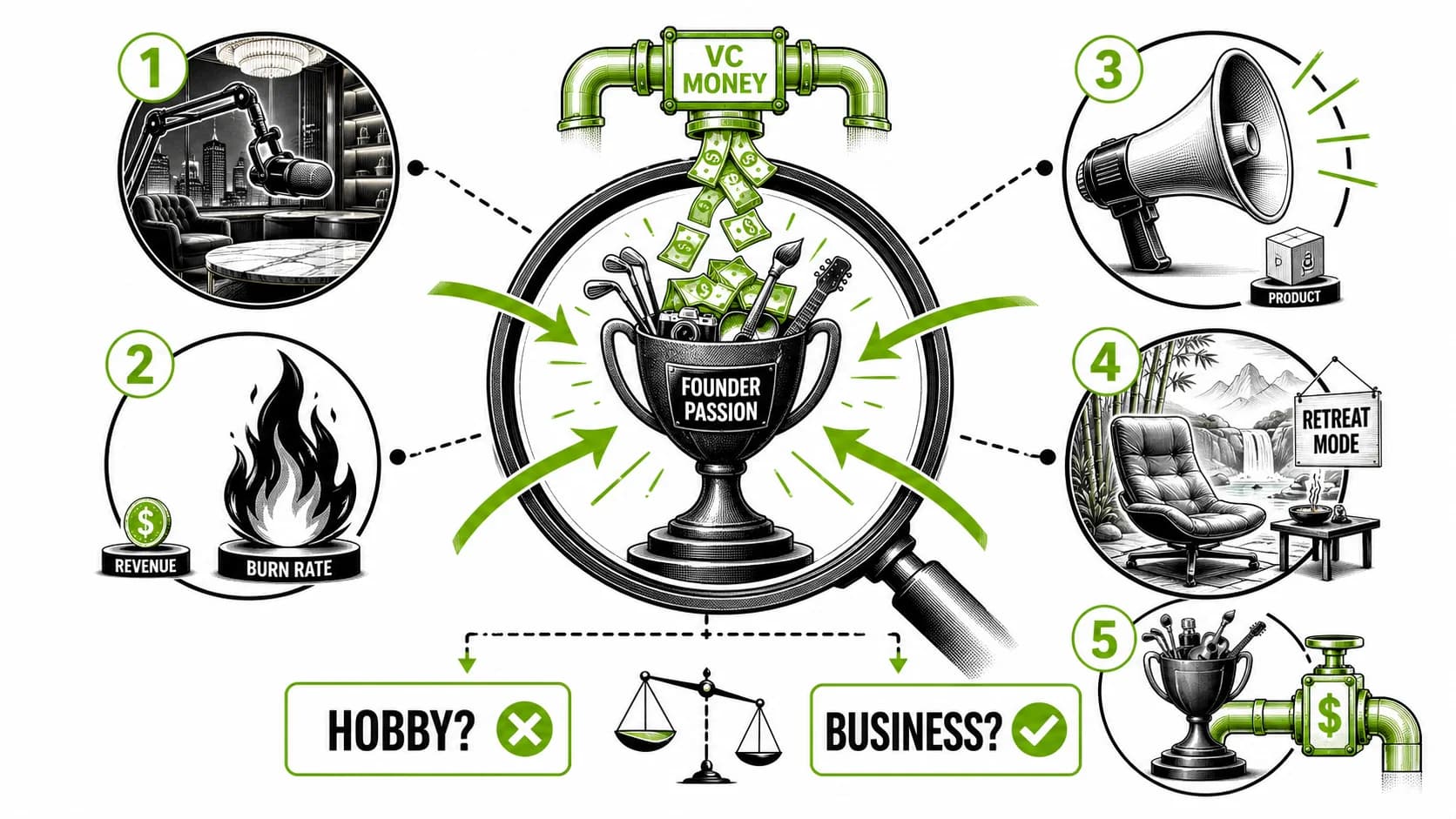
In February 2026, a TechCrunch exposé sent shockwaves through Silicon Valley. It detailed a "wellness-tech" startup that had burned through $18 million in Series A funding. Their primary "product"? A $2,500/month subscription for a founder-hosted podcast about "entrepreneurial mindfulness," complete with a custom-built, architecturally-awarded studio that doubled as the founder's personal meditation retreat. Revenue? A rounding error. The hashtag #FounderFantasyCamp trended for days.
Welcome to the golden age of the venture capital vanity project. In a market where narrative often outweighs metrics, a new breed of founder has mastered the art of selling a compelling "passion" story to investors, using their capital not to build a scalable business, but to fund an elaborate, unprofitable personal hobby disguised as a world-changing startup.
This isn't about failure—every startup risks failure. This is about a fundamental misalignment of incentives. It's about founders who are more passionate about the aesthetic of being a founder—the keynote speeches, the glossy profiles, the "thought leadership"—than about solving a real problem for real customers. Their "passion" is for the lifestyle, not the labor.
This article is your decoder ring. We'll dissect the 2026 playbook of the vanity founder, teaching you to distinguish between a genuine, difficult vision and a PR-funded hobby. Whether you're an investor, a potential employee, a partner, or just an observer trying to make sense of the startup circus, these patterns will help you see through the narrative.
The Anatomy of a Vanity Project: More Theater Than Traction
At its core, a vanity project is a startup where the founder's personal brand and lifestyle are the primary products, and the actual company is merely the vehicle. The business model isn't designed for sustainable profit; it's designed to attract enough capital to sustain the founder's desired narrative and lifestyle until the next funding round or a quiet acqui-hire.
The 2026 model is sophisticated. It's no longer the blatant fraud of fake revenue screenshots (though that still happens—see our guide on spotting fake revenue screenshots). It's a softer, more socially acceptable grift, often perpetrated by charismatic, well-connected individuals who genuinely believe their own hype.
The 5 Red Flags of a VC-Funded Hobby
Spotting a vanity project requires looking beyond the press release and the polished LinkedIn post. Here are the five definitive red flags.
1. The "Solution" in Search of a Problem (That Only the Founder Has)
The Pattern: The startup's core offering solves an incredibly niche, first-world problem that the founder personally experienced. Think: "Uber for private jet sharing among eco-conscious billionaires" or "blockchain-based authentication for artisanal cheese provenance."
- The Tell: The target market is vanishingly small, often described in TAM (Total Addressable Market) slides with absurdly broad strokes ("the $10 trillion 'wellness' market") to mask the fact that their specific solution appeals to maybe 0.001% of it. Customer discovery consists of the founder and their three wealthy friends.
2. Metrics That Celebrate Inputs, Not Outputs
The Pattern: The company's KPIs (Key Performance Indicators) are all about activity, not outcomes. The pitch deck and updates are filled with "vanity metrics" that sound impressive but have little to do with business health.
- The Vanity Metric Menu:
* "Partnerships": Press releases about non-exclusive "integrations" or MOUs (Memorandums of Understanding) with no revenue attached.
* "Platform Growth": Number of registered "users" (not paying customers), often driven by free tiers or costly incentives.
* "Brand Awareness": Media mentions, speaking engagements, and awards.
- The Tell: You'll struggle to find clear, honest metrics about Revenue, Retention (churn), and Customer Acquisition Cost (CAC). When pressed, the founder pivots to "We're building a community" or "We're focused on top-of-funnel brand narrative." This is a classic diversion. For a deeper dive into deciphering real metrics from larper theater, our hub on startup analysis is essential reading.
- The Reality Check: A real business measures what matters: Are customers paying? Do they stay? Can you acquire them for less than they're worth? Everything else is set dressing.
3. The Founder-as-Celebrity Complex
The Pattern: The founder's personal brand grows faster and shines brighter than the company's. They are the undisputed star of the show.
- The Tell: The company's social media is 80% founder content: podcast clips, keynote speeches, "day-in-the-life" reels from exotic "workations," and inspirational quotes. The company's "About" page is a 10-paragraph founder biography. The founder's personal follower count dwarfs the company's. Hiring seems to prioritize personal assistants, "content creators," and a "Chief of Staff" over engineers or salespeople.
- The Reality Check: While founder-led marketing is powerful (think Steve Jobs or Elon Musk), it's in service to the product. In a vanity project, the product is in service to the founder's brand. Ask: "If the founder disappeared tomorrow, would the company have any value or identity left?"
4. The "Artisanal" Burn Rate
The Pattern: Spending is conspicuously aligned with the founder's personal tastes and the company's "aesthetic," rather than frugal, ROI-driven growth.
- The Expenditure Hall of Fame:
* "Brand-Accurate" Everything: Custom-designed, sustainably-sourced, painfully slow-to-manufacture everything—from notebooks to hoodies—long before product-market fit.
* Elite "Team Offsites": Quarterly retreats to five-star resorts or remote lodges, framed as "strategy sessions" or "bonding."
* Philanthropic & Political Allocations: Significant, early-stage donations or lobbying efforts that align perfectly with the founder's personal causes, presented as "corporate values."
- The Tell: The burn rate is high, but the explanation is always about "quality," "culture," or "brand building," never about efficient scaling. There's a palpable disdain for the "grubby" aspects of business (like sales or cost control).
5. The Perpetual "Pre-Revenue" Pivot
The Pattern: The business model is a moving target. Every 12-18 months, there's a "strategic pivot" that coincides with the need to raise a new round of funding.
The Tell: The narrative is one of visionary adaptation. "We started in AI-powered pet nutrition, but we've learned so much. Our true calling is the metaverse* for pets! It's a much larger market." The core technology or team might change slightly, but the founder's central role and the company's lavish operational style remain constant.
The Reality Check: Real pivots are painful, often involving layoffs, downsizing, and a return to scrappiness. A vanity project pivot is a narrative refresh*—a new story to tell investors to keep the funding flowing, without the fundamental austerity of a real business turnaround.
The Investor Enablers: Why Does This Keep Happening?
Vanity projects don't exist in a vacuum. They require a ecosystem of enablers.
How to Protect Yourself: Due Diligence for the Skeptical Mind
Whether you're considering investing, taking a job, or partnering with a startup, your due diligence needs to go beyond the data room.
For Investors & Partners:
- Follow the Money (Literally): Analyze bank statements and credit card reports. Categorize expenses. How much is going to "brand" vs. product development and sales?
Pressure-Test the TAM: Challenge the market size assumptions. Ask for the data behind the "$10 trillion market" claim. Get them to define their Serviceable Obtainable Market* (SOM)—the slice they can realistically capture in 3-5 years.
Gut Check the Founder: Are they obsessed with the problem, or with being seen as the person who solves* the problem? In meetings, who does most of the talking?
For Potential Employees:
- Decode the Job Description: Is the role about building and selling, or about supporting the founder's brand? Be wary of titles like "VP of Founder Operations" or "Narrative Architect" in a 15-person company.
- Ask About Runway & Revenue: In interviews, ask: "What's the current runway? What percentage of expenses is covered by revenue?" If they get defensive or vague, it's a major red flag.
- Evaluate Equity vs. Salary: A vanity project may offer high equity and a lower salary, betting you'll be seduced by the "vision." Remember, equity in a lifestyle business is often worthless.
The skills to detect this modern form of entrepreneurial larping are more valuable than ever. It's not just about avoiding scams; it's about allocating your time, money, and talent to ventures that create real value. This is precisely why we built Larpable—to give you the toolkit to Apprendre à Détecter the patterns of narrative over substance, whether in a guru's course or a founder's pitch deck. It's about seeing the strings behind the marionette show.
Case Study in Contrast: Vanity vs. Vision
Let's make this concrete. Imagine two "sustainable fashion" startups that raised $5M seed rounds in 2025.
| Aspect | "EcoVogue" (The Vanity Project) | "StitchFix Circular" (The Genuine Venture) |
|---|---|---|
| Founder Focus | Frequent keynote speaker on "the future of conscious consumerism." Personal Instagram features designer showrooms and climate conferences. | Head down, usually in the warehouse or on calls with supply chain partners. Rare media appearances. |
| Office | A converted Soho loft with living walls and a zero-waste café for employees. | A functional warehouse space in a cost-effective logistics hub. |
| Key Metrics Cited | Press mentions, Instagram followers, number of "sustainability influencers" partnered with. | Customer return rate, cost per repaired garment, net revenue retention. |
| Spending Priority | A high-profile celebrity ambassador campaign. Custom, biodegradable packaging that costs 10x industry standard. | Investing in proprietary repair technology and building a logistics network for item collection. |
| Answer to "What's your moat?" | "Our brand narrative and founder's authenticity." | "Our data on garment longevity and a logistics network competitors can't easily replicate." |
By 2026 Q1, EcoVogue is burning cash, has pivoted to being a "sustainability media platform," and is out raising a Series A to "scale its community." StitchFix Circular is quietly hitting operational milestones, preparing for a Series A based on unit economics that actually work.
Conclusion: Passion is a Verb, Not a Aesthetic
Genuine entrepreneurial passion is gritty, uncomfortable, and customer-obsessed. It's about solving a hard problem, often at great personal cost. The "passion" of the vanity founder is a noun—a static identity, a curated image, a lifestyle to be maintained.
The 2026 startup scene is a theater, and many of the best-funded actors are playing the part of "visionary founder" in a production funded by venture capital. Your job is to be the critic who can tell the difference between a groundbreaking play and an expensive dress rehearsal for a show that may never open.
Look for the work, not the words. Follow the money, not the myth. Value outputs over inputs. In an age of unlimited narrative, the most radical skill is clear-eyed discernment. For more on developing this skill set across the entrepreneurial landscape, from gurus to growth hackers, explore our definitive 2026 guide to spotting fake gurus.
Frequently Asked Questions (FAQ)
1. What's the difference between a "lifestyle business" and a "vanity project"?
This is a crucial distinction. A lifestyle business is intentionally built to generate sustainable, modest profits that support the owner's desired lifestyle. It's often bootstrapped, grows organically, and has a clear connection between revenue and expense. Think of a successful freelance consultant or a niche e-commerce store. The owner's goal is personal freedom and stability.
A vanity project is a loss-making enterprise propped up by external capital (usually VC). It scales expenses to match the founder's aspirational lifestyle, with no clear path to profitability that would support those expenses without continuous funding. The goal isn't sustainable profit; it's the perpetuation of the founder's narrative and status.
2. Aren't some of the world's biggest companies accused of being vanity projects early on?
It's a common retort from founders in this category. The key difference is trajectory and evidence. Companies like Amazon or Tesla burned cash for years, but they did so while demonstrating exponential growth in a fundamental metric (Amazon: revenue and customer base; Tesla: production volume and technology advancement) that pointed to a future monopoly or market dominance. The spending was an aggressive investment in infrastructure and scale, not in the founder's personal brand or office decor. The "evidence" was in the operational achievements, not the press clippings.
3. As an employee, what are the real risks of joining a vanity project?
The risks are significant:
- Career Stagnation: You may not develop hard, transferable skills in growth, efficiency, or scalable engineering. You might become an expert in "founder support."
- Financial Instability: When the funding music stops (and it always does), layoffs are sudden and severe. Equity packages become worthless.
- Reputational Risk: Being associated with a failed, frivolous venture can make it harder to land your next role at a serious company.
- Psychological Toll: Working in an environment where style is valued over substance can be deeply demoralizing for talented, driven people.
4. Why don't VC investors just stop funding these obviously flawed ventures?
The VC model is predicated on outliers. For every 10 investments, they expect 7-8 to fail, 1-2 to return the fund, and 1 to return 10x+ the fund. Some investors consciously make "narrative bets" on charismatic founders, hoping they'll figure it out or get acquired for the team. There's also herd mentality, fear of missing out (FOMO), and the fact that it can take years for the fundamental lack of a business to become undeniable. By then, the early investors may have already sold their position to later-stage investors in a secondary market.
5. Can a vanity project ever become a real business?
It's rare, but possible through a profound crisis. This usually requires one of two things:
In most cases, however, the patterns are too entrenched, and the venture runs out of money before it can transform.
6. What are some authoritative sources to learn more about startup metrics and due diligence?
To build your knowledge beyond pattern recognition, consult primary sources:
- The Y Combinator Library: Contains essential, no-nonsense essays on startup fundamentals, from Paul Graham on what to do before product-market fit to how to talk to users.
- The SEC's EDGAR Database: For later-stage startups, you can find official S-1 filings for IPOs. Reading these (especially the "Risk Factors" section) is a masterclass in how serious companies are forced to describe their business with brutal honesty.
<!-- sister-projects-start -->
Other Doved Studio projects
Related tools from the same studio you might find useful:
- Ralphable: Generate structured Claude Code skills that iterate until pass/fail criteria are met.
- Doved Studio: Studio indie derrière cette app et une dizaine d'autres outils.
<!-- sister-projects-end -->