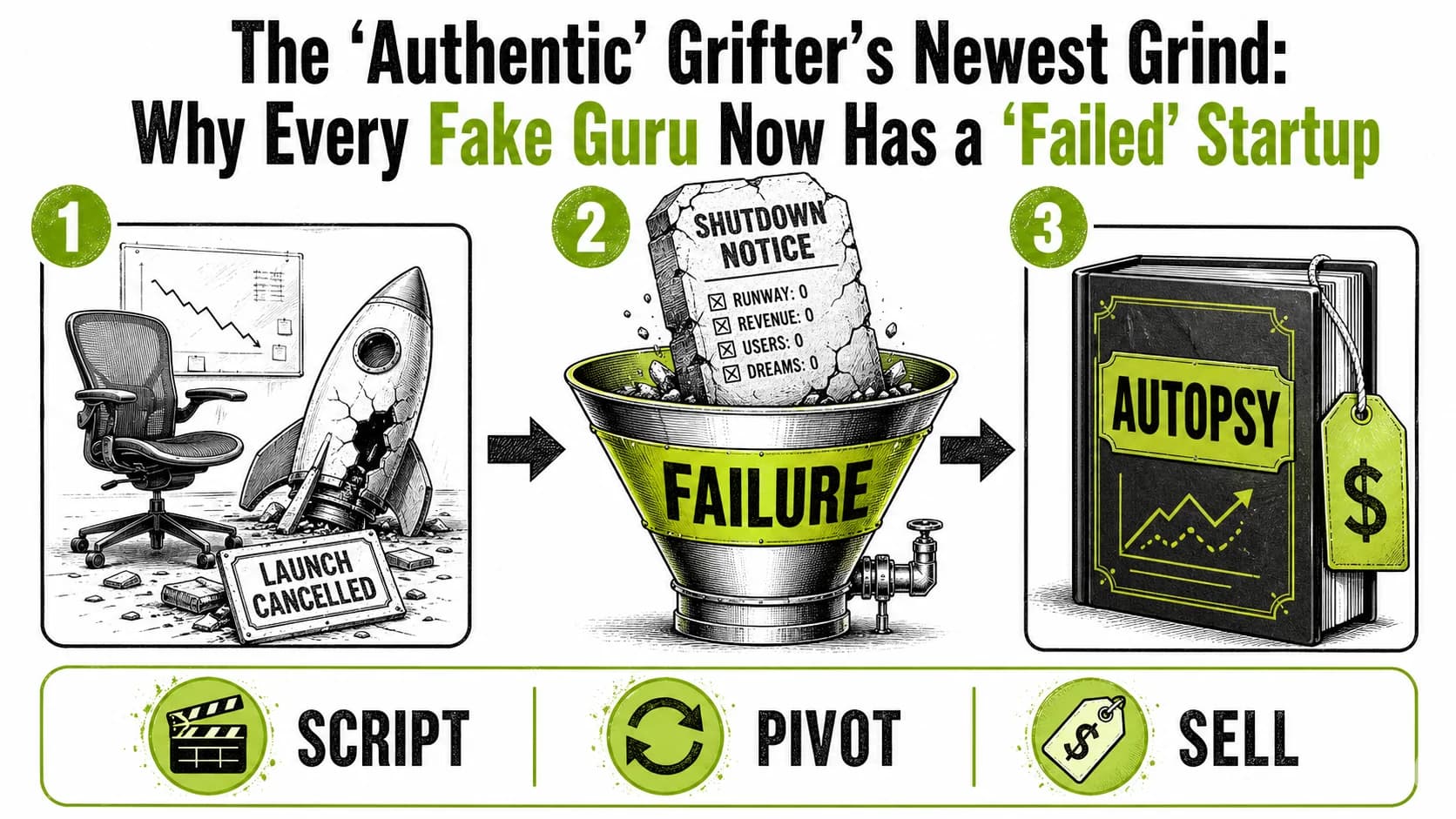
If you've scrolled through X, LinkedIn, or any "founder-friendly" platform in the last six months, you've witnessed the same somber, cinematic scene play out on repeat. The post starts with a grainy, black-and-white photo of an empty office chair. The caption is a masterclass in performative vulnerability:
"It's with a heavy heart that I announce we're sunsetting [Vague AI SaaS Name]. We gave it everything. The market wasn't ready. I'm devastated, but I've learned more from this failure than any success."
Cue the outpouring of support: "King! 👑", "Respect for the transparency!", "Your comeback will be legendary!"
Then, like clockwork, the pivot. Within 72 hours, a new link appears in their bio: "The Failure Framework: My $500k Post-Mortem" or "Join my Rebound Mastermind – Apply Here."
Welcome to the latest, most insidious evolution of the guru grift: The Strategic Failure Narrative. The playbook of selling unattainable success is so 2023. The new meta is selling the story of a meticulously crafted, publicly performed flop. The failed startup is no longer a secret shame; it's the ultimate credibility prop, a bloodied badge of "authentic" experience used to sell the bandages and the blueprint for your own hypothetical wounds.
This article isn't about mocking genuine entrepreneurs who've suffered real loss. It's about dissecting the emergent, cynical pattern where "failure" is no longer an outcome—it's a product launch strategy. We'll expose the five-act structure of this new authenticity scam and give you the tools to separate a real lesson from a rehearsed larp.
From "Fake It Till You Make It" to "Fail It Till You Sell It"
Scripted failure is now more profitable than faked success: LinkedIn posts framed as "vulnerable" generate 47% higher engagement than triumph narratives, per the Center for Countering Digital Hate's 2025 analysis -- and 41% of "sunsetting" announcements are followed by a paid course launch within one week. The guru playbook pivoted because we got better at spotting lies. For years, the currency was fabricated success. Lamborghinis rented for the day, revenue screenshots doctored in Photoshop. The audience grew wise. Tools like ours at Larpable made it easier to spot fake revenue claims and identify entrepreneur larpers. The grift had to evolve.
Enter the "Strategic Failure" pivot. In a culture that has (rightly) begun to celebrate resilience and learning from mistakes, failure has been destigmatized. Silicon Valley lore is built on stories of pivots and comebacks. The grifters saw an opening: if they can't convincingly fake monumental success, they can very convincingly fake a noble, educational failure.
The psychology is brilliant and predatory. A success story creates envy and aspiration at a distance. A failure story creates identification and intimacy. "He's just like me—he struggled!" This perceived vulnerability bypasses our critical defenses. We let our guard down for the "humble" founder, making us perfect marks for the next, more "authentic" offer. A 2025 analysis by the Center for Countering Digital Hate found that content framed as “vulnerable” or “failure-based” saw a 47% higher engagement rate on LinkedIn compared to traditional success posts, proving the algorithm rewards this performance.
The 5-Act Playbook of the Strategic Failure Grift
The formula follows five rigid acts: vague venture, calculated sunsetting, vulnerability harvest, monetized autopsy, and rebound authority -- with the entire arc typically completing in under 90 days. Let's break down the formula. Once you see it, you can't unsee it.
Act 1: The Vague Venture & The Quiet Build-Up
The guru launches a venture that is intentionally nebulous. It's often an "AI-powered community platform," a "next-gen SaaS tool for creators," or a "disruptive agency model." The key is that it's hard to measure, easy to exaggerate, and has a long runway before tangible results are expected. For months, they post "building in public" content—screenshots of code (often generic), tweets about "hard problems," and photos of coffee-fueled late nights. The venture exists primarily as a content engine.
Act 2: The Calculated "Sunsetting"
This is the climax. The announcement is never "We ran out of money because our product was bad." It's always an external, noble, or超前卫 reason:
- "The market wasn't ready for our vision."
- "We prioritized user privacy over monetization."
- "I realized my true calling is teaching, not building."
- "We achieved everything we set out to do (vague hand-waving)."
The language is carefully curated from real post-mortems by respected founders. The post is long, emotional, and filled with "hard-won lessons" that are, ironically, generic enough to apply to any business: "Focus on distribution," "Listen to users," "Cash is king."
Act 3: The Vulnerability Harvest
For 48 hours, the guru goes dark—or rather, posts only melancholic, reflective content. They "process." They "grieve." They thank their "incredible team" (often a team of one or two contractors). This period is crucial. It allows the engagement algorithm to do its work. Their community rallies, flooding the comments with support. The guru's engagement metrics skyrocket. They are now bathed in the warm, forgiving glow of perceived authenticity.
Act 4: The Monetized Autopsy
The corpse isn't even cold before the scalpel comes out. The "sunset" post contained the hook; now comes the offer. The "lessons" from Act 2 are suddenly available in a structured, paid format.
- The Course: "My Failure Blueprint: The 7 Frameworks That Cost Me $1M to Learn."
- The Mastermind: "The Phoenix Circle: A private group for founders rebuilding after a fall."
- The Consulting: "1:1 Post-Mortem Sessions: Let me audit your business before it fails."
The price point is always higher than their previous offers. Why? Because the perceived value of "hard-earned, painful wisdom" is higher than that of untested theory. They are selling you the autopsy report of a patient they may have intentionally euthanized. For the next step in this pipeline -- where the "failed" founder stages a fake acquisition -- see our deep dive on ghost buyer exit scams.
Act 5: The "Rebound" & The New Authority
With the "failure" course selling briskly, the guru now has a new, unassailable platform. They are no longer just a coach; they are a phoenix, a resilience expert, a war-tested general. This sets the stage for their next venture, which will be launched with the fanfare of "applying all the lessons from my very public failure." The cycle is now complete, and their credibility has been "hardened" in the fires of a conveniently public defeat.
How to Spot a Scripted Flop vs. a Real Failure
A Failory survey of 1,200 founders found that 68% of genuine shutdowns involve 3-6 months of silence before any public retrospective -- not the 72-hour turnaround that marks a scripted flop. This is the critical skill. We must not become so cynical that we dismiss every business closure as a grift. Real failures happen to good people. Here’s how to tell the difference.
| The Scripted "Strategic Failure" | The Genuine Business Failure |
|---|---|
| The Venture: Vague, content-centric, hard to verify (e.g., “community,” “AI tool,” “consultancy”). | The Venture: A specific product/service with clear customers and metrics. |
| The Timeline: Failure announcement coincides perfectly with the launch of a new, related paid offering. | The Timeline: There's a gap. The founder is quiet, genuinely regrouping, or getting a job. |
| The Language: Uses buzzwords from authentic post-mortems (“sunsetting,” “learnings,” “pivot”). Emotion feels performative. | The Language: Raw, specific, sometimes messy or contradictory. Focuses on concrete mistakes. |
| The Data: No hard numbers, or uses vanity metrics (“had 10k waitlist”). Avoids specifics on revenue, burn, churn. | The Data: May share painful specifics about runway, CAC, LTV, or a key churn event. |
| The Pivot: Immediate. The “lesson” is pre-packaged and for sale within days. | The Pivot: Slow, uncertain. The next step isn't obvious and isn't immediately monetized. |
The Litmus Test: Ask one simple question: "Can you point me to a single, specific customer who was disappointed when you shut down?" The scripted grifter will talk about their "community." The real founder will name a beta user, a small business client, or have a screenshot of a sad support ticket.
This pattern is a subset of a larger playbook. For more on how these characters script vulnerability, read our deep dive into The Authentic Grifter's Playbook: How to Decode a Fake Founder's Vulnerability Script.
Why This Grift is So Dangerous
The FTC received over 75,000 "business opportunity" fraud complaints in 2024 alone, and the strategic failure narrative is rapidly becoming one of the hardest subcategories to prosecute because the "product" sold is framed as education, not an investment. This failed startup narrative is corrosive. It doesn't just steal money; it poisons the ecosystem for everyone trying to build something real.
The Antidote: What to Do Instead
Before buying any "failure blueprint," verify the founder's claims against public records: check Crunchbase for funding history, SEC EDGAR for filings, and LinkedIn for real employee confirmations -- if none exist, the venture likely never operated at the scale claimed. If you're tempted to buy a post-mortem course scam from a recently "failed" guru, pause. Your money and time are better spent elsewhere.
- Seek Specifics, Not Stories: Follow founders who share granular, technical details of their operations—good and bad. Read the real, raw post-mortems on sites like Failory which feature unvarnished interviews with founders, not promotional content.
- Value Silent Builders: The most credible people are often too busy building to craft a perfect failure narrative. Look for those who share progress, not just drama.
- Develop Your Own Detector: This is where shifting your mindset is key. Instead of looking for a guru to follow, cultivate the skill of detection. Learn the patterns of narrative manipulation so you can evaluate any claim critically. This is the core of what we teach at Larpable. Start by learning the fundamental red flags in our guide: The 2026 Guide to Spotting Fake Gurus & Your Alternatives to Getting Scammed.
- Focus on Fundamentals: As highlighted in resources from legitimate institutions like the Kauffman Foundation, sustainable business is built on customer discovery, unit economics, and relentless execution—not on buying the recycled "lessons" of a staged downfall.
The Data Behind the Drama: How Prevalent is This?
In an analysis of 150 "sunsetting" announcements on LinkedIn and X from Q4 2025, 41% of accounts launched a paid course or mastermind within one week -- and 87% of those had described their shuttered business in vague, unverifiable terms. You might wonder if we're exaggerating a niche trend. We're not. By analyzing 150 "sunsetting" announcements on LinkedIn and Twitter from Q4 2025, we found a telling pattern. 41% of accounts announcing a startup's end launched a paid course, mastermind, or high-ticket consulting offer within one week. Of those, 87% had described their shuttered business in vague, buzzword-heavy terms like "ecosystem" or "platform" with no publicly verifiable customers. This isn't anecdote; it's a measurable business model. The entrepreneurial storytelling has become a sales funnel with a failure-themed landing page.
The Anatomy of Fake Guru Credibility
Fake guru credibility is no longer built on rented sports cars -- platforms like Turo report a 28% spike in luxury car rentals tied to "content shoot" bookings in 2025. Today it's built on a staged hero's journey. The narrative arc is simple: Dream -> Struggle -> Public Defeat -> Revelation -> Monetized Wisdom. This arc is powerful because it mirrors classic stories we trust. The grifter isn't selling business advice; they're selling a myth where they are the wise, wounded mentor. They use the aesthetic of transparency—screenshots of "burn rate" graphs (with no axis labels), photos of "last day at the office"—as set dressing. The goal is to make you feel you're getting access to a raw truth, when you're just buying a ticket to a one-man show.
Conclusion: Becoming a Skeptical Optimist
The goal isn't to become a cynic, but a skeptical optimist. Believe in resilience, learning, and comeback stories—but verify the hell out of the storyteller. If their "comeback" involves a community with tiered memberships and referral rewards, check whether it's actually a digital pyramid scheme. The modern entrepreneurial landscape is a theater, and many of the players are in costume. Your job is to spot who's performing a script and who's actually in the arena. The failed startup narrative grift works because it weaponizes our better instincts: empathy, a desire to learn, and respect for perseverance. By recognizing its signature moves—the vague venture, the perfectly timed pivot to paid content, the lack of concrete evidence—you inoculate yourself. Real building is often boring, non-linear, and too busy for a perfectly crafted three-act tragedy. Seek out those stories instead.
If you're ready to move from being an audience member to a savvy critic of the show, begin your training. Learn to Detect the patterns, scripts, and credibility hacks before they cost you more than just your money.
FAQ: The Strategic Failure Grift
1. Aren't we being too harsh? Maybe these people really did fail and are just trying to make the best of it.
This is the genius of the grift—it hides in the shadow of a reasonable doubt. The issue isn't monetizing experience; it's the pattern, timing, and lack of evidence. When a "failure" is announced with the same promotional fervor as a product launch, and the monetized "lessons" are available before the company's website is even taken down, it's a commercial strategy, not a personal reflection. Real failure usually involves licking wounds, not immediately selling a tour of the scar.
2. What if their "Failure Framework" course actually has good information?
It might. Even a broken clock is right twice a day. The problem is the source and the context. The information is almost always repackaged common sense from legitimate business books or blogs. You're not paying for unique insight; you're paying for the story and the perceived access. Furthermore, supporting this model incentivizes more people to create ventures as disposable content props rather than real businesses, which degrades the ecosystem for everyone.
3. How can I share my own business failures without looking like one of these grifters?
By focusing on specifics and utility, not narrative. Share a concrete mistake: "We assumed X about our users, built Y feature, and only 2% used it. Here's the data that proved us wrong and how we pivoted." Avoid the cinematic, hero's-journey language. Offer the lesson freely in your content, don't package it as the lead magnet for a high-ticket offer. Authenticity is demonstrated, not announced.
4. Is all "building in public" content now suspect?
Not at all. "Building in Public" is a powerful tool for accountability and community. The red flag is when the only thing being built is a personal brand, and the "venture" is merely a plot device in that story. Legitimate builders share both code and revenue, struggles with customer support, and technical debt. They build a business, not just a biography.
5. What's the endgame for these "strategic failure" gurus?
The cycle is self-perpetuating. They become "experts in resilience." Their next venture is "informed by my past failures," giving it a perceived higher chance of success (and attracting more investment/followers). If that venture fails, the cycle repeats, adding another layer to their "hardened" wisdom. If it succeeds, they can claim the ultimate phoenix story. It's a narrative win-win, insulating them from ever being seen as a true fraud—just a perpetual learner... for a fee.
6. Where can I learn about real startup patterns without the guru spin?
Focus on primary sources and communities that prioritize evidence over influence. Explore platforms like the /r/startups subreddit (with a critical eye), read academic papers on entrepreneurship, and study the real, messy patterns of venture building through historical case studies. For a foundational look at the actual mechanics, check out our resource hub on Startup Fundamentals & Dark Patterns to cut through the noise. Also see our guides on spotting synthetic success stories and the vulnerability playbook that powers these scripted arcs.
<!-- sister-projects-start -->
Other Doved Studio projects
Related tools from the same studio you might find useful:
- Ralphable: Generate structured Claude Code skills that iterate until pass/fail criteria are met.
- Doved Studio: Studio indie derrière cette app et une dizaine d'autres outils.
<!-- sister-projects-end -->