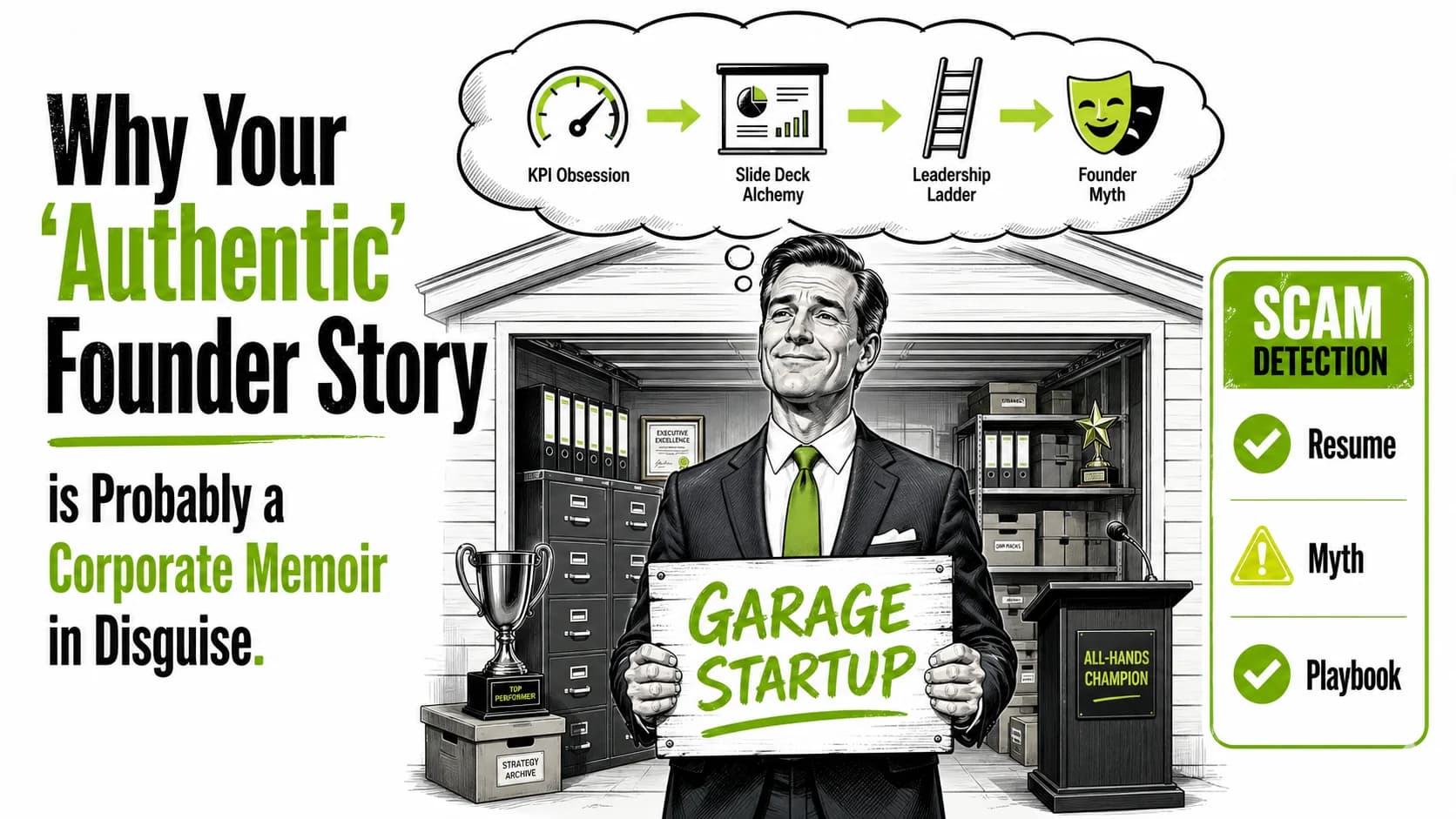
You know the story. It’s 2026, and your LinkedIn feed is a graveyard of polished despair. Another wave of tech layoffs has hit, this time from legacy giants trying to pivot to AI. The posts are identical: a somber, reflective tone, a photo of a coffee cup on a wooden desk, and a promise of a new, "authentic" chapter. The former VP of Growth at a Fortune 500 company is now, apparently, a bootstrapped founder who just "saw a problem and had to solve it."
This isn't a mid-life crisis. It's a rebrand. A specific, calculated narrative grift where a decade of corporate ladder-climbing is laundered into a founder myth of scrappy independence. The playbook is simple: take the McKinsey frameworks, the Salesforce sales methodologies, and the corporate politicking skills, then wrap them in the aesthetic of a garage startup. Sell it as a personal epiphany. The goal isn't to build a product; it's to build an audience to sell the process of building a product—a process that looks suspiciously like their old corporate job, just with more hoodies.
This article dissects the anatomy of the corporate founder rebrand. We'll trace the formula from layoff announcement to "thought leader" status, identify the tells that give away the fake authenticity, and explain why this specific type of founder storytelling is more dangerous than the classic "guru." It's not a wild-eyed charlatan selling magic beans. It's a seasoned operator selling you a repackaged corporate playbook, and they're better at hiding the receipts.
What is the Corporate Memoir Grift?
The corporate memoir grift is a narrative laundering operation where ex-executives erase institutional advantages from their story and repackage a conventional corporate career as a self-made founder myth. The FTC's 2025 enforcement actions against misleading income claims in online coaching confirm this is now a regulatory concern, not just a cultural one.
![Screenshot of a LinkedIn profile showing a headline transition: "Former Director of Strategy @ BigCorp Inc." is crossed out, and below it reads "Founder & CEO @ AuthenticStartup | Building the future of [vague buzzword]". The profile banner is a generic photo of a mountain peak.](GENERATE_IMAGE: screenshot of a LinkedIn profile showing the before-and-after of a corporate to founder rebrand, with crossed-out corporate title and new founder title)
At its core, the corporate memoir grift is a narrative laundering operation. It’s the process by which an individual with a conventional, often privileged, corporate career systematically erases the institutional advantages of that career to construct a public identity of a self-made, visionary founder. The output is an authentic founder story that feels personal and relatable, but the inputs are entirely procedural and impersonal.
The grift works because it exploits a cultural tension. On one side, there's a deep, justified skepticism of large corporations—seen as bureaucratic, soul-crushing, and slow. On the other, there's a romantic ideal of the founder—the visionary, the risk-taker, the maker. The corporate escapee positions themselves perfectly in the middle: they have the "real-world" experience and operational rigor of the corporate world (which they now critique), paired with the supposed freedom and authenticity of the founder. It's a compelling, and highly marketable, contradiction.
Let's break down the key components of this narrative formula:
| Narrative Element | Corporate Reality | Laundered "Authentic" Version |
|---|---|---|
| The Catalyst | Layoff, missed promotion, corporate restructuring. | A "crisis of conscience," a moment of clarity that the "old way" was broken. |
| The Skills | Mastery of internal politics, budget forecasting, PowerPoint, managing upward. | "Strategic vision," "capital efficiency," "storytelling," "building high-performance teams." |
| The Network | A Rolodex of vendors, consultants, and other mid-level executives from industry conferences. | "A trusted circle of advisors," "a community of fellow builders." |
| The Capital | A substantial severance package, stock vesting, and spouse's income. | "Bootstrapped from my savings," "betting on myself." |
| The Product | A SaaS tool that automates a process they oversaw at their old company. | "A passion project born from my own frustration." |
The danger isn't that they were corporate. Many excellent founders come from that world. The danger is the erasure and repackaging. The grift lies in claiming the struggle and insight of a true outsider while quietly leveraging every insider advantage.
The Three-Act Structure of a Fake Origin Story
Every compelling story needs structure, and these rebrands follow a Hollywood-ready three-act play.
Act I: The Rebellion. The story opens with the protagonist in the belly of the beast. They describe the "ivory tower" decisions, the pointless meetings, the innovation-stifling bureaucracy. There's always a specific, anecdotal "last straw"—a tone-deaf executive memo, a killed project that "would have changed everything." This act establishes their credibility ("I was there, I saw the rot") and their moral high ground ("I couldn't be part of it anymore"). It frames their departure not as a termination but as an escape.
Act II: The Revelation. This is the "garage" moment, though the garage is a well-appointed home office. They describe a period of deep, almost spiritual, searching. They reconnected with "why" they got into the business in the first place. They talk about talking to "real users" and discovering a "pain point so obvious" the big companies missed it. This act transforms corporate skills into founder insights. That budget model becomes "lean financial planning." That stakeholder presentation becomes "visionary storytelling." The authentic grifter's playbook is in full effect here, teaching how to perform vulnerability as a sales tactic.
Act III: The New Gospel. The protagonist has seen the light, and now they must spread it. They are not just building a company; they are "building a movement" or "challenging the status quo." Their LinkedIn content shifts from corporate updates to philosophical threads on agility, authenticity, and the future of work. The product—often a course, a community, or a consultancy—is positioned not as a commodity, but as the key to unlocking the same "freedom" and "impact" they have found. This is where the executive to guru pipeline is completed.
Why This Isn't Just a Career Pivot
Calling this a "career pivot" is like calling a submarine a boat. It misses the engineered depth. A genuine pivot involves skill translation and often a dose of humility—a former marketer might become a content consultant. The grift requires a narrative overhaul. It demands the individual reframe their entire professional history, not adapt it.
This is supported by a cottage industry of "personal branding" coaches and ghostwriters who specialize in this exact transformation. A 2025 report from the Columbia Journalism Review analyzed the bylines of major "founder journey" pieces in business publications and found a significant overlap with PR firms known for corporate reputation management. The storytelling is outsourced, but the signature is personal.
The goal is to achieve what sociologist Erving Goffman called "impression management" at an industrial scale. The individual is curating a front-stage performance of the ideal founder, while the back-stage machinery—the severance pay, the retained corporate network, the professional content writers—remains carefully hidden. For those trying to navigate this new landscape of influencer-founders, our 2026 guide to spotting fake gurus offers a crucial primer on separating signal from noise.
Why This Fake Authenticity Matters Now
In Q1 2026, over 50,000 tech workers were laid off according to Layoffs.fyi, creating an unprecedented supply of mid-to-senior executives with six-figure severance packages pivoting directly into coaching businesses. The SEC has flagged misleading "revenue proof" screenshots as potential securities fraud when used to solicit investment, and the FTC fined three online coaching operations a combined $4.2 million in late 2025 for deceptive earnings claims. This pattern mirrors what we track in the bootstrapped mentor corporate defector pipeline.
![A split-screen image: on the left, a headline from a financial news site reads "Tech Layoffs Surge to 50,000 in Q1 2026." On the right, a social media feed shows multiple nearly identical posts starting with "After 15 years at [Big Tech Co], I'm excited to announce my next chapter...".](GENERATE_IMAGE: screenshot comparison showing tech layoff headlines alongside identical "new chapter" founder announcement posts on social media)
The corporate memoir grift isn't new. People have been repackaging corporate experience for decades. But in early 2026, the conditions for this particular strain of narrative fraud are perfect. It's not just an individual choice; it's a systemic output. Understanding why this matters requires looking at the collision of economic forces, media dynamics, and audience psychology.
First, the supply is unprecedented. The tech layoff waves of 2024-2026, particularly from non-tech legacy companies scrambling for AI relevance, didn't just create unemployed workers. They created a specific class of unemployed: mid-to-senior level managers and executives with substantial severance packages (often 6-12 months of salary), fully vested stock, and a professional identity entirely tied to a single corporation. They have capital, they have time, and they have a sudden, gaping hole where their LinkedIn headline used to be. This cohort isn't looking for another job; they're looking for a new identity. Founding something—or appearing to found something—is the most prestigious identity available.
Second, the media machine is primed for it. Business journalism has always loved a neat narrative. The "corporate escapee finding true calling" is a editor's dream: it's relatable, it's aspirational, and it fits perfectly into a 800-word profile. Publications like Forbes' "Next 1000" or TechCrunch's "Founder Stories" need a constant stream of subjects. A former Fortune 500 director with a slick website and a compelling "why" is a far safer, more professional interview than a 22-year-old with a chaotic, actual garage startup. The media legitimizes the grift by giving it a platform, which in turn attracts more corporate refugees to the playbook. It's a symbiotic cycle.
Third, the audience is vulnerable. For the genuine aspiring entrepreneur or the disillusioned corporate employee, these stories are catnip. They offer a seemingly viable escape route. "If that VP from Salesforce could walk away and build something real, maybe I can too." The narrative sells hope, but it sells a specific, sanitized version of hope. It glosses over the sheer financial runway provided by severance, the safety net of a spouse's healthcare, and the value of a decade-long professional network. It presents a meritocratic fairy tale that is, for most people, financially impossible to replicate. This creates a market of frustrated buyers who then become the perfect audience for the grifter's next product: the course on how to do what they did.
The Real Damage: Corrupting the Idea of "Authenticity"
The most pernicious effect of this trend is the corruption of the very concept it claims to champion: authenticity. When a meticulously crafted, professionally ghostwritten narrative of corporate disillusionment is labeled "authentic," the word loses all meaning. It becomes a marketing tag, not a state of being.
This has two concrete negative impacts:
The grift works because it offers a lower-risk, higher-immediate-reward path than actual company-building. Writing a viral LinkedIn thread about your founder journey is easier than fixing a critical bug in your app. Selling a $499 "founder mindset" course is faster and more profitable than landing your first enterprise client. The system incentivizes the performance of entrepreneurship over the practice of it. For those caught in this cycle, whether as performer or audience, understanding the toolkit of the startup larper -- from fake revenue screenshots to online course scam checklists -- is the first step toward breaking free.
How to Spot a Corporate Memoir in Disguise: A Step-by-Step Guide
Five forensic checks -- timeline autopsy, jargon decoding, aesthetic audit, product-to-audience pipeline mapping, and pain-point pressure testing -- will expose a repackaged corporate memoir within 30 minutes. Tools like Crunchbase, Wayback Machine, SimilarWeb, and WHOIS lookups do the heavy lifting. For a companion checklist on revenue proof specifically, see our guide to spotting fake revenue screenshots.
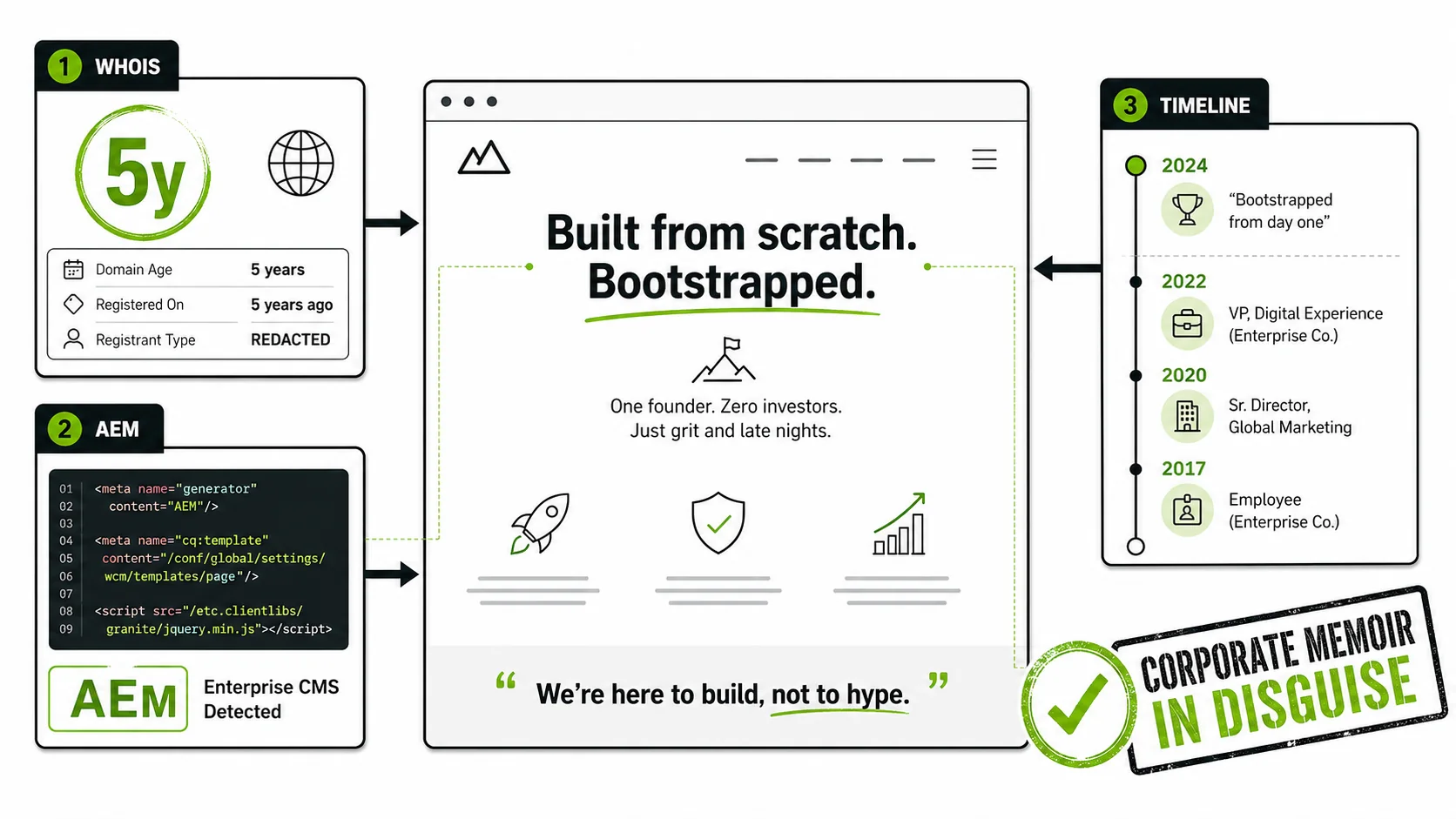
Spotting this grift requires moving beyond the narrative and examining the forensic evidence. The story will be polished. The tells are in the infrastructure, the language, and the timeline. Here is a methodical approach to dissecting a suspect "authentic founder" story.
Step 1: Conduct a Timeline Autopsy
The origin story is always about a recent, dramatic break. Your job is to reconstruct what came before.
- Tool: LinkedIn, Crunchbase, and the Wayback Machine (archive.org).
- The Tell: A radical, total rebrand that happens within a 3-6 month period following a layoff announcement. All previous corporate content is either deleted or reframed. The narrative presents the founder journey as a clean break, with no evidence of a gradual, organic shift in interest.
Step 2: Decode the Jargon Shift
Corporate refugees don't shed their language; they translate it. They have a deep thesaurus for making corporate concepts sound indie.
- Tool: Your own ears and a critical eye.
- Action: Listen for euphemisms. Create a mental translation key.
* "Optimizing KPIs" becomes "focusing on meaningful metrics."
* "Managing stakeholder expectations" becomes "community building."
* "Blue-sky thinking" becomes "vision sessions."
* "Portfolio diversification" becomes "building in public."
- The Tell: The underlying thinking is still hierarchical, process-obsessed, and focused on optics. They talk about "building a personal board of advisors" instead of finding friends who give good advice. They discuss "content strategy" instead of sharing things they find interesting. The human element is always processed through a professional framework. This is a core tactic outlined in our guide to decoding a fake founder's vulnerability script, where emotional language is deployed strategically, not authentically.
Step 3: Audit the "Bootstrapped" Aesthetic
The visual brand is carefully designed to signal "anti-corporate," but the production value betrays it.
- Tool: Basic web sleuthing.
- Action:
2. Inspect the design: Is the website too perfectly minimalist? Does it use a bespoke, custom typeface that costs $500/year? Does the "simple" logo have multiple refined lockups? A genuine early-stage founder uses Carrd, Webflow, or a default Shopify theme. A corporate grift often uses a pricey agency or an enterprise-grade platform like WordPress with a heavily customized premium theme.
3. Analyze the content: Are the "casual" photos professionally lit and shot? Is the "off-the-cuff" video podcast recorded with a multi-camera setup, professional audio, and branded lower-thirds? High production value early on is a signal of capital, not traction.
- The Tell: A dissonance between the "scrappy" messaging and the polished, expensive-looking execution. It screams "severance package funded," not "customer revenue funded."
Step 4: Follow the Product-to-Audience Pipeline
What are they actually selling? And to whom?
- Tool: Examine their product offerings and email lists.
- Action: Map their business model.
Is their primary call-to-action to "join the waitlist" or "join our community" rather than to use* a specific tool or service?
* Who is in their audience? Scroll through their Twitter or LinkedIn commenters. Are they other aspiring founders, corporate employees, and "personal brand" enthusiasts? Or are there actual customers from a specific industry using their core product?
The Tell: The business is meta. It's a business about business. It targets people who want the identity* of a founder (often other corporate escapees) rather than solving a concrete problem for an external market. The revenue comes from selling the dream, not from a product that delivers independent value. This is a hallmark of the ecosystem we track in our broader analysis of the startup hub phenomenon, where the activity of startup culture often outweighs the output.
Step 5: Pressure-Test the "Pain Point"
The foundational myth is always a personal, visceral pain point they experienced.
- Tool: Socratic questioning.
- Action: Ask blunt questions about the origin.
"If this pain was so widespread in your industry, why did it take you* leaving to see it? What about the thousands of other people still in those jobs?"
* "Is your first customer you, or is it someone who never had your corporate title or resources?"
- The Tell: The answers are vague, philosophical, or circle back to the "broken corporate system." They cannot provide a specific, credible reason why someone with their former resources and position was powerless to address the problem internally. The pain point often feels abstract—"alignment," "communication," "strategy execution"—rather than a tangible, technical, or operational snag.
This five-step process won't just identify grifters. It will also help you identify the rare, genuine corporate escapee who is actually building something new. The genuine article will have a messy timeline, a product that exists for non-founders, a less polished aesthetic, and answers about the pain point that are specific, humble, and focused on the customer, not their own hero's journey.
Advanced Strategies: Building Immunity to the Narrative
Four cognitive defenses -- the Ancillary Revenue Test, incentive reverse-engineering, contradictory evidence seeking, and execution archaeology -- will make you functionally immune to narrative-based sales pitches. A 2025 Stanford Digital Economy Lab study found that founders who applied structured skepticism frameworks were 62% less likely to purchase high-ticket coaching ($2,000+) with no measurable ROI. These same patterns appear in the authentic grifter's vulnerability playbook and in how to spot a synthetic success story.
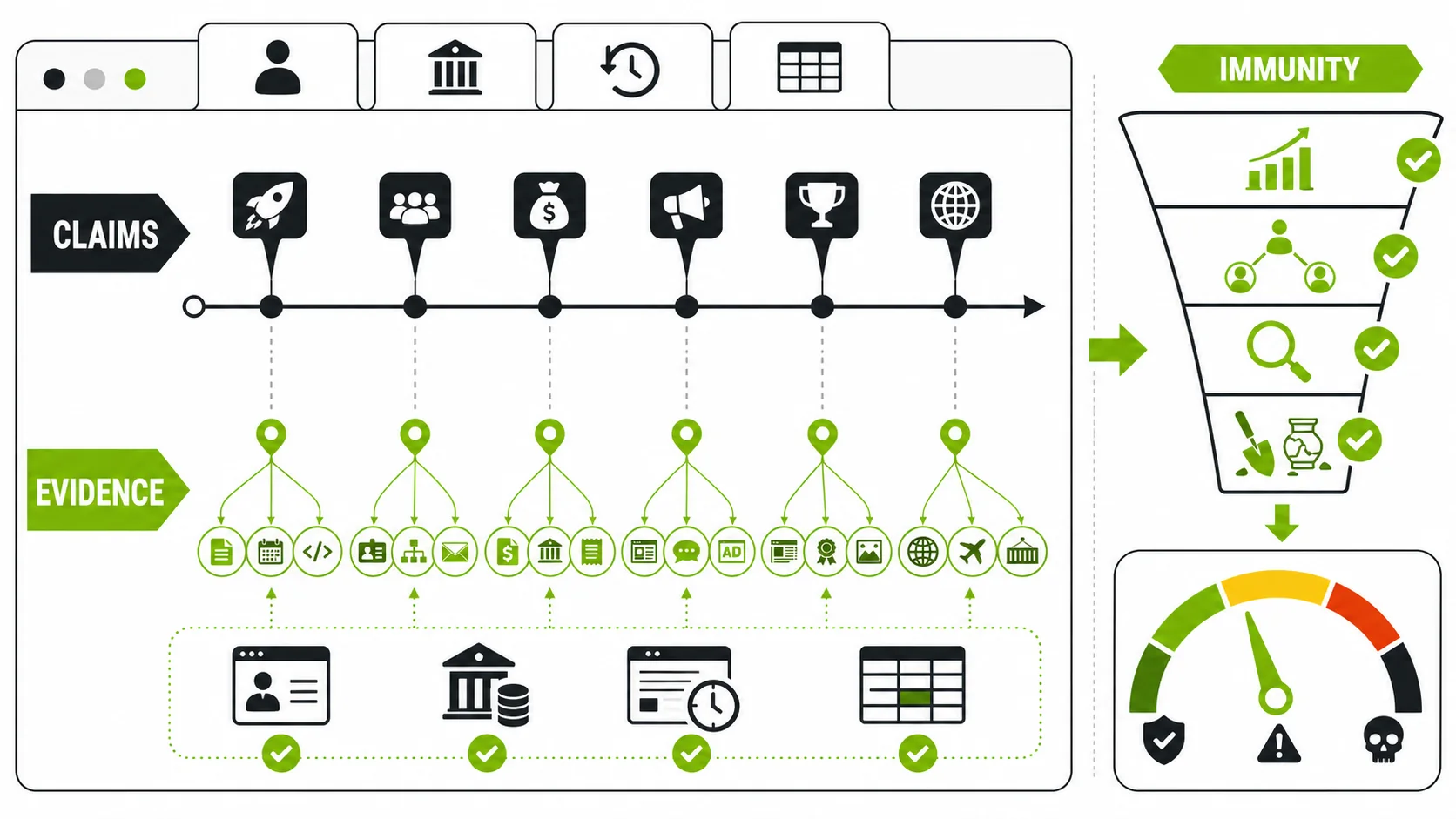
Once you can spot the grift, the next step is to build cognitive immunity so you're not subconsciously influenced by it. This isn't about cynicism; it's about developing a more sophisticated framework for evaluating founder stories and business advice. Here are advanced tactics to rewire how you consume entrepreneurial content.
Tactic 1: Apply the "Ancillary Revenue" Test
This is the single most effective filter. Before taking advice from a founder, determine their primary source of revenue.
Implementation: When you encounter a compelling founder story, immediately ask: "What does this company sell to people who are not* interested in becoming founders?" If the answer is "nothing" or "a course on marketing," you are not looking at a traditional business. You are looking at a pedagogical enterprise where the founder's experience is the product.
- Why it works: It separates practitioners from preachers. A founder whose SaaS tool is used by 10,000 e-commerce stores has incentives aligned with product performance. A founder who sells a "founder coaching program" has incentives aligned with narrative performance. The former must solve a real problem for others. The latter must make their own path seem replicable and desirable. Advice from the first group is grounded in market reality. Advice from the second is grounded in sales conversion reality.
Tactic 2: Reverse-Engineer the Incentives
Every piece of content, every thread, every podcast appearance has a purpose. Don't just listen to what is said; ask why it is being said now.
- Implementation: Map the content to the business funnel.
* A deep-dive case study on their website is middle-of-funnel, designed to build credibility for a specific service.
* A webinar about "funding strategies" is a bottom-of-funnel sales event for a high-ticket course or mastermind.
- Why it works: It demystifies "generosity." Much of the free, valuable content from grifters is a loss leader. Understanding its place in a sales machine allows you to extract the useful bits while remaining aware of the commercial context. It also helps you spot when advice is being simplified or dramatized to fit a narrative that sells, rather than to reflect a complex truth.
Tactic 3: Seek Contradictory Evidence
A robust narrative suppresses contradiction. Your job is to seek it.
- Implementation: Actively look for information that doesn't fit the hero's journey.
2. Check the edits: Some platforms (like certain podcast show notes) show edit history. Was the story subtly changed between versions?
3. Look for the old product: Many of these founders have previous, failed "passion projects." What were they? Often, they reveal a different, earlier narrative that conflicts with the current one.
- Why it works: It moves you from a passive consumer of a story to an active investigator. The grift depends on a unified, controlled narrative. Any crack in that facade is revealing. Finding that their former team remembers them as a staunch defender of the very processes they now condemn is a major red flag.
Tactic 4: Value Execution Archaeology Over Vision Statements
Anyone can craft a beautiful vision statement. Very few can show the messy, iterative, unglamorous steps that got them from Day 1 to Day 500.
- Implementation: Discount the "future of work" pronouncements. Instead, prize concrete, tactical details about past actions.
* Suspect: "We believe in a human-centric future of distributed work."
* Valuable: "Our landing page converted at 0.5%. We changed the headline, the hero image, and the CTA button color. Here are the A/B test results."
* Suspect: "Brand storytelling is the most important skill of the 21st century."
- Why it works: Execution is hard to fake. Vision is cheap. The corporate memoir grift is heavy on vision and philosophy (skills honed in boardrooms) and light on granular, tactical execution details (the messy work of real building). Prioritizing the latter automatically filters for practitioners. This focus on the tangible mechanics of building is what separates useful resources from the generic playbook of the authentic grifter. If you suspect your mentor's "secret sauce" is borrowed rather than built, our breakdown of why your mentor's framework is probably a leaked corporate playbook traces the exact laundering pipeline.
Building this immunity does more than protect you from bad advice. It recalibrates your own compass for what matters in building something substantive. You start to value incremental progress over dramatic announcements, customer validation over personal branding, and reproducible systems over inspirational rhetoric.
Got Questions About Corporate Founder Rebrands? We've Got Answers
How long does it typically take for a corporate rebrand to a "founder" to become profitable?
Most corporate-to-guru rebrands generate their first $10,000-$50,000 within 3-6 months through paid newsletters, founder circles, or introductory courses -- but this revenue ceiling rarely translates into a sustainable product business. The initial "profit" often comes not from a product but from the rapid monetization of the audience itself. Through paid newsletters, early-access "founder circles," or introductory courses, many of these rebrands generate their first $10k-$50k within 3-6 months. This is enabled by their existing LinkedIn network of corporate peers who are both curious and have disposable income. However, this is usually a ceiling. Building a sustainable, product-driven business that reaches true profitability (covering a market-rate salary for the founder) typically takes 2-3 years, if it happens at all. Many rebrands stall after the initial audience monetization is exhausted.
What's the biggest mistake people make when evaluating these founder stories?
The biggest mistake is accepting the narrative's framing of time and struggle. The story compresses years of corporate career-building—which provided financial security, network, and skill—into a prologue, and then presents the last 6 months of "bootstrapping" as the heroic main event. This creates a distorted view of risk and opportunity. People see the 6-month "struggle" and think, "I could do that," without accounting for the 10-year corporate safety net that made the 6-month gamble possible. They compare their own ground-zero position to someone who started from base camp.
Can a corporate background ever be an authentic advantage for a founder?
Absolutely, and many of the world's best founders have corporate experience. The authenticity isn't determined by the background itself, but by how it's integrated. A genuine founder leverages their corporate experience transparently: "I spent 8 years at Procter & Gamble, so I understand brand architecture and supply chain logistics, which helped me launch this CPG brand. But I had to learn digital marketing from scratch." The grift hides the corporate past or repackages it as a spiritual awakening. The authentic founder uses their past as a specific toolkit, not as a mythological origin story.
Should I avoid all advice from founders who have this background?
Not at all. The key is to triage the advice based on its nature. Treat visionary, philosophical, and "mindset" advice from this cohort with extreme skepticism—it's often repackaged corporate leadership training. However, their tactical, operational advice can be gold. A former finance director might give brilliant, specific advice on SaaS unit economics or cap table management. A former engineering manager might have deep insights into agile development for small teams. Consume the tactical, discard the theatrical. Focus on the "how" and verify it against other sources, not the "why," which is likely a sales narrative.
Ready to see through the polished founder facade?
Larpable - Detect or Create helps you dissect the narratives, spot the recycled corporate playbooks, and protect yourself from the latest wave of guru grifts. Stop being an audience for someone else's career-rebranding story. Learn the patterns, so you can build something real—or simply avoid getting sold the same old thing in a new, "authentic" package. Apprendre à Détecter
<!-- sister-projects-start -->
Other Doved Studio projects
Related tools from the same studio you might find useful:
- Ralphable: Generate structured Claude Code skills that iterate until pass/fail criteria are met.
- Doved Studio: Studio indie derrière cette app et une dizaine d'autres outils.
<!-- sister-projects-end -->