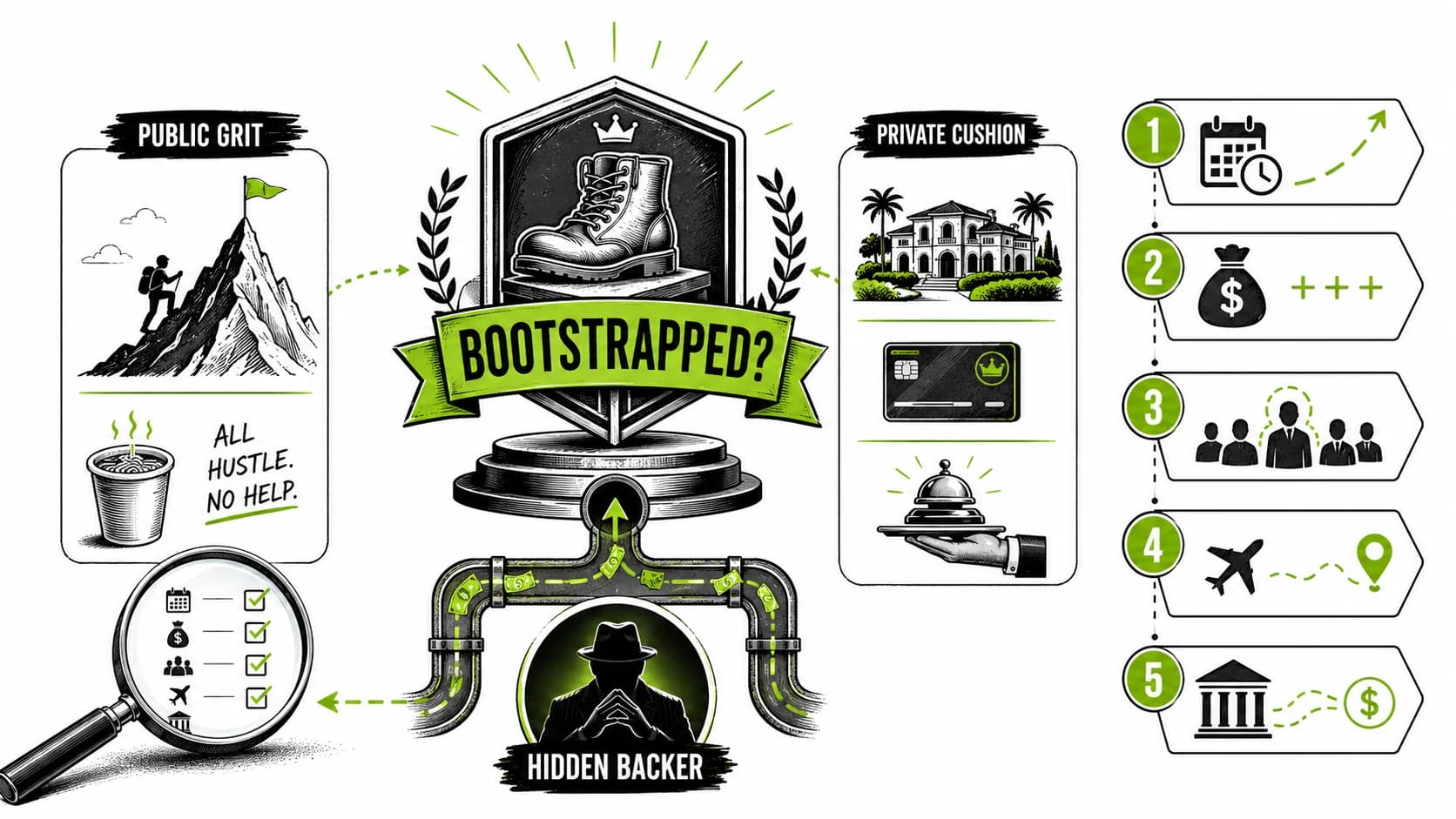
In the startup world, few labels are as coveted—or as suspiciously weaponized—as "bootstrapped." It conjures images of gritty, self-reliant geniuses, toiling away in garages and coffee shops, building empires from sheer will and ramen-fueled nights. It's the ultimate underdog story, a David vs. Goliath narrative that sells courses, builds cult-like followings, and commands premium prices for "how I did it" masterclasses.
But in 2026, the "bootstrapped" badge has become the ultimate entrepreneurial fashion accessory. It's less a statement of financial reality and more a carefully crafted marketing persona. Recent exposés, including a notable TechCrunch investigation in early 2026, have peeled back the curtain on a growing trend: the "stealth-funded bootstrap." These are founders who loudly proclaim their independence while quietly enjoying the financial cushion of a secret sugar daddy—be it a wealthy angel investor, a family office, or a venture studio operating in the shadows.
This isn't just harmless posturing. It's narrative fraud. It distorts the market, sets impossible standards for real bootstrappers, and preys on the aspirations of genuine founders who wonder why their own "garage" journey looks so much messier. This article is your decoder ring. We'll dissect the five telltale signs that your favorite "self-made" hero is playing a lucrative game of make-believe, and equip you to separate the authentic hustle from the well-funded larp.
The Allure of the Bootstrap: Why the Lie is So Profitable
Before we spot the fakes, we need to understand why the charade is so appealing. The "bootstrapped" narrative is a powerful sales and branding tool.
- Moral High Ground: It positions the founder as pure, uncorrupted by greedy VC interests, building for customers, not investors.
- Underdog Sympathy: It triggers a psychological bias where we root for the little guy, making us more forgiving of stumbles and more celebratory of wins.
- Perceived Authenticity: In an age of spray-painted "authenticity," claiming to have built something with your own two hands (and bank account) is the ultimate signal of realness.
- Monetizable Content: The story of "how I built a $10K/month SaaS in 6 months with $0" is a content goldmine for Twitter threads, YouTube videos, and paid newsletters.
The problem arises when this narrative is detached from reality. A founder with a $500,000 safety net from a rich uncle can take wild risks, hire a freelance developer from day one, and run aggressive ads—all while claiming to be a "scrappy" bootstrapper. This creates a rigged game, and the audience is the one being played.
The 5 Telltale Signs of a "Stealth-Funded Bootstrap"
Spotting a founder who's larping as bootstrapped requires moving beyond the headline and examining the subtext of their story. Here are the patterns that should trigger your skepticism.
1. The Physics-Defying Growth Timeline
This is the most glaring red flag. Real bootstrapped growth is rarely a smooth, vertical line. It's a jagged graph of trial, error, customer feedback, and slow, organic compounding.
The Larper Pattern: The founder claims to have gone from "idea" to "$50,000 MRR" in under 12 months, often while working a full-time job. The timeline feels compressed, with each milestone hitting with metronomic precision.
How to Spot It:
- Lack of Pivot Stories: Real startups pivot. The larper's story is often a linear, frictionless path from perfect idea to perfect execution.
- Instant Product-Market Fit: They talk about launching and immediately being "flooded" with paying customers, skipping the grueling months of crickets and refunds that characterize most early journeys.
- Resource Contradiction: The claimed growth would require significant upfront investment in development, marketing, or customer support—expenses that are casually glossed over. For a deeper dive into manipulated metrics, see our guide on spotting fake revenue screenshots.
Stat Check: According to a Startup Genome report, only 1.2% of bootstrapped startups reach $50K MRR within 12 months. The median time to $10K MRR for bootstrapped companies is 24 months. If your guru claims to have done it in 6 months, they're either a statistical unicorn or lying.
2. The Suspiciously Polished "Struggle" & Origin Story
Every bootstrapper mythos needs a humble beginning. The larper's version is often an aestheticized, Instagram-ready struggle.
The Larper Pattern: The "garage" or "spare bedroom" looks like a WeWork pod, outfitted with high-end audio/visual equipment from day one for pristine content creation. The "I ate ramen for a year" story is told while wearing a $300 Patagonia vest.
How to Spot It:
- Professional-Grade Early Content: Scroll to their earliest YouTube video or podcast. Is the audio crisp, the video well-lit, and the graphics professional? This costs money or requires connections.
- Name-Drop Adjacency: They constantly mention rubbing shoulders with known investors or successful founders very early in their journey, suggesting access to a network that often comes with capital.
- The Missing "Day Job" Grind: The story skips the soul-crushing details of balancing a 9-5 while coding at midnight. The timeline implies they were "full-time on the startup" suspiciously early.
Stat Check: A Buffer survey found that 68% of bootstrapped founders worked a second job for at least 18 months. If your guru was "full-time from day one" without a clear explanation of how they paid rent, that's a red flag.
3. The Team That Appears Out of Nowhere
You can't bootstrap a complex SaaS product alone at a breakneck pace. But hiring is the single biggest cash burn for a startup.
The Larper Pattern: At a key inflection point in the story, a "fantastic engineer" or "growth guru" just happens to join the mission. Their compensation is described vaguely as "sweat equity" or a "late-night agreement."
How to Spot It:
- Vague Equity Tales: Be wary of phrases like "we worked out a deal" or "they believed in the vision." Talented professionals need to pay rent. A secret cash stipend from the founder's backer often facilitates these "belief-based" hires.
- Instant Senior Hires: The first hire is a "former FAANG lead engineer" or a "ex-Google growth marketer." These people command high salaries, even at startups. Their participation signals unstated financial security.
- Lack of Contractor Chaos: Real bootstrappers rely on a rotating cast of freelancers from Upwork or Fiverr, with all the management headaches that entails. The larper's team appears cohesive and professional from the jump.
Stat Check: Data from AngelList Talent shows that the average salary for a senior engineer at a Series A startup is $150K+. If your "bootstrapped" founder hired three senior engineers in year one, that's $450K in salary alone—without benefits, taxes, or equity. Math doesn't lie.
4. Aggressive, Non-Organic Marketing from Day One
Organic growth is slow. Paid growth is fast and expensive. The choice between them is often a matter of resources.
The Larper Pattern: The founder talks about running sophisticated, scaled paid ad campaigns (Google, LinkedIn, Meta), sponsoring industry podcasts, or attending high-cost conferences in the first year—tactics that require significant and risky upfront capital.
How to Spot It:
- Jargon Without Jank: They discuss "CAC," "LTV," and "scaling paid channels" as if it were a phase anyone can just choose, not a capital-intensive gamble.
- Premature Brand Building: Early investment in expensive branding assets (professional logo suites, custom illustrations, high-production video) suggests a budget unconcerned with immediate ROI.
- Contradiction in Messaging: They preach "organic community building" but their own growth trajectory clearly indicates a heavy, behind-the-scenes paid injection. For more on the personas that use these tactics, explore our hub on startup larping patterns.
Stat Check: The FTC's 2024 Consumer Sentinel Network report found that 42% of online business opportunity complaints involved misrepresentation of funding sources. The FTC's 2024 Data Book confirms that "fake bootstrap" narratives are a growing category of fraud complaints.
5. The Strategic Omission & Deflective Language
When directly questioned about funding, the larper becomes a master of omission and misdirection.
The Larper Pattern: They never outright lie but construct a truth that leads you away from the reality. The secret backer is hidden behind layers of semantic deflection.
How to Spot It:
- "We're 100% Founder-Funded": This classic. It's technically true if the founder's personal bank account received a "gift" from a family member or a "low-interest loan" from a friend's office.
- "No Institutional VC": They loudly reject VC money to bolster their bootstrap credentials, while quietly accepting money from high-net-worth individuals (angels) who act like VCs but aren't "institutional."
- The "Advisor" Who's Really a Banker: They thank a roster of "amazing advisors," one of whom is a known investor. The financial relationship is obscured by the advisory title.
- Aggressive Pushback: When a commenter gently asks, "This seems like a lot of spend for a bootstrap," the response is often an emotional defense of their "hard work" and "sacrifice," attacking the questioner rather than clarifying the finances.
Stat Check: A Crunchbase analysis found that 23% of startups claiming "no outside funding" in their public materials had at least one undisclosed angel investor. The gap between narrative and reality is real.
Comparison Table: Real Bootstrapper vs. Stealth-Funded Larper
| Category | Real Bootstrapper | Stealth-Funded Larper |
|---|---|---|
| Growth Timeline | 18-36 months to $10K MRR | 6-12 months to $50K MRR |
| Origin Story | Messy, includes failures, pivots, and "crickets" | Polished, linear, "perfect execution" |
| Hiring | Freelancers, contractors, part-time help | Senior FAANG engineers, "vision believers" |
| Marketing | Organic content, slow community building | Aggressive paid ads, premium sponsorships |
| Funding Claims | "I maxed out credit cards" or "I saved for 3 years" | "We're 100% founder-funded" with no details |
| Response to Questions | Transparent about struggles and trade-offs | Defensive, vague, or attacks the questioner |
Why This Narrative Fraud Matters (It's Not Just Jealousy)
You might think, "Who cares? If they're building a real business, what's the harm?" The harm is multifaceted:
Stat Check: The Better Business Bureau's 2025 Scam Tracker reported a 34% increase in complaints about "entrepreneur education" products sold by founders with fabricated bootstrap narratives. That's real money lost by real people.
How to Protect Your Own Hustle & Mind
Conclusion: Stop Worshiping the Myth, Start Detecting the Fraud
The "bootstrapped" badge is a powerful signal—but only when it's real. The larpers have co-opted it to sell courses, build audiences, and crush genuine competitors. The goal isn't to become a cynical hater, but a discerning observer. The entrepreneurial landscape is filled with both genuine heroes and compelling actors. Learning to tell the difference is a critical skill for protecting your time, money, and mental health. It's about reclaiming the meaning of "bootstrapped" from the larpers and recognizing true hustle in all its messy, unglamorous glory.
If you're tired of decoding the fiction and want to systematically learn to separate the real from the fabricated, start with our foundational guide: Apprendre à Détecter.
FAQ: Bootstrapped Founder Narrative Fraud
What's the difference between a "secret investor" and just having a supportive family?
A supportive family might provide a place to live or a small loan. A "secret sugar daddy" is typically a sophisticated individual or entity providing substantial capital (often $100K+) with an expectation of return, while allowing the founder to publicly maintain a "no outside money" narrative. The key is scale, intent, and the active concealment for marketing benefit.
Are all rapidly-growing bootstrapped companies fake?
Absolutely not. Some teams are exceptionally talented and hit a viral product-market fit. The signs we outline are about patterns. A single red flag might be explainable; a founder who ticks 4 or 5 of these boxes is almost certainly benefiting from undisclosed resources. Genuine rocketships are rare, and their founders are usually stunned by their own luck, not presenting it as a predictable, replicable process.
Is it illegal to hide investors like this?
Not typically illegal, but it can venture into unethical and potentially fraudulent territory. If a founder is selling an investment opportunity (e.g., a course, a "cohort-based community") based on the false premise of their bootstrapped journey, it could constitute fraud. It also violates the trust of their audience and customers who buy into a specific, fabricated story.
How can I ask a founder about funding without being rude?
Frame it as curiosity about their strategy. You can ask: "Your early growth was so impressive—did you find a particular marketing channel that worked immediately, or did you have the budget to test aggressively from the start?" or "How were you able to support yourself and hire so early without outside capital?" Their reaction—transparent detail vs. vague deflection—will often tell you more than the answer itself.
What should I do if I realize a founder I follow is larping?
That's a personal choice. Some choose to quietly unfollow, withdrawing their attention and engagement—the currency of the modern influencer. Others may call it out publicly, especially if the founder is selling expensive advice based on the false narrative. At minimum, use it as a learning experience to sharpen your own detection skills for other guru patterns.
Are venture-backed companies more "honest"?
They are at least transparent about one source of capital and its associated pressures (growth for return). However, VC-backed founders can larp in other ways—overstating traction, vanity metrics, or the "story" of their fundraise. The core issue is the disconnect between narrative and reality, regardless of funding type.
<!-- sister-projects-start -->
Other Doved Studio projects
Related tools from the same studio you might find useful:
- Ralphable: Generate structured Claude Code skills that iterate until pass/fail criteria are met.
- Doved Studio: Studio indie derrière cette app et une dizaine d'autres outils.
<!-- sister-projects-end -->