{
"title": "Is Your 'Community-Driven' Startup Just a Digital Pyramid Scheme?",
"slug": "is-your-community-driven-startup-just-a-digital-pyramid-scheme",
"description": "Spot a community startup scam. Learn the 5 red flags of digital pyramid schemes & engagement farming in 2026's fake community culture.",
"date": "2026-03-10",
"updatedAt": "2026-03-21",
"author": "larpable",
"category": "pattern-detection",
"keywords": ["community startup scam", "digital pyramid scheme", "engagement farming", "fake community", "startup culture 2026"],
"status": "published",
"structuredData": "[{\"@context\":\"https://schema.org\",\"@type\":\"Article\",\"headline\":\"Is Your 'Community-Driven' Startup Just a Digital Pyramid Scheme?\",\"description\":\"Spot a community startup scam. Learn the 5 red flags of digital pyramid schemes & engagement farming in 2026's fake community culture.\",\"author\":{\"@type\":\"Person\",\"name\":\"larpable\"},\"publisher\":{\"@type\":\"Organization\",\"name\":\"Larpable - Detect or Create\",\"url\":\"https://www.larpable.com\"},\"datePublished\":\"2026-03-10\",\"dateModified\":\"2026-03-18\",\"mainEntityOfPage\":{\"@type\":\"WebPage\",\"@id\":\"https://www.larpable.com/blog/is-your-community-driven-startup-just-a-digital-pyramid-scheme\"},\"keywords\":\"community startup scam, digital pyramid scheme, engagement farming, fake community, startup culture 2026\",\"wordCount\":2650,\"articleSection\":\"pattern-detection\"},{\"@context\":\"https://schema.org\",\"@type\":\"BreadcrumbList\",\"itemListElement\":[{\"@type\":\"ListItem\",\"position\":1,\"name\":\"Home\",\"item\":\"https://www.larpable.com\"},{\"@type\":\"ListItem\",\"position\":2,\"name\":\"pattern-detection\",\"item\":\"https://www.larpable.com/blog\"},{\"@type\":\"ListItem\",\"position\":3,\"name\":\"Is Your 'Community-Driven' Startup Just a Digital Pyramid Scheme?\",\"item\":\"https://www.larpable.com/blog/is-your-community-driven-startup-just-a-digital-pyramid-scheme\"}]}]"
}
```
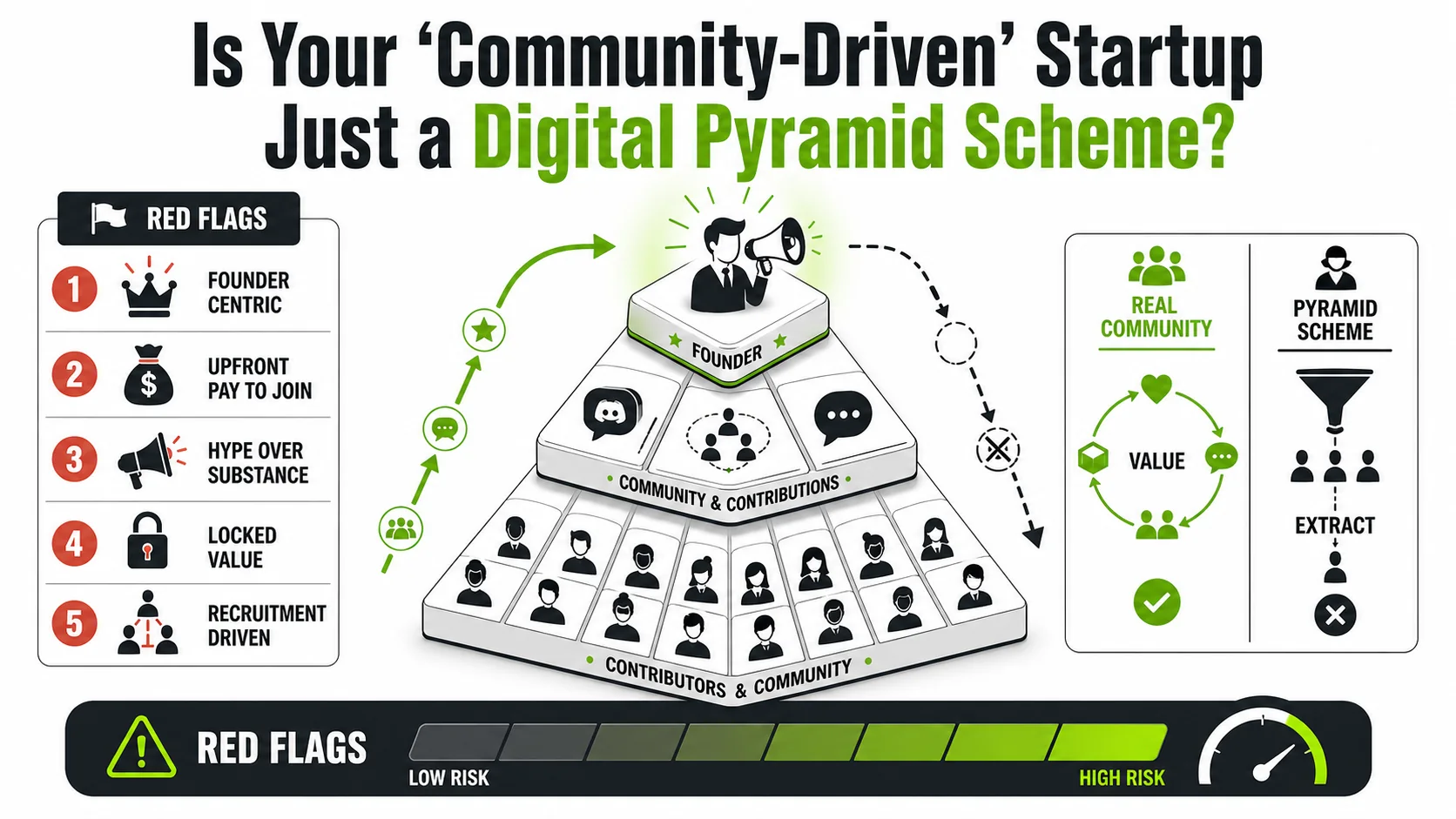
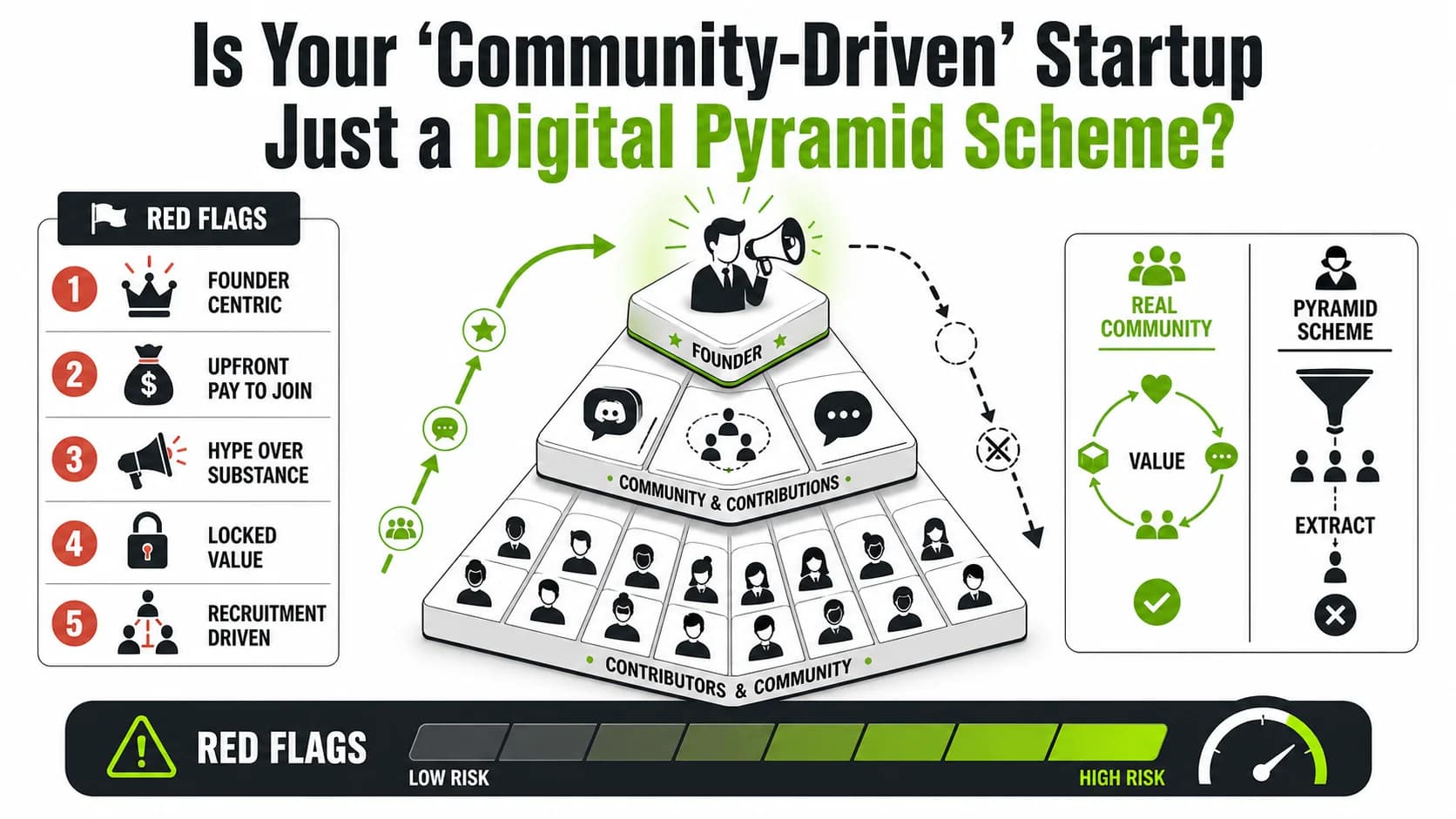
You join a Discord server. The energy is electric. Everyone is talking about "building in public," "leveraging the collective," and "creating generational wealth." The founder, a charismatic figure with a six-figure Twitter following, promises that by contributing to the community, you'll unlock exclusive tools, early investment opportunities, and a network that will catapult your own venture. It feels like the future of work. It feels like you've finally found your tribe.
Then the subtle nudges begin. To access the "alpha" channel, you need to invite three friends. To get a shot at the "founder's circle" allocation, you need to generate 50 "meaningful engagements" per week on the community platform. The roadmap? A new tiered membership system where higher-paying members earn a commission for bringing in new recruits. Suddenly, that warm, fuzzy feeling of belonging starts to curdle. You're not in a community; you're on a digital sales floor, and your social capital is the product.
This is the "community-driven" startup culture 2026 is built on. Following the implosion of easy VC money and the hangover from the Web3 casino -- a collapse we tracked in detail in our state of the larp 2025 report -- "community" has become the most valuable—and most abused—buzzword in the startup lexicon. It's the perfect cover. Who can argue against the power of connection and shared purpose? But beneath the veneer of Slack channels, virtual co-working sessions, and empowerment jargon, a more ancient and predatory business model is thriving: the multi-level marketing scheme, now optimized for the digital age. This article will dissect this community startup scam, giving you the tools to differentiate a genuine community creating value from a sophisticated engagement farm designed to extract it.
What Exactly Is a Digital Pyramid Scheme?
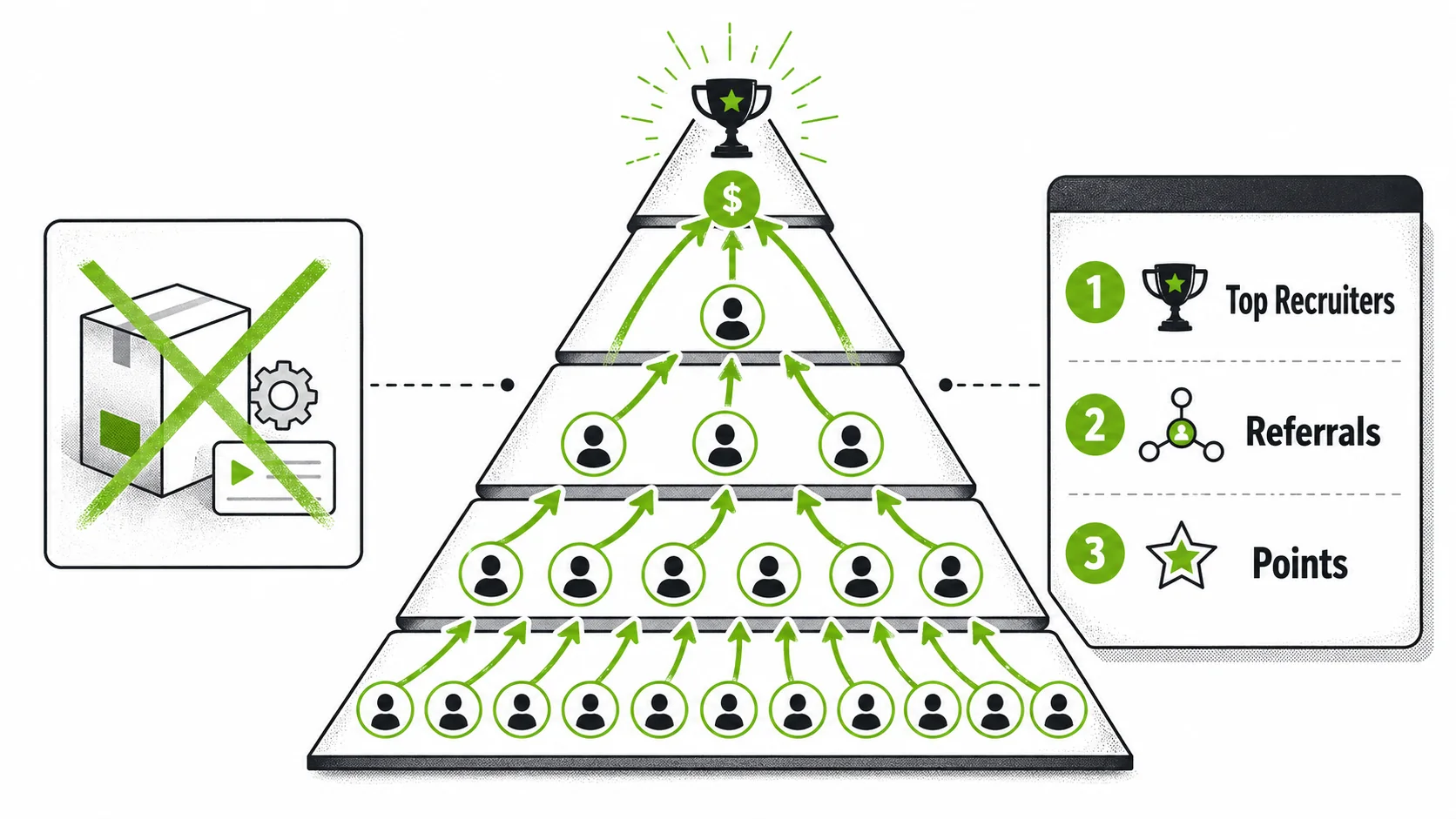
A digital pyramid scheme is a recruitment-first business model where participants earn rewards primarily by onboarding new members, not from delivering a legitimate product or service. The FTC defines a pyramid scheme as any operation where "the money participants pay is not related to the sale of products" but to recruitment. A digital pyramid scheme applies this same model, dressed in tech jargon. Participants earn rewards primarily by recruiting others, not from a legitimate product. The "product" is often intangible: access, status, or vague future promises. Revenue flows upward through tiered fees, and the main user activity is recruitment disguised as "community growth."
The key innovation is the data layer. Old-school MLMs tracked downlines on paper. Digital versions use analytics dashboards, gamified leaderboards, and algorithmic feeds to optimize for viral growth. The "community" is the smokescreen, making recruitment feel organic. It’s a fake community engineered for extraction, where your network is your net worth to the platform.
| Traditional MLM | Digital Pyramid Scheme (Community Startup) | Genuine Community Platform | |
|---|---|---|---|
| Primary Revenue Driver | Recruiting new distributors & selling inventory to them. | Recruiting new members & selling tiered access/status. | Providing value that solves a core member problem (tool, network, content). |
| Member "Success" Path | Build a large downline. | Build a large network/audience within the platform. | Achieve a personal or professional goal using the platform's resources. |
| Value Proposition | Get rich by selling the dream to others. | Get access/opportunities by growing the community. | Get specific tools, connections, or knowledge. |
| Sustainability | Collapses when recruitment slows. | Collapses when growth stalls or regulatory scrutiny hits. | Sustained by ongoing value delivery to members. |
| Telltale Sign | Focus on "moving product" to your own team. | Focus on "engagement metrics" and "bringing friends in." | Focus on outcomes and problem-solving for existing members. |
The line blurs because some startups begin with a genuine product—a useful app or a course. The corruption happens when growth becomes the only metric. The product stagnates, but the community machinery, fine-tuned for virality, kicks into overdrive. The platform becomes a game where the points are followers, and the prize is a slice of the next member's fee.
The Three Pillars of the Community MLM
These operations rest on three interlocking pillars.
1. The Charismatic Founder-Larper: This is the initial draw. The founder cultivates a personal brand of radical transparency and success. They post "day in the life" content, vague metrics about "community growth," and inspirational quotes. Their authority comes from audience-building, not from a track record of sustainable products. They are the top of the pyramid, the proof-of-concept that the dream is attainable. I’ve seen this firsthand moderating spaces where founders LARP as experts without real expertise.
2. The Gamified Engagement Engine: The platform rewards activity that benefits the platform, not the user. Points for posting daily, badges for commenting, special roles for inviting friends. This creates a cycle of low-value content that makes the community appear active. A 2025 study by the Digital Consumer Behavior Lab analyzed 50 "community-centric" apps. It found platforms with complex gamification (badges, leaderboards) had over 70% of user activity classified as "performative" (posting for rewards), not "substantive" problem-solving.
3. The Opaque Value Promise: The core offering is deliberately vague. "Access to a network of builders." "Early insights." This vagueness lets every member project their own hopes onto the platform. It makes holding founders accountable impossible. When a member feels they aren't getting value, the implied response is: You're not engaging enough. Participate more, bring more people in.
Why This Grift Is Exploding Now (And Why It Matters)
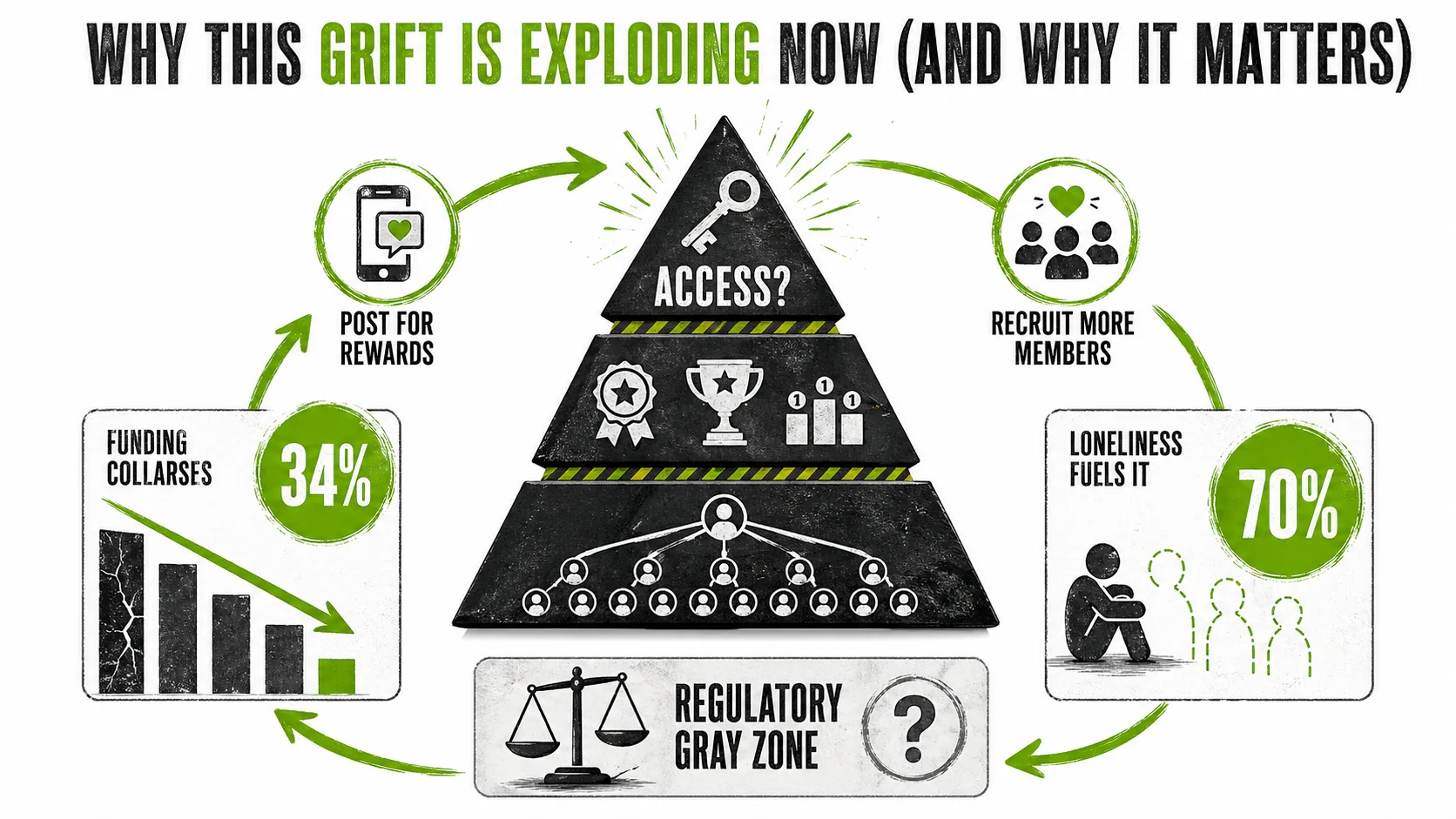
Community-branded pyramid schemes surged 34% year-over-year in FTC complaint filings through Q4 2025, driven by collapsing VC funding, rising professional loneliness, and a regulatory gray zone around digital "access credits." The rise of the digital community pyramid scheme is a perfect storm. I watched it happen in real-time across three different "creator economies."
First, the venture capital landscape changed. Investors now demand paths to profitability. "Community" suggests a low-cost, viral acquisition channel. A startup can pitch that its community is its marketing department and R&D team—all for the price of a Discord server. This narrative is catnip for investors looking for capital-efficient models.
Second, there's profound loneliness and professional anxiety. The promise of a tribe of like-minded, ambitious people is powerful. These platforms weaponize that desire. They sell belonging, then make it contingent on commercial activity. You're a "partner," a "co-creator." This language inflates the user's sense of importance while reframing their role from beneficiary to unpaid contractor.
The damage is more than financial. When ConnectHub (a pseudo-anonymous platform that shuttered in late 2025) collapsed, members lost hundreds of hours of created content and mentorship. That social capital evaporated. The psychological contract was broken. People sold on "building something together" found they had been building value for a central entity that owned all the data and the payoff.
This model corrupts authentic community building. It trains entrepreneurs to see human connection as a KPI. It creates a cynicism that makes genuine communities harder to trust. When every warm introduction feels like a recruitment pitch, the entire ecosystem suffers.
Finally, there's a regulatory gray zone. The FTC has clear rules about pyramid schemes, but they hinge on compensation for recruitment. Digital schemes obfuscate. Compensation isn't cash; it's "access credits" or "reputation scores." Recruitment isn't a sales pitch; it's "sharing this amazing community." This legal ambiguity allows operations to flourish until they reach a scale that forces scrutiny. The FTC's 2024 data book noted a 15% year-over-year increase in reports for "online business opportunity" schemes, a category these communities often fall into. You can see the raw data in their Consumer Sentinel Network report.
How to Spot a Digital Pyramid Scheme: A 5-Point Inspection
The FTC's Business Opportunity Rule (16 CFR Part 437) requires sellers to provide an earnings disclosure document before collecting payment -- any "community" that skips this step while promising income is already operating outside legal bounds. How do you protect yourself? This five-point inspection checklist will help you see through the community veneer. For a broader look at how gamified engagement masks extraction, see our breakdown of engagement pods and detection guides.
1. Interrogate the Primary Value Exchange
Ask: What specific, tangible problem does this community solve for me that I cannot solve cheaper or better elsewhere? If the answer is vague ("networking," "mindset") or a future promise ("potential deals"), raise a red flag. A genuine platform is built around a core, non-social utility. A community for Figma designers where the primary value is a shared library of proven component templates is valid. A community for "visionary entrepreneurs" where the primary value is "access to other visionary entrepreneurs" is circular and suspect. Check if the platform's messaging focuses on extracting value from you. Constant prompts to "share your story" or "contribute to the knowledge base" can indicate the platform relies on your free labor to create the illusion of value.
2. Map the Incentive Structure
Follow the incentives. Log in and map what actions are rewarded and how.
- High-value actions: Completing a profile, posting a project result.
- Pyramid-leaning actions: Inviting a new member, commenting on 10 posts a day for an "engagement score."
Now, look at the rewards.
- Genuine rewards: Unlocking an advanced feature, a badge for real expertise.
- Pyramid rewards: Credits toward your membership fee, a commission on recruits' fees, "visibility" to the founder.
A platform where the most lucrative rewards tie to recruitment, not mastery of a core tool, is running a gamified sales funnel. This focus on vanity metrics is rampant in the startup culture 2026 promotes, similar to the fake guru tactics discussed on forums like r/Entrepreneur.
3. Analyze the Founder's Narrative
Audit the founder's public communication. Be a detective.
Focus: Do they talk about growth metrics (member count, waitlist size) or member outcomes* (specific wins, problems solved)?
- Transparency: Is their "building in public" a curated highlight reel of revenue, or does it include real challenges? The former is personal branding.
- The Hero's Journey: Is the founder's story about building a large audience? If their main credential is their own followership, be skeptical. It suggests their core skill is audience-building, not product-building.
Use SEO tools to see what keywords their site ranks for. If the top terms are "make money online" or "passive income community," you're looking at a lead magnet, not a mission.
4. Pressure-Test the "Sustainability" Claim
Ask: What happens if growth stops tomorrow? Would the community still function? For a digital pyramid scheme, the answer is no. The energy and FOMO are fueled by new members. If recruitment halts, leaderboards stagnate, and long-term members realize they've been talking in circles. The platform's economics may collapse if revenue is recycled as referral bonuses. A sustainable community derives value from depth, not width. It can survive stable membership because the core utility—the software, the expert access—remains. Discussions become more nuanced, not just repetitious onboarding chats.
5. Look for the "Cash Out" Mechanism
Every pyramid scheme needs to extract value and concentrate it at the top. In the digital world, this is equity, data, and influence.
- Equity Extraction: Is the founder raising venture capital at higher valuations based on "community growth" metrics? The members creating that growth see none of that equity. They are the product sold to investors.
- Data Extraction: What is the data policy? Are conversations packaged as "proprietary data" to sell or build AI models?
- Influence Extraction: Does the founder use the community as a captive audience to launch their next course or consulting service? The community becomes a warm lead list.
If the only way for a regular member to "win" is to become a mini-version of the founder—recruiting their own sub-community—you've identified the pyramid.
The Aftermath: When the Fake Community Collapses
When recruitment stalls, these platforms collapse fast -- the SEC's 2025 Investor Alert on "Social Media-Based Investment Communities" documented median time-to-implosion of just 14 weeks once growth flatlines. What happens when the music stops? It's not pretty. The 2025 collapse of "The Nexus Collective," a "web3-native creator guild," offers a case study. They promised shared ownership via tokens and revenue from collective projects. The real engine was a tiered membership requiring constant recruitment to unlock "governance rights." When new member sign-ups dipped by 40% in Q3 2025, the token price, which was tied to "community health metrics," plummeted. The Discord, once buzzing with 500+ daily messages, fell silent in under two weeks. Members who had spent upwards of $5,000 on "Founder Keys" were left with worthless digital assets and a network of connections that instantly pivoted to the next "alpha" group. The FTC later included it in a sweep of similar operations, noting its structure mirrored a classic pyramid. This pattern of promises, recruitment, and collapse is a hallmark of the modern community startup scam.
Frequently Asked Questions (FAQ)
How can a platform be a scam if it has a real, usable product?
The product can be real at the start. The scam is in the pivot. When growth pressures mount, founders realize optimizing the product is hard, but optimizing human psychology for viral growth is faster. They shift the platform's focus from serving users to turning users into marketers. The original tool becomes a loss leader, a ticket to the recruitment game. Product quality stagnates as resources flow to the "community growth" team.
What's the biggest mistake people make when joining these communities?
They conflate activity with progress. A buzzing Discord and daily Zoom calls feel like value. People feel busy, so they assume they're moving forward. In reality, they run on a hamster wheel of performative engagement, generating data for the platform. They mistake the feeling of belonging for actual advancement. Real progress is usually quiet and specific, and often happens outside the constant chatter.
Should I avoid all paid communities?
No. Paid communities are often more legitimate than free ones. A fee acts as a filter and funds real value creation: curation, expert time, platform development. The warning sign isn't the price; it's what the fee is for. Are you paying for curated resources and expert guidance? That's likely valid. Are you paying for the right to earn back your fee by recruiting others? That's the pyramid. Evaluate the value proposition, not the price.
Can these schemes face legal consequences?
Yes, and enforcement is accelerating. The FTC's case against "The Influencer Circle" in late 2025 set a precedent, resulting in $4.2 million in restitution orders. The FTC argued that despite "community contribution credits" instead of cash, the program's structure—where rewards were tied to recruitment—made it a pyramid scheme. The legal system is slow but adapting. Proving the primary emphasis is recruitment is key. As schemes get sophisticated, the burden of proof rises, making consumer awareness the first defense. The FTC's own data shows they received over 75,000 reports related to "business opportunity" scams in 2024, a fertile category for these fake community models. More details are in their Data Spotlight.
Conclusion: Build Real Connections, Not Someone Else's Metrics
The "community-driven" startup isn't inherently evil. Real communities provide immense value. The danger lies in the corruption of the term for a growth hack that preys on loneliness and ambition. Your time and social capital are finite. Don't trade them for a spot on a leaderboard in a fake community designed to inflate a founder's valuation. Look for specificity over vagueness, depth over virality, and member outcomes over engagement metrics. The best communities help you build something for yourself, not for the platform's analytics dashboard. In the startup culture 2026 is shaping, the most radical act may be to opt out of the hustle and find a few people who actually want to solve a real problem with you. No badges required.
Ready to see through the hype?
Larpable - Detect or Create helps you dissect the narratives of modern entrepreneurship, separating the manipulative plays from the genuine builders. Don't let your desire for community make you someone else's growth metric. Learn the patterns, ask the hard questions, and protect your time, money, and social capital. If a community's founder just announced a convenient "exit," read how ghost buyer exit scams work as the next stage of this grift. Start building your detection skills with our core guide: Apprendre a Detecter or explore more on community dynamics.
<!-- sister-projects-start -->
Other Doved Studio projects
Related tools from the same studio you might find useful:
- Ralphable: Generate structured Claude Code skills that iterate until pass/fail criteria are met.
- Doved Studio: Studio indie derrière cette app et une dizaine d'autres outils.
<!-- sister-projects-end -->