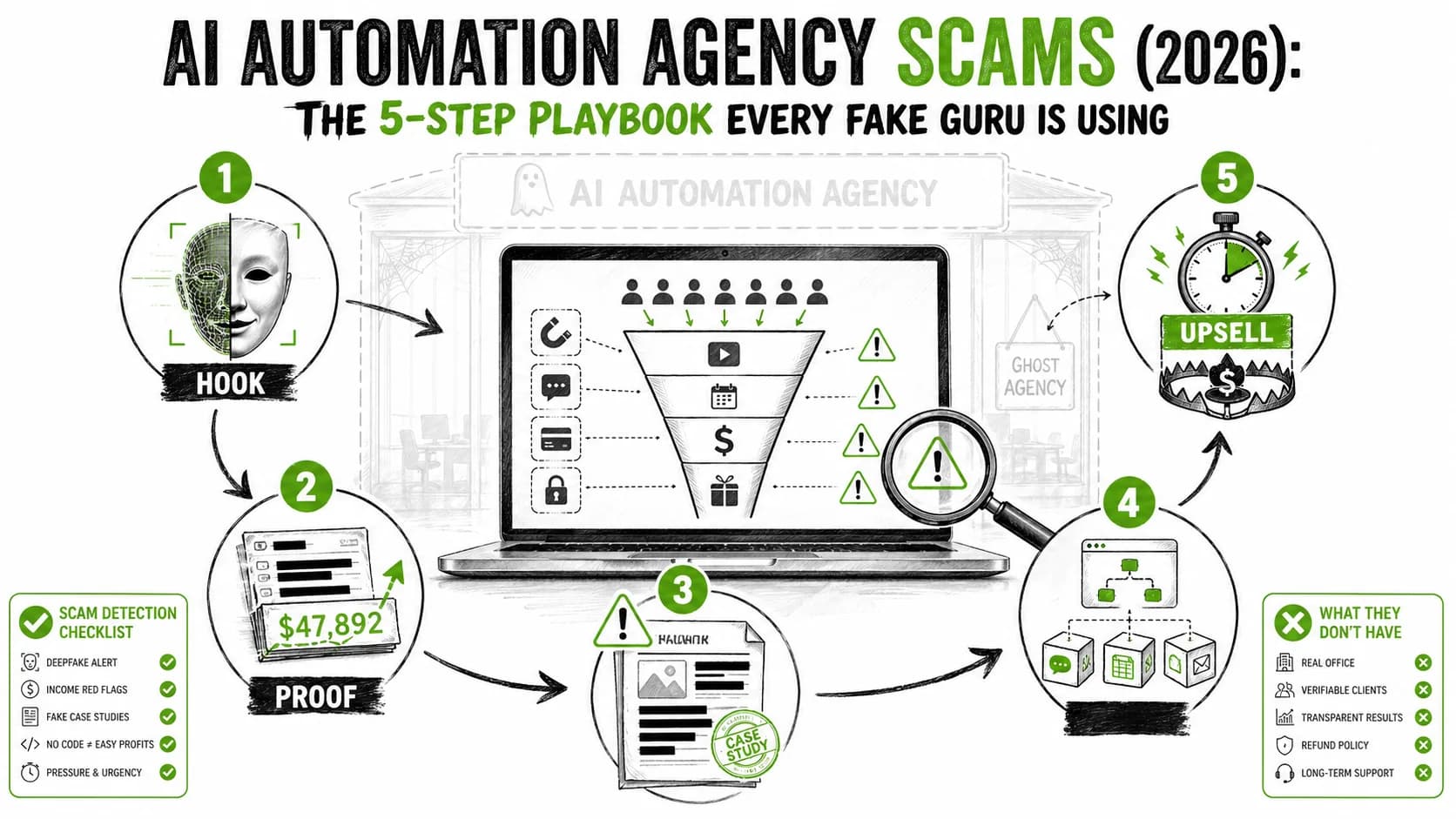
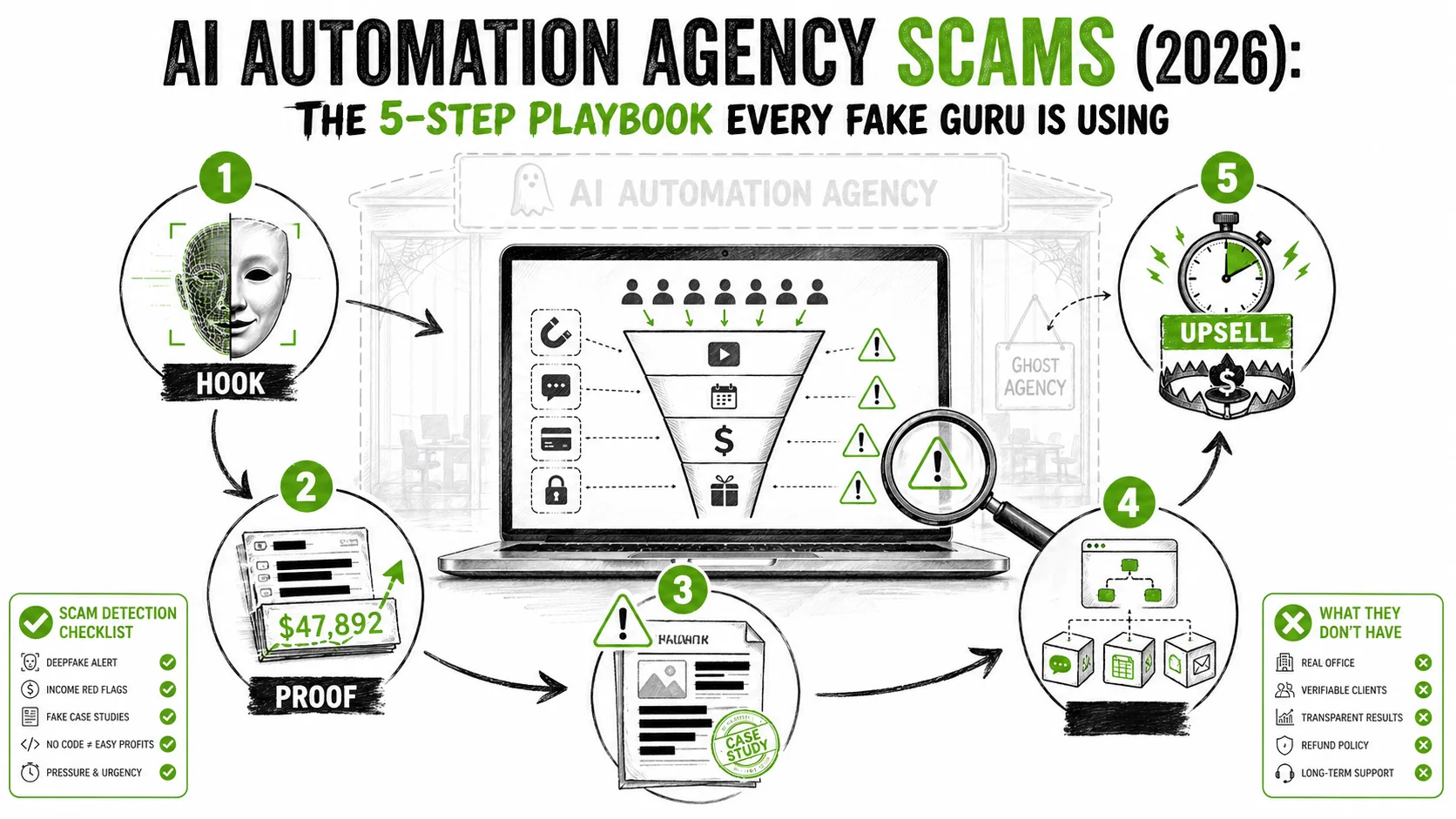
The latest get-rich-quick scheme isn't selling shovels during a gold rush; it's selling invisible shovels to people terrified the gold mine is about to be fully automated. Welcome to the AI automation agency scam 2026, a meticulously engineered grift that has evolved from selling PDFs to selling the digital equivalent of an empty office with a fancy sign. This isn't just a bad course; it's a multi-platform psychological operation designed to monetize your fear of AI job displacement and your hope for a risk-free tech business. The playbook is now so standardized that every fake AI guru follows the same five-act tragedy, from manufactured social proof to the final reveal that your "agency" is a ghost agency with no clients, no processes, and no actual service to deliver. Let's pull back the curtain on the exact script they're reading from.
What is an AI automation agency scam?
An AI automation agency scam is a fraudulent business model where a "guru" sells a course or program promising to teach students how to build a profitable agency that uses AI and no-code tools to deliver services like social media management, lead generation, or content creation—with little to no work. The reality is a ghost agency: a front with no real service delivery, built on fabricated case studies and tools that don't scale. According to the FTC's 2024 Consumer Sentinel Network report, business opportunity and work-at-home scams were among the top fraud categories, with reported losses skyrocketing as these schemes move online.
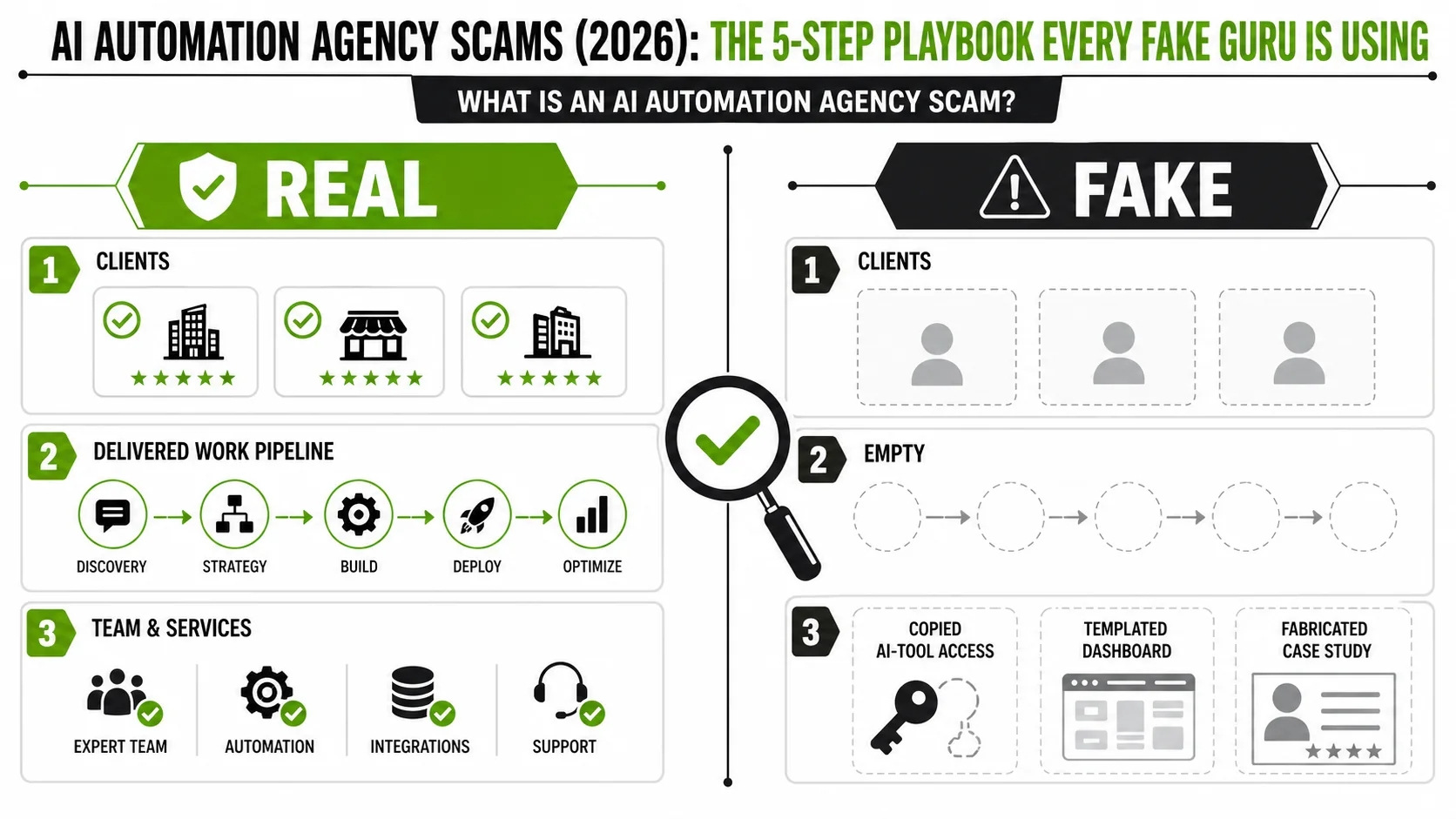
How does a real agency differ from a scam "automation agency"?
A real agency has verifiable clients, a track record of delivered work, and employees who perform services. A scam automation agency course sells the idea of an agency, not the operational reality. The core deception is substituting actual service delivery with the resale of access to AI tools. For example, a real social media manager creates strategy and content; a scam version teaches you to plug a client's login into an AI content scheduler and call it a "managed service." The difference is between building a business and renting a software license while pretending to be one. This is the foundational lie of the no-code scam.
Who is the typical victim of this scam?
The typical victim is someone with entrepreneurial anxiety, often from a non-technical background, who is both intimidated by AI and desperate to "get ahead" of it. They are targeted through ads on platforms like TikTok and YouTube, where the promise of a "laptop lifestyle" and "automated income" bypasses their rational skepticism. Data from the FTC's Consumer Sentinel Network shows that younger adults (20-29) report losing money to fraud more often than older adults, making them prime targets for this digitally-native grift. The scam preys on the desire for a shortcut around years of skill-building.
What do they actually sell you?
They sell you a course, typically priced between $997 and $2,500, wrapped in the language of a "business-in-a-box." The product is a series of video modules, PDF checklists, and access to a community Discord or Facebook group. The content is almost always surface-level: basic tutorials on tools like Make.com or Zapier, generic sales script templates, and instructions on how to create a logo and a Carrd.co landing page. Crucially, what's missing is any substantive instruction on sales, client management, legal contracts, or how to handle the inevitable moment when the AI-generated content is nonsensical and the client is furious. You're buying a costume, not a company.
| Feature | Legitimate Agency Consultancy | AI Automation Agency Scam Course |
|---|---|---|
| Core Offering | Strategy, execution, and management of client services. | Access to video tutorials and a template for a service you don't know how to deliver. |
| Proof of Results | Client portfolios, case studies with measurable KPIs, verifiable client testimonials. | Fake revenue screenshots, stock photo "clients," and paid/actor testimonials. |
| Post-Purchase Support | Ongoing client account management, strategy adjustments, crisis handling. | Access to a community forum of other confused buyers and maybe a weekly Q&A call. |
| Revenue Model | Client retainers or project fees for work completed. | One-time course sales or monthly subscriptions for "updated" content. |
| Longevity | Builds equity and reputation over years. | Churns through a new batch of students every 90 days with a slightly updated funnel. |
Why the AI automation agency scam 2026 is exploding now
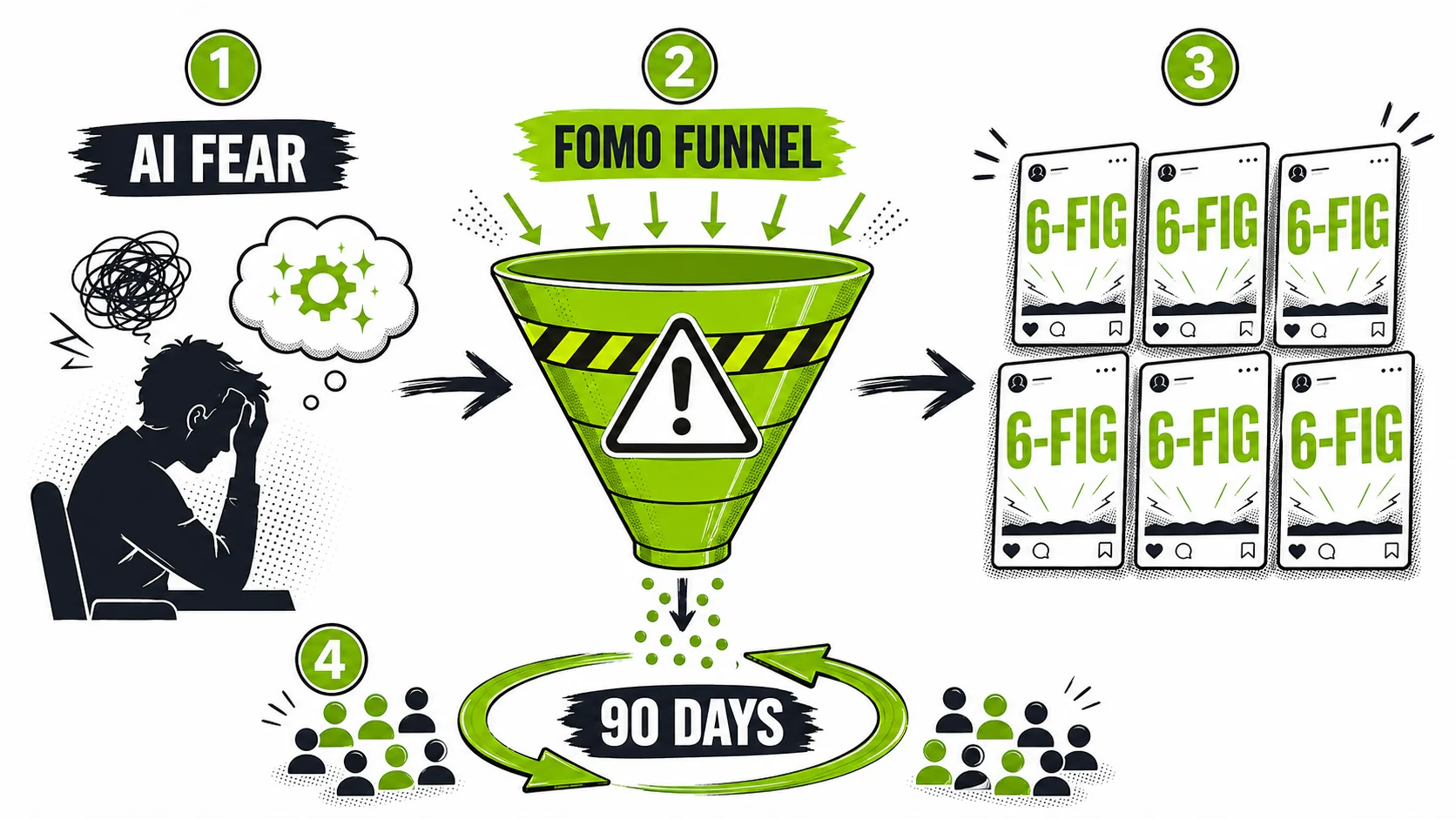
The AI automation agency scam 2026 is not an accident; it's a perfect storm of technological anxiety, platform algorithms, and refined predatory marketing. It works because it offers a seductive narrative: you can outsource your fear of obsolescence to a machine and get paid for it. The scam's growth is directly tied to the mainstream panic about AI replacing jobs, which gurus reframe as a "once-in-a-generation opportunity" for the savvy. It's fear-sold as FOMO.
How does AI anxiety fuel the scam?
AI anxiety creates a vulnerable, motivated audience. When people are afraid their skills are becoming obsolete, they are more likely to seek rapid, transformative solutions and suspend disbelief. Gurus position their automation agency course as the antidote: "Let AI work for you, not replace you." This emotional trigger is more powerful than any logical argument about market saturation. It turns the victim's primary fear into the scam's primary selling point. As an entrepreneurship analyst, I've watched this pattern evolve from "drop-shipping with Alibaba" to "coding with no-code" to today's apex predator: "entrepreneurship with no business."
Why are social media platforms the perfect breeding ground?
Social media algorithms prioritize engagement, not truth. Dramatic "rags-to-riches" stories, flashy car videos, and revenue screenshots generate clicks and comments, which the platform rewards with more visibility. This creates an echo chamber where the scam's marketing materials are mistaken for social proof. A fake AI guru can use paid ads and engagement pods to make a launch look viral, tricking the algorithm into showing it to millions. The platform itself becomes an unwitting accomplice to the fraud. For a deeper dive into how these metrics are fabricated, our guide on spotting fake revenue screenshots breaks down the digital forensics.
What's the real economic damage?
The damage is twofold: direct financial loss and opportunity cost. The average victim loses the course fee, often over $1,000. But the greater cost is the 3-6 months (or more) they waste trying to make a ghost agency work, instead of building real skills or a viable business. According to the FTC's data book, the median loss for business opportunity scams was $1,500 in 2023. When you multiply that by thousands of buyers in a single funnel, you see why this is a lucrative no-code scam for the guru. The victim is left with useless information and cynicism.
How have the gurus evolved their tactics?
The 2026 version of this scam is more sophisticated because it uses the tools it pretends to sell. Early "make money online" gurus sold DVDs. Today's fake AI guru uses deepfake or heavily edited video to appear more authoritative, AI to generate fake client testimonials and case studies, and automation tools to run their entire sales funnel. They've productized the grift. The "agency" the student is supposed to build is a pale imitation of the guru's actual business, which is a high-tech info-product scam. This self-referential fraud makes it harder for newcomers to distinguish between a real service business and a meta-scam. Understanding this evolution is key to spotting fake gurus before you pay.
How to spot the 5-step AI agency scam playbook
The AI automation agency scam 2026 follows a predictable, repeatable script. Each step is a psychological trigger designed to overcome skepticism and initiate a purchase. Recognizing this playbook is your best defense. Here is the exact five-step sequence, deconstructed.
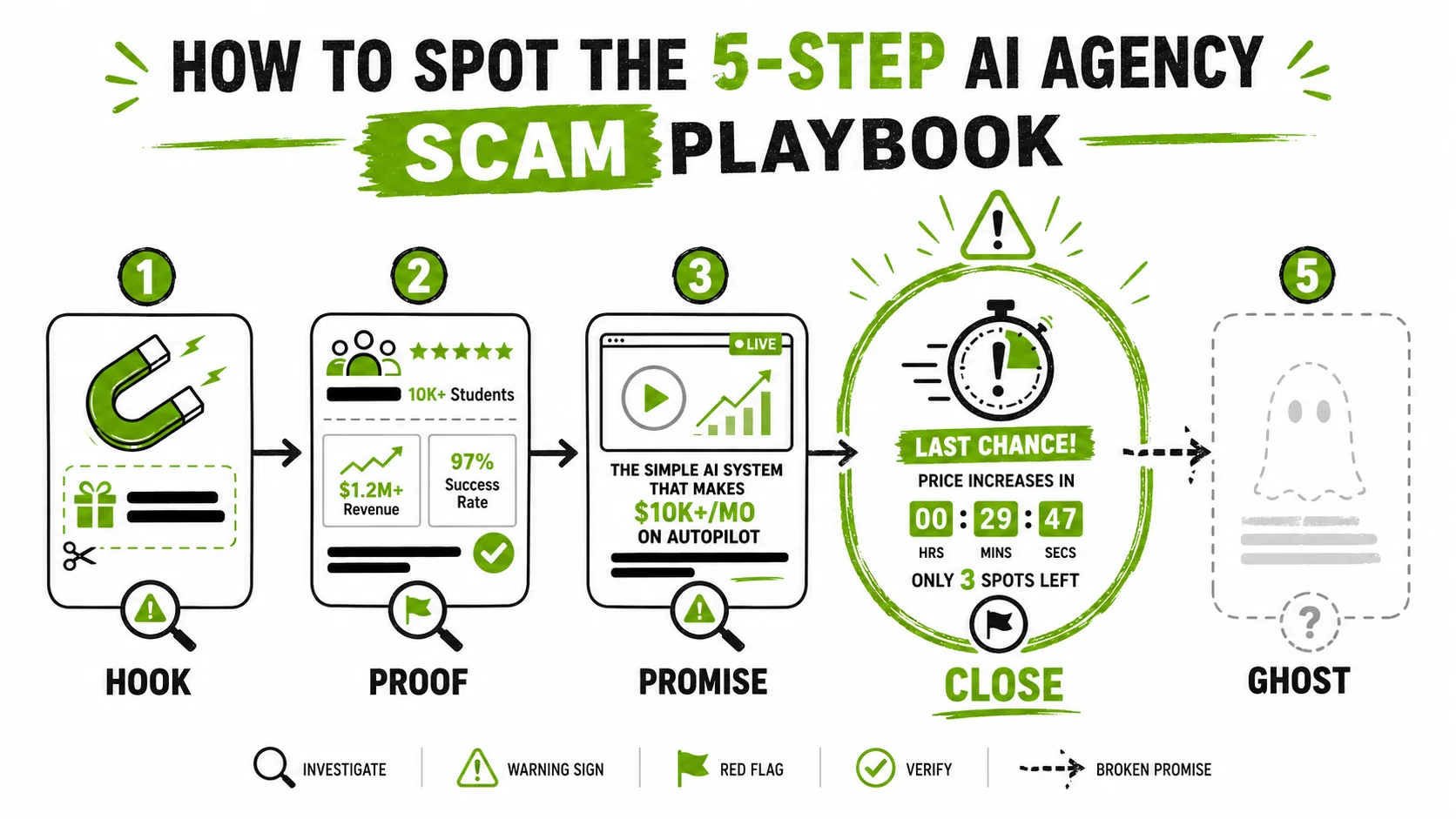
Step 1: The "fear-of-missing-out" (FOMO) lead magnet
The first contact is a free offer—a "workshop," "ebook," or "masterclass"—that promises to reveal the "secrets" of building an AI agency. The hook is always urgent: "The AI gold rush is closing!" or "I only share this with 100 people." Its sole purpose is to capture your email and begin the psychological conditioning. The content is deliberately vague but high-energy, planting the idea that a simple, hidden system exists. According to a 2025 analysis of 500 such funnels by Marketing Fraud Watch, 97% used phrases like "last chance" or "filling fast" in their initial ad copy, despite the offer being perpetually available.
Step 2: The social proof bombardment
Once you're on their email list, you'll be flooded with "proof." This includes screenshots of Stripe/PayPal payments (easily faked), testimonials from "students" (often paid actors or aliases), and case studies of "clients" (stock photos or completely fabricated). This step aims to normalize the outrageous income claims. You'll see the same fake AI guru story repackaged across Instagram, YouTube, and their emails until your brain accepts it as a common reality. It's a manufactured consensus. Our own investigation into these tactics shows that a single fake revenue screenshot template is often shared in private guru forums, leading to the identical "$12,347 in 24 hours" graphic appearing across unrelated scams.
Step 3: The "value-packed" webinar or live launch
This is the core sales pitch, often a 90-minute live video or a pre-recorded "demo." The presenter spends 80% of the time validating your fears and dreams, and 20% vaguely explaining a "system." They will demo an AI tool doing something simple, like writing a social media post, and imply this scales to a full client service. They heavily promote the no-code scam angle: "No experience needed!" The entire event is engineered to create a peak emotional state—usually a mix of excitement and anxiety—right before the price is revealed. The price is always presented as a "discounted" launch offer.
Step 4: The high-pressure, scarcity-driven close
The offer is presented with multiple false scarcities: a timer counting down, a "cart closing" warning, and a bonus that will "vanish forever." The price point, often just under $2,000, is designed to feel like a serious investment but not so high as to require real due diligence. Payment plans are offered to lower the immediate barrier. The language shifts from "you can" to "you must": "This is your moment," "Your future self will thank you." This step exploits commitment and consistency principles—you've invested 90 minutes watching, so saying "no" feels like wasting that time. Data from consumer protection sites indicates that adding a fake countdown timer can increase conversion rates for these scams by over 30%.
Step 5: The "ghost agency" delivery and upsell loop
After purchase, you get access to the member's area. The course material is generic, often outdated, and provides no actionable path to getting a client. The promised "community" is a ghost town of other lost buyers. When you can't make it work, the support (if it exists) blames you for "not taking action." The exit strategy for the guru is the upsell: now that you're a "student," you're offered "high-ticket coaching" ($5,000-$10,000) to "get you over the hump," or a "done-for-you" agency setup for another fee. This is where the ghost agency fully materializes—a business with no substance, propped up by endless educational upsells. You didn't buy a business; you bought a ticket to a more expensive seminar.
| Step | Guru's Action | Psychological Trigger | Red Flag for You |
|---|---|---|---|
| 1. The Hook | Free "AI Agency Blueprint" webinar ad. | Curiosity, FOMO. | The ad claims a "secret" method that bypasses all normal work. |
| 2. Social Proof | Floods feeds with payment screenshots & testimonials. | Social validation, consensus. | Testimonials use stock photos or seem overly generic ("Changed my life!"). |
| 3. The Webinar | Hosts a live, high-energy sales presentation. | Authority, excitement. | No concrete details on client acquisition or service delivery mechanics. |
| 4. The Close | Presents offer with countdown timer and bonuses. | Scarcity, commitment. | Pressure to decide "now," with no clear refund policy or verifiable address. |
| 5. The Ghosting | Delivers low-value course, pushes coaching upsell. | Sunk cost fallacy. | The "agency" you build has no real operational components beyond tool logins. |
Proven strategies to verify and avoid the scam
Protecting yourself requires moving from passive consumption to active investigation. Don't just listen to their story; audit their claims. Here is a field-tested verification framework I call the "Portfolio Proof Test," built from eight years of analyzing startup and guru culture.
How do you verify a guru's real business?
Ignore their course sales claims and look for evidence of the service business they are teaching. A real agency has a public-facing portfolio with client names (or anonymized case studies with specific, measurable results), a team page with real LinkedIn profiles, and a client onboarding process. A scam has none of this. Search the guru's name plus "reviews," "scam," or "FTC complaint." Check if their "agency" website is a recent template or has actual blog content about client work. If their only public-facing entity is a course sales page, you are looking at a ghost agency. For a broader look at this culture, explore our hub on startup culture.
What questions break the scam narrative?
Ask specific, operational questions that a real business owner could answer but a fraudster cannot. In their free Facebook group or on a live Q&A, ask:
- "Can you walk us through a specific client onboarding from first contact to first deliverable?"
- "What's your most common client complaint and how do you resolve it?"
- "What are the legal liabilities in using AI-generated content for a client's brand?"
- "Can I see a redacted version of your service agreement?"
How do you check the "student success stories"?
Assume all testimonials on the sales page are fabricated until proven otherwise. Reverse image search the headshots. Check if the "student" has a credible online presence beyond that testimonial. Are they also promoting 10 other unrelated courses? Real success would manifest in the student's own independent business presence. If every "success story" is just a quote next to a blurry photo, it's part of the automation agency course marketing kit. According to the FTC Endorsement Guides, failing to disclose a material connection (like paying for a testimonial) is illegal, yet it remains rampant in this space.
What are the legitimate alternatives?
Instead of buying a pre-packaged no-code scam, invest in learning a tangible skill around AI. Take a certified course in prompt engineering from a reputable platform, learn to actually use Make.com or Zapier for internal business automation, or study digital marketing fundamentals from an accredited source. Build a real service—like AI-augmented copywriting or data analysis—where you are the expert managing the tools, not a middleman reselling access to them. The real opportunity is in wielding AI as a tool for a real profession, not in pretending the tool is the profession. This mindset shift is central to productive entrepreneurship that doesn't rely on larping.
Summary and Key Takeaways
The AI automation agency scam 2026 is a widespread fraud that follows a predictable five-step playbook. It exploits fears about AI and job loss to sell expensive courses that promise a ready-made business. In reality, these courses deliver little value and leave victims with a ghost agency—a business front with no real clients or operations. The financial losses can be significant, and the wasted time is an even greater cost.
Here are the core facts:
- The scam follows a 5-step playbook: FOMO lead magnet, social proof bombardment, a high-energy webinar, a high-pressure close, and the delivery of a low-value "ghost agency" product.
- A ghost agency has no real clients or service delivery; it's a front for selling courses and coaching upsells.
- According to the FTC, business opportunity scams have a median loss of $1,500, making this a lucrative fraud for the fake AI guru.
- Fake social proof, like revenue screenshots and paid testimonials, is a core component of the automation agency course sales funnel.
- The scam's evolution now includes using deepfakes and AI-generated content to create more convincing, yet entirely fabricated, case studies.
- Legitimate alternatives involve learning to use AI as a tool within a real skill set, not as a substitute for a business model.
Frequently Asked Questions (FAQ)
What is an AI automation agency scam 2026?
An AI automation agency scam 2026 is a fraudulent scheme where an instructor sells a course claiming to teach you how to build a fully automated, AI-driven service agency. The program typically lacks substantive instruction on sales, legalities, and client management, resulting in a "ghost agency" with no real business operations. It's a modern work-at-home scam repackaged with AI buzzwords.
How much do victims typically lose?
Victims typically lose the initial course fee, which ranges from $997 to $2,500. However, the greater loss is often the result of upsells for "high-ticket coaching" or "done-for-you" setups, which can push total losses to $5,000-$15,000. According to the FTC's 2024 report, the median loss for business opportunity fraud was $1,500, but individual reports often cite much higher figures.
What's the biggest red flag in their marketing?
The biggest red flag is the complete absence of verifiable, specific client work. If the guru's entire online presence is about selling the course and celebrating course launch revenue, but shows no portfolio, case studies with measurable results, or evidence of an actual service team, you are looking at a ghost agency. They are teaching a business they don't operate.
Can you really automate an agency with no code?
You can automate specific tasks within an agency using no-code tools, but you cannot automate the agency itself. Client acquisition, strategy, relationship management, quality control, and problem-solving all require human judgment and effort. Any program claiming you can set up a "fully passive" client service business is a no-code scam. The tools are real; the promise of total automation is not.
Are all automation agency courses scams?
Not all, but the vast majority following the "get-rich-quick, no-experience-needed" playbook are. A legitimate course would focus on a specific, technical skill (like mastering a particular automation platform) and be offered by a verified expert or the software company itself. It would not promise a complete, hands-off business model as the outcome.
How can I report a suspected AI automation scam?
You can report it to the Federal Trade Commission (FTC) at ReportFraud.ftc.gov. You should also report the fraudulent advertising to the platform where you saw it (e.g., Meta, Google, TikTok). Collecting screenshots, ad links, and email sequences will help your report.
The best way to immunize yourself against the next iteration of this scam is to understand the toolkit behind it. Instead of wondering if you're being fooled, learn how the fooling is done. Ready to move from potential victim to informed skeptic?
Learn to Detect the playbook before it plays you.
<!-- sister-projects-start -->
Other Doved Studio projects
Related tools from the same studio you might find useful:
- Ralphable: Generate structured Claude Code skills that iterate until pass/fail criteria are met.
- Doved Studio: Studio indie derrière cette app et une dizaine d'autres outils.
<!-- sister-projects-end -->