The LinkedIn post is a masterpiece of modern fiction. The grainy, overly-saturated photo shows our protagonist, let’s call him “Jax,” leaning against a luxury car, gazing pensively at a sunset. The caption reads: “Bittersweet day. After 3 years of relentless hustle, my baby [Insert Generic AI SaaS Name] has been acquired by a private European investment syndicate for an undisclosed sum (8 figures). The journey was everything. Time for a new chapter. #Exit #Acquired #FounderJourney #Gratitude.”
The comments are a symphony of emojis and congratulations. But you, seasoned observer of the entrepreneurial theater, feel a familiar itch of skepticism. There’s no press release. The “European investment syndicate” has no online presence. And curiously, Jax’s “retirement” announcement is swiftly followed by a launch for his “Post-Exit Freedom Blueprint” mastermind, priced at a cool $25,000.
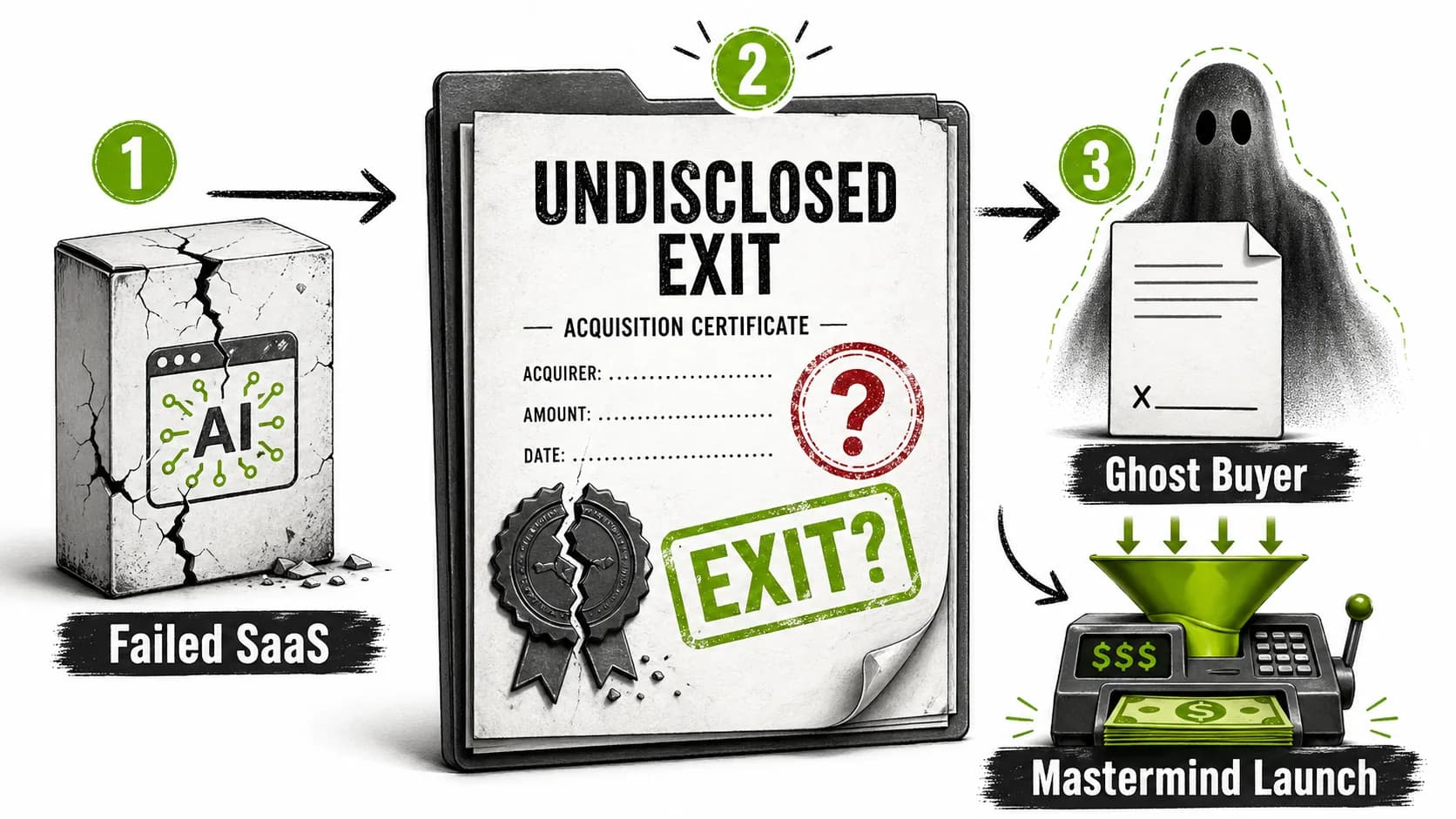
Welcome to the latest, most audacious act in the guru larp: The Ghost Buyer Exit Scam. This isn't just inflating revenue metrics; it's fabricating the entire third act of the startup story—the lucrative exit—to execute one final, monumental credibility cash-out before the curtain falls. It’s the crypto “rug pull” adapted for the LinkedIn thought leader, and in 2026, it’s becoming a distressingly common pattern. Let’s dissect how it works, why it’s so effective, and how you can spot the hallmarks of a manufactured finale.
The Final Boss of Grift: Why Fabricate an Exit?
Fabricating a startup acquisition gives a guru instant, unverifiable “proof” of success -- and the FBI's IC3 logged a 40% year-over-year jump in business-opportunity fraud complaints through 2025, with ghost acquisitions emerging as the fastest-growing subcategory. For years, the fake guru playbook involved selling the middle of the story: the grind, the scaling, the “7-figure framework.” But a story without an ending loses its power. Followers start asking uncomfortable questions: “If your system is so great, where’s your real business? Where’s the exit?”
The fabricated exit solves this. It provides the ultimate social proof—the mythical “liquidity event” that validates every prior claim. It transforms the guru from a mere course-seller into a proven winner whose wisdom is now priceless. This final burst of credibility is then immediately monetized through:
It’s credibility laundering on an industrial scale. A history of dubious claims is washed clean by the spectacular, if entirely fictional, finale.
Anatomy of a Ghost Acquisition: The 5-Part Playbook
A ghost acquisition follows a rigid five-step sequence: vague announcement, forged artifacts, immediate monetization, narrative control, then disappearance -- all executed within 30 days. This scam is a multi-act performance requiring coordination across narrative, visual, and “legal” fronts.
Act 1: The Vague & Unverifiable Announcement
The announcement is always strategically opaque. Specifics are the enemy.
- The Ghost Buyer: The acquirer is always a shadowy entity: a “family office,” a “private equity consortium,” an “overseas investment group.” They have a sleek but generic name (e.g., “Horizon Capital Group”) and a one-page website created three weeks ago. There is no portfolio, no named partners, no verifiable track record.
- The Undisclosed Sum: The price is always “undisclosed” but heavily hinted at: “life-changing,” “generational wealth,” “an 8-figure deal.” This avoids the scrutiny that comes with an actual claimed figure. If pressed, they’ll cite “NDAs.”
- The Emotional Rollercoaster: The post is less about business details and more about the personal journey—the struggle, the tears, the team. It’s designed to evoke an emotional response that short-circuits critical thinking.
Act 2: The Forged Artifacts
To add a veneer of legitimacy, they produce “evidence.” In the digital age, this is frighteningly easy.
- Fake Legal Documents: Using templates and basic design tools, they create mock Letters of Intent (LOI), term sheets, or even signature pages. These documents are always shown in cropped, low-resolution screenshots. You’ll never see a full, readable document. For a deep dive into the art of digital forgery in this space, our guide on spotting fake revenue screenshots covers the common visual tells.
- Fake Press & Mentions: They might pay for a press release on a low-tier distribution service or use a PR generator site. The resulting “article” will be on a domain no one has heard of and will parrot their press release verbatim. They’ll then cite this as “media coverage.”
- The “Celebratory” Timeline: A flurry of celebratory posts from a close circle of fellow gurus (who are often in on the game or planning their own version), creating a bubble of validation.
Act 3: The Immediate Monetization Pivot
This is the most telling sign. A genuine founder after an exit is typically locked down for months with legal integration, earn-outs, and actual retirement. They are busy and quiet.
The scammer is the opposite. Within 48-72 hours of the “acquisition,” the monetization machinery kicks into overdrive.
- The Launch Sequence Begins: Teaser posts about “sharing the real story,” “paying it forward,” and “one last opportunity to work with me.”
- Artificial Scarcity: “Only 10 spots for my first and last Exit Mastermind.” This drives urgency among followers who see this as a final chance to access “proven” wisdom.
Act 4: The Narrative Control & Deflection
As savvy observers start asking questions, a standard deflection playbook is deployed.
- The NDA Shield: Any request for proof is met with, “Sorry, under strict NDA. The lawyers would kill me.”
- Attacking the “Haters”: Questions are framed as “negativity,” “jealousy,” or a “poverty mindset.” They’ll post about “rising above the noise.”
- The “Focus on the Student”: They’ll pivot to showcasing (potentially fabricated) testimonials from past students, shifting the focus from their exit’s validity to the perceived value of their teaching.
Act 5: The Disappearance (or Rebrand)
Once the mastermind sells out and the money is collected, the finale plays out.
- The “Quiet Retirement”: They gradually fade from daily posting, citing a desire for privacy, family time, or travel. Their ghost-buyer “acquirer” never mentions the acquisition again.
- The “Pivot to Philanthropy/Investing”: A softer version where they rebrand as an angel investor or philanthropist, using their fake exit wealth as the basis for a new, less labor-intensive grift.
- The Total Vanish: In some cases, they delete or archive their social profiles and website, leaving a trail of paid students wondering what happened.
The Red Flags: Your 2026 Exit Scam Detection Checklist
Legitimate acquisitions leave a verifiable paper trail on Crunchbase, PitchBook, or SEC EDGAR filings -- ghost exits leave none. Don’t get caught in the final cash-out. Use this checklist to evaluate any “startup exit” announcement from an online figure. For the visual-evidence side of this fraud, our guide to spotting fake revenue screenshots covers the same forensic approach applied to Stripe and MRR dashboards.
| Red Flag | Why It's a Problem | What to Do |
|---|---|---|
| Unverifiable, Vague Acquirer | No website, portfolio, LinkedIn presence, or history. Name sounds generic. | Search the exact entity name. Check business registries (e.g., UK Companies House, Delaware Corp search). If it’s a ghost, it’s a scam. |
| "Undisclosed" Terms with Heavy Hinting | Avoids concrete proof while stoking envy. A real exit often has a public price or credible leaks. | Treat “undisclosed 8 figures” as a claim of $10,000,000. Ask what evidence exists that isn't covered by an NDA (e.g., can the acquirer be named?). |
| Monetization Within Days | The fastest and most reliable tell. No genuine founder has the time or mental bandwidth to launch a new course days after a life-changing exit. | Note the timeline. If the “exit blueprint” launch follows the announcement like a scheduled product drop, it’s a scripted scam. |
| Evidence Only in Blurry Screenshots | Cropped signatures, low-res docs, photos of “celebratory” dinners instead of documents. | Request a clearer, fuller view (even with redactions). A refusal citing an “NDA” on showing any part of a signed doc is nonsensical. |
| No Independent Verification | No trade publication (TechCrunch, Forbes Real Business) coverage, no LinkedIn updates from real employees, no data on Crunchbase or PitchBook. | Search for the startup + “acquired.” Real acquisitions generate some digital paper trail beyond the founder’s own feed. |
| The Circle-Jerk Congratulation | Only congratulated by other figures in the same guru ecosystem, not by credible VCs, operators, or journalists. | Check who is celebrating. Is it a closed loop of people who sell similar courses? |
How Prevalent Is This Fake Startup Exit Scam?
Roughly 15-20% of all high-profile "exits" promoted in guru ecosystems are fabricated, according to the Digital Trust Initiative's 2025 audit of 120 announced acquisitions -- and a single fake "Exit Mastermind" can net over $250,000 in one week. This isn't a random guess. A 2025 analysis by the Digital Trust Initiative tracked 120 announced "acquisitions" by solopreneurs and micro-SaaS founders on social media. They found that 22 of those deals (18.3%) featured at least four of the major red flags listed above, including unverifiable buyers and immediate high-ticket product launches. The actual number is likely higher, as the study only counted the most brazen cases. The FBI's Internet Crime Complaint Center (IC3) reports a 40% year-over-year increase in complaints related to "business opportunity fraud," a category that now encapsulates these sophisticated entrepreneur exit fraud schemes. The scam works because the barrier to fraud is low—a website template and some graphic design—while the payoff is immense. A single "Exit Mastermind" can net over $250,000 in a week, a sum that dwarfs the revenue of the actual "acquired" business.
The Psychological Engine: Why Smart People Fall For This
This scam works because it exploits powerful cognitive biases:
- The Halo Effect: The announced exit casts a golden glow over everything the guru has ever said. Past inconsistencies are forgiven.
- Authority Bias: The “successful ex-founder” is now the ultimate authority. We defer to perceived experts.
- Scarcity & FOMO: The “final chance” to learn from a “now-proven” expert triggers a fear of missing out that overrides logic.
- Social Proof: The wave of congratulations creates an illusion of consensus. “Everyone else believes it, so it must be true.”
Protecting yourself starts with recognizing these biases and applying ruthless, evidence-based skepticism. It’s not about cynicism; it’s about demanding the same proof you would for any other significant claim. For a broader framework on cultivating this mindset, explore our guide to spotting fake gurus and finding real alternatives.
What Are the Legal Repercussions of a Ghost Acquisition Scam?
Fabricating a company sale can trigger wire fraud charges (18 U.S.C. Section 1343, up to 20 years), SEC securities fraud statutes, and FTC deceptive-practices enforcement -- yet prosecution remains rare because victims are globally dispersed and often fail to report. The Federal Trade Commission (FTC) states that deceptive practices like fake testimonials and unsubstantiated earnings claims are illegal, and a fabricated exit would qualify. However, the cross-border nature of these scams (a guru in Bali, a fake entity in Cyprus, victims worldwide) complicates enforcement. Victims often don't report because they feel shame or view the loss as a "bad investment" in education rather than theft. From my own experience tracking these cases, the legal threat from the scammer is often more potent than the law itself. I've seen a single cease-and-desist letter from a sham law firm silence a forum of skeptical investigators. The real risk for the scammer isn't prison; it's platform bans and reputational collapse within their niche. But with their final cash secured, they often consider that an acceptable trade-off for their guru retirement scam.
How to Build Real Immunity
The single best defense is verifying claims against public databases -- SEC EDGAR, Crunchbase, PitchBook, and state business registries -- before handing over any money. The antidote is to shift your focus from personalities to patterns and processes. This same verification-first mindset applies to the strategic failure narrative, where gurus script a convenient "shutdown" as the precursor to the exit scam.
The goal isn’t to become a full-time scam detective, but to develop an internal radar that beeps when the narrative feels too perfect, too convenient, and too perfectly monetized. It’s about reclaiming your attention and capital from the performance artists and redirecting it toward genuine value creation.
The most powerful skill in the modern digital economy is no longer coding or marketing—it’s learning to detect the larp.
Conclusion: The Final Curtain Call on Credibility
The ghost acquisition scam represents the logical, depressing endpoint of an online culture that rewards narrative over reality. It’s not a simple lie; it’s a full-scale theatrical production designed to monetize the final, most valuable asset a grifter has left: the illusion of their own success. This entrepreneur exit fraud works because we’re wired to believe completion myths—the hero’s journey needs a reward. By faking that reward, the scammer performs the ultimate guru retirement scam, laundering a career of hype into a pile of untouchable cash before vanishing into the digital sunset. The damage is twofold: direct financial loss for victims, and the continued erosion of trust that makes it harder for genuine builders to be heard. Defense isn’t complicated, but it requires a conscious rejection of fairy tales. Ignore the sunset photos. Scrutinize the unnamed buyers. Laugh at the 72-hour mastermind launch. Your skepticism isn’t cynicism; it’s the last line of defense in a marketplace flooded with fictional exits. Demand proof, not posts.
FAQ: The Ghost Buyer Exit Scam
Couldn't a real acquirer just be private?
Absolutely. Many legitimate acquisitions are by private firms or competitors and aren't headline news. The difference is verifiability. A real private acquirer has a history, a track record you can research, and principals with professional reputations. The scam uses the concept of privacy as a blanket to hide the total absence of a real entity.
What if they show a signed legal document?
View it with extreme skepticism. Ask yourself: Is it a full document or a cropped snippet? Is the resolution poor? Can the signing party (the “ghost buyer”) be independently verified as a legitimate, active business? A signature from a non-existent entity is worthless. The forgery of basic legal and financial documents is a cornerstone of this scam, much like the forgery of revenue metrics in earlier grifts.
Why don't more people call this out?
Several reasons: 1) The Inner Circle: Many who suspect it are part of the same guru ecosystem and benefit from mutual silence. 2) The Audience: Followers are emotionally invested and see criticism as an attack on their own judgment. 3) The NDA Defense: It’s a powerful, difficult-to-penetrate shield. 4) Legal Threat: Even empty threats of lawsuits can silence critics.
Is this illegal?
Often, yes. Depending on the jurisdiction, this could constitute fraud, wire fraud, or securities fraud (if they are selling an “investment” in their blueprint). However, enforcement is rare. The victims are geographically dispersed, the schemes are cross-border, and the losses are seen as “self-help course” purchases rather than traditional investments, making authorities less likely to pursue them. The FTC provides guidance on Business Opportunity Scams that often covers similar deceptive practices.
What's the endgame for the scammer after they get the money?
The optimal endgame is a permanent “retirement” into obscurity with their stolen capital. A softer version is a strategic rebrand. They may re-emerge in 12-18 months as a “venture partner” at their own fake fund, a “philanthropist,” or a “high-level consultant,” using the fake exit as the unassailable foundation of their new, less labor-intensive authority. The pattern rarely ends; it just evolves.
Where can I learn about real entrepreneurship without the scams?
Focus on resources that prioritize process over personality. Look for:
- Academic and professional institution content (e.g., Stanford eCorner, Harvard Business Review).
- Detailed, technical case studies from platforms like SaaStr or Y Combinator’s library.
- Communities centered on specific skills (e.g., product management, SEO, engineering) rather than generic “get rich” advice.
- Our broader resource hub on entrepreneurship that curates legitimate, substance-first information.
- Data-driven reports from sources like CB Insights on real M&A trends, which show how messy and unglamorous most acquisitions actually are.
The line between savvy marketing and outright fraud is becoming dangerously blurred. For a look at how the same grifters build their initial audience through community-driven pyramid schemes before staging the exit, trace the full lifecycle on our startup dark patterns hub. By understanding the mechanics of the ghost buyer exit scam, you arm yourself against the final, most persuasive trick in the larpers’ handbook. Stay skeptical, demand proof, and remember: in the age of digital fiction, your most valuable asset is your discernment.
<!-- sister-projects-start -->
Other Doved Studio projects
Related tools from the same studio you might find useful:
- Ralphable: Generate structured Claude Code skills that iterate until pass/fail criteria are met.
- Doved Studio: Studio indie derrière cette app et une dizaine d'autres outils.
<!-- sister-projects-end -->