Introduction
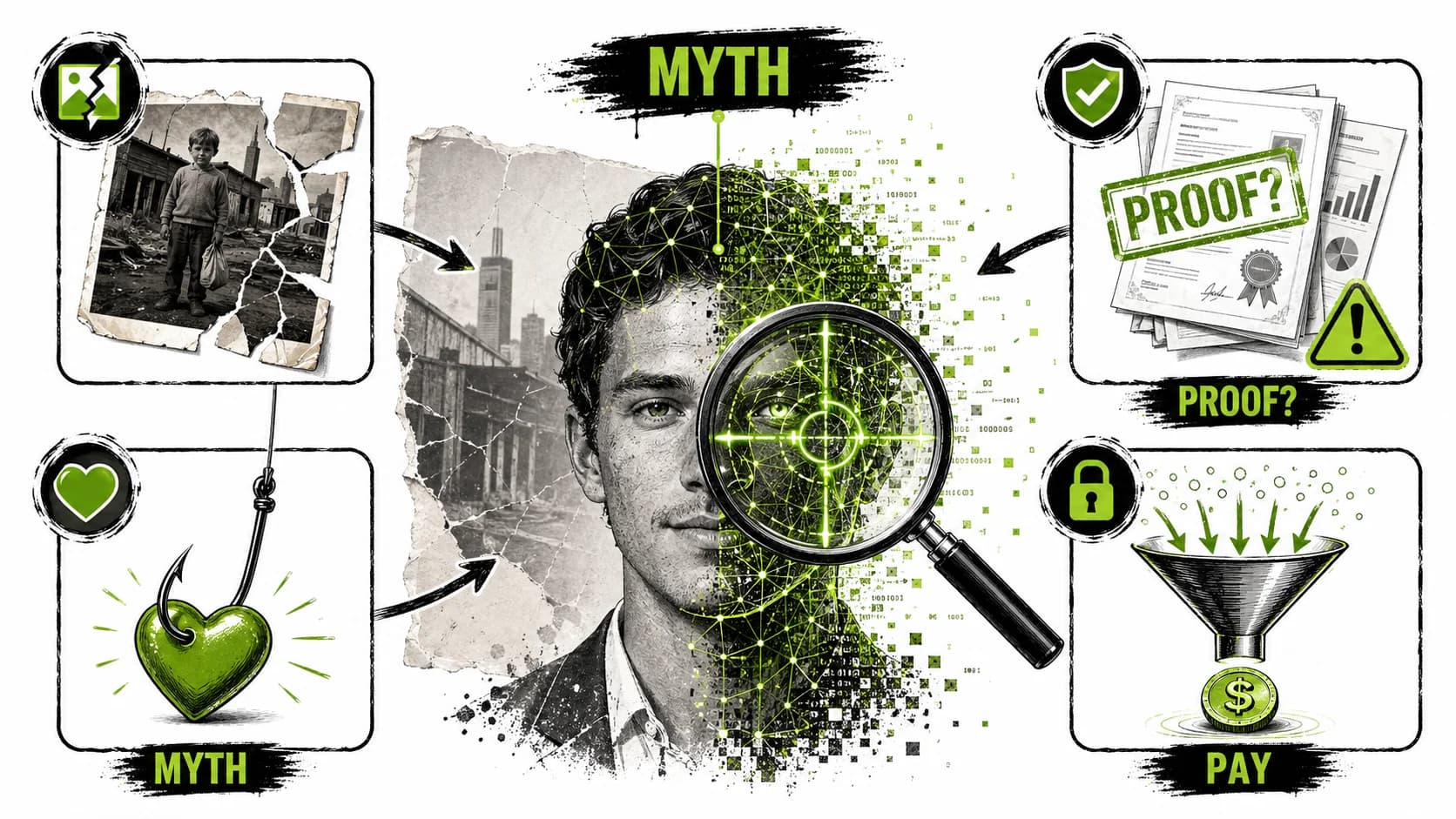
Remember the last time you scrolled through LinkedIn or X and felt a pang of inadequacy? There it was: another founder, younger than you, with a story so compelling it felt like a movie script. They overcame impossible odds, built a seven-figure business from a laptop in a coffee shop, and now they want to teach you their secrets—for a price. In 2026, that pang is more likely a warning signal. The story you just read wasn't just polished; it was likely fabricated, a synthetic success story generated by an AI trained on every motivational biography ever written.
The game has evolved. It's no longer just about photoshopping a revenue screenshot or renting a Lamborghini for a photoshoot. The new frontier of entrepreneurial fakery is narrative. Advanced language models are now being used to craft entire founder personas, complete with detailed, emotionally resonant backstories, specific business milestones, and curated hardship anecdotes. This makes the scam exponentially more convincing. We're wired to connect with stories, not spreadsheets. When a founder's journey tugs at your heartstrings, your logical defenses drop. This article is your guide to rebuilding those defenses. We'll walk you through the specific, often subtle, signs that a founder's myth is machine-made, teaching you how to conduct a narrative audit that separates the authentic from the algorithmic.
What Is a Synthetic Success Story?
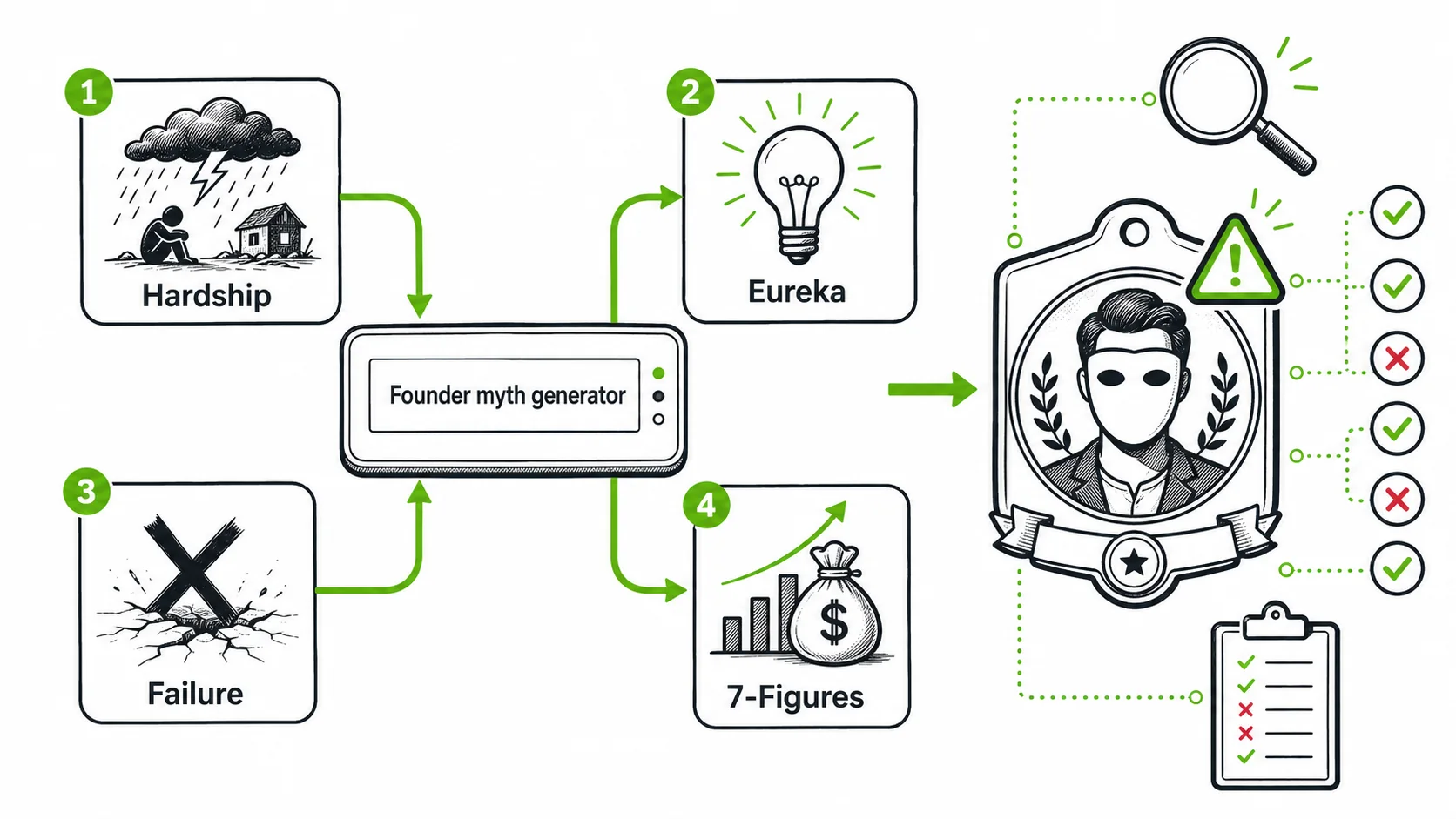
A synthetic success story is a fabricated narrative of entrepreneurial achievement, generated or heavily augmented by artificial intelligence, designed to build credibility, attract an audience, and ultimately, sell a dream. It's not merely an exaggeration or a spin on real events—it's a wholesale creation. The core components—the struggle, the breakthrough, the metrics of success—are algorithmically assembled from patterns in existing success literature. The goal is to bypass your skepticism by speaking directly to your aspirations and insecurities with a story that feels archetypally "right."
This trend is fueled by a burgeoning underground market of AI tools and services. Platforms are no longer just for writing blog posts; they're marketed explicitly for "personal brand architecture." You can find guides on "Prompt Engineering for the Perfect Founder Origin Story" and services that offer "AI-Personalized Biography Generation" based on a few input keywords like "humble beginnings," "tech," and "coach."
The output is a founder myth that ticks every box of the hero's journey but lacks the messy, inconsistent fingerprints of real human experience. To understand what you're looking for, let's break down the key characteristics that distinguish a synthetic story from a real one.
The Hallmarks of an AI-Generated Narrative
AI is brilliant at pattern recognition, but it struggles with the idiosyncratic chaos of real life. When auditing a story, look for these tell-tale signs:
Narrative Over-Optimization: The story is too perfect. The "darkest moment" always occurs at the narratively convenient time, just before the breakthrough. The supporting characters are archetypes (the doubting parent, the mentor who appears at just the right time, the loyal first employee). There are no true dead-ends, only "valuable lessons." Real entrepreneurial paths are littered with random luck, pointless detours, and failures that taught you nothing except that you wasted six months.
Emotional Beats on Cue: The story manipulates emotion with the precision of a Hollywood screenplay. You'll feel a swell of inspiration exactly where the algorithm intended. The language used to describe hardship is often florid and literary ("a crucible of despair," "the gnawing void of uncertainty") rather than the blunt, tired language of someone who actually lived it ("I was broke and scared," "I thought I'd ruined my life").
Vague Specificity: This is a crucial paradox. The story will be packed with specific-sounding details—"I built the first prototype in my uncle's garage in Toledo," "Our first 100 users came from a Reddit post in r/Entrepreneur." But these details are often generic types of specifics. They're plausible but unverifiable, or they're details that, upon closer inspection, don't actually add meaningful, unique color. It's specificity without substance.
Synthetic vs. Embellished: A Critical Distinction
It's important to separate a synthetic story from a merely embellished one. Most founders polish their narrative. They frame setbacks as learning experiences and highlight their wins. That's normal marketing. A synthetic story is different in its origin and completeness.
| Characteristic | Embellished (Human) Story | Synthetic (AI) Story |
|---|---|---|
| Core Foundation | Based on real events, stretched or re-framed. | Fabricated from whole cloth or massively extrapolated from a tiny seed of truth. |
| Emotional Texture | Contains genuine, if amplified, emotion. May include awkward, less-polished moments. | Emotion is applied like a veneer. It feels cinematic and orchestrated. |
| Consistency Over Time | Details may shift slightly in retelling as memory fades or perspective changes. | Details are perfectly consistent, even robotic, across all platforms and retellings. |
| Response to Probing | Under gentle questioning, can provide deeper, messier context or admit to forgotten details. | Deflects or repeats the polished narrative verbatim. New details sound like more of the same script. |
| Purpose | To make a real journey more compelling and digestible. | To create a persuasive fiction that sells a product, course, or persona. |
The rise of these narratives is documented. A March 2026 investigation by Wired detailed how a network of "growth hackers" used fine-tuned language models to create dozens of interchangeable founder personas for affiliate marketing schemes. The technology has moved from the fringes to a standard tool in the authentic grifter's playbook, making emotional manipulation a scalable business operation.
Why Synthetic Founder Myths Are the Most Dangerous Scam Yet
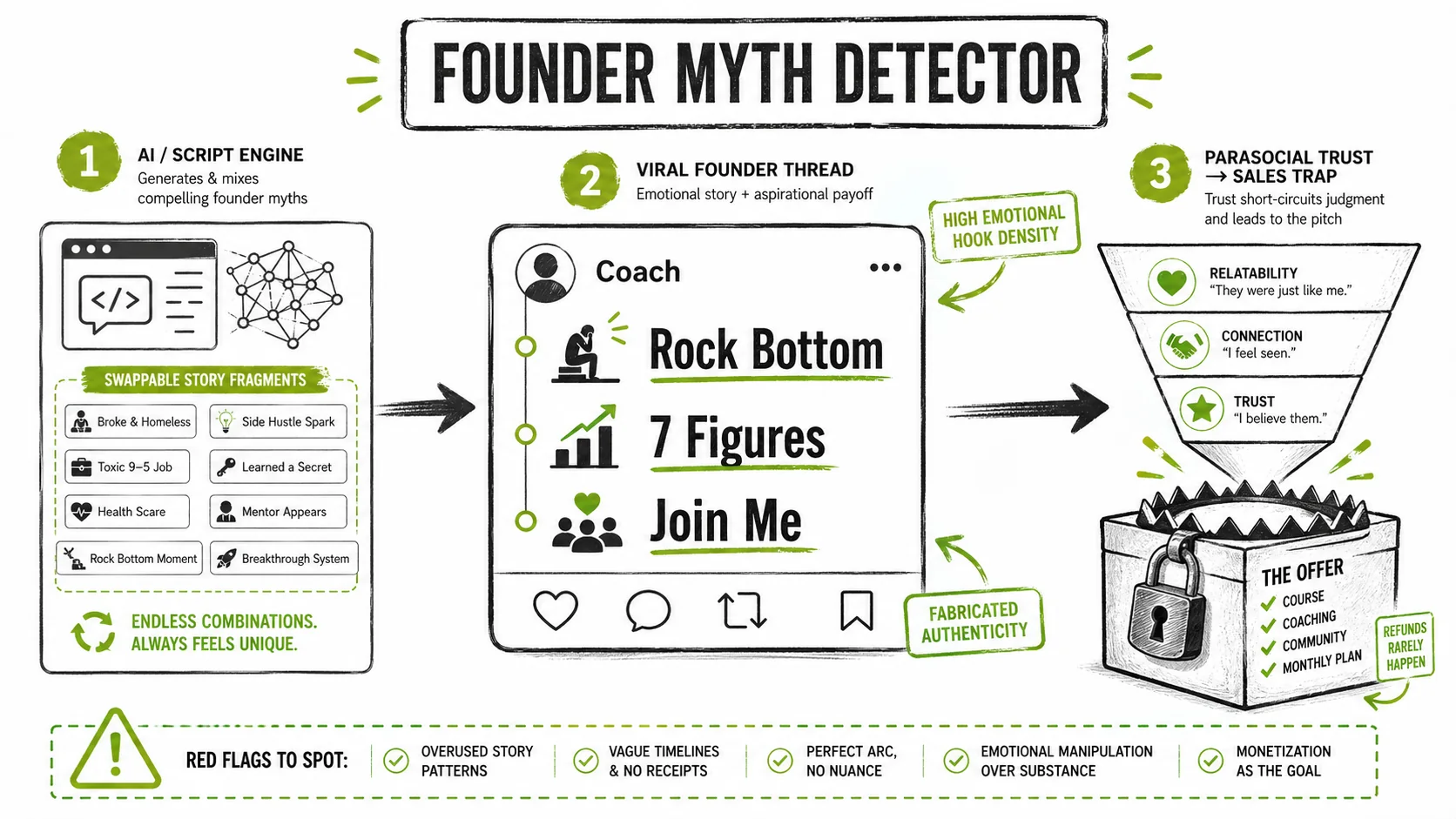
The old scams were transactional. You saw a fake screenshot, you bought a "make money online" course, you got burned. It was a financial transaction based on a false promise. The new scam is relational. It's a founder myth designed to build parasocial trust, making the eventual financial ask feel like supporting a friend or investing in a visionary. This shift in strategy exploits deeper psychological vulnerabilities, making it far more effective and damaging.
They Bypass Logical Defense Mechanisms
Our brains have two primary systems for processing information: the intuitive, emotional System 1, and the analytical, logical System 2. Fake revenue numbers trigger System 2. We might think, "That graph looks odd," or "How is that possible?" A powerful, emotionally charged story triggers System 1. We feel inspired, connected, and empathetic. We want to believe the story because it makes us feel good. By the time System 2 kicks in to ask tough questions, we're already emotionally invested in the person's success. This is the core mechanism behind the AI-powered founder's journey—it's a hack for your empathy.
They Create a False Sense of Intimacy and Accessibility
A detailed story about childhood struggles, personal doubts, and specific failures makes a founder seem relatable and "just like you." The implicit promise is, "If I did it from nothing, so can you!" This manufactured intimacy is a powerful sales tool. It transforms the guru from a distant expert into a peer who has conquered the mountain and is now throwing down a rope for you. You're not buying from a corporation; you're buying from a person you feel you know. This tactic is a cornerstone of modern guru culture, making followers more loyal and less critical.
They Are Infinitely Scalable and Hard to Disprove
Photoshopping a bank statement takes some skill. Fabricating a years-long business history with consistent social media posts, blog articles, and podcast interviews is a massive undertaking for a human. For an AI, it's a weekend project. Tools can generate a year's worth of "authentic" LinkedIn posts chronicling a fake business journey, complete with simulated ups and downs. Furthermore, disproving a personal narrative is notoriously difficult. How do you prove someone didn't feel a certain way in 2021? How do you audit their personal memories? This evidentiary fog protects the scammer. A 2025 report from the Stanford Internet Observatory highlighted the growing trend of "narrative laundering," where AI-generated backstories are used to lend credibility to financial and political influence campaigns, precisely because they are so resilient to fact-checking.
The damage goes beyond lost money. It erodes trust across the entire entrepreneurial ecosystem. It makes genuine founders with less-polished stories seem less credible. It sets unrealistic expectations for what a "real" journey looks like, leading to imposter syndrome and burnout when people's own messy realities don't match the perfect synthetic archetype. Learning to spot a synthetic founder isn't just about protecting your wallet; it's about preserving your sense of what real success entails.
How to Conduct a Narrative Audit: Your Step-by-Step Method
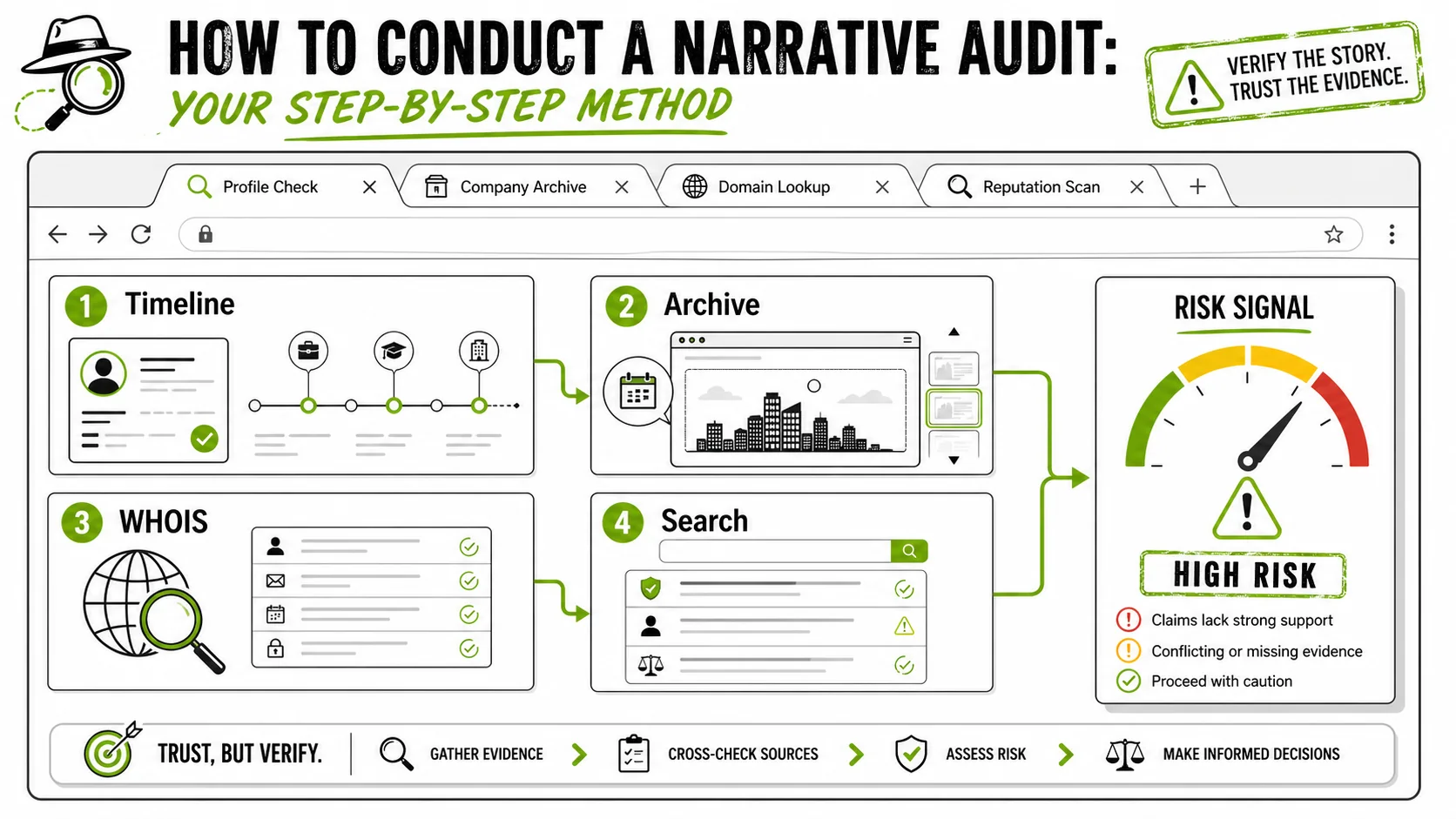
Conducting a narrative audit is a systematic process of verifying the key claims and emotional beats of a founder's story. You're not being cynical; you're being a responsible investor of your attention, trust, and potentially, your money. Think of it as due diligence for a person. Follow these steps to separate the human from the hologram.
Step 1: Establish the Timeline and Corroborate "Hard" Claims
Every story exists in time. The first step is to map the narrative onto a real-world timeline and look for external, objective evidence.
Action: Create a simple timeline with two tracks. Track A is the founder's claimed milestones: "Quit job in Q4 2022," "Launched MVP in March 2023," "Hit $10K MRR by August 2023." Track B is the digital footprint you can find.
Tools & Checks:
- Domain History: Use ICANN Lookup to find when their company domain was actually registered. If the story says "I've been building this since 2021," but the domain was registered 6 months ago, that's a red flag.
- Social Media Archaeology: Don't just look at their current, polished posts. Scroll back. Way back. Use platform search functions to find their earliest mentions of their product or business idea. Does the timeline match? Look for deleted or inconsistent posts using the Internet Archive's Wayback Machine. A common synthetic tactic is to backdate or fabricate old social proof.
- Business Registries: For claimed companies, check official registries like your state's Secretary of State website (in the US) or Companies House (in the UK). Verify the incorporation date and the listed officers.
The Tip: Real stories have messy, public evolution. You should find early, clumsy versions of their idea, maybe even posts asking basic questions. A synthetic timeline is often retroactively clean, with the "first" post already being a confident declaration of a fully-formed vision.
Step 2: Analyze the Language and Emotional Cadence
This is where you move from the objective to the subjective, but with a critical eye. Listen to how the story is told, not just what it says.
Action: Gather the primary telling of the story—their "About Me" page, a keynote speech, a long-form interview. Read or listen to it carefully, then read it again looking for patterns.
Red Flags to Hunt For:
- The Thesaurus Overdose: An overuse of emotionally charged, slightly literary vocabulary. Words like "crucible," "odyssey," "tapestry," "fervor," "indomitable spirit." Real people in business tend to use more direct language, even when describing hard times.
- The Perfect Three-Act Structure: Does the story feel like it was plotted by a screenwriter? Introduction (humble beginnings/struggle), Rising Action (the big problem/eureka moment), Climax (the launch/the big failure), Falling Action (the pivot/perseverance), Resolution (success and wisdom). Real life isn't that neatly packaged.
- Lack of Trivial, Irrelevant Detail: Humans remember weird specifics. "I was eating a peanut butter sandwich when the idea hit." "My first office was so small I had to keep the printer in the hallway." AI-generated stories focus only on details that serve the narrative arc. The absence of meaningless, charmingly human clutter can be a sign.
The Tip: Compare the same story told in different formats (a written bio vs. an off-the-cuff podcast answer). A human will vary wording, forget a minor detail, add a new aside. An AI-generated narrative, or a person reciting one, will be remarkably consistent, almost verbatim, across platforms. This consistency is unnatural.
Step 3: Pressure-Test the Supporting Cast and Evidence
No founder is an island. Their story involves other people, products, and evidence. See if these elements hold up under mild pressure.
Action: Identify the key supporting characters (co-founders, first customers, mentors) and key pieces of evidence (early prototypes, first sales, media mentions).
Checks to Perform:
- The Ghost Co-Founder: If a co-founder is mentioned, can you find them? Do they have their own independent digital presence that predates the story? Do they ever tell the story from their perspective? A synthetic story often has phantom partners.
- The Unverifiable Testimonial: "Our first customer, Sarah, said it changed her life..." Can you find Sarah? Is she linked? If it's a B2B product, is the first client company real, and does their timeline of using the product match up?
- The Missing Artifacts: They talk about a "clunky first prototype" or "the notebook where I sketched the idea." Do they ever show it? A real founder often loves sharing these relics. A fabricated one only has the polished, current version. A deep dive into the synthetic success stack often reveals a lack of these genuine historical artifacts.
The Tip: Gently ask for more detail. In a comment or email, you could say, "Loved hearing about your early days with [First Client]. What was the biggest challenge in onboarding them?" A real founder will usually have a ready, granular story. A fabulist will either deflect, give a vague answer that rehashes the public narrative, or not respond at all.
Step 4: Look for the "Source Code" – The Underlying Business Model
The story is a vehicle. What is it carrying? Ultimately, the narrative exists to sell something. Analyze the destination of the story.
Action: Ignore the story for a moment and look coldly at what the founder is actually offering. What is the product, course, or service? What is the price point? What is the promised outcome?
Key Questions:
- Does the story logically justify the offer? A heart-wrenching tale of building a complex SaaS platform doesn't naturally lead to selling a $497 "Instagram Secrets" course. The disconnect is a sign the story is a modular, plug-and-play narrative.
- Is the business model itself reliant on selling the dream? Look for the classic guru funnel: free inspirational content (the story) -> lead magnet (PDF on their "framework") -> webinar -> high-ticket coaching or "mastermind." When the primary product is access to the person who lived the story, and the story is fake, the entire enterprise is a house of cards. This is the core loop exposed in the 2026 guide to spotting fake gurus.
The Tip: The most damning audit often comes from examining the business, not the biography. A synthetic story is a marketing asset. If the core business is weak, non-existent, or entirely about recruiting more people into the same system, the story's purpose becomes clear: it's bait.
Proven Strategies to Put Your Audit to Work
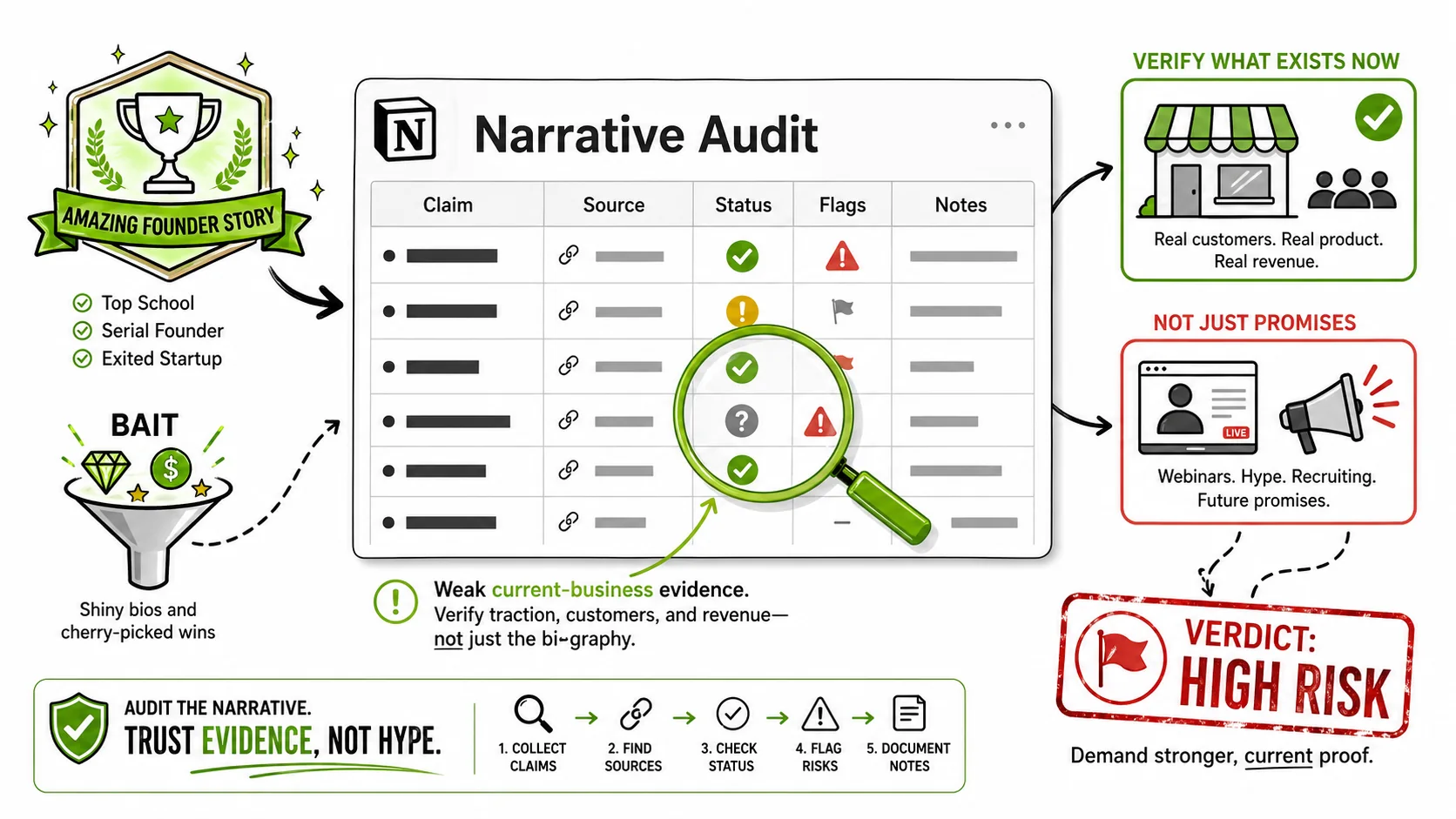
Knowing the steps is one thing. Integrating this skeptical mindset into your daily consumption of entrepreneurial content is another. Here’s how to move from conducting a one-off audit to developing a lasting immunity to synthetic success.
Strategy 1: Cultivate "Narrative Friction"
Your default setting online should be mild, polite friction. When you encounter a powerful story, pause the emotional response. Literally say to yourself, "That's a great story. Is it true?" This simple cognitive interrupt breaks the spell of System 1 thinking and allows your analytical mind to engage. Bookmark the page. Don't sign up for anything in the emotional afterglow. Let the story sit for 24 hours. Often, the sheen wears off, and questions begin to form naturally. This habit transforms you from a passive consumer of content into an active investigator.
Strategy 2: Practice Lateral Research
Don't just read the story on the founder's chosen platform. This is where you employ the tools from your audit in a broader way.
- Search Their Name + "Scam," "Complaint," "Lawsuit," "Fake." See what the dissenting voices are saying.
- Look for Them on Alternative Platforms. A founder might have a pristine LinkedIn but a toxic history on niche industry forums or older platforms like Reddit. Use search operators like
site:reddit.com "[founder name]"orsite:twitter.com "[founder name] controversy". - Check for Plagiarism or Template Use. Sometimes, synthetic stories are low-effort copies. Take a unique-sounding phrase from their bio and Google it in quotes. You might find it verbatim on five other "coach" websites. This is a hallmark of the low-tier synthetic success stack, where pre-written narratives are sold as templates.
Strategy 3: Value the "Anti-Story"
Start giving more credibility to founders who are bad storytellers. The one who stumbles through their origin, contradicts themselves slightly, says "I don't really remember how we got that first customer, it was kind of a mess," and shows you a genuinely ugly first website—that person is almost certainly real. Their lack of narrative polish is a badge of authenticity. In your hub for startup research, seek out these voices. They offer practical insights unvarnished by myth-making. The willingness to be publicly uncertain or to share genuine failures is a powerful anti-signal against synthetic fabrication.
Strategy 4: Follow the Money, Not the Myth
Always trace the financial circuit. Ask: Where does the revenue actually come from? Is it from selling a tangible product or service to a broad market? Or is it from selling courses, coaching, and speaking fees about how to sell courses, coaching, and speaking fees? A business that makes money by teaching people how to be in the same business is a pyramid scheme by another name, no matter how compelling the founder's story. A robust, legitimate business can stand on its own metrics without needing a cinematic biography to justify its existence. This financial audit is the most reliable strategy in your hub for entrepreneurship toolkit.
Got Questions About Synthetic Success Stories? We've Got Answers
How common are completely AI-generated founder stories?
As of early 2026, they are moving from rare to prevalent in specific online niches, particularly the "make money online," "personal branding," and "life coaching" spaces. It's less common in venture-backed tech startups where due diligence is more rigorous, but it's appearing there too, especially in early-stage founder pitches. The ease of generation means we should expect the number to grow significantly. It's not that every inspiring story is fake, but the probability that a too-perfect, emotionally optimized narrative from a solo online guru is synthetic is now high enough to warrant automatic skepticism.
What's the biggest mistake people make when evaluating a founder's story?
The biggest mistake is conflating a good story with good character or real competence. We are culturally trained to believe that someone who can tell a compelling narrative about overcoming adversity is trustworthy and capable. This is a dangerous heuristic. A compelling narrative is a skill—one that can be learned by humans and perfected by machines. It is not a proxy for integrity, business acumen, or the quality of their product. Separate the artistry of the telling from the truth of the tale and the substance of the offer.
Can I use AI tools to help spot AI-generated stories?
Yes, but with major caveats. AI detection tools (like Originality.ai, GPTZero) are an imperfect first filter. They can sometimes flag text that is statistically similar to AI-generated content. However, they produce false positives (flagging human writing) and false negatives (missing sophisticated AI text). A human who has edited AI output can easily bypass them. Relying solely on a detection tool is a mistake. Use it as one data point in your broader audit. The most effective tool is still your own critical thinking, applied to the narrative and business inconsistencies we've outlined.
What should I do if I suspect someone I follow is using a synthetic story?
First, conduct your own private audit using the steps above. If your suspicions are confirmed, you have options. You can simply disengage—unfollow, unsubscribe. Your attention is your power. If you feel compelled to act, you can ask thoughtful, specific questions in public comments, focusing on verifiable details rather than accusations. For example, "Your story mentions launching the beta in June 2022. I couldn't find any press or community mentions from back then. Do you have any links?" This applies polite pressure. Avoid online mob mentality. The goal isn't to "cancel" someone but to create accountability and protect others in your network who might be less skeptical.
Ready to see through the fiction?
Larpable - Detect or Create helps you spot the patterns of deception before they cost you time, money, and hope. The next time a story seems too good to be true, you'll know exactly how to check. Stop consuming myths and start detecting them. Apprendre à Détecter
<!-- sister-projects-start -->
Other Doved Studio projects
Related tools from the same studio you might find useful:
- Ralphable: Generate structured Claude Code skills that iterate until pass/fail criteria are met.
- Doved Studio: Studio indie derrière cette app et une dizaine d'autres outils.
<!-- sister-projects-end -->