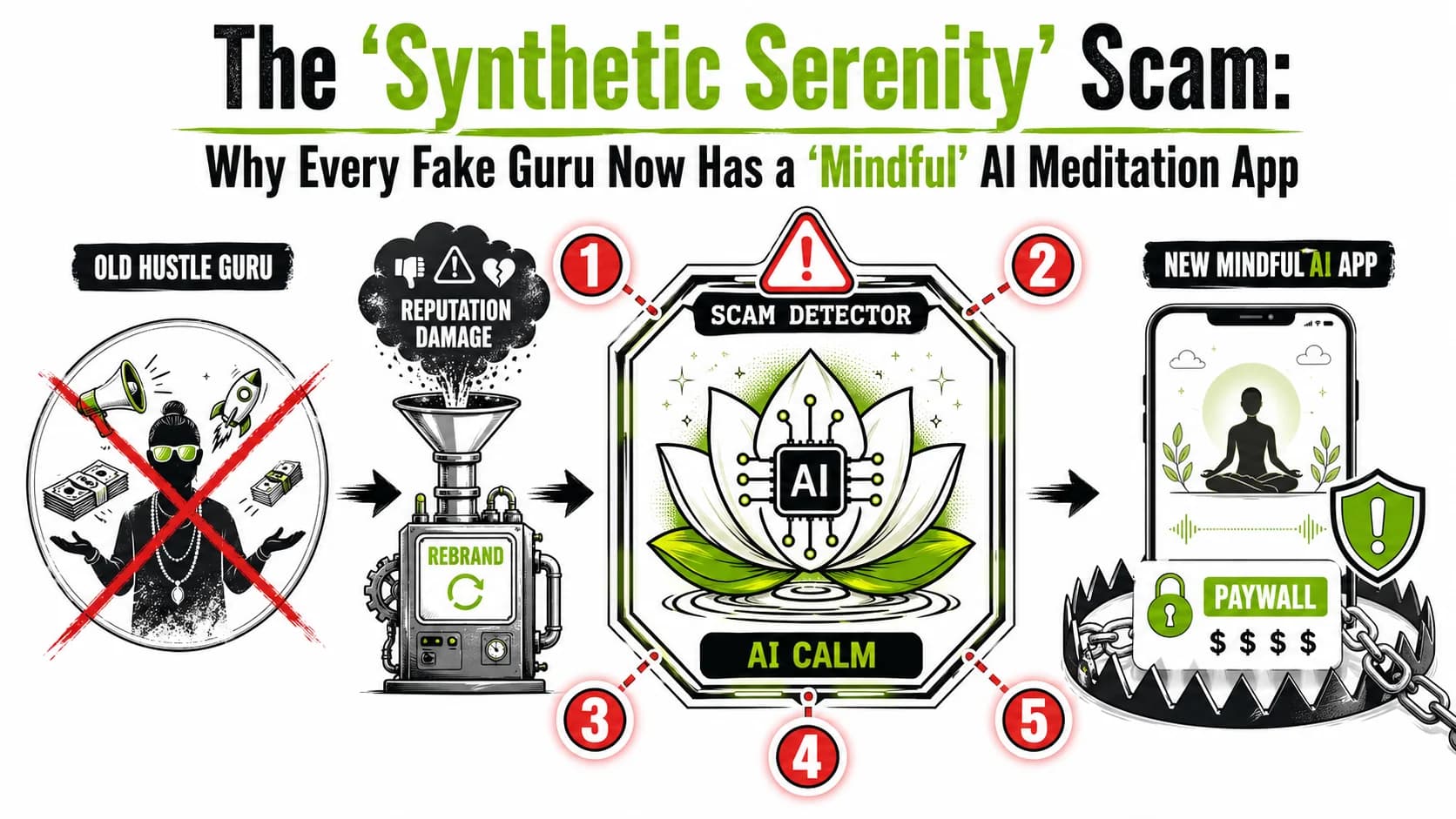
It’s February 2026, and the digital air is thick with the scent of burning sage and burning bridges. A curious pattern has emerged across LinkedIn, Twitter, and the podcast circuit: the same faces who, just 18 months ago, were screaming about “crushing it,” “sleeping 4 hours,” and “closing seven-figure deals in your DMs” are now… serene. They speak in hushed, measured tones. Their bios have swapped “8-Figure Exit” for “Conscious Leader.” And, without fail, they all have a new product to sell: an AI-powered meditation app.
Welcome to the era of Synthetic Serenity, the latest and most cynical pivot in the fake guru playbook. When the “hustle porn” grift collapses under the weight of exposed fake revenue screenshots and disillusioned followers, the disgraced influencer’s survival instinct kicks in. They don’t retreat; they rebrand. They weaponize the $50B+ digital wellness market not as a genuine offering, but as a reputational shield and a soft landing for their bankrupt credibility.
This isn’t wellness; it’s wellness-washing. It’s the grift cycle’s detox phase. Let’s pull back the curtain on this coordinated campaign of faux-spirituality and learn how to spot the five red flags before you pay to have your peace of mind algorithmically manipulated by a proven scammer.
From Grind to “Om”: The Anatomy of a Reputation Launder
The wellness pivot is a three-act reputation laundering playbook: stage a burnout confession, rebrand with spiritual aesthetics, then launch a subscription meditation app that monetizes the $50B+ digital wellness market. The FTC received over 5.4 million fraud reports in 2024 alone, and wellness-washing schemes like these increasingly fill those filings.
The pivot follows a predictable, almost ritualistic, three-act structure.
Act I: The Calculated Burnout. The guru, whose previous “7-Figure SaaS Course” has just been dissected by critics, posts a long-form thread. The tone is vulnerable, raw. They confess to “hustle culture addiction,” to neglecting family, to a deep, spiritual emptiness beneath the Lamborghini photos. They frame their past grift not as a scam, but as a necessary lesson—a “dark night of the entrepreneurial soul” they had to experience to find true wisdom. It’s a masterstroke: past victims are gaslit into believing the scam was part of their guru’s heroic journey.
Act II: The Enlightenment Arc. Enter the sabbatical in Bali or Costa Rica. Social media fills with photos of journaling, silent retreats, and tasteful shots of matcha. The branding palette shifts from aggressive reds and blacks to soft beiges and sage greens. The content pivots from “How I Made $100K in a Day” to “How I Learned to Sit With My $100K-Sized Trauma.” They quote Rumi instead of Gary V. The previous grift is now their “origin story,” giving their new venture a false depth and gravitas.
Act III: The Productized Peace. The guru returns, “healed” and ready to serve. They announce their new venture: NeuroFlow, SoulSync AI, Zenith Mind. It’s always an app. It always uses “AI” and “neuroscience” (terms used loosely). It promises to deliver the calm they’ve allegedly found, but for a monthly subscription. The launch is a spectacle of “conscious capitalism,” where buying their app isn’t a transaction—it’s an act of “joining a movement” toward collective mindfulness. The cycle is complete: the toxin (the old grift) has been processed, and the antidote (the new grift) is now for sale.
The 5 Red Flags of the “Synthetic Serenity” Scam
A fake wellness app is identified by five tells: founder-centric marketing instead of clinical evidence, pseudoscientific “quantum” claims, spiritual shaming of critics, aggressive upsells from a free tier to $2,000+ masterminds, and zero independent reviews on Trustpilot or the App Store. The SEC has flagged similar deceptive marketing in its 2025 investor alerts on “AI-powered” financial wellness tools.
How do you separate a genuine digital wellness tool from a credibility-laundering scheme? Look for these telltale signs.
1. The “Philosopher-King” Founder Narrative
The product is inseparable from the founder’s personal redemption arc. The marketing is 80% about the guru’s “transformative journey from asshole to avatar” and 20% about the app’s features. You’re not buying software; you’re buying access to their hard-won enlightenment. This is a classic diversion tactic—focus on the compelling story to distract from the unproven, often vapid, product. A genuine wellness tool stands on its own merits, not its creator’s publicity-stunt pilgrimage.
2. Vague, Jargon-Heavy “Science”
The sales page is a minefield of buzzwords with no substantive citations. You’ll see claims like:
- “Harnessing quantum mindfulness algorithms.”
- “Using generative AI to craft personalized neural pathways to peace.”
- “Backed by cutting-edge neuroscience (patent pending).”
When pressed for details, studies, or the names of the neuroscientists on their team, the answers are evasive. They might link to a general article about meditation’s benefits from Scientific American, but nothing specific to their proprietary “AI.” This is the digital equivalent of selling snake oil as “electromagnetic vitality juice.” For more on decoding empty claims, our guide to spotting fake gurus is essential reading.
3. The “Community” as a Shield
Criticism is met not with data or refutation, but with spiritual shaming. Questions about pricing, data privacy, or evidence are framed as “negative energy,” “a sign of your own resistance to healing,” or “a reflection of the hustle mindset you need to shed.” The guru’s newly cultivated community then mobs the critic, protecting the leader under the guise of protecting “the group’s peaceful vibe.” It’s a brilliant, manipulative tactic that converts skepticism into a moral failing.
4. Monetizing the “Free” Model Aggressively
The app itself might have a free tier—5 basic meditations, a daily “gratitude ping.” But the real product is the upsell. The free content constantly nudges you toward:
- The $2,000 “Ascension Mastermind” to “go deeper.”
- The $500/month “1:1 AI Consciousness Coaching” (which is just a ChatGPT wrapper).
- The $297 “Soul Purpose Algorithm” report.
The initial app is merely a lead magnet for a high-ticket, high-margin coaching program that looks suspiciously like their old coaching program, just with different slide deck backgrounds.
5. No Independent Verification, Only “Testimonials”
You will find no reviews on independent platforms like Trustpilot or the App Store that aren’t curated. Instead, “proof” comes in the form of glowing video testimonials from other influencers in their circle (engaged in the same reputation swap) or anonymous quotes (“J.S., Startup Founder, says ‘I found my soul!’”). There is no third-party audit of their “AI,” no clinical trials, no data on user outcomes beyond self-reported “feeling better.” As we’ve learned from exposing larper metrics, if the only proof is controlled by the seller, assume it’s synthetic.
Why This Grift Is Particularly Insidious
Wellness-washing is uniquely harmful because it exploits genuine mental health needs, corrupts therapeutic language for marketing, and has a built-in exit strategy when exposed. According to Grand View Research, the global digital wellness market reached $52.6 billion in 2025, making it a high-value target for reputational pivots. The same authenticity playbook exposed gurus use for scripted vulnerability applies here.
The “Synthetic Serenity” scam is more dangerous than a simple dropshipping course for three reasons:
Protecting Yourself: How to Vet Digital Wellness (or Any) Tools
Before spending a cent, verify funding on Crunchbase, demand published research from the team, and search "[Founder Name] scam" outside their ecosystem. A $10M Series A for a meditation app means growth-at-all-costs is the real mantra. The FTC's Consumer Sentinel Network logged $10 billion in consumer fraud losses in 2024 — apps like these feed that pipeline. For more on vetting dubious coaching offers, see our online course scam checklist.
Before you download or input your credit card, run this quick audit:
- Follow the Money Trail: Who funded this? Is it VC-backed with demands for 10x returns, or bootstrapped? Check Crunchbase. A $10M Series A for a meditation app often means growth-at-all-costs is the real mantra.
- Interrogate the “Science”: Email support and ask, “Can you link me to the published research paper detailing your methodology and results?” Silence or a deflection is your answer.
- Check the Team Page: Are there actual psychologists, neuroscientists, or licensed therapists on staff? Or is the “team” just the founder, a CTO, and a “Chief Mindfulness Officer” who is the founder’s yoga instructor?
- Trust the Product, Not the Prophet: Does the app provide clear, tangible value in the free tier without constant upsell pressure? Would it be valuable if it were built by an anonymous, boring company? If the value is inextricably linked to the founder’s personality cult, walk away.
The core skill here is pattern recognition. The same psychological tricks used to sell fake business courses are now being used to sell fake peace. The medium has changed from “notion templates” to “neural calm,” but the manipulative architecture is identical. Developing this detector is the first, most important step in protecting your time, money, and mental space in the modern digital landscape. It’s why we built the foundational toolkit at our Entrepreneurship Hub.
Conclusion: The Only Authentic Detox
The wellness-washing grift is the guru economy’s most adaptable mutation. The same founders exposed for faking revenue screenshots now sell $297 “soul purpose” reports, and the same community dynamics found in community-driven pyramid schemes insulate them from criticism.
The rise of the “Synthetic Serenity” scam is the ultimate testament to the fake guru’s adaptability. It reveals their true product: not courses, not apps, but narratives. They sell stories of success, then stories of redemption, packaging human longing into subscription plans.
The antidote isn’t cynicism—it’s discernment. It’s recognizing that authentic wellness and business wisdom are quiet, iterative, and rarely come with a dramatic three-act redemption story sold by a charismatic central figure. They are built on verifiable data, ethical practices, and tangible results, not algorithmic aphorisms.
Your peace of mind is not a SaaS metric to be gamified. Don’t let the very people who profited from your anxiety sell you the cure. Learn to see the pattern, so you can protect what’s real. Start by learning the foundational skills to Apprendre à Détecter the grift, no matter what form it takes next.
FAQ: The Synthetic Serenity Scam
1. Isn't some of this AI wellness tech potentially legitimate?
Absolutely. Legitimate biofeedback devices, clinically-validated CBT apps (like those based on real research from institutions like Oxford), and tools built with input from credentialed professionals are valuable. The red flag isn't "AI + wellness." It's the combination: an AI wellness tool + a founder with a recent, exposed grift history + a marketing narrative focused solely on the founder's personal enlightenment + a lack of transparent, independent science. Context is everything.
2. What should I do if I've already bought into one of these apps?
First, don't blame yourself. The manipulation is sophisticated. Audit what you've actually received:
Value Check: Are you getting tangible benefits from the core product* (the app itself), or are you being funneled into constant, expensive upsells?
- Data Check: Review the app's privacy policy. What data is it collecting? Can you delete it? These apps often harvest incredibly sensitive biometric and mental state data.
- Cancel: If it feels off, cancel your subscription. Your intuition is a better guide than any "AI consciousness coach." Consider supporting a reputable, boring, evidence-based app instead.
3. How can I tell a genuine personal transformation from a marketing pivot?
Genuine transformation is rarely monetized with such immediacy and precision. Look for consistency over time (years, not months), a de-centering of the self in the narrative (they talk about ideas and others, not just their own journey), and often, a period of genuine retreat from the public eye or commercial activity. A marketing pivot is announced with a landing page, a pricing tier, and a launch sequence. A transformation is often something you observe in someone over time; they don't need to sell it to you.
4. Why is the digital wellness market so susceptible to this?
The market is booming (projected to exceed $50B) and is inherently subjective. Outcomes are often self-reported ("I feel less stressed"), making it hard to disprove claims. It also taps into deep, universal human desires for peace and purpose, which are powerful emotional drivers that can override logical scrutiny. Grifters follow the money and the emotional vulnerability.
5. Are all influencer-led wellness brands a scam?
No, but the burden of proof is higher. The critical question is: Is their authority based on credentials/verifiable expertise, or solely on their personal brand narrative? A licensed therapist who builds an audience and then creates a course is leveraging a pre-existing, accredited skill. A failed crypto influencer who pivots to "mindful leadership coaching" is leveraging a narrative. Always look for the foundation of their authority.
6. What's the endgame for these gurus? Where do they pivot after this?
History suggests the cycle continues. The "mindful leader" brand may last 2-3 years. When growth stalls or skepticism mounts, the next pivot will likely be into something like "regenerative leadership," "post-capitalist community building," or "applied existential philosophy." The core formula remains: identify a growing market laden with unmeasurable outcomes, attach a personal redemption story to it, and productize it. The only lasting defense is a well-honed detector for the underlying patterns of manipulation.
<!-- sister-projects-start -->
Other Doved Studio projects
Related tools from the same studio you might find useful:
- Ralphable: Generate structured Claude Code skills that iterate until pass/fail criteria are met.
- Doved Studio: Studio indie derrière cette app et une dizaine d'autres outils.
<!-- sister-projects-end -->