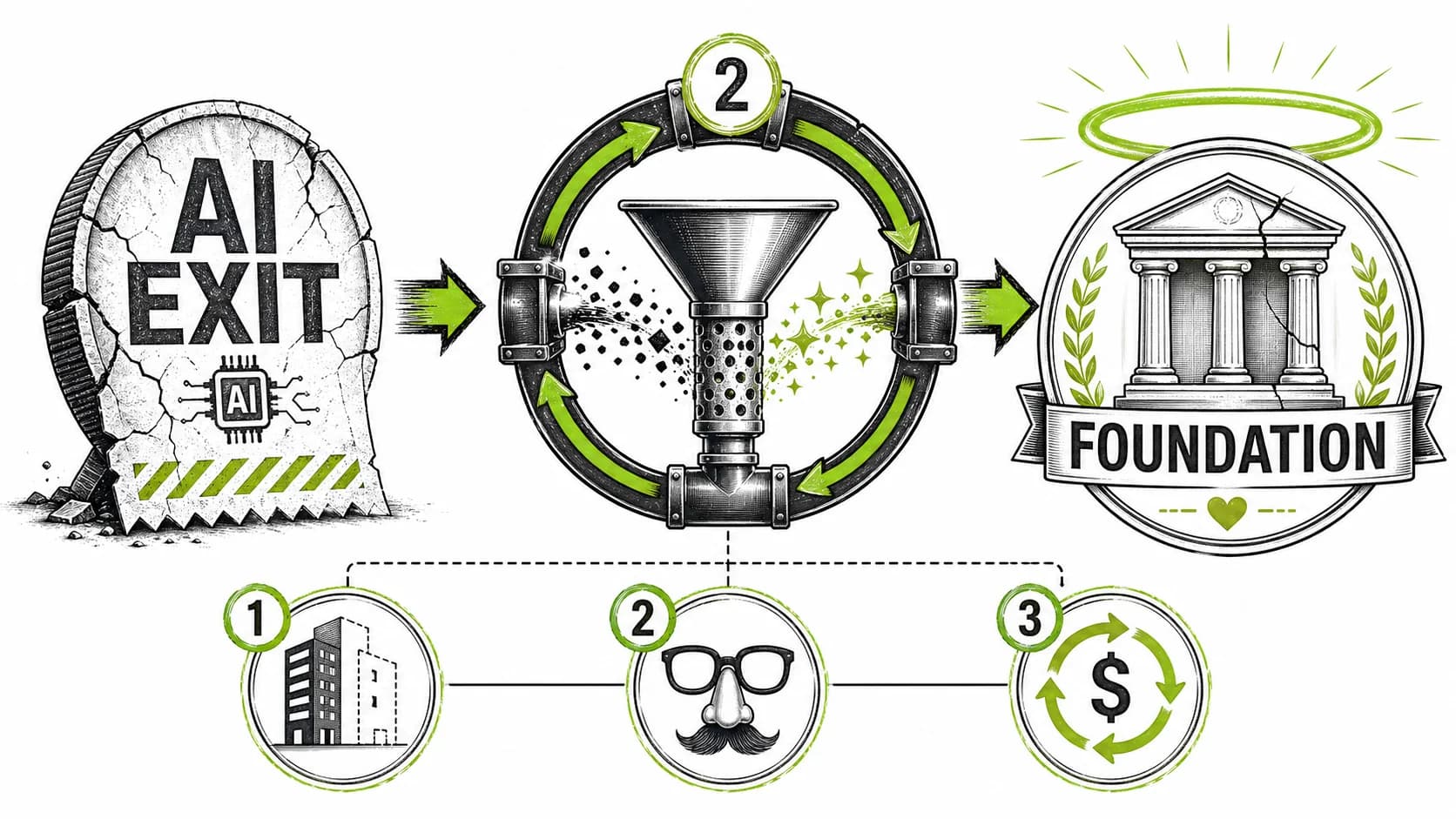
If you’ve been anywhere near tech Twitter, LinkedIn, or the darker corners of Hacker News in early 2026, you’ve seen the announcement. The same founder who, just 18 months ago, was breathlessly posting about their “AI-native” startup’s “exponential growth” is now solemnly declaring their next chapter: a philanthropic foundation.
The post is a masterpiece of narrative engineering. It talks about “giving back,” “creating a lasting legacy,” and “solving humanity’s grand challenges” with the same capital they “generated” from their recent, vaguely-defined “exit.” The comments are filled with applause. “Inspiring!” “A true leader!” “This is what success looks like.”
But you have a nagging doubt. You remember the whispers about their revenue being… creative. You recall the exposé on fake revenue screenshots. Their “exit” was to a shell company you’d never heard of. And now, they’re a philanthropist?
Congratulations. Your skepticism is your greatest asset. You’re witnessing the latest, most sophisticated evolution of the guru grift: the Post-Exit Philanthropic Pivot. It’s not just about laundering money; it’s about laundering an entire reputation. It’s the final act in a play of synthetic success, designed to cement a fraudulent narrative into the historical record as benevolent fact.
This article will dissect this new pattern. We’ll explore why fake gurus are suddenly so charitable, how to spot the hallmarks of synthetic charity, and what this move really accomplishes for them. Most importantly, we’ll give you the tools to separate the genuinely generous from the grifters performing their magnum opus.
From Grindset to “Givebackset”: The Philanthropy Pivot Timeline
To understand the 2026 “legacy foundation,” we need to trace the guru’s lifecycle. It’s a predictable, multi-act drama.
- Act I: The Hustle (2020-2023). The founder builds a “personal brand” around hustle culture. Content is about closing deals, 5 AM routines, and “building in public” with suspiciously perfect metrics. The product is often secondary to the narrative.
- Act II: The AI Rebrand (2024-2025). As skepticism grows, they pivot. Their SaaS for dog walkers is now an “AI-powered logistics optimization platform.” They raise a “seed round” from other influencer-friends. The narrative shifts to tech profundity.
- Act IV: The Legacy Launch (2026-Present). With the “exit” as their credibility anchor, they launch the “Smith Family Foundation” or the “Future of Work Fund.” The press release is heavy on vision, light on details. The founder is now a “philanthropist,” “impact investor,” and “thought leader on ethical technology.”
This pivot solves multiple problems for the larper:
The Anatomy of a Synthetic Charity: 7 Red Flags
Not all new foundations are scams. Many genuine entrepreneurs do incredible work with their wealth. The key is pattern recognition. Here’s what to look for in a fake philanthropy operation.
1. The Opacity of the “Exit”
This is the foundational crack. A real exit of substance (an IPO, acquisition by a major tech firm) is a matter of public record. There are SEC filings, press releases from the acquirer, and verifiable data.
- The Fake Guru Tell: The exit is shrouded in mystery. Phrases like “undisclosed terms,” “partnered with a private family office,” or “merged with a strategic ally” are used. The “acquiring” entity has no digital footprint beyond a landing page created the month before the announcement. If you can’t trace the source of the purported wealth, the philanthropy built on it is a house of cards.
2. The AI-Generated “Impact”
This is the 2026 signature. The cause is often grand, vague, and perfectly aligned with current buzzwords: “Democratizing AI Education,” “Solving Mental Health with Neurotechnology,” “Climate Resilience through Web3.”
- The Fake Guru Tell: The foundation’s website and materials feel… synthetic. The “research” section is populated with AI-generated summaries of complex papers. The “team” page features stock photos or overly polished AI-generated headshots. The mission statement is a word salad of TED Talk keywords, likely crafted by ChatGPT. There’s no tangible, on-the-ground work, just a website announcing future “initiatives” and “summits.”
3. The Founder-Centric Universe
Real philanthropic institutions work to institutionalize their mission beyond the founder. Fake ones exist solely to burnish the founder’s brand.
The Fake Guru Tell: Every piece of communication centers the founder. It’s their legacy, their vision, their* generosity. The foundation’s name often includes their name or a derivative. The “work” consists primarily of the founder giving interviews and keynotes about philanthropy. The foundation is a PR vehicle, not an operational entity.
4. The Lack of Financial Transparency
Legitimate foundations, especially those seeking public trust, are transparent. They file Form 990-PF with the IRS (in the U.S.), detailing assets, expenditures, and grants.
- The Fake Guru Tell: No financial data is published. There are no clear grant-making processes. If asked about funding, they cite “an initial endowment from my exit” and “ongoing support from a community of donors” (who are never named). The money flows in, but there’s no visible track record of it flowing out to actual causes in a significant, documented way.
5. The “Advisory Board” of Fellow Larpers
A board of directors or advisors lends credibility. The fake guru populates theirs with a curated circle of peers from the same ecosystem.
- The Fake Guru Tell: The advisory board reads like a who’s-who of other “post-exit” founders, growth hackers-turned-“impact coaches,” and micro-influencers. It’s a circle of mutual reputation laundering, not a group of subject-matter experts in the foundation’s stated field. You can learn more about this ecosystem in our broader guide to spotting fake gurus.
6. The Monetization of Morality
This is the ultimate goal. The foundation becomes a funnel.
- The Fake Guru Tell: Quickly, ancillary monetization appears. The founder launches a “Philanthropy Masterclass” ($2,999). They sell “Impact NFTs” to fund the foundation (with 40% going to “operational costs”). They get paid $50,000 to speak about “Conscious Capitalism” at corporate events. The charity is the loss leader for a new, morally-armored grift.
7. The Aggressive Narrative Policing
Criticism of a fake charity is framed as an attack on goodness itself.
- The Fake Guru Tell: Anyone who questions the foundation’s financials or the legitimacy of the exit is met with extreme hostility. They are labeled “negative,” “cynical,” or “against progress.” The guru’s community mobs the critic. The message is clear: questioning our charity is a moral failing. This is a classic manipulation tactic to avoid scrutiny.
Why This Works: The Psychology of Reputation Laundering
The post-exit guru isn’t just seeking money; they’re seeking unassailable social capital. Philanthropy is the ultimate reputation laundering tool.
How to Investigate a “Legacy” Foundation: A Practical Guide
Your B.S. detector is buzzing. Here’s a step-by-step process to validate a newfound philanthropic zeal.
* Search for the acquiring company. Check business registries (like Delaware’s Division of Corporations if in the U.S.). Is it a real, operating company with other employees and clients?
* Look for SEC filings (EDGAR database) if a public company was involved.
* Search news archives not just for the announcement, but for any mention of the acquirer before or after.
* In the U.S., use ProPublica’s Nonprofit Explorer or the IRS Tax Exempt Organization Search to find the foundation’s Form 990. If they don’t have one, it’s a major red flag. The 990 will show assets, revenue, executive compensation, and grant recipients.
* Look at the grants. Are they going to established, reputable organizations? Or to vague “consultants” and companies owned by the founder’s friends?
* Go beyond the press releases. If they claim to fund “AI education,” find the recipients. Call or email one. Ask about their experience with the foundation.
* Are there concrete outputs? A curriculum? Published research? A built tool? Or just “fellowships,” “dinners,” and “thought leadership reports”?
* Use an AI detector tool on their mission statements and blog posts. A high probability of AI-generation for core content suggests a lack of genuine intellectual investment.
* Is the language specific and actionable, or vague and aspirational? “Empowering 10,000 African girls with coding kits by 2027” is specific. “Reimagining global education for the AI age” is not.
* Look at the board and advisors. Google each one. Are they experts in the field of philanthropy (e.g., development economists, nonprofit lawyers, scientists) or are they other startup founders, podcasters, and branding experts?
* Check if the foundation’s “partners” are real organizations with their own independent web presence.
The Bigger Picture: Why This Matters for Everyone
You might think, “So what if a few grifters play at being philanthropists? Isn’t any money to good causes still good?”
This is a dangerous fallacy. Synthetic charity causes real harm:
- It Diverts Resources and Attention: It sucks up donor money, media oxygen, and partnership opportunities that should go to legitimate, effective organizations doing hard, unglamorous work.
- It Corrupts Solutions: It promotes flashy, tech-bro “solutions” to complex human problems (e.g., “an app to end hunger”) over nuanced, evidence-based work, often harming the communities they claim to serve.
- It Rewards Deceit: It completes the cycle, proving that a career built on lies can be not only profitable but crowned with social admiration. This incentivizes more fraud.
The goal isn’t cynicism; it’s discernment. The world needs more genuine philanthropy, not more performance art. By learning to spot the AI legacy scam, you protect the integrity of real giving and stop rewarding pathological storytelling with prestige.
The toolkit for seeing through business fraud is the same one needed to see through charitable fraud. It’s about following the data, ignoring the narrative, and demanding transparency. If you want to sharpen these skills across the board, start by learning the fundamental patterns of deception in our entrepreneurship hub.
The most powerful form of skepticism is an informed one. When you see the next “legacy” announcement, you won’t just feel doubt—you’ll know exactly where to look. Start honing your detection skills today.
FAQ: Synthetic Charity and Reputation Laundering
What’s the difference between a new, genuine founder foundation and a fake one?
The core difference is transparency and focus. A genuine foundation, even if new, will be transparent about its funding source (e.g., “funded by proceeds from the sale of Company X to Google”). It will have clear, specific goals and begin making verifiable grants or operational work quickly. Its focus will be on the cause, not on the founder’s personal branding. A fake foundation is opaque about the money, vague in its goals, and centers the founder’s narrative above all else.
Are they breaking the law?
It depends. If they are soliciting public donations for a registered nonprofit but misusing the funds (e.g., paying for the founder’s luxury travel as a “program expense”), that is fraud. If the foundation is just a shell that never files the required tax forms, that is illegal. However, much of this activity operates in a gray area. Using personal (or allegedly personal) wealth to fund a vanity project that loses money isn’t illegal—it’s just a sham. The illegal part is often the fraudulent business practices (the fake “exit”) that generated the myth of wealth in the first place.
Why is AI so central to this new wave of scams?
AI serves two purposes. First, it was the narrative engine for the “exit.” From 2024-2025, claiming an “AI-powered” product was the easiest way to attract hype and create a story of cutting-edge value. Second, AI is now the production tool for the “legacy.” It can generate convincing website copy, research summaries, and even synthetic imagery for the foundation, allowing one person to create a vast, hollow facade of impact with minimal effort. It’s the perfect tool for synthetic output to match synthetic success.
How can I support real philanthropy without getting scammed?
Do your due diligence like you would with an investment:
What should I do if I suspect someone is running a fake philanthropic foundation?
First, gather evidence discreetly using the investigation steps above. Then, you can:
- Ask pointed, public questions in a neutral tone. “Congratulations on the launch! Can you share a link to your foundation’s 990 form so we can see the impactful work you’re funding?” or “Your exit to [Company Y] sounds interesting. What was their core business before the acquisition?”
- Report them to the relevant authorities if you have evidence of fraud. In the U.S., this could be your state’s Attorney General’s office (Charities Bureau) or the IRS.
- Write about it. Use your platform or contribute to forums that expose these patterns. Sunshine is the best disinfectant.
Is this just a tech industry problem?
While it’s most visible and acute in tech due to the combination of hype cycles, rapid wealth creation (real or imagined), and social media culture, the pattern exists elsewhere. It’s seen in finance (“the hedge fund manager turned conservationist”), real estate, and even entertainment. The core playbook—use a murky success to fund a reputation-laundering philanthropic vehicle—is universal. The tech industry simply provides the newest tools and fastest narrative velocity.
<!-- sister-projects-start -->
Other Doved Studio projects
Related tools from the same studio you might find useful:
- Ralphable: Generate structured Claude Code skills that iterate until pass/fail criteria are met.
- Doved Studio: Studio indie derrière cette app et une dizaine d'autres outils.
<!-- sister-projects-end -->