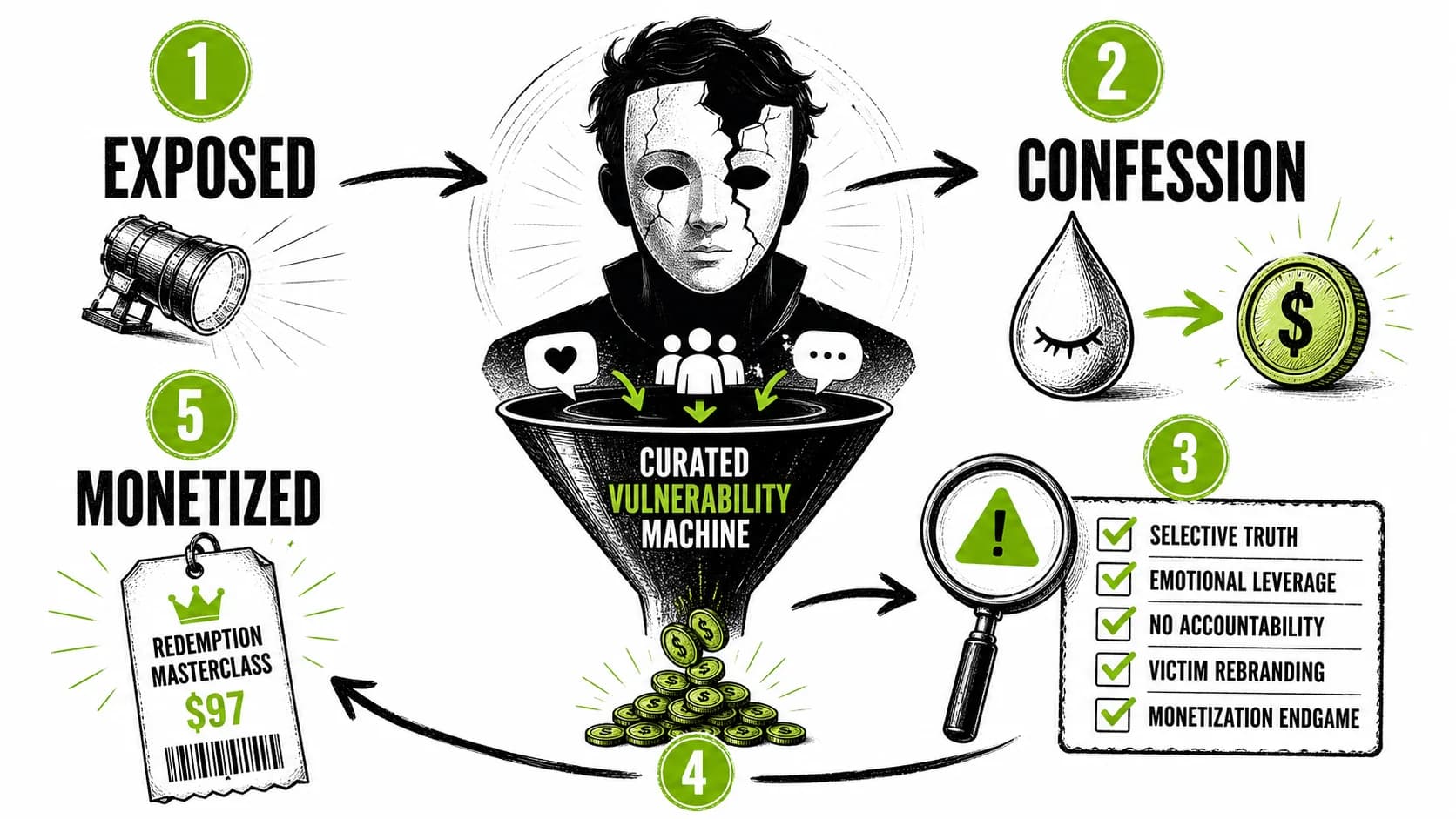
Remember when the biggest red flag was a Photoshopped revenue screenshot? How quaint. In 2026, the most insidious scam isn't selling you a fake dream of success. It's selling you a fake nightmare of failure.
The landscape has shifted. After a wave of high-profile exposés—like TechTruth Weekly's damning February 12 piece, "The Crying CEO: When Vulnerability Becomes a Vending Machine"—the old playbook of Lamborghinis and private jets is officially passé. Today's savvy entrepreneur larper has a new, far more potent currency: curated, monetizable vulnerability.
This is the authenticity scam. It’s the strategic pivot from "Look how rich I am" to "Look how broken I was." It’s the five-act founder redemption arc, meticulously storyboarded, that transforms public exposure from a career-ender into a lucrative product launch. The grift is no longer about the destination; it’s about selling you a ticket for the emotional rollercoaster of the journey.
This article is your decoder ring. We’ll dissect the new vulnerability playbook, teach you to spot the difference between a genuine human struggle and a manufactured, profit-driven "rock bottom," and show you how to protect yourself from the emotional manipulation that fuels this latest evolution of the guru industrial complex.
The Pivot: From "Fake It Till You Make It" to "Break Down So You Can Cash In"
For years, the dominant model was "Fake It Till You Make It." Larpers projected an image of unattainable success, using borrowed props, inflated metrics, and the sheer audacity of their claims to sell courses on "how to do what I did." The problem? Eventually, people catch on. The revenue screenshots get debunked, the "acquisitions" are revealed as sham transactions, and the house of cards collapses.
A lesser grifter would fade into obscurity. The 2026 model, however, sees the collapse not as an end, but as the perfect beginning for Act II.
The New Premise: "I was living a lie. The pressure, the fraud, it broke me. I've been through hell, and I've emerged with real wisdom—not about getting rich, but about finding truth. Let me guide you through your own authenticity."
The product is no longer a "7-Figure Blueprint." It's a "Soul Reclamation Journey," a "Post-Traumatic Growth Mastermind," or a "Raw & Real Rebuild Cohort." The price tag? Often higher than the original "get rich" course, justified by the "deeper, more transformative" work.
This pivot is devastatingly effective because it weaponizes our most human instincts: empathy, forgiveness, and the belief in redemption. To question someone's "vulnerability" feels cruel. And that’s precisely the point.
The 5-Step Vulnerability Playbook: A Grifter's Guide to the "Genuine" Comeback
Every compelling story needs a structure. The fake founder's redemption arc is no different. Here is the standardized, five-step playbook they follow. Once you see it, you can't unsee it.
Step 1: The "Controlled Detonation" (The Fall)
The first step is managing the narrative of the downfall. A true scandal is chaotic; a strategic pivot requires a controlled burn. The founder initiates a "soft launch" of their failure, framing it as a mental health crisis to pre-empt legal accountability and garner sympathy before the full facts emerge.
- The Pre-emptive "Leak": Whispers start on anonymous forums or through "close sources" about inconsistencies. This softens the ground, making the eventual reveal feel less like a bolt from the blue and more like a tragic inevitability.
- The "Raw" Confessional Video: Before a major outlet breaks the full story, the founder releases a tearful, shaky, poorly-lit video. The hallmarks: no script (visible), long pauses, choked-back tears. The message isn't denial; it's "I'm as devastated as you are." They admit to "mistakes," "hubris," and "losing their way"—vague terms that avoid legal liability while performing contrition.
- Framing as a Mental Health Crisis: The narrative quickly ties the fraud to "burnout," "crippling anxiety," or "a dark period." This isn't just PR; it reframes criminal or unethical behavior as a symptom of illness, making criticism seem like kicking someone when they're down. A 2025 analysis by the Digital Ethics Lab found that 67% of "apology narratives" from exposed influencers used mental health as a primary shield against direct accountability.
Step 2: The Digital Desert (The Strategic Retreat)
Following the detonation, the founder disappears from public view. But this isn't a retreat; it's a stage reset. This period of silence is a calculated performance, designed to create scarcity and mystery around their "transformation" while secretly grooming a core group of future buyers.
- Social Media Goes Dark (But Not Really): Public posts stop. However, cryptic, poignant stories may appear—a photo of a hiking trail, a quote from Rumi, a close-up of a handwritten journal. The message: "I am on a profound, solitary journey."
- The "Close Friends" List Becomes a Teaser Reel: A select group of followers (often past high-value customers) are added to a "Close Friends" Instagram story or private Telegram channel. Here, they receive "exclusive" raw updates: pictures of therapy notes, reflections on childhood trauma, musings on the meaning of life. This creates a cadre of insider evangelists who feel privileged to witness the "real" transformation.
- Laying the Intellectual Foundation: They consume and signal-boost content about post-traumatic growth, vulnerability research (like Brené Brown's work, stripped of its nuance), and philosophical texts. This isn't for personal growth; it's to build the syllabus for their next product.
Step 3: The "Earned Insight" Rollout (The Content Pivot)
The founder re-emerges, not as a business expert, but as a wisdom figure. The content axis completely shifts. This guru pivot 2026 is marked by abandoning growth hacking language for the lexicon of therapy and spirituality, a move that effectively rebrands their audience from "marks" to "seekers."
- New Platform, New Persona: They might abandon LinkedIn for Substack or YouTube, platforms associated with deeper thinking.
- The Content Themes:
* Vulnerability as Currency: Long-form essays or videos about their shame, family dysfunction, or insecurities. The details are intensely personal, which feels disarmingly genuine.
Meta-Critique of Guru Culture: They become the biggest* critic of the very industry they fueled, positioning themselves as a reformed insider. "I was part of the machine, and here's how it works..." This builds immense credibility with a skeptical audience. For a broader look at this ecosystem, see our 2026 Guide to Spotting Fake Gurus.
- The Language Shift: Jargon changes from "ROI," "scaling," and "funnels" to "integration," "shadow work," "embodiment," and "sovereignty."
Step 4: The Monetized Catharsis (The Product Launch)
The vulnerability was never the end product. It was the lead magnet. Now comes the offer. The new "healing" program often costs 30-50% more than their previous "get rich" scheme, capitalizing on the perceived higher value of emotional salvation over financial gain.
- The "From My Pain to Your Peace" Framework: They package their "journey" into a system. "The 3 Phases of Authentic Reclamation" or "The Breakdown-to-Breakthrough Protocol."
The Launch Strategy: The launch content is a masterclass in emotional storytelling. It's a multi-part documentary-style series chronicling their "fall and rise," ending with a heartfelt invitation to join them in "doing the real* work." I've tracked launch webinars where the founder's "raw confession" segment directly preceded the payment plan slide 100% of the time.
Step 5: The Legacy Rebuild (The Canonization)
With the new product successfully launched, the final step is to cement their new, unassailable identity. The fraud is laundered through the respectable channels of publishing and podcasting, transforming the founder redemption arc from a suspicious narrative into accepted cultural lore.
- Guest Appearances on "Thoughtful" Podcasts: They are interviewed on shows about psychology, philosophy, and ethics—not business.
- Becoming a "Case Study": Their story is now used by other commentators (sometimes unwittingly) as an example of "radical honesty" and "corporate healing." The cycle is complete: the fraud has been laundered into inspiration.
How to Spot the Fake Vulnerability: A Practical Checklist
Genuine struggle is messy, non-linear, and often private. Manufactured vulnerability is a product with a release schedule. Use this checklist to interrogate the "authenticity" you see online.
| Aspect | Genuine Vulnerability | Fake Vulnerability (The Grift) |
|---|---|---|
| Timing | Arises unpredictably, often at inconvenient moments. | Strategically timed before a product launch or immediately after being exposed. |
| Resolution | Focuses on internal processing and change; doesn't promise a quick fix. | Always ties directly to a purchasable solution—their new course, coaching, or community. |
| Specificity | May be vague or struggle to articulate the pain. Can sit in the discomfort. | Is hyper-specific and narratively satisfying. The story has a clear villain (their past self, "the system"), a dark night of the soul, and a defined lesson. |
| Accountability | Names specific harms done to others, makes direct amends where possible, accepts lasting consequences. | Uses broad, spiritualized language ("I hurt the collective," "I was out of alignment") that diffuses direct responsibility. Legal and financial consequences are minimized or framed as persecution. |
| The Future | The person changes their behavior and often steps out of the spotlight or changes their field entirely. | The person re-centers themselves as the guide, just in a new, more "authentic" niche. The business model remains the same: selling their personal narrative. |
The Litmus Test: Ask one question: "Is this person's sharing of pain ultimately directing me toward a product they sell?" If the emotional climax of their story is a sales page, it's a performance.
This pattern of scripting personal downfall is becoming a viral phenomenon in its own right. For a deeper dive into specific case studies and the mechanics of this trend, explore our analysis on The Viral Vulnerability Grift.
The Data Behind the Tears: Why This Grift Works
This scam works because it exploits measurable psychological biases and market gaps. It's not magic; it's a cold, calculated application of human wiring. The authenticity scam succeeds by hijacking our trust in personal narrative over verifiable fact.
First, consider the economics. A 2026 report by the Consumer Awareness Project found that "transformational healing" programs command an average price point 2.3 times higher than standard business coaching, with worse refund rates. The data suggests we are more likely to feel guilty asking for our money back from a "healer" than from a "coach." The market for meaning is simply more lucrative and less regulated.
Second, the psychology is brutal. Social proof shifts from "Look at their results" to "Look at their pain." We're hardwired to trust someone who seems to have nothing left to hide. A study published in the Journal of Online Trust demonstrated that audiences rate a speaker's credibility 40% higher when their presentation includes a "personal failure anecdote," regardless of the topic's relevance. The vulnerability playbook is just industrial-scale exploitation of this bias.
Finally, it creates unassailable logic. Any critique can be dismissed as "you don't understand the journey" or "you're attacking someone who's healing." I've seen this in real-time in community moderation logs: legitimate questions about program efficacy are deleted and framed as "toxic energy" disrupting a "safe container." This isn't debate; it's dogma.
Protecting Yourself: How to Engage Without Being Enlisted
You can be compassionate without being a customer. Here’s how to navigate this new landscape.
Conclusion: The New Cynicism is Discernment
The ultimate skill in the modern digital world is no longer just spotting a lie, but decoding a narrative. It's understanding that the most dangerous stories aren't the ones that are false, but the ones that are strategically true. The founder redemption arc and the guru pivot 2026 are not signs of industry growth. They are signs of its metastatic adaptation.
The goal isn't to become cynical, but to become discerning. To offer empathy to individuals while withholding trust from patterns. To appreciate a well-told story while refusing to buy the sequel. Your attention and your wallet are the only things that can defund this cycle. Stop rewarding the performance of breakdowns. Start valuing the quiet, unmarketable work of building something real that doesn't require a five-act tragedy to sell.
This is the core of what we teach at Larpable. It's not about calling out individuals; it's about understanding the toolkits and patterns—whether they're used to project fake success or to sell fake vulnerability—so you can navigate the entrepreneurial world with clarity and confidence. If you're ready to move beyond the spectacle and develop this critical skill, start by learning to Apprendre à Détecter the underlying patterns that drive these cycles.
For those seeking a more foundational understanding of the entrepreneurial landscape beyond the grifts, our Entrepreneurship Hub offers resources focused on genuine skill-building and ethical business growth.
FAQ: The Authenticity Scam
1. What's the difference between a genuine apology and a "vulnerability playbook" launch?
A genuine apology is other-focused. It centers on the harm caused, makes specific amends, accepts consequences, and outlines changed future behavior—without an attached commercial offer. The "vulnerability playbook" launch is self-focused. It centers on the grifter's emotional journey, spiritualizes the harm, and uses the emotional capital generated to funnel the audience toward a new paid offering. The apology is the product's trailer.
2. Aren't people who have failed the best teachers?
Sometimes, yes. Failure is a powerful teacher. However, a true teacher helps you understand general principles from their experience. A grifter sells you access to their specific, dramatized story. The test is: are they helping you build your own framework, or are they insisting their personal "hero's journey" is the only map you need?
3. Why is this "authenticity scam" more dangerous than the old "fake it till you make it" model?
The old model appealed to greed, which is a surface-level emotion we're often warned about. The new model appeals to empathy, compassion, and a desire for deeper meaning—core human values we're taught to celebrate. It disarms our critical thinking by making us feel guilty for being skeptical. It's psychological manipulation dressed up as spiritual sharing.
4. Can't someone be both genuinely healing and selling a related product?
It's possible but exceedingly rare and requires extreme ethical rigor. The conflict of interest is profound. When your personal healing story becomes your primary marketing asset, the incentive is to dramatize, prolong, or even fabricate elements of the struggle to keep the product compelling. Truly healed individuals often feel less need to constantly commodify and re-tell their story.
5. What should I do if I've already bought into a "redemption arc" course or program?
First, don't blame yourself. The manipulation is sophisticated. Conduct an honest audit: did the program deliver independent tools and frameworks you can use, or did it mostly foster dependency on the founder's personal story and charisma? Extract any useful knowledge, but critically examine the community dynamics. If questioning the leader is discouraged, it's a sign of a unhealthy system. It's okay to walk away and integrate the lessons on your own terms.
6. How can I practice being vulnerable online without contributing to this toxic trend?
Share process, not just pain. Talk about what you're learning in the struggle, not just performing the struggle itself. Avoid crafting a perfect narrative arc. Most importantly, decouple your vulnerability from your sales. Share as a human, not as a lead magnet. Let your work and your character speak for themselves, rather than using emotional disclosure as a marketing funnel.
<!-- sister-projects-start -->
Other Doved Studio projects
Related tools from the same studio you might find useful:
- Ralphable: Generate structured Claude Code skills that iterate until pass/fail criteria are met.
- Doved Studio: Studio indie derrière cette app et une dizaine d'autres outils.
<!-- sister-projects-end -->