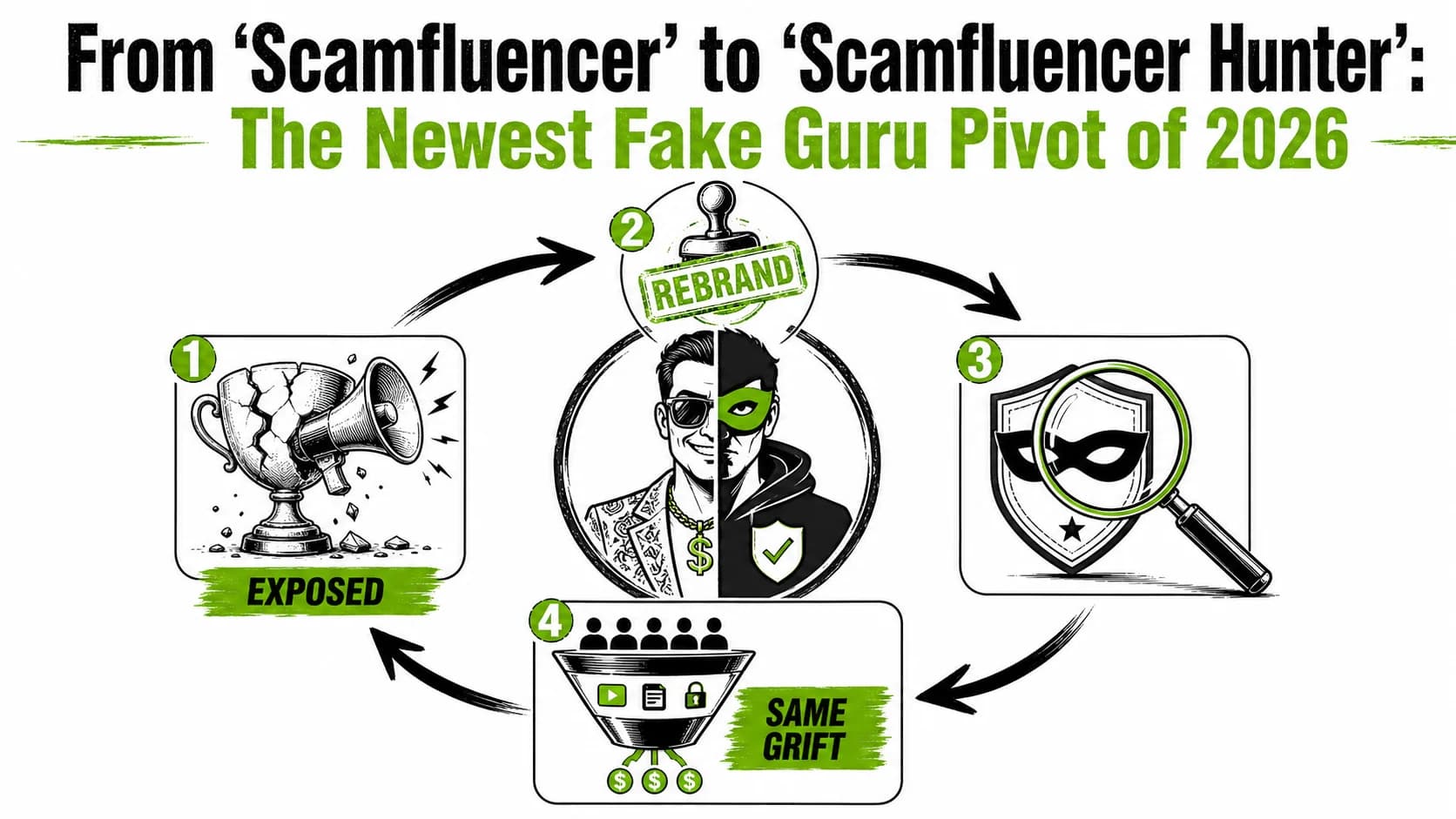
In the grand, tragicomic theater of online entrepreneurship, the curtain never truly falls. It just gets a new coat of paint. One week, a "thought leader" is being publicly flayed on X for selling a $2,000 "AI wealth accelerator" that was, in fact, a PDF of recycled 2017 crypto advice. The next week, the same figure is back, reborn. Their bio no longer reads "7-Figure Exit Strategist." Now, it declares: "Scamfluencer Hunter. Exposing the frauds so you don't have to."
Welcome to the most cynical, predictable, and frankly brilliant fake guru rebrand of 2026. The grifter pivot is complete: from perpetrator to prosecutor. They've realized that the market for selling dreams is saturated, but the market for selling skepticism is booming. It's reputation laundering on a digital scale, a masterclass in turning your greatest liability—being exposed as a fraud—into your primary asset: "insider knowledge."
This isn't a redemption arc; it's a strategic repositioning. And if you're not careful, you'll pay for the privilege of being scammed by the very person teaching you how to avoid scams. Let's dissect this new species of scamfluencer hunter, understand their playbook, and arm you with the tools to see through the anti-grift grift.
The Anatomy of a Reputational Hail Mary
The pivot doesn't happen in a vacuum. It follows a predictable, almost ritualistic, three-act structure.
Act I: The Unraveling. A damning thread goes viral. Maybe it's forensic analysis of their "private jet" photos revealing obvious Photoshop errors (the window curvature is all wrong, rookie mistake). Perhaps it's a former "success story" student revealing the "7-figure system" was just a directive to spam LinkedIn DMs. The evidence mounts, the engagement plummets, and the revenue streams dry up overnight. The community they built turns into a digital mob.
Act II: The Strategic Disappearance (The "Dark Retreat"). The guru vanishes for 2-4 weeks. All posts are paused. Stories disappear. This isn't shame; it's calculation. It allows the initial fury to subside and creates a narrative vacuum. Followers begin to wonder: "Are they okay? Did they learn their lesson?" During this time, the guru and their team are not in meditation. They're in a war room, storyboarding the comeback.
Act III: The Lazarus Launch. They return, not with an apology, but with a manifesto. A long-form video, shot in stark black and white, titled something like "The Truth About The Game I Played." They admit to "getting caught up in the hype," to "using aggressive marketing," framing their past scams as a necessary education. They position themselves not as a villain, but as a reformed insider—the only one brave enough to tell you how the sausage really gets made. The new scamfluencer hunter is born, their past sins now repackaged as unique qualifications.
The 5 Telltale Signs of a Fake Scam Hunter
So, how do you spot a reputation laundering operation masquerading as a public service? Look for these five red flags.
1. The Vague, Unverifiable "Inside Knowledge"
The core of their new brand is "I was there, so I know." But their revelations are curiously shallow.
- They'll say: "They use psychological tricks to make you buy."
- But they won't say: "Specifically, they use the 'foot-in-the-door' technique followed by artificial scarcity timers on a Kajabi checkout page, and here's the exact JavaScript snippet they inject to fake the '3 people are viewing this offer' counter."
- The Grift: Real investigators provide forensic details. Fakers provide vibes. Their "exposés" lack names, dates, receipts, or technical specifics because providing those would either expose their own past methods in damning detail or reveal they never knew the mechanics in the first place.
2. The Immediate Monetization of Skepticism
This is the most glaring sign. The pivot from selling "get rich quick" to selling "spot get rich quick schemes" should, in theory, involve a period of building trust through free, valuable work.
- The Faker's Timeline: Week 1: Return as scam hunter. Week 2: Announce a "free webinar" on the top 5 guru scams. Week 3: At the end of the webinar, launch the "$997 Scam-Proof Investor Toolkit" or a "Due Diligence Masterclass."
3. Selective Targeting & "Frenemy" Dynamics
A true scam hunter is an equal-opportunity exposer. The fake hunter has a very clear enemy list and a very clear "ally" list.
- They will aggressively target: Newer, smaller gurus who are direct competitors, or old rivals from their previous life. The attacks are personal, not principled.
- The Pattern: Their "investigations" are often just competitive takedowns or personal vendettas dressed up as journalism. It's business strategy disguised as moral crusading.
4. The Unaddressed Past & The Linguistic Dodge
They never fully atone. Listen to their language.
- "I got swept up in the culture." (Passive voice, removes agency)
- "I used aggressive marketing." (Euphemism for "I lied to people.")
- "I was teaching a simplified model." (Euphemism for "I sold an ineffective system.")
- What you'll never hear: "I knowingly fabricated testimonials. I used fake screenshots to sell a course that didn't work. I emotionally manipulated vulnerable people into debt. Here is a list of every person I harmed and what I am doing to make it right."
5. The Cult of Personality 2.0
The methods change, but the central pillar remains the same: them. Their previous brand was "Follow me to wealth." Their new brand is "Trust me, I know the truth."
- The content is still 80% about their journey, their struggles, their "hard-won" realizations.
- They replace the "us vs. the poor" mentality with an "us vs. the scammers" mentality, but the in-group/out-group dynamic and the reliance on a charismatic leader are identical. It's the same psychological trap with a different coat of paint.
Why This Pivot Is So Effective (And Dangerous)
This anti-scam scam works because it's brilliantly tailored to the current online psyche.
The danger is profound. It erodes trust in genuine critics and investigators. It turns the vital act of calling out fraud into just another cynical market niche. And it leaves the victim scammed twice over: first by the original dream, then by the false promise of immunity.
How to Cultivate Real Scam Immunity (Without Buying It)
You don't need to pay a reformed grifter to learn how to think. You need a framework. Here’s how to build your own internal scamfluencer hunter toolkit.
1. Follow the Evidence, Not the Narrative.
A real investigator leads with data. A storyteller leads with a feeling. When you see an exposé, ask:
- Where is the primary evidence? (DMs, emails, contracts, unedited screen recordings)
- Is it corroborated by independent sources?
- Are the claims specific and falsifiable? (Instead of "he lies," look for "he claimed revenue of X on date Y, but here's the Stripe dashboard showing Z.")
2. Analyze Incentives, Not Just Words.
Before trusting any source—guru or anti-guru—map their incentives.
- Financial: What are they selling, and when did they start selling it relative to their "awakening"?
- Social/Reputational: Does this content build their status as the "only honest one"? Does it attack competitors?
- Psychological: Does this persona allow them to retain a position of authority while avoiding accountability for their past?
A simple table can help deconstruct this:
| Source | Claims To Be... | Primary Revenue Source | Who They Target | Who They Avoid |
|---|---|---|---|---|
| Fake Guru (v1.0) | Wealth Guide | "High-Ticket" Mastermind | Aspiring Newbies | Legitimate VCs/Entrepreneurs |
| Fake Hunter (v2.0) | Truth Teller | "Scam-Proof" Course/Reports | The Skeptical & Scammed | Their Old Inner Circle & Bigger Gurus |
3. Value Consistency Over Charisma.
Charisma is the grifter's primary tool. Consistency of principle is the antidote.
- Does this person apply the same skeptical framework to their friends as they do to their enemies?
- Do they admit when they are wrong or when their analysis is limited?
- Do they promote other critical thinkers, or do they try to be the sole source of truth?
4. Learn the Foundational Tactics Yourself.
The best defense is education. You don't need an "insider" to teach you the basics of:
- Digital Literacy: Reverse image search, analyzing EXIF data, spotting AI-generated faces (look at the teeth and ears).
- Financial Skepticism: Understanding basic business metrics. Our 2026 guide to spotting fake gurus is a great starting point.
- Psychological Manipulation: Learn the names of the tricks—social proof, false scarcity, authority bias. Once you can name it, you can notice it.
The goal isn't to become a full-time detective. It's to install a mental "immune system" that flags manipulative patterns before they take root. This is the core of what we teach at Larpable: not to make you dependent on another expert, but to give you the foundational skills to detect the patterns yourself.
The Future of the Grift: What Comes After the Hunter?
If 2024 was the year of the AI guru, and 2025 was the year of the mass exposure, then 2026 is the year of the reputation laundering pivot. But what's next? Based on the pattern, we can predict the next evolution:
The cycle continues because the underlying market forces—fear, hope, and the desire for a simple answer—remain constant.
Conclusion: Breaking the Cycle
The shift from scamfluencer to scamfluencer hunter is the ultimate testament to the grifter's adaptability. It's a chameleon-like survival tactic that preys on our best instincts—our desire for justice and safety.
The solution isn't to find a better hunter to follow. It's to refuse to be prey. It's to develop the critical skills that make you immune to the narrative, regardless of its packaging. It requires embracing a less sexy truth: that real expertise is slow, domain-specific, and often boring. That genuine protection comes from foundational knowledge, not secret insider lists.
Stay skeptical, especially of those selling skepticism. Do the work to understand the toolkit from the ground up. Because in the endless game of online deception, the only winning move is to step off the board they've designed and learn to build your own.
FAQ: The Scamfluencer Hunter Phenomenon
1. What's the difference between a genuine critic and a fake "scamfluencer hunter"?
A genuine critic or investigator is motivated by a consistent principle of truth and accountability. Their work is evidence-led, they cite sources, they apply their scrutiny evenly, and their primary goal is exposure, not immediate monetization. Their credibility is built over years of consistent work. A fake hunter's work is narrative-led, targets selectively, avoids their own past, and moves to monetize the "anti-scam" position with alarming speed, often using the same high-pressure sales tactics they claim to expose.
2. Can a former guru ever legitimately reform and become a trustworthy source?
It's possible but exceedingly rare and should be met with extreme, evidence-based skepticism. Legitimate reform involves: full, specific, and unqualified admission of harm; tangible, verifiable efforts at restitution to those they wronged; a long period (years, not weeks) of contributing valuable, free work to the community without monetizing their "reformed" status; and submitting to scrutiny from independent, trusted figures. The default assumption should be that a rapid, strategic pivot is a continuation of the grift, not an end to it.
3. Isn't some of the information from these "reformed" hunters still useful?
It can be, but it's dangerous to treat it as unique insight. Often, the useful information they share (e.g., "gurus rent Lambos") is already widely known in critical circles. The risk is the "Trojan Horse" effect: you let your guard down because parts are true, making you vulnerable to the new falsehoods or manipulative pitches embedded within their content. It's safer to learn these common tactics from established, principled sources with no baggage.
4. What are the first steps I should take to protect myself from this new kind of scam?
- Audit Your Feed: If you're following someone who recently pivoted from guru to hunter, apply the "5 Telltale Signs" from this article.
- Delay Purchase Decisions: Impose a mandatory 30-day "cooling-off" period between discovering a new "truth-teller" and buying anything they sell. See if their content remains valuable when the sales pitch is removed.
- Diversify Your Inputs: Don't rely on one person as your sole source of truth. Follow journalists, academics, and critics with established, transparent track records.
- Build Core Skills: Invest time in learning basic digital verification and business literacy yourself. Start with foundational resources like our guide on spotting fake revenue screenshots.
5. Why is this trend happening so much in 2026?
The confluence of three factors: 1) Saturation: The "make money online" space is overrun, making the original guru grift harder to sustain. 2) Backlash: Public awareness and skepticism are at an all-time high, creating a ripe market for "anti-grift" content. 3) The Playbook is Public: The success of one or two high-profile pivots has created a visible blueprint for other exposed figures. They see it as a proven survival strategy in the face of cancellation.
6. Where can I learn real scam detection without falling for another grifter?
Seek out resources that focus on teaching you methodologies, not just handing you lists. Look for content that explains how to verify a screenshot, how to analyze a business claim, how cognitive biases work. Universities and reputable journalism outlets sometimes offer free courses on media literacy. Platforms like Larpable are built specifically to teach the underlying patterns and detection skills without creating dependency on a single charismatic figure. The goal is to empower your own judgment.
<!-- sister-projects-start -->
Other Doved Studio projects
Related tools from the same studio you might find useful:
- Ralphable: Generate structured Claude Code skills that iterate until pass/fail criteria are met.
- Doved Studio: Studio indie derrière cette app et une dizaine d'autres outils.
<!-- sister-projects-end -->