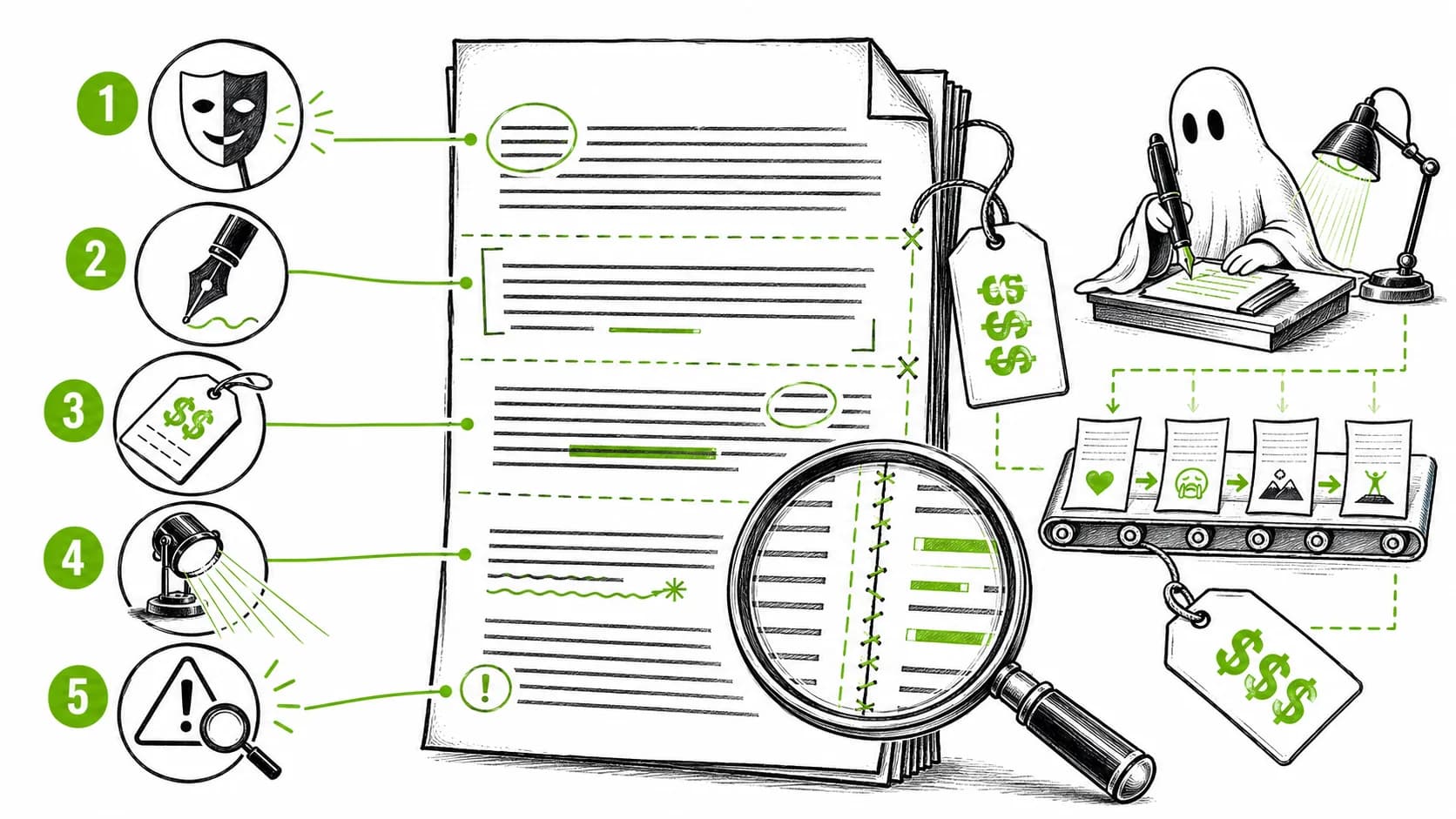
In 2026, the most valuable currency in the entrepreneurial ecosystem isn't Bitcoin, equity, or even proprietary data. It's authenticity. Or, more accurately, the convincing performance of it. The market has spoken: a founder's "personal story" is now a core business asset, a non-negotiable slide in the pitch deck, and the primary engine for selling high-ticket courses and coaching programs.
This demand has birthed a shadow industry. As recent exposés in TechTruth Weekly have detailed, a new breed of agency—"founder narrative designers" and "authenticity architects"—are thriving. They don't just write LinkedIn posts; they construct entire biographical backstories, complete with market-tested "rock bottom" moments, heroic struggles, and epiphanies perfectly timed for a Series A announcement. The vulnerability is outsourced, the pain points are focus-grouped, and the "humble beginnings" are polished to a high-gloss sheen.
This article isn't about shaming ghostwriting (a legitimate profession). It's about arming you with the forensic tools to distinguish between a genuine, if messy, human journey and a personal brand fabrication—a purchased past designed to bypass your critical thinking and build false trust. When the story is the product, you must learn to audit the storyteller.
The Rise of the Manufactured Memoir: Why Your B.S. Detector is Obsolete
The old signs of a scam were easy: get-rich-quick promises, stock photo wealth, and blatant exaggeration. Today's entrepreneur storytelling scam is far more sophisticated. It preys on our collective hunger for meaning, connection, and narrative.
The playbook is simple:
This narrative is emotionally compelling and commercially bulletproof. It transforms a salesperson into a savior, a course into a cure. The problem arises when the story is a complete fabrication, a ghostwritten authenticity pasteurized of any real risk or grit. You're not connecting with a person; you're being marketed to by a character.
The 5 Forensic Red Flags of a Purchased Past
Spotting a fake founder story requires moving beyond sentiment and analyzing structure, consistency, and linguistic tells. Here’s your diagnostic checklist.
Red Flag 1: The Emotionally Perfect, Chronologically Vague Arc
The Tell: The story hits every single beat of the classic "Hero's Journey" (Call to Adventure, Ordeal, Reward, Return) with uncanny, Hollywood precision. Yet, when you try to pin down dates, locations, or specific names, everything becomes fuzzy.
- Real Story: "In late 2023, after my third failed Shopify store, I was sharing a tiny apartment in Austin with two roommates. I remember my friend Sam specifically told me over coffee at Mozart's that my product photos were terrible. That was the kick I needed."
- Ghostwritten Story: "I was at my lowest point, drowning in debt and self-doubt. The universe sent me a sign—a chance encounter that made me realize the problem wasn't the market, it was my mindset. I pivoted everything that very night."
How to Investigate: Ask simple, specific follow-up questions in your mind (or in comments). "What month was that?" "What was the name of the cafe?" "What was the first product you actually sold?" Vague, spiritualized, or avoidant answers are a major warning sign.
Red Flag 2: The Lexical Disconnect: When the "Voice" Doesn't Match
The Tell: The vocabulary, sentence structure, and rhetorical flourishes in the deeply personal "origin story" post are radically different from the same person's off-the-cuff video comments, live streams, or older, less-polished content.
- Check the Receipts: Compare the language in their tear-jerking "how I built this" article with their tweets from 2-3 years prior. Does the "voice" mature naturally, or does it suddenly leap from casual and error-ridden to possessing the vocabulary of a Pulitzer-nominated memoirist?
This linguistic analysis is a core part of learning to Apprendre à Détecter the modern larper. The persona is a patchwork.
Red Flag 3: The Syndicated "Vulnerability"
The Tell: The "raw" personal story is published simultaneously across multiple platforms (LinkedIn, Medium, a "personal" blog, Forbes Council) in verbatim or near-verbatim form. Genuine, emotional sharing is often messy and platform-specific. A ghostwritten piece is an asset to be deployed.
The Corporate Feel: The story feels like a case study, not a confession. It's structured with clear subheadings, call-out quotes formatted for sharing, and a conclusion that neatly ties back to their business offering. The emotional climax doubles as a value proposition.
This is a key tactic in what we've termed The Authentic Grift—the weaponization of personal disclosure for commercial gain.
Red Flag 4: The Anecdote That Never Evolves
The Tell: The founder tells the same exact story, with the same exact phrasing, pauses, and emotional cadence, for years on end. It becomes a canned keynote speech. In a real human, memories fade, perspectives shift, and new details emerge upon reflection. A script remains static.
- The "Goldilocks" Detail: The story has details that are just specific enough to be believable but never so specific they can be fact-checked into a corner. ("I was using a 2019 MacBook Pro with a cracked screen" is safe. "I was at the public library on 5th Avenue, and the librarian, Mrs. Henderson, shushed me" is verifiable and risky.)
Red Flag 5: The "Proof" That Proves Nothing
The Tell: To bolster the story, the founder shares "evidence" that is either trivial to fake or entirely circumstantial.
| Type of "Proof" | Why It's Suspect | The Reality |
|---|---|---|
| A photo of a old, messy desk | "This was my 'war room'!" | Easily staged. Says nothing about revenue or success. |
| A screenshot of a hostile email/doubtful comment | "Look at the haters I proved wrong!" | Could be from a friend or an alt account. Unverifiable. |
| A vague "first dollar" framed | "I'll never forget this!" | A prop. Anyone can frame a dollar bill. |
| Mention of a real, public hardship | "See, it's true!" | They may have experienced the hardship, but the narrative of how they "overcame" it to build this specific business is the fabricated part. |
The reliance on this low-stakes "proof" is often a distraction from the lack of verifiable, substantive business evidence—the kind we teach you to scrutinize in our broader guide on The 2026 Guide to Spotting Fake Gurus.
The Ghostwriter's Toolkit: From Human to AI
Understanding how these stories are built makes them easier to deconstruct. The toolkit has evolved.
1. The Human Ghostwriter/ Narrative Designer:
These professionals interview the founder (sometimes for just an hour) and spin a compelling narrative from thin threads of truth. They are masters of emotional language and classic story structure. Their work is high-quality but expensive, often used by VC-backed startups needing a polished founder-market-fit story.
2. The AI Narrative Generator:
The 2026 frontier. Founders input bullet points ("failed business," "divorce," "discovered crypto," "now make $50K/month"). The AI, trained on thousands of successful "origin story" posts from TechCrunch and Entrepreneur.com, outputs a fully-formed, emotionally manipulative article. Tools can even adjust for platform: more corporate for LinkedIn, more raw for Twitter. The tell? A strange, hollow perfection and occasional "uncanny valley" phrasing.
3. The Community-Sourced Script:
The founder lifts the structure of a story that recently went viral in their niche, swapping out only the superficial details. This is why you'll see a dozen "I lost everything in the crypto winter, then found AI" stories in the same month. It's narrative plagiarism.
How to Perform Your Own Authenticity Audit
Before you buy that course inspired by a heart-wrenching story, conduct this due diligence:
Beyond Detection: Reclaiming Real Stories
The goal here isn't cynicism; it's clarity. Real entrepreneurship is chaotic, non-linear, and often embarrassing. The lessons are in the unvarnished details, not the polished parable.
If you're building something real, your story is being written day by day, in the unglamorous decisions and small failures. Focus on that. For a deeper dive into building substance over spectacle, explore our resources on Sustainable Entrepreneurship.
And if your goal is to inoculate yourself against the most sophisticated narrative manipulators in the digital space, you need to go beyond simple checklist. You need to develop a foundational skill in pattern recognition. This is exactly what we teach in our core curriculum: Apprendre à Détecter. It's not just about spotting fake screenshots; it's about deconstructing the entire persona, from the story they tell to the "proof" they offer.
FAQ: Ghostwritten Founder Stories
Q1: Is it always wrong for a founder to use a ghostwriter?
Not inherently. Many busy executives use writers to articulate their thoughts clearly. The ethical line is crossed when the ghostwriter is hired to invent a past, fabricate struggles, or create a false persona of "authentic struggle" for commercial exploitation. Transparency is key. If the story is presented as a raw, personal diary entry but was crafted by a team of narrative designers, that's deception.
Q2: Can AI really write a convincing personal story?
In 2026, yes—to a point. AI can generate structurally perfect, emotionally calibrated narratives. The current failure modes are a lack of truly idiosyncratic detail (the weird, specific memory that rings true) and a tendency to use emotionally "correct" phrases that feel hollow upon close reading. However, for an audience scrolling quickly, an AI-generated story can be highly effective, making detection skills more vital than ever.
Q3: What's the difference between a well-told true story and a fake one?
Consistency and granularity. A true story, even well-edited, will have consistent, verifiable details over time and across platforms. It can withstand gentle, specific questioning. The founder can digress and tell a different anecdote from the same period. A fake story is a monolithic, fragile artifact. It must be repeated precisely and often avoids deep, spontaneous examination.
Q4: I suspect a guru I follow has a fake story. What should I do?
First, conduct your own audit using the red flags above. Avoid public accusation (which often backfires). Instead, adjust your trust level accordingly. Stop taking their narrative as proof of expertise. Evaluate their current work, advice, and deliverables on their own merits, divorced from the origin myth. Let your skepticism inform your wallet.
Q5: Are there legitimate services that help founders tell their story better?
Absolutely. Ethical services include:
- Editorial Coaches: Who help you find and articulate your own voice.
- Interview-Based Writers: Who faithfully amplify your true experiences.
The distinction is between amplification and invention. A good rule of thumb: if the service promises to "create your founder legend" or "design your hero's journey," be wary.
Q6: How can I make my own real story more compelling without fabricating it?
Focus on specific lessons over general drama. Instead of "I was poor and sad," try "I learned unit economics the hard way when I mis-calculated shipping costs on my first 100 orders and lost $1,500—here's the exact spreadsheet error I made." Authenticity isn't about the depth of the pain; it's about the precision of the lesson learned. Your real, granular struggles are your most credible asset.
<!-- sister-projects-start -->
Other Doved Studio projects
Related tools from the same studio you might find useful:
- Ralphable: Generate structured Claude Code skills that iterate until pass/fail criteria are met.
- Doved Studio: Studio indie derrière cette app et une dizaine d'autres outils.
<!-- sister-projects-end -->