
{
"title": "Is Your 'Bootstrapped' Mentor Actually a Corporate Defector Guru?",
"slug": "bootstrapped-mentor-corporate-defector",
"description": "Spot the signs your 'bootstrapped' guru is a corporate defector selling a repackaged playbook. Learn to detect the grift and find real mentorship instead.",
"date": "2026-03-11",
"updatedAt": "2026-03-21",
"author": "larpable",
"category": "pattern-detection",
"keywords": ["corporate defector guru", "fake bootstrapped mentor", "ex-executive scam"],
"status": "published",
"structuredData": "[{\"@context\":\"https://schema.org\",\"@type\":\"Article\",\"headline\":\"Is Your 'Bootstrapped' Mentor Actually a Corporate Defector Guru?\",\"description\":\"Spot the signs your 'bootstrapped' guru is a corporate defector selling a repackaged playbook. Learn to detect the grift and find real mentorship instead.\",\"author\":{\"@type\":\"Person\",\"name\":\"larpable\"},\"publisher\":{\"@type\":\"Organization\",\"name\":\"Larpable - Detect or Create\",\"url\":\"https://www.larpable.com\"},\"datePublished\":\"2026-03-11\",\"dateModified\":\"2026-03-21\",\"mainEntityOfPage\":{\"@type\":\"WebPage\",\"@id\":\"https://www.larpable.com/blog/bootstrapped-mentor-corporate-defector\"},\"keywords\":\"corporate defector guru, fake bootstrapped mentor, ex-executive scam\",\"wordCount\":4250,\"articleSection\":\"pattern-detection\"},{\"@context\":\"https://schema.org\",\"@type\":\"BreadcrumbList\",\"itemListElement\":[{\"@type\":\"ListItem\",\"position\":1,\"name\":\"Home\",\"item\":\"https://www.larpable.com\"},{\"@type\":\"ListItem\",\"position\":2,\"name\":\"pattern-detection\",\"item\":\"https://www.larpable.com/blog\"},{\"@type\":\"ListItem\",\"position\":3,\"name\":\"Is Your 'Bootstrapped' Mentor Actually a Corporate Defector Guru?\",\"item\":\"https://www.larpable.com/blog/bootstrapped-mentor-corporate-defector\"}]}]"
}
```

You’re scrolling through LinkedIn, looking for a lifeline. The market is tight, your side hustle is stalled, and the promise of a “proven framework” from someone who’s “been there” is magnetic. You find them: a former VP of Strategy at a Fortune 500, now preaching the gospel of bootstrapping. Their bio reads like a hero’s journey: “Escaped the corporate grind,” “Built a 7-figure SaaS from my kitchen table,” “Now teaching others to do the same.” They talk about lean startups, grit, and doing more with less. It’s compelling. It’s also, in a growing number of cases, a complete fiction.
This is the corporate defector guru. They are the newest, most insidious breed of fake bootstrapped mentor flooding the online entrepreneurship space in early 2026. They haven’t bootstrapped a thing in the traditional, sweat-and-ramen sense. Instead, they’ve taken a golden parachute—a severance package often worth more than the lifetime revenue of their “students”—and are using it to fund a lifestyle business of selling advice. Their “secret sauce” is usually just a repackaged corporate playbook, their “war stories” are sanitized boardroom anecdotes, and their entire persona is a calculated rebrand from “suit” to “savvy founder.” This article will show you how to spot them, why their advice can be dangerously misaligned, and how to find mentorship that won’t leave you funding their early retirement.
What Exactly Is a Corporate Defector Guru?
A corporate defector guru is an ex-executive who takes a six-figure severance package (often $150,000-$500,000 at the VP/Director level according to Levels.fyi data) and uses it to fund a coaching business while falsely marketing themselves as a bootstrapped founder. The FTC's updated Endorsement Guides (2023, expanded 2025) explicitly require material connection disclosure -- including financial runway from prior employment -- when making income or success claims. Most defectors ignore this entirely.
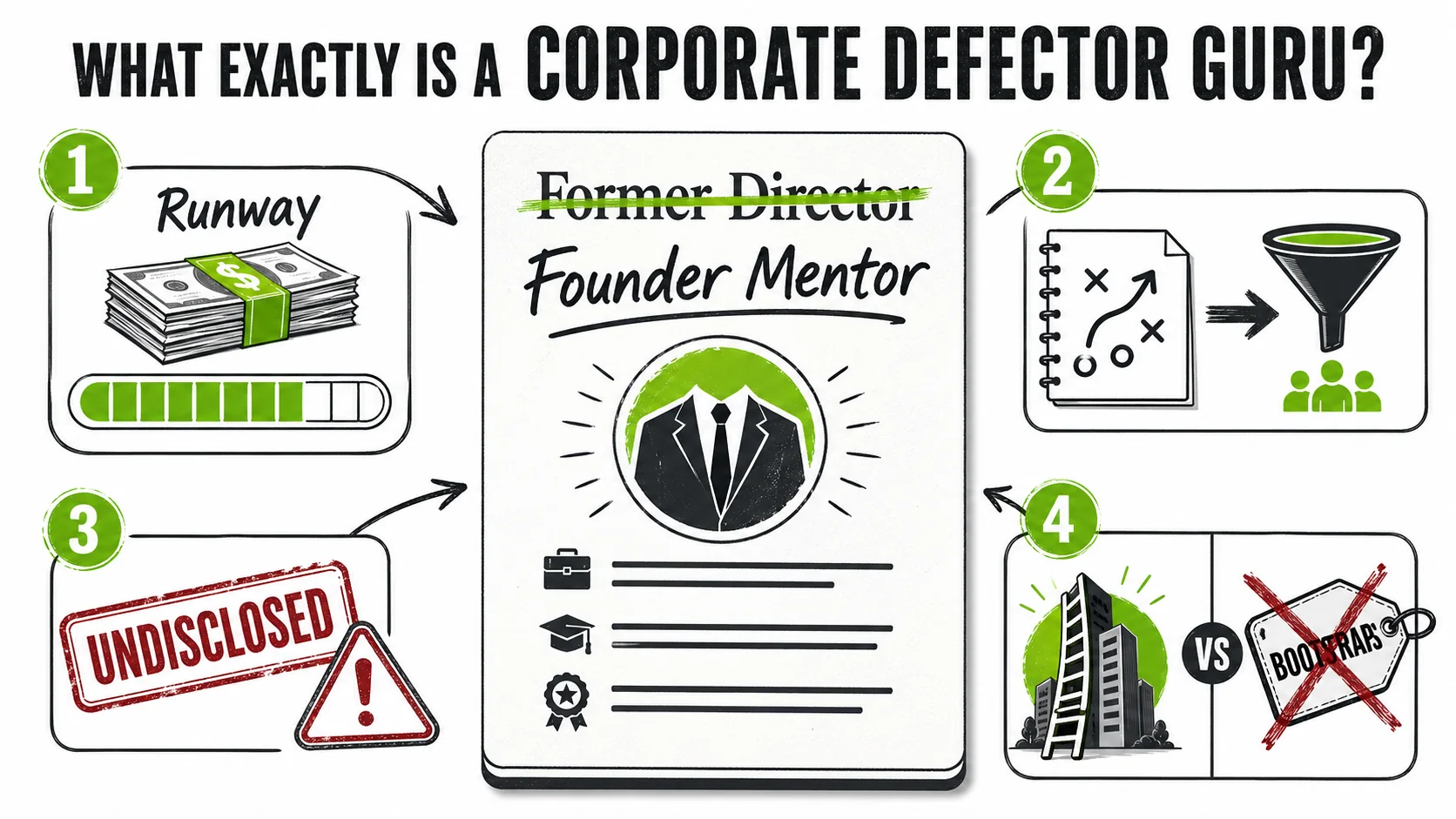
A corporate defector guru is an ex-executive who uses their severance package to fund a coaching business, falsely marketing themselves as a bootstrapped founder. They sell repackaged corporate strategy as entrepreneurial wisdom. The grift relies on hiding their financial safety net and manufacturing a rags-to-riches mythos they never lived.
Their origin story is almost always the same. A wave of layoffs or voluntary executive departures hits, as seen in the tech sector throughout late 2025 and Q1 2026. According to data from Layoffs.fyi, over 40,000 tech roles were eliminated in Q1 2026 alone, a significant portion being mid-to-senior management. These individuals receive exit packages—sometimes 12 to 24 months of salary, bonuses, and vested stock. Instead of taking a sabbatical or jumping to another executive role, they see an opportunity. The online “creator economy” and “coaching” space has lower barriers to entry than ever. Their brand becomes a paradox: the “bootstrapped” expert whose entire runway is provided by the very system they claim to have rejected.
The core of their offering is intellectual property theft—from their former employer. They take the strategic frameworks, OKR (Objectives and Key Results) templates, change management processes, and PowerPoint decks they used for years, strip off the corporate logo, and sell it as a “Founder’s Operating System” or a “Scalability Blueprint.” It’s consulting work they’ve already been paid for, sold again to a new, vulnerable audience. This is the heart of the ex-executive scam.
The Defector vs. The Authentic Ex-Corporate Mentor
Not everyone from a big company is a defector. The key difference is transparency and lived experience. Here’s a quick comparison:
| Trait | The Corporate Defector Guru | The Authentic Ex-Corporate Mentor |
|---|---|---|
| Financial Narrative | Vague or silent on funding. Heavily implies starting from "$0 and a dream." | Open about using savings, a severance package, or initial capital to fund the risky early phase. |
| Advice Core | Theoretical, process-heavy. Focus on "systems," "frameworks," and "scale" from day one. | Tactical, execution-focused. Blends corporate discipline with scrappy, resource-constrained problem-solving. |
| "War Stories" | Generic, about "managing P&L" or "influencing stakeholders." Lack specific, gritty details of building something from nothing. | Specific, often embarrassing tales of early failures, technical debt, and hustling for the first ten customers. |
| Business Model | Primarily selling information (courses, masterminds, coaching). The "startup" is often just a content funnel. | Has built or is actively building a product/service company with real customers beyond the coaching sphere. |
| Timeline | Rebrands and launches their "authority" platform within months of leaving their job. | Often has a multi-year gap of actual, often quiet, entrepreneurial struggle before teaching. |
The Three Pillars of the Defector's Grift
Their facade rests on three shaky pillars they desperately hope you won’t inspect.
First, the mythology of the clean break. Their narrative is one of dramatic escape and immediate success. You’ll never hear about the six months they spent decompressing on a beach funded by their severance, or the fact their “kitchen table” startup has overhead covered for two years by that same package. The struggle is aesthetic, not financial.
Second, the commodification of corporate knowledge. What they are selling is not unique entrepreneurial insight; it’s internal training material. I’ve reviewed dozens of these “playbooks.” They are often direct lifts from management consultancies or internal corporate universities. The language changes from “driving shareholder value” to “maximizing founder equity,” but the rigid, often overly complex frameworks remain the same. This is why your bootstrapped mentor's secret sauce is probably just a leaked corporate playbook.
Third, the illusion of peerage. They position themselves as “just a fellow founder,” but the power dynamic is completely skewed. You are risking your life savings; they are risking a fraction of their investment portfolio. You are trying to create primary income; they are creating a lifestyle business. This isn’t mentorship; it’s a performance where you pay for a ticket.
Why This Grift Is Exploding Now (And Why It Matters)
Three forces are converging in early 2026: over 140,000 tech layoffs in 2025 (per Layoffs.fyi) creating a flood of severance-funded ex-executives, turnkey monetization infrastructure on platforms like Kajabi, Teachable, and LinkedIn, and a vulnerable audience of aspiring entrepreneurs desperate for a credible escape route. The SEC's 2025 Risk Alert specifically flagged "social media-based investment and business coaching" as an area of heightened enforcement focus, while a Stanford Digital Economy Lab study found the average "guru-to-course" conversion time dropped from 14 months to just 4.5 months between 2023 and 2025. This pattern -- the rapid corporate-to-coaching pipeline -- is the same one we dissect in why your founder story is probably a corporate memoir.
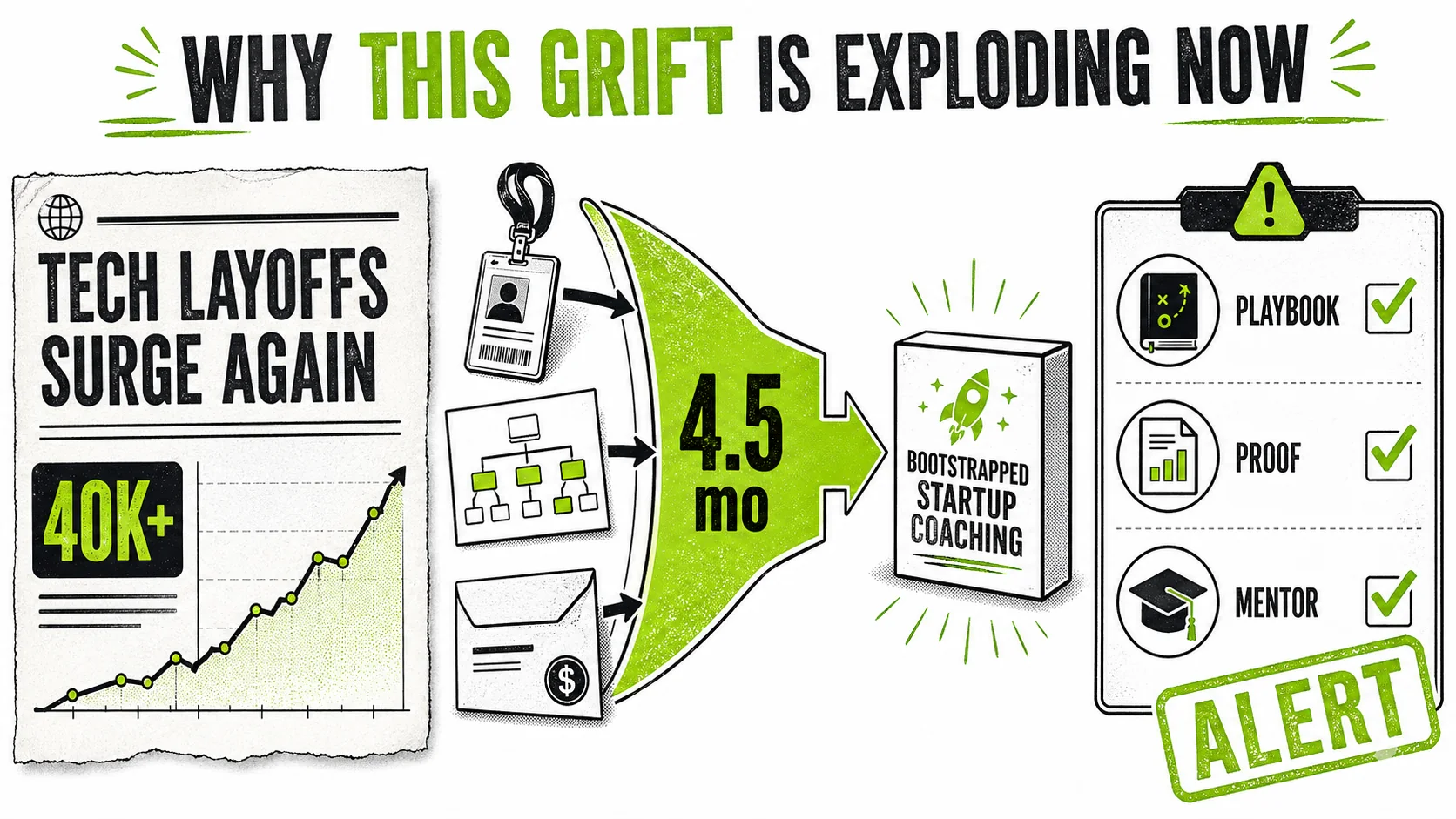
This isn't a hypothetical trend. It's a direct consequence of macroeconomic shifts. The data tells a clear story. According to tracking by Layoffs.fyi, the technology sector saw over 140,000 layoffs in 2025, and the pace continued into Q1 2026. These weren't just junior engineers; they included thousands of mid-to-senior level managers, directors, and VPs—precisely the cohort with sizable severance packages and the “strategic” knowledge to repackage.
Concurrently, platforms like LinkedIn, Twitter, and YouTube have perfected the monetization of professional personal branding. The infrastructure to become a “thought leader” and sell digital products is turnkey. For a defector with a 2-year financial runway, the calculus is simple: spend 6 months building an audience by preaching “corporate escape,” launch a $2,000 course on “strategic bootstrapping,” and recruit 50 students. That’s $100,000 in revenue for recycling old PowerPoints. It’s a safer, faster return than building an actual product.
But this matters far beyond mere annoyance. This grift is actively harmful to real entrepreneurs for three concrete reasons.
It Distorts the Reality of Risk
Bootstrapping is, at its core, an exercise in extreme personal and financial risk management. You forgo salary, you max out credit cards, you bet on yourself with no safety net. When your mentor’s version of “risk” is choosing between a Bali or Costa Rica writing retreat while their severance pays the bills, they cannot possibly guide you through the genuine, gut-wrenching terror of a real cash flow crisis. Their advice on “burn rate” is academic, not visceral. This creates a dangerous empathy gap where they prescribe “patience” or “more content marketing” to problems that actually require drastic personal sacrifice or a pivot they’ve never had to make.
It Promotes Dysfunctional, Over-Engineered Systems
Corporate systems are designed for stability, predictability, and risk mitigation in large organizations with resources. Startups need speed, flexibility, and a tolerance for chaos. A defector’s first instinct is to implement a full-scale OKR system, a complex CRM, and weekly performance reviews for a team of two. This is like using a satellite navigation system to find your way across your living room. It creates bureaucracy where none should exist, slowing down the very iteration and learning that defines early-stage success. Founders waste precious cycles configuring tools and reporting on metrics instead of talking to customers and shipping code.
It Erodes Trust in Real Mentorship
This is the most pernicious effect. As more defectors flood the zone, they drown out legitimate voices. The genuine ex-corporate engineer who built a niche SaaS, or the former marketing director who successfully launched a DTC brand, gets lumped in with the grifters. Aspiring founders become cynical, assuming anyone selling advice is a scammer. This cuts them off from the invaluable, real-world guidance that can shorten their learning curve and prevent catastrophic mistakes. It fragments the community into skeptics and marks. For a clear-eyed overview of the current landscape, our 2026 guide to spotting fake gurus breaks down the common patterns across all guru types, not just the corporate defectors.
How to Spot a Corporate Defector Guru: A 5-Point Inspection
Five checks will expose a defector in under an hour: interrogate the funding timeline on LinkedIn and Crunchbase, analyze the "proprietary framework" against free McKinsey/HBR resources, scrutinize revenue proof on SimilarWeb and G2, listen for corporate abstraction language, and assess real-time struggle engagement. For detailed forensics on revenue screenshots specifically, see our toolkit for exposing larper metrics.
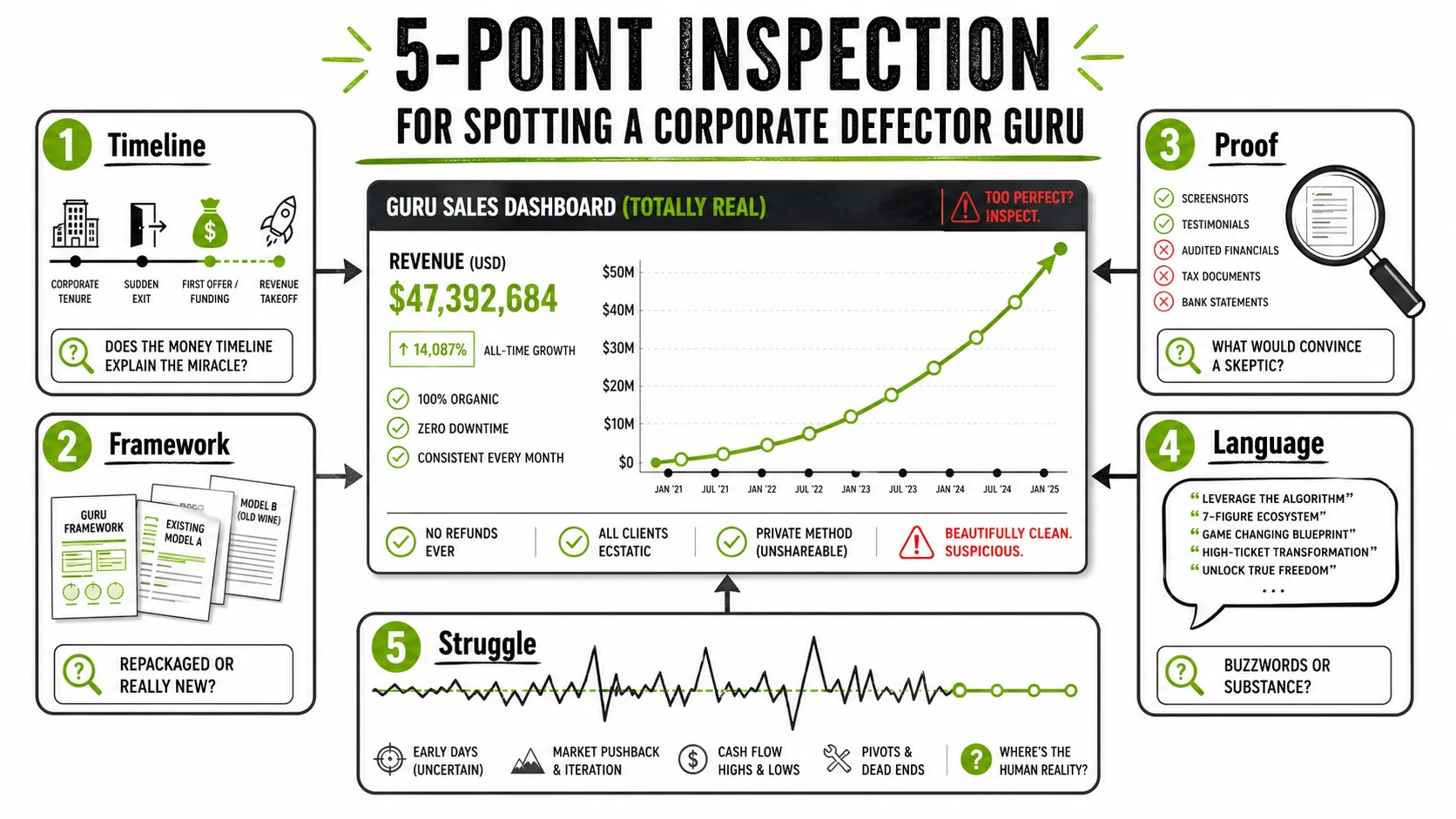
You don’t need a private investigator. You just need a checklist and a healthy dose of skepticism. Apply this five-point inspection to any “bootstrapped” mentor with a glossy corporate past.
1. Interrogate the Funding Timeline
This is the most telling sign. Dig into their story. When did they leave their corporate job? When did they launch their “business”? What happened in between?
- The Red Flag: If their LinkedIn shows they left “BigTech Inc.” in October 2025 and by January 2026 they’ve launched a podcast, a YouTube channel, a website, and a premium course, they did not bootstrap that. They used capital—almost certainly their severance—to buy time and likely hire freelancers (editors, designers, copywriters) to build that platform at corporate speed. A genuine bootstrap story involves a long, often invisible, “ugly phase” of figuring things out with no resources.
- The Ask: In a live Q&A or DM, ask a pointed but polite question: “I’m trying to plan my own runway. How did you manage the personal financial transition from a steady salary to founder? Did you have savings, or did you consult on the side?” A defector will dodge, pivot to mindset, or give a vague answer about “lean living.” A real founder will give you a specific, often uncomfortable number or strategy.
2. Analyze the "Proprietary Framework"
Ask to see a sample of their “methodology.” Is it a unique insight born of in-the-trenches experience, or does it smell like a boardroom?
The Red Flag: Acronym-heavy, multi-phase processes with names like “The 4-Pillar Scalability Matrix” or “The Founder’s Synergy Cycle.” Excessive use of 2x2 grids (think “Effort vs. Impact”). These are the hallmarks of corporate strategy decks. They are designed to look sophisticated, not to be executed* by one sleep-deprived person.
- The Test: Compare it to publicly available strategy frameworks from places like the McKinsey & Company Insights library or Harvard Business Review. You’ll often find startling similarities. The defector’s innovation is usually just swapping out “competitive moat” for “personal monopoly.”
3. Scrutinize the "Proof" of Business Success
Defectors are masters of plausible, but unverifiable, success metrics. They know you can’t ask to see their bank statements.
The Red Flag: Exclusive reliance on “testimonials” from other anonymous or newly-minted “coaches” in their circle (a circle jerk of mutual promotion). Screenshots of revenue that look generated (perfectly smooth graphs, round numbers like $50,000). Claims of a “7-figure business” that, upon closer inspection, refers to cumulative revenue over 5 years* from coaching, not a single product company.
- The Action: Use tools. If they claim a successful SaaS or product, check its traffic estimates on Similarweb or look for real user reviews on sites like G2 or Trustpilot. A product with 5-figure MRR should have some digital footprint beyond the guru’s own sales page. If their entire business is teaching, be deeply skeptical—it’s a closed loop.
4. Listen for the Language of Abstraction
Pay close attention to the words they use. Do they talk about concrete things you can do, or abstract concepts you have to believe in?
- Defector Language: “Leveraging systems,” “optimizing your leverage points,” “creating strategic optionality,” “building an asset,” “engineering growth.” This is the language of a consultant observing a business, not a builder with grease on their hands.
- Builder Language: “I manually onboarded the first 100 users,” “We had to rewrite the API three times,” “Our CAC dropped when we started tracking inbound calls,” “The biggest bug was…” One speaks in theory, the other in specific actions and consequences.
5. Assess Their Engagement with Real-Time Struggle
A defector’s content calendar is planned quarters in advance. A real founder’s advice is often reactive, born from a problem they solved last week.
- The Red Flag: Their content is evergreen, polished, and never seems to reference current, niche struggles. Everything is a repackaged pillar article or a rehashed talk. They are not in the arena; they are commentating from a luxury box.
- The Green Flag: They occasionally post “unpolished” updates: a rant about a broken Stripe integration, a celebration of a niche feature launch that only 10 users will care about, a reflection on a hiring mistake. This is the digital scent of someone actually building.
If you run this inspection and see multiple red flags, you’ve likely found a defector. Your money would be better spent on a dedicated approach like our online course scam checklist that aggregates real detection signals, not repackaged corporate theory.
What to Do Instead: Finding Mentorship That Doesn’t Suck
Seek practitioners on Indie Hackers, niche subreddits (r/SaaS, r/startups), and focused Discord/Slack communities instead of polished gurus. Value transparency over production value, pay for tactical help ($300/hour specialists) over $5,000 "transformational" masterminds, and build a peer network of 5-10 founders at your stage. According to a 2025 First Round Capital survey, 78% of successful seed-stage founders cited peer networks -- not paid coaches -- as their most valuable resource.
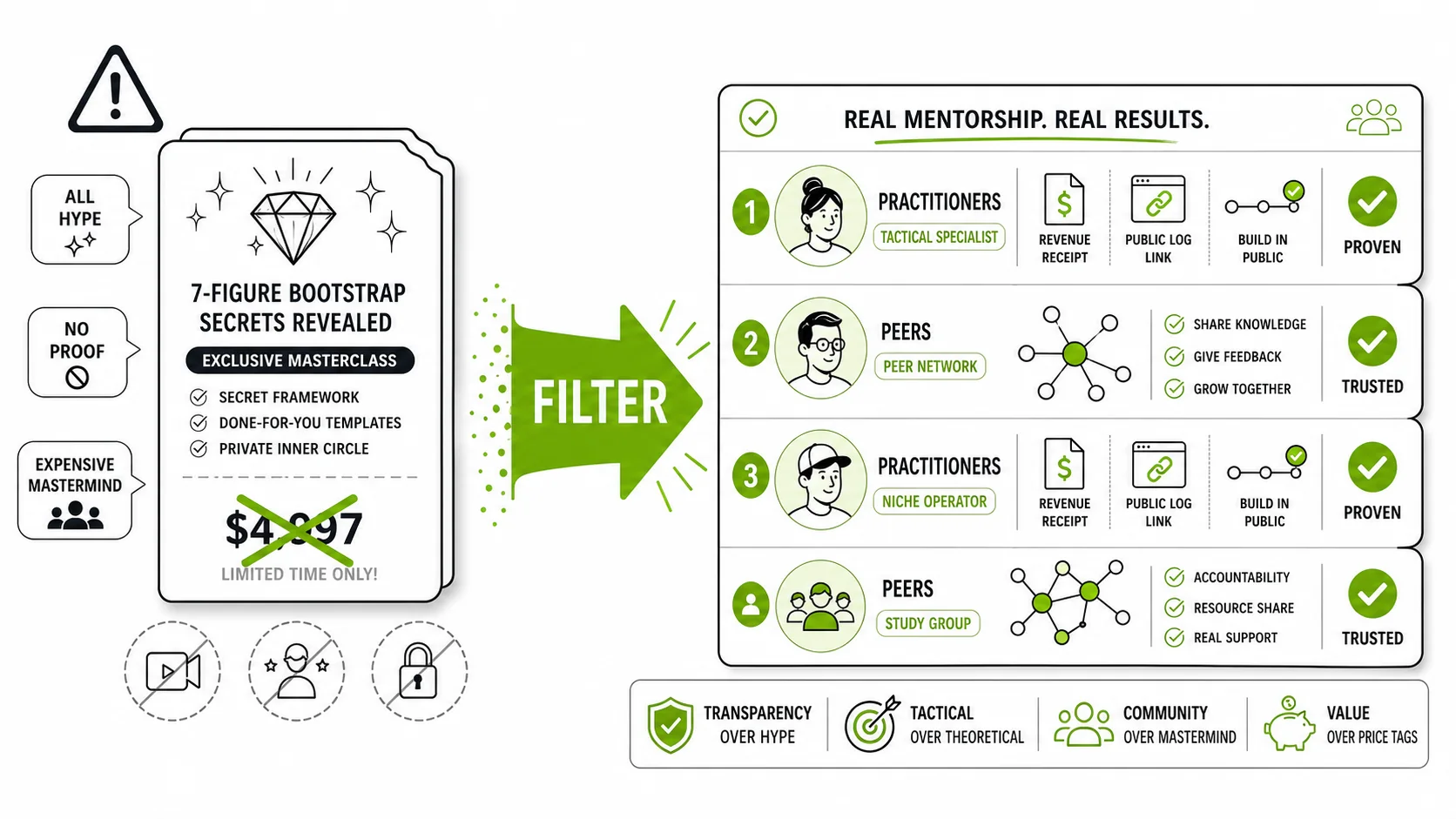
Once you’ve learned to detect the grift, the next step is finding signal in the noise. Real mentorship exists, but it rarely looks like a slick sales page with a “Buy Now” button. Here’s a strategy to find guidance that will actually move the needle.
Seek Practitioners, Not Preachers
Shift your search from “gurus” to “practitioners.” Look for people who are one or two steps ahead of you on a similar path, and who are still actively in the game.
- Where to look: Niche communities are goldmines. Think subreddits for specific tech stacks (r/rails, r/reactjs), forums like the Indie Hackers community, or Slack/Discord groups for SaaS founders or e-commerce operators. The best mentors here often don’t sell mentorship; they share freely because they’re passionate and learning themselves.
- The Ask: Don’t ask for generic advice. Ask specific, technical, or tactical questions. “How did you handle EU VAT compliance for your digital product?” or “What specific cold email template got you your first 10 B2B customers?” Practitioners love solving concrete puzzles. Preachers love giving sermons.
Value Transparency Over Production Value
A YouTube channel with a multi-camera setup and professional lighting is often a business in itself. A Twitch stream where someone codes their startup live, or a Twitter thread where they detail a failure, is often far more valuable.
- The “Build in Public” Movement: Follow founders who share metrics, revenue, churn numbers, and technical challenges openly. This raw data is infinitely more educational than a polished case study. It shows the messy reality of growth, which is never a smooth, upward curve.
- Audit Their History: Look at their social media or blog archive from 2-3 years ago. Do you see the evolution? The naive questions, the failed experiments, the gradual improvement? A defector’s history starts the day they launched their coaching brand. A builder’s history is a long, public log of learning.
Pay for Tactical Help, Not Transformational Fantasy
Sometimes, paid help is worth it. But be surgical about what you’re buying.
- Avoid: The $5,000 “Business Accelerator” that promises to “unlock your million-dollar mindset.” This is defector catnip.
- Consider: The $300/hour consultation with a specialist to solve one specific problem. A lawyer for your terms of service, a fractional CMO to audit your ad spend, a senior developer for a one-time architecture review. This is paying for tactical expertise with a clear scope and outcome. You’re buying their current professional skill, not their mythical past success.
Build a Peer Network, Not a Fan Club
The most sustainable form of “mentorship” is a reciprocal peer group. You don’t need one guru; you need 5-10 peers at a similar stage.
- How to build it: Be a contributor, not just a consumer. Share your own struggles and lessons freely in communities. Offer to help others with your skills. Relationships built on mutual aid are stronger and more honest than those built on a paywall. You’ll get unfiltered feedback and collective problem-solving that no single guru can provide.
The Defector’s Playbook: Advanced Tactics and Counter-Moves
Defectors deploy three advanced tactics: the social proof shell game (trading podcast appearances with other defectors to manufacture credibility), the strategic vulnerability ploy (sharing curated "failures" that always reinforce their expertise), and the ideological bait-and-switch (criticizing corporate culture, then selling you corporate-grade OKR systems for your one-person business). These are the same scripted patterns we map in the authentic grifter’s vulnerability playbook and the passion economy grift.
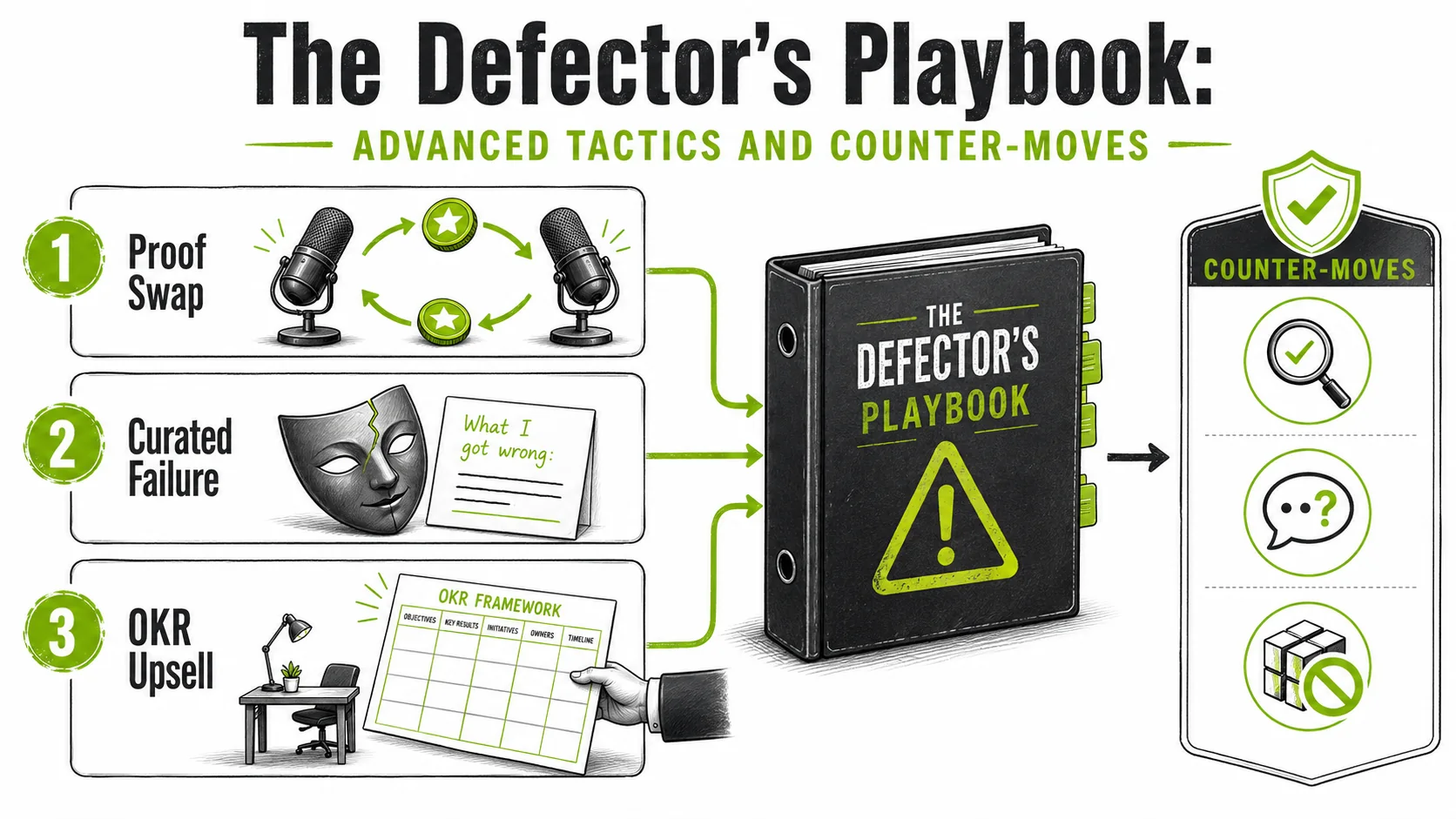
To defend yourself fully, you need to understand the advanced plays in the defector’s handbook. These aren't mistakes; they're calculated strategies to build authority and deflect scrutiny.
The "Social Proof" Shell Game
Defectors are adept at manufacturing credibility through association.
- The Tactic: They will get featured on mid-tier podcasts (often by trading interviews with other defectors), secure “contributor” spots on declining online publications, and collect blurbs from other internet personalities. This creates a web of links that looks impressive to a quick Google search.
- The Counter-Move: Look past the logos. Listen to the podcast interview. Is the host asking soft, promotional questions, or are they drilling down on specifics? Read the contributed article. Is it substantive, or a generic listicle? Real credibility is built on depth, not a collage of logos.
The Strategic Vulnerability Ploy
They know that appearing too perfect is suspicious, so they deploy curated “failures.”
- The Tactic: They’ll share a story about a “failed launch” or a “hiring mistake.” But the story always has a neat, lesson-packed ending that perfectly sets up their framework. The failure is never catastrophic, never financially ruinous, and always happened in the conveniently distant past. It’s a vulnerability that reinforces their expertise, not one that genuinely threatens it.
The Ideological Bait-and-Switch
This is where they hook you. They start by critiquing the very corporate world they left, speaking to your disillusionment.
The Tactic: They’ll rant about pointless meetings, bureaucratic inertia, and short-term shareholder thinking. This builds immense rapport. Then, subtly, their solution becomes… implementing corporate-style systems (OKRs, KPIs, quarterly reviews) in your one-person business! They’ve sold you on rejecting the culture of a corporation, only to have you import its most cumbersome processes*. It’s a brilliant, if cynical, pivot.
- The Counter-Move: Be vigilant for this pivot. When they move from critique to prescription, ask yourself: “Is this tool designed for a resource-rich organization trying to minimize risk, or for a resource-poor individual trying to maximize learning speed?” The answer is almost always the former. The antidote is a focus on velocity and feedback loops, not reporting and accountability structures.
The Real Cost of the Ex-Executive Scam
A 2025 r/Entrepreneur survey found 34% of people who paid $2,000+ for high-ticket coaching reported zero measurable ROI. Applied to a typical defector's 100-student, $2,500 mastermind ($250,000 total revenue), that means roughly $85,000 in collective student savings burned for recycled corporate slide decks.
Let's talk numbers. This isn't just about hurt feelings; it's about wasted capital and time. A 2025 survey by the r/Entrepreneur subreddit found that 34% of respondents who had paid for high-ticket coaching ($2,000+) reported zero measurable return on investment. When you apply that to the corporate defector guru model, the math gets ugly. If a defector recruits 100 students into a $2,500 "mastermind," that's $250,000 in revenue. If 34 of those students get nothing, that's $85,000 of collective savings incinerated for recycled PowerPoints. The student's loss is total; the defector's risk was zero. This is the core of the ex-executive scam: monetizing the asymmetry of risk. They sell certainty they never needed to have, funded by a safety net they never admit exists. The community impact is corrosive. It pushes real builders, the ones who might share hard-won lessons for free, out of public discourse, leaving a vacuum filled by confident charlatans. It turns mentorship from a communal practice into a predatory transaction.
Conclusion: Your Bullshit Detector is Your Best Mentor
The ultimate defense against the corporate defector guru isn't a better checklist; it's a stronger internal compass. Real entrepreneurship is messy, non-linear, and deeply personal. No repackaged corporate playbook can navigate it for you. The fake bootstrapped mentor sells a fantasy of a clean, systematic victory. The reality is a series of chaotic, unique problems solved with grit, creativity, and peer support. Invest in your own judgment. Value transparency over polish, specific tactics over grand frameworks, and peer accountability over guru worship. Your goal shouldn't be to find a leader to follow blindly, but to sharpen your own ability to think, decide, and act amidst uncertainty. That skill, not any "proven system," is the only thing that actually scales.
Got Questions About Corporate Defector Gurus? We've Got Answers
How can I verify if someone actually bootstrapped their business?
Cross-reference their LinkedIn timeline, Crunchbase funding records, and Wayback Machine snapshots of their website. A genuine bootstrap leaves a multi-year trail; a defector's digital footprint begins the month after their layoff.
You can't get definitive proof without a forensic audit, but you can get strong indicators. Look for a long, documented history. A blog or social media account that starts years before they sold anything, detailing the messy process. Check if their product/service has an existence independent of their personal brand—real users, third-party reviews, a functioning app. Search for their company name on LinkedIn; do they have actual employees, or just a team of virtual assistants? A business built on a severance package and coaching fees often lacks this tangible, external footprint.
What if their advice seems good, even if they are a defector?
This is the tricky part. Broken clocks, etc. Some of their repackaged corporate advice can be useful—later. The danger is in the timing and context. A complex GTM (Go-To-Market) strategy is useless before you have product-market fit. A detailed HR handbook is irrelevant before you hire employee #1. The defector doesn't know how to sequence this advice for a true bootstrap because they never lived that sequence. You risk implementing Phase 3 solutions for a Phase 0 problem, which wastes your most precious resource: focus. It's better to get foundational advice from someone who remembers what the foundation felt like.
Should I completely avoid mentors with corporate experience?
Absolutely not. That would be throwing the baby out with the bathwater. Many of the world's best entrepreneurs and investors have corporate backgrounds. The key differentiator is what they did after. Did they spend 5 years in the wilderness actually building something new and risky, or did they pivot directly into selling advice? Look for the "builder's gap." A 10-year corporate career followed by a 5-year stretch of building a real, product-based company is a powerful combo. A 10-year corporate career followed by 6 months of "content creation" leading to a course launch is a major red flag.
What's the single biggest mistake people make with these gurus?
They outsource their thinking. They buy the "proven system" hoping it will be a paint-by-numbers path to success. Entrepreneurship is not a system to be installed; it's a series of unique, chaotic problems to be solved. The biggest mistake is surrendering your problem-solving agency to a framework. A good mentor helps you sharpen your own thinking. A defector sells you a pre-packaged box of thoughts and calls it a day. Trust your own judgment about what's working more than any guru's dashboard.
Ready to spot the grift before it costs you?
Larpable - Detect or Create helps you see through the facade of the corporate defector guru and every other flavor of online guru. We give you the tools to analyze their claims, understand their playbooks, and protect your time and money. Stop funding someone else's golden parachute retirement. Start developing the critical skill of pattern detection. Learn to separate the LARPers from the real builders, whether they're in a fantasy field or on LinkedIn. For a deeper dive into performative identities, see our analysis on the parallels between online gurus and LARP culture.
<!-- sister-projects-start -->
Other Doved Studio projects
Related tools from the same studio you might find useful:
- Ralphable: Generate structured Claude Code skills that iterate until pass/fail criteria are met.
- Doved Studio: Studio indie derrière cette app et une dizaine d'autres outils.
<!-- sister-projects-end -->