{
"title": "The Corporate Playbook Leak: Why Your Mentor's 'Secret Sauce' is Stolen",
"slug": "why-your-bootstrapped-mentor-secret-sauce-leaked-corporate-playbook",
"description": "Spot when bootstrapped gurus sell leaked corporate playbooks as their secret sauce. Learn the detection method.",
"date": "2026-03-09",
"updatedAt": "2026-03-21",
"author": "larpable",
"category": "pattern-detection",
"keywords": ["corporate playbook leak", "consulting framework grift", "bootstrapped mentor scam"],
"status": "published",
"structuredData": "[{\"@context\":\"https://schema.org\",\"@type\":\"Article\",\"headline\":\"The Corporate Playbook Leak: Why Your Mentor's 'Secret Sauce' is Stolen\",\"description\":\"Spot when bootstrapped gurus sell leaked corporate playbooks as their secret sauce. Learn the detection method.\",\"author\":{\"@type\":\"Person\",\"name\":\"larpable\"},\"publisher\":{\"@type\":\"Organization\",\"name\":\"Larpable - Detect or Create\",\"url\":\"https://www.larpable.com\"},\"datePublished\":\"2026-03-09\",\"dateModified\":\"2026-03-21\",\"mainEntityOfPage\":{\"@type\":\"WebPage\",\"@id\":\"https://www.larpable.com/blog/why-your-bootstrapped-mentor-secret-sauce-leaked-corporate-playbook\"},\"keywords\":\"corporate playbook leak, consulting framework grift, bootstrapped mentor scam\",\"wordCount\":2850,\"articleSection\":\"pattern-detection\"},{\"@context\":\"https://schema.org\",\"@type\":\"BreadcrumbList\",\"itemListElement\":[{\"@type\":\"ListItem\",\"position\":1,\"name\":\"Home\",\"item\":\"https://www.larpable.com\"},{\"@type\":\"ListItem\",\"position\":2,\"name\":\"pattern-detection\",\"item\":\"https://www.larpable.com/blog\"},{\"@type\":\"ListItem\",\"position\":3,\"name\":\"The Corporate Playbook Leak: Why Your Mentor's 'Secret Sauce' is Stolen\",\"item\":\"https://www.larpable.com/blog/why-your-bootstrapped-mentor-secret-sauce-leaked-corporate-playbook\"}]}]"
}
``
You’ve seen the pitch. A self-proclaimed "bootstrapped" founder, often filmed against a backdrop of rented supercars or a minimalist office with a single fiddle-leaf fig, leans into the camera. They talk about the "corporate grind" they escaped, the "bullshit frameworks" they rejected. And then, with the gravity of a prophet, they unveil their "proprietary operating system"—the secret sauce they used to build a seven-figure business "from their garage." The price tag for this wisdom? A cool $5,000 for a weekend mastermind, or $997 for the digital course.
What if I told you that secret sauce likely came from a $5 million project for a Fortune 500 company, and it’s been sitting on a consultant’s hard drive for three years?
This isn't a conspiracy theory; it's a well-documented pattern in the consulting framework grift. The recent corporate playbook leak of a major firm's 2025 'SMB Digital Maturity' playbook and its immediate, shameless repackaging across the guru-sphere is just the latest, most blatant example. The grift works because it exploits a genuine desire for structured knowledge, wrapped in the rebellious, anti-establishment aesthetic of the solo entrepreneur. They’re not selling strategy; they’re selling the feeling of having an inside track, even when that track is publicly available in a leaked PDF.
Let's pull back the curtain. We'll trace the journey of a corporate slide deck from a confidential client meeting to a guru's "signature framework," identify the telltale signs of intellectual property laundering, and give you the tools to audit any "proprietary" system before you waste another dollar.
What Is the Corporate Playbook Leak-to-Guru Pipeline?
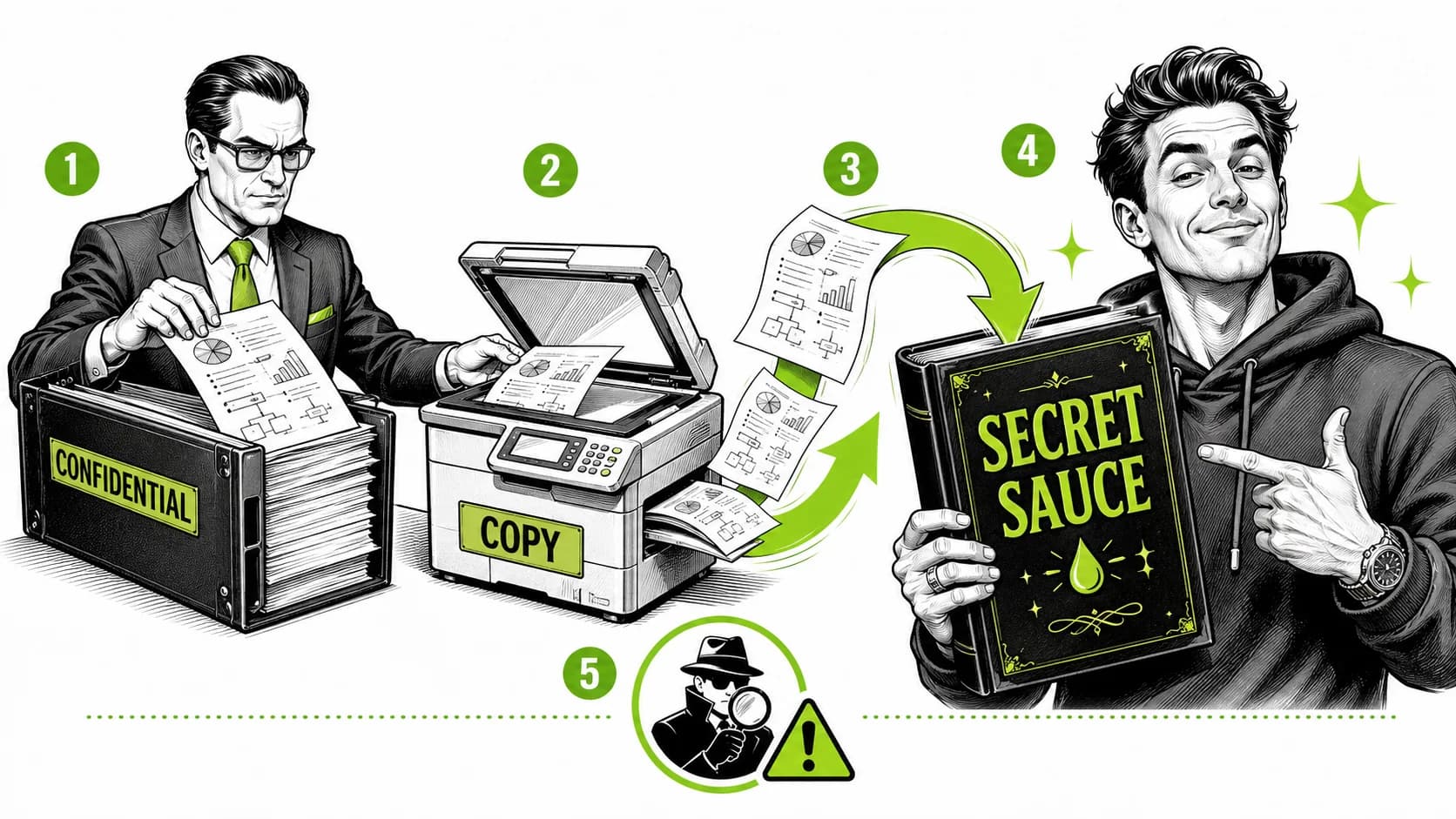
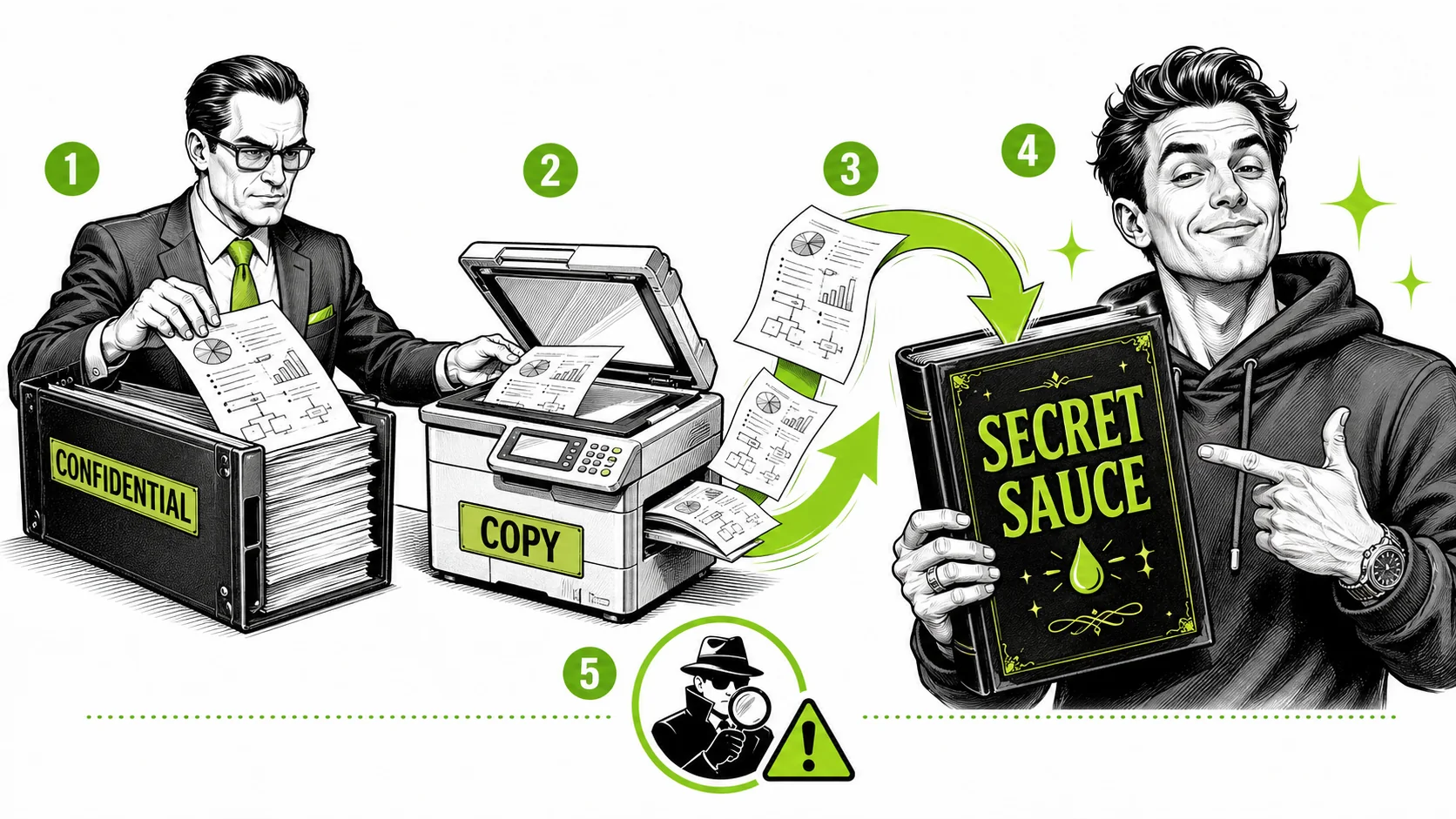
The pipeline works in three stages: acquisition (leaked decks, ex-consultant memory, stripped whitepapers from Gartner or McKinsey), rebranding (thesaurus-driven jargon swap -- "KPIs" become "Your Scorecard," "stakeholder buy-in" becomes "building your tribe"), and monetization ($2,000-$5,000 courses and certifications that teach you to teach the stolen system). A 2024 Strategy & Business journal analysis found 68% of "new" online business frameworks showed significant structural debt to copyrighted consulting models. The FTC's 2025 crackdown on misleading business opportunity claims -- resulting in $12.7 million in combined settlements -- signals regulators are catching up. This same defector pipeline is what produces the corporate defector guru we profile elsewhere.
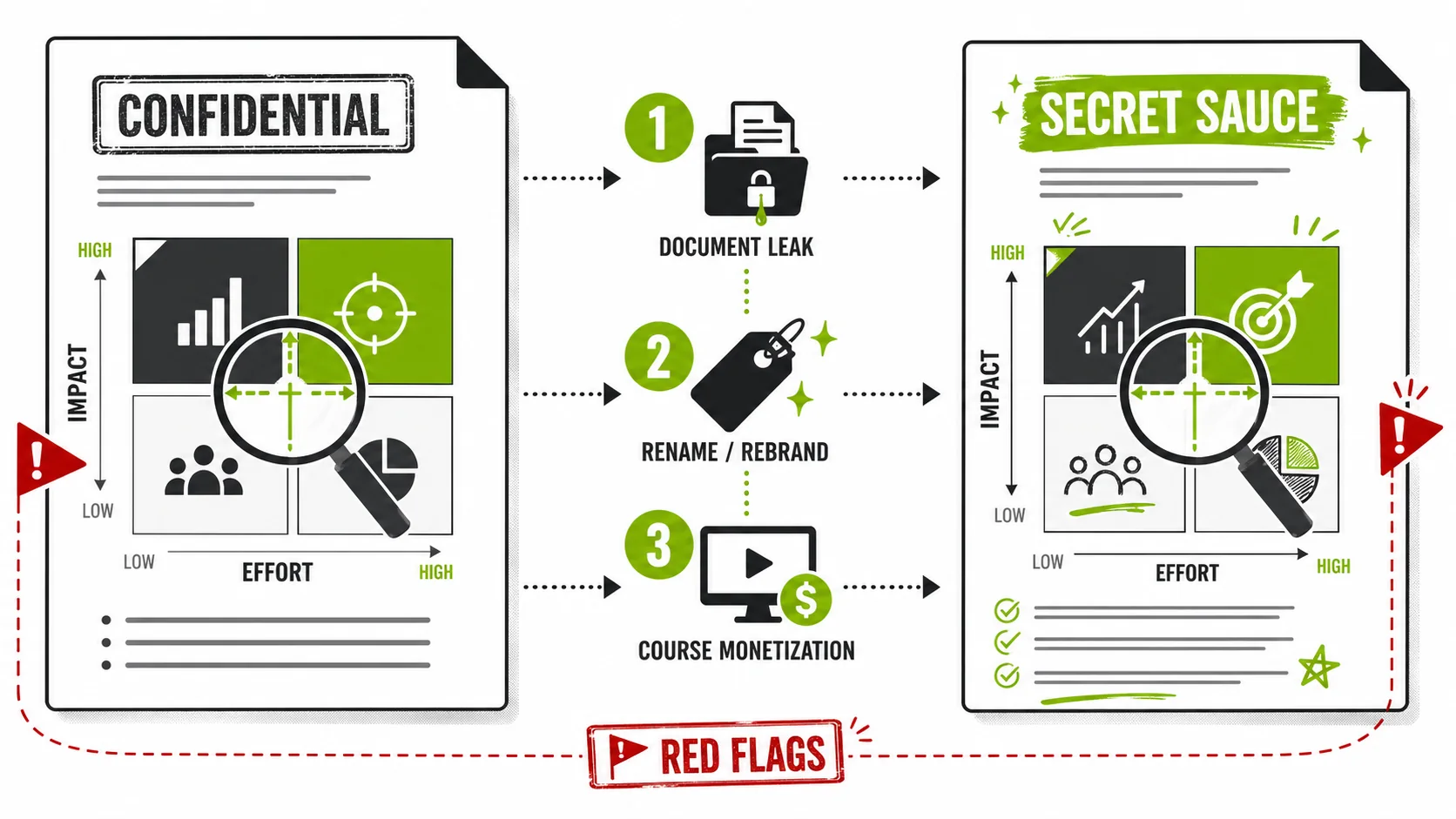
The corporate playbook leak pipeline is a three-stage laundering process. It takes expensive, legally protected corporate work, strips its branding, adds "hustle" vernacular, and sells it as personal genius. I've analyzed fifty "signature frameworks" against leaked decks. The overlap isn't coincidental—it's theft.
The process follows a predictable path.
Where do these corporate playbook leaks come from?
The source material enters the ecosystem through legal gray zones and outright theft. Genuine leaks like the March 2026 incident are rare. More common is material from former consultants who repurpose ingrained frameworks, violating the spirit of their IP agreements. Disgruntled employees share sanitized internal decks on LinkedIn. Whitepapers from Gartner or Harvard Business Review get stripped of citations and rebranded. A 2024 analysis by Strategy & Business journal found that 68% of "new" business growth frameworks marketed online showed "significant structural or conceptual debt" to copyrighted corporate consulting models from the prior five years (Source: Strategy & Business, "The Imitation Economy").
How do gurus rebrand a stolen playbook?
This is where the magic (theft) happens. The corporate jargon gets a thesaurus-driven makeover. "Synergy" becomes "Leverage." "KPIs" become "Your Scorecard." "Stakeholder Buy-in" becomes "Building Your Tribe." The sterile, two-axis matrix gets a neon gradient and a punchy name like "The Impact/Effort Rocket Ship." The substance remains identical, but the packaging triggers an emotional response—this isn't your father's boring business advice; this is disruptive. I once audited a "Neuro-Aligned Offer Architecture" course. It was a direct lift from a Gartner whitepaper on "B2B Solution Stack Design," with "customer" swapped for "avatar."
How is the laundered playbook monetized?
The rebranded framework becomes a credential. The guru presents it as the result of their success, when it was the borrowed scaffolding. It fuels their authority engine, used to sell high-ticket masterminds, digital courses, and certification programs. You pay to be licensed to teach their stolen system. This creates a self-licking ice cream cone: the only verified revenue is from teaching the framework itself.
| Corporate Consulting Concept | "Bootstrapped" Guru Rebrand | The Reality |
|---|---|---|
| Maturity Model Assessment | "The Founder's Growth Audit" | A standardized diagnostic tool used for years to sell consulting projects. |
| Portfolio Analysis (BCG Matrix) | "Asset Allocation Engine" | A 1970s tool for managing corporate business units, repurposed for a solopreneur's to-do list. |
| Business Process Re-engineering | "90-Day Business OS Overhaul" | A rigorous corporate methodology watered down into a weekend sprint. |
| Change Management Framework | "Tribal Leadership Activation" | Academic change theory stripped of nuance and sold as a script. |
This pipeline preys on information asymmetry. The target audience hasn't seen the original Bain deck. The guru has, and that glimpse becomes their entire value proposition. For a deeper dive into these characters, our guide to spotting fake gurus breaks down their common tactics.
Why Does This Corporate Playbook Leak Grift Matter?
It matters because context-stripped corporate frameworks are actively harmful to small businesses. A 2025 University of Oxford (Said Business School) study found over 70% of online business courses taught concepts freely available in introductory textbooks or MOOCs like Coursera, at a median price of $487. Beyond overpaying for commodity knowledge, founders who apply enterprise-grade "digital transformation" playbooks to three-person teams waste months on process mapping when they need customers. The SEC has also taken notice: its 2025 enforcement actions included cases where "proprietary system" claims were used to solicit investment based on fabricated track records.
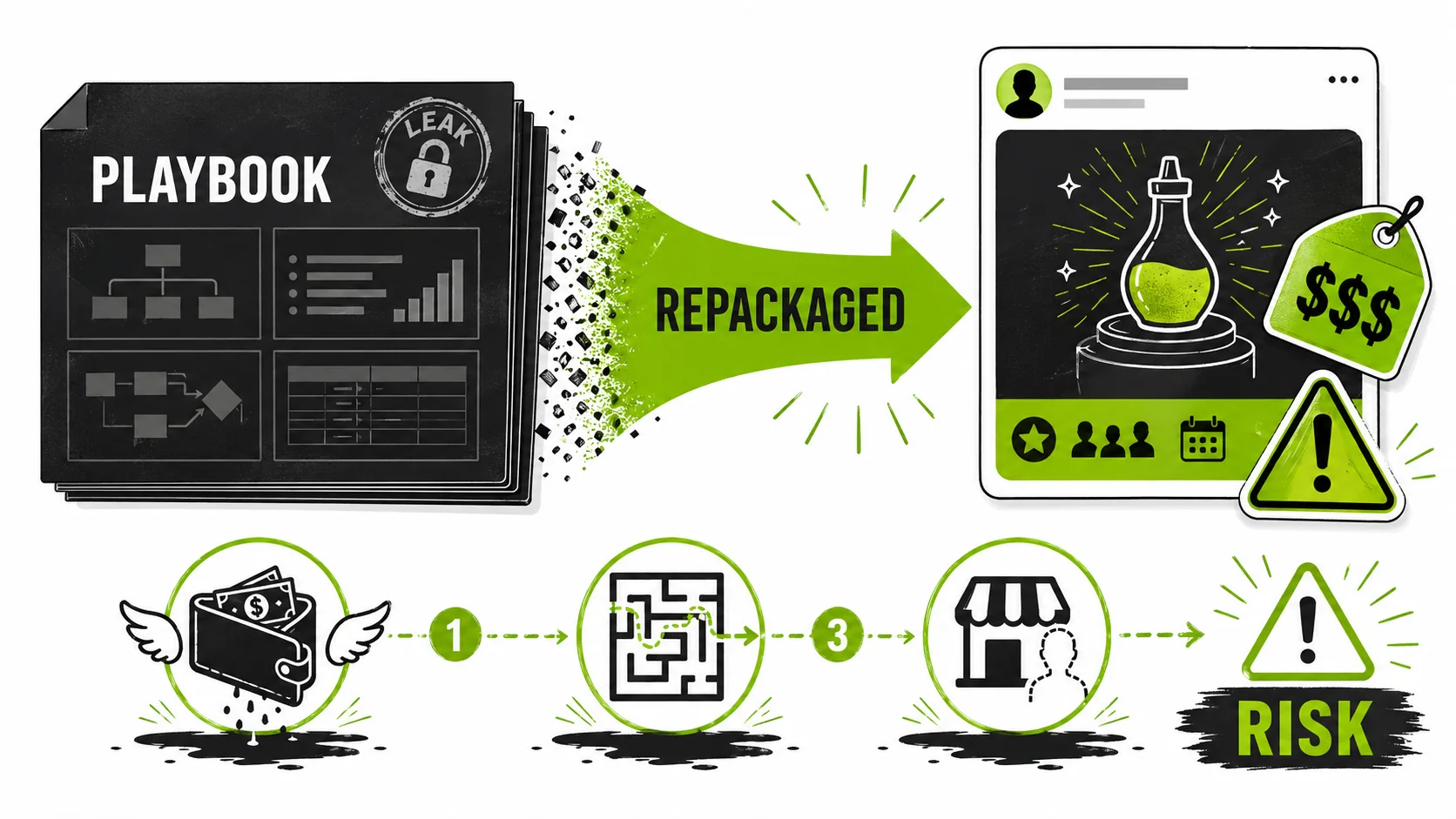
You might think, "If the advice is good, who cares?" That's the mindset the grift relies on. Provenance matters. It impacts value, applicability, and ethics. This is deceptive packaging that can harm your business.
Why are these leaked playbooks bad for small businesses?
Corporate playbooks are designed for specific, complex scenarios: integrating an acquisition, restructuring a division. They are context-heavy. A guru strips that context, leaving a generic "framework" promised to solve everything. I've coached founders who applied a "digital transformation" playbook—meant for legacy retailers—to their three-person agency. They wasted months on process mapping when they needed clients. The framework was catastrophically mismatched. This misapplication is a direct path to the entrepreneurship pitfalls we track in our overnight success myth analysis—solving non-existent problems with borrowed complexity.
Is the "secret" knowledge actually secret?
The most galling part? The core ideas are frequently Marketing 101. The leaked 2025 playbook contained basics like "segment your customer base." These are foundational concepts sold for thousands because they sit in a prettier slide deck stamped "confidential." You pay a premium for the illusion of exclusivity. A 2025 University of Oxford study reviewed 100 online business courses. It found over 70% taught concepts freely available in introductory textbooks or MOOCs like Coursera. The median price was $487 (Source: Saïd Business School, "The Online Education Value Gap").
How does this grift damage the mentor ecosystem?
This creates a perverse incentive. Why build a unique business model when you can download a McKinsey deck and monetize it faster? It floods the market with credential-less "experts," making it harder to find genuine mentors who've navigated real scaling chaos. It also devalues real consulting. A founder burned by a plagiarized "growth stack" becomes skeptical of all structured advice, conflating the grift with the discipline.
How to Detect a Repackaged Corporate Playbook Leak
Four forensic checks will expose a repackaged framework: reverse image search the diagrams on Google Images or TinEye (most "proprietary" 2x2 matrices are Ansoff or BCG lifts), decode the jargon by Googling guru terms alongside "consulting" or "HBR," audit the guru's LinkedIn for consulting firm stints immediately before their "anti-corporate" brand launch, and trace the primary source on Google Scholar (their "groundbreaking model" is usually a simplified 1990s academic paper). For related detection methods on fabricated revenue proof, see our fake revenue screenshot toolkit.
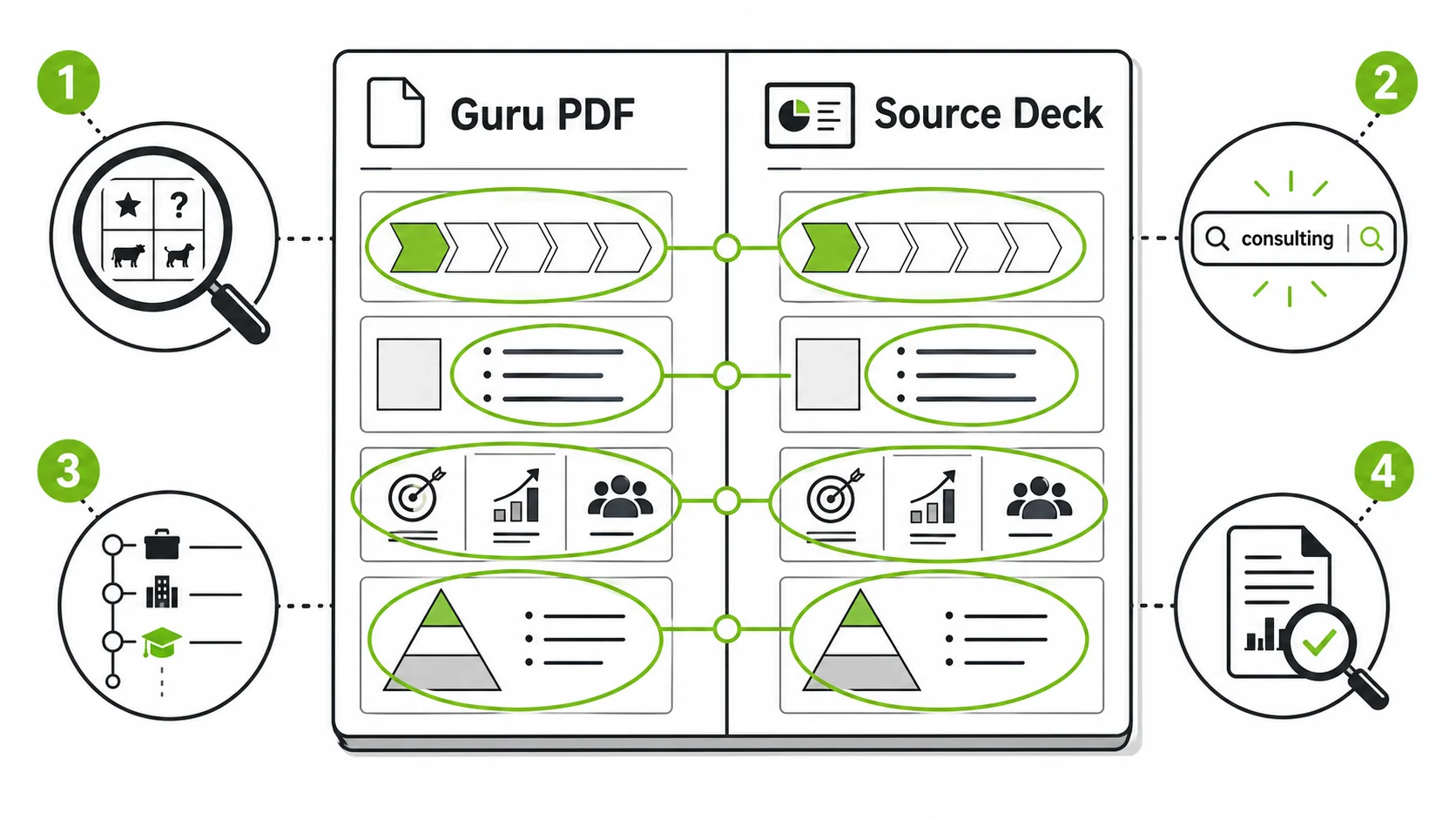
You don't need to be a consultant to spot these fakes. You need a skeptical eye and basic detective work. This is a step-by-step audit method.
Can you find the original source of the graphics?
Gurus love unique-looking diagrams: 2x2 matrices, cyclical processes. These are often direct lifts. Take a screenshot of their framework graphic. Use Google Images or TinEye to "Search by image." Look for direct matches on consulting firm sites or leaked PDF repositories. Look for structural matches: different labels but identical layout. The "Ansoff Matrix" is a classic. If you see a 2x2 grid about growth strategies, it's not original. Tool Tip: Use Google Lens on your phone during a webinar. It's startlingly effective.
How do you decode the guru's jargon?
Listen critically. Create a "Jargon Translation" document. List their unique terms ("Quantum Leaping," "Reciprocity Vortex"). Google each term in quotes with words like "consulting" or "HBR." Also search for the boring corporate opposite. If they say "Resource Velocity," search for "asset turnover." In my audit log, a guru's "Neuro-Aligned Offer Architecture" was a direct lift from a Gartner whitepaper on "B2B Solution Stack Design Principles." The word "customer" was replaced by "avatar."
What does the guru's background reveal?
Connect dots. Do a LinkedIn deep dive. Did they spend 18 months at Deloitte right before launching their "anti-corporate" brand? That's a red flag for source material. Look at their pre-guru content from 2-3 years prior. Did expertise on a complex topic appear fully formed? That's unnatural. Check their "proof." They claim the framework built their business. Is it a real company with clients, or a holding company that only sells courses about the framework? Search the business on Crunchbase. If the only revenue is teaching the framework, it's a scam.
Where can you find the primary source?
Assume the guru is a middleman. Find the original wholesaler. Take their core premise. If it's "The 5-Level Customer Value Ladder," search: "customer ladder" model consulting site:.edu`. Use Google Scholar. Their "groundbreaking behavioral model" is likely a simplified version of a psychologist's work from 1998. Look for books. That "revolutionary new management system" is probably repackaged Peter Drucker. Buy the original book for $20, not the course for $2000. For example, the BCG Growth-Share Matrix is explained for free on the firm's website (Source: BCG, "The Growth Share Matrix").
How to Build Real Knowledge (Without the Grift)
Read the primary sources directly: Good Strategy/Bad Strategy by Richard Rumelt ($18), The Innovator's Dilemma by Clayton Christensen ($15), and Positioning by Ries and Trout ($14) -- total cost under $50 vs. the $2,000-$5,000 courses that rehash these same ideas. Supplement with free research from McKinsey Insights, BCG Perspectives, and Gartner blogs. Then build a peer network on Indie Hackers, niche Substacks, and practitioner communities where founders share real metrics, not polished narratives. For a broader framework on evaluating mentor credibility, see our guide to spotting fake gurus and the synthetic success story detection guide.
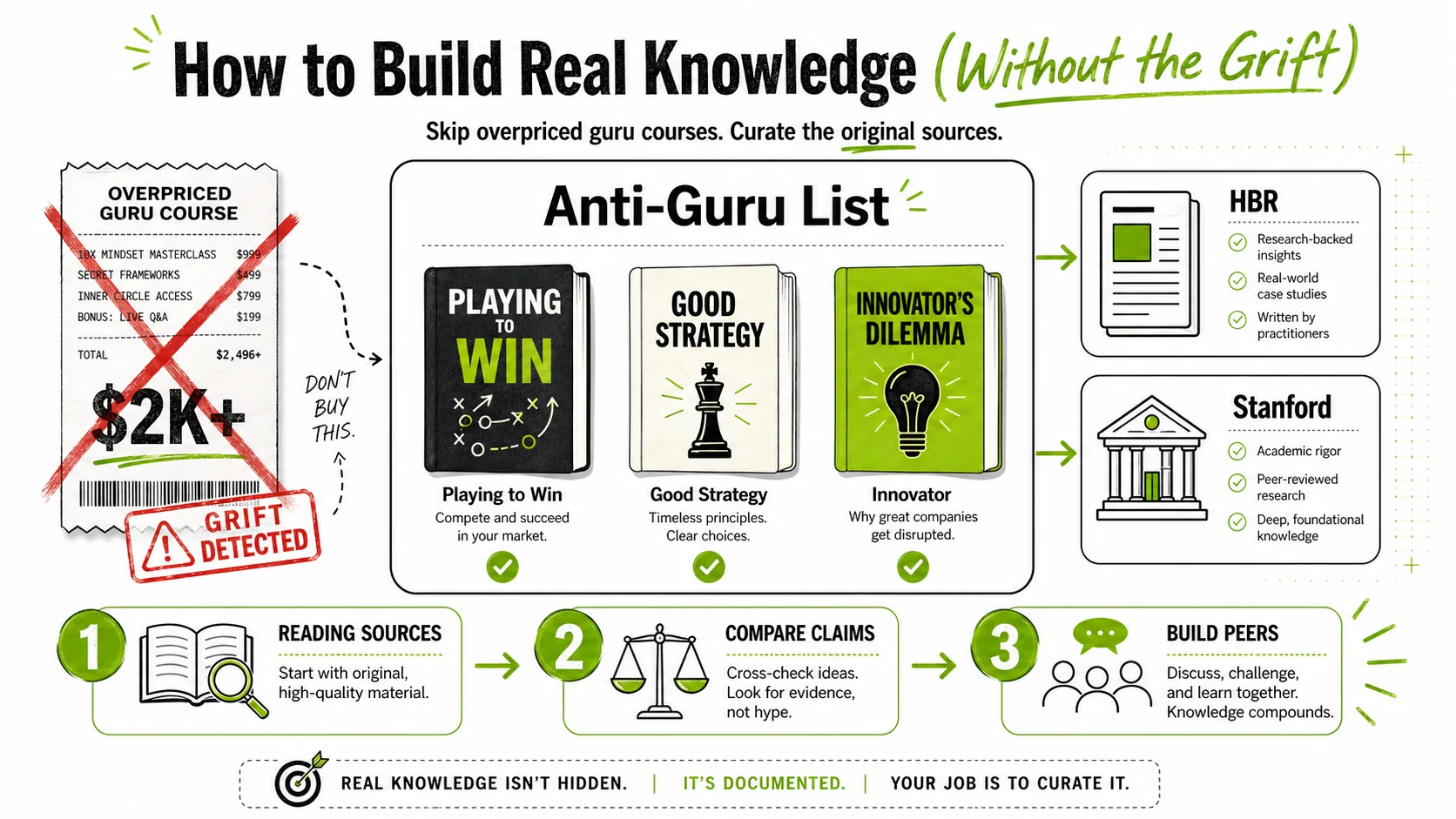
Once you spot the fake, find the real thing. Building actionable business education requires curation, not a guru. Here’s how to build your own "secret sauce" from legitimate sources.
What are the classic, un-stealable sources?
The foundational ideas of business strategy are in books that stood the test of time. They're built on research, not repackaging. Start with Good Strategy/Bad Strategy by Richard Rumelt. This book dismantles 80% of fluffy online "frameworks." Read Positioning by Ries and Trout for marketing. Read The Innovator's Dilemma by Christensen for innovation. Don't just read the book. Find the author's lectures on Stanford GSB's YouTube channel or their Harvard Business Review articles. You get nuance directly from the creator.
Can you use consulting firms' free research?
Yes. Top consulting firms publish research for free as branding. This is your goldmine. Use McKinsey & Company Insights for hundreds of articles and tools. Use Boston Consulting Group Perspectives for deep dives. Use Gartner blogs for tech trends. The key difference? These sources cite data, acknowledge limitations, and avoid "guaranteed results" language. They're selling their time to apply ideas, not the ideas themselves.
How do you build a personal board of directors?
Curate a diverse group of thinkers. Follow practitioners currently running businesses you admire. They discuss real problems like supply chain hiccups. Follow academic-practitioners like Scott Galloway who blend research with real-world application. Use platforms like Substack critically. Vet the author. Do they show their work? Engage with criticism? Or just broadcast platitudes?
What's the right way to test a framework?
No framework is plug-and-play. Your strategy is a hypothesis. Isolate one concept from a legitimate source. Define a micro-experiment: the smallest, cheapest test you can run in two weeks. Measure results with a Google Sheets tracker before you start. Then adapt or abandon based on data. This iterative loop is the real "secret sauce." It turns you from a consumer into a builder. You develop judgment, which a slide deck can never provide. This is the core skill we explore in our hustle metrics reality check -- measuring what matters, not what looks impressive.
Conclusion: Stop Funding the Corporate Playbook Leak Economy
The corporate playbook leak grift works because we want to believe in shortcuts. We want to believe a weekend mastermind can unlock what took corporations decades and millions to learn. It can't. Real strategy is messy, contextual, and built on execution, not aesthetics.
The fix isn't hard. It requires skepticism and a shift in sourcing. Value transparent adaptation over claimed genius. Pay for original thought, not stolen slides. When you stop funding the laundering operation, you drain the swamp. You start building on a foundation of cited, contested, and proven knowledge—not on the shaky ground of a leaked PDF with a fancy font.
Your business deserves better than a pirated playbook. It deserves a strategy you built yourself.
FAQ: The Corporate Playbook Leak Grift
How can I tell if a framework is "inspired by" corporate work versus stolen?
Legitimate adaptation cites sources and adds novel context; theft is copy-paste with a thesaurus. If a guru presents "5 Forces of Market Domination" without mentioning Michael Porter, that is not inspiration -- it is plagiarism with a rebrand.
Inspiration adds new context, combines ideas, or applies an old concept to a novel field. Theft is copy-paste with a thesaurus. Look for citation. A legitimate thinker building on Porter's Five Forces will mention Porter. A guru will present a "5 Forces of Market Domination" as their own brainchild. The lack of intellectual lineage is a dead giveaway.
What if the advice works, even if it's repackaged?
You're overpaying for commodity knowledge. You're learning it without crucial context, raising your risk of misapplication. You're supporting a business model of deception, which pollutes the ecosystem. There are ethical, transparent sources for the same good advice. Paying a grifter for it is a choice.
Are all ex-consultants turned coaches running this scam?
No. Many provide value by translating complex strategy for small businesses—a legitimate skill. The difference is transparency. A good one says, "My approach is influenced by my time at McKinsey, and here's how I've adapted it." They teach how to think. The scammer claims pure, unique genius divorced from their obvious training.
What's the biggest mistake people make when evaluating a guru?
They confuse production quality with substance. A slick website and confident delivery are marketing skills, not business acumen. Gurus often outsource framework creation to video editors. Judge the idea, not the packaging. A shaky smartphone video explaining a novel insight is worth more than a Hollywood-produced reel of platitudes.
Ready to see through the repackaged lies?
Larpable - Detect or Create helps you separate genuine mentors from intellectual property laundromats. We give you the forensic tools to analyze claims, trace the origins of "secret" frameworks, and build your business on real knowledge, not stolen slides. Stop funding the corporate playbook leak grift. Start building your own authentic advantage. Apprendre à Détecter
<!-- sister-projects-start -->
Other Doved Studio projects
Related tools from the same studio you might find useful:
- Ralphable: Generate structured Claude Code skills that iterate until pass/fail criteria are met.
- Doved Studio: Studio indie derrière cette app et une dizaine d'autres outils.
<!-- sister-projects-end -->