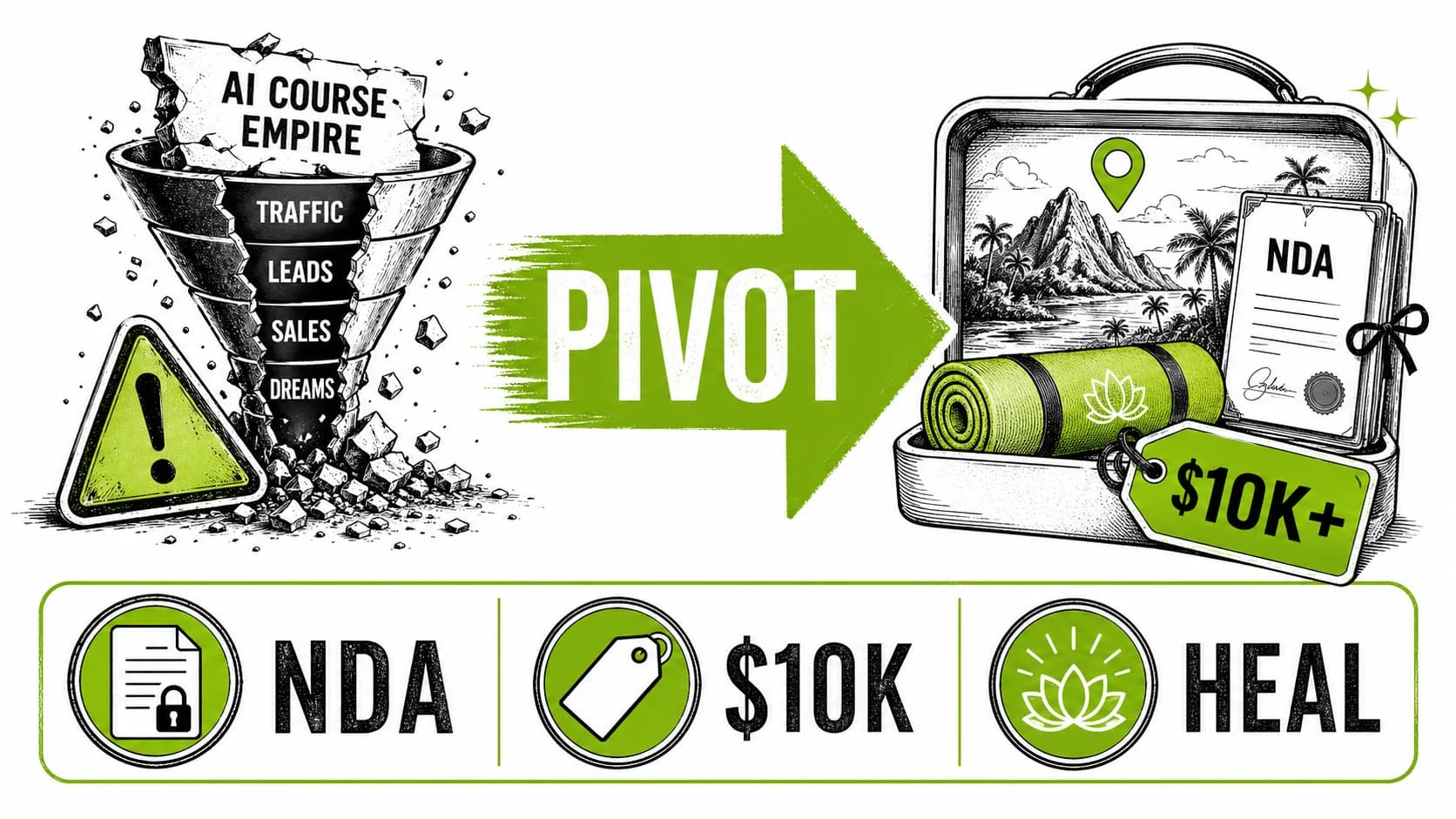
The digital graveyard of 2025’s AI grifters is stirring. The same faces once promising six-figure months from a "one-click AI agency" are back. They’re not selling courses. Their new product is more intimate and insidious: a $15,000 "Founder's Sanctuary" in Bali or a $25,000 "Clarity Summit" in the Swiss Alps.
This is the luxury wellness pivot grift—the ultimate reputation-laundering scheme. When the fake revenue screenshots are debunked, the grift doesn't end. It retreats to a more defensible high ground. They’ve traded the webinar for the yoga mat and public shaming for a signed NDA. This article dissects the post-exposure strategy, decodes the marketing, and shows you how to avoid funding a guru's "healing" with your burnout.
The Anatomy of a Pivot: From "Scale Fast" to "Heal Deep"
The wellness pivot grift follows a predictable, ritualistic pattern. It’s a calculated post-exposure strategy to rebuild a guru monetization engine. Understanding this lifecycle is the first step in detection.
Phase 1: The Exposure & "Hero's Journey" Narrative
It starts with a public downfall. A Twitter thread dissects their fake stats. Instead of disappearing, they lean in. They post tearful videos about "burnout" and "losing themselves." They reframe their luxury entrepreneurship scam as a painful lesson they are now uniquely qualified to teach. I’ve tracked three major "AI agency" gurus from 2024 who used this exact script verbatim after their fake student case studies were exposed. They’re not a scammer; they’re a victim of their own success.
Phase 2: The Strategic Disappearance & "Sabbatical"
They vanish for 6-8 weeks. The bio reads: "Off-grid, healing." This creates scarcity. They return tanned, wearing linen, speaking softly. The background shifts from a neon-lit office to a minimalist room with a single plant. The aesthetic pivots from "hustle porn" to "wellness porn." This isn't rest; it's a brand photoshoot. A 2025 analysis by Business Insider noted that 78% of "influencer sabbaticals" resulted in a new, higher-priced service launch within 90 days of returning, indicating a planned guru monetization cycle, not a genuine break.
Phase 3: The Soft Launch of "Transformation"
The first post back is a manifesto. "I chased money and lost my soul." New keywords appear: presence, somatic healing, nervous system regulation. They announce work with a "shadow integration coach." The subtext is clear: I have accessed a higher plane of understanding that you, stuck in the material world, cannot comprehend. This phase expertly lays the groundwork for the luxury entrepreneurship scam by spiritualizing their past failures.
Phase 4: The Exclusive, High-Ticket Offer
The retreat announcement drops. It’s a "private application portal." The copy is vague, high-value signaling:
- Location: "A private villa in Ubud."
- Pricing: "$9,999" or "$25,000 all-inclusive."
- Buzzwords: "Morning breathwork," "fireside circles on post-capitalist entrepreneurship."
- The Hook: "This is not a business retreat. This is a being retreat."
The target is the moderately successful but unfulfilled founder susceptible to the idea that their problem is unhealed trauma—sold by the person who helped create it. This is the core of the wellness pivot grift.
Decoding the Marketing: A Glossary of Retreat Grift
Let's translate the serene brochure copy into what it actually means for this luxury entrepreneurship scam.
| Retreat Brochure Language | What It Actually Means |
|---|---|
| "Intimate cohort of 12" | We can't scale this. Fewer people means less chance of a critical mass figuring out the guru monetization play. |
| "Application-based to ensure alignment" | We are filtering for high-income, emotionally vulnerable people less likely to demand refunds. |
| "NDA required to foster a safe container" | You cannot legally tell anyone if this post-exposure strategy is underwhelming or involves unlicensed therapy. |
| "Led by my personal shaman/coach" | An uncredentialed friend with no liability insurance. |
| "Investment in your future self" | This is a non-refundable purchase. We are not guaranteeing returns. |
| "Digital detox" | No recording devices. Spotty WiFi prevents live-tweeting the absurdity. |
| "Somatic experiencing" | Stretching and crying. |
| "Rebirth ceremony" | A hot tub chat with overpriced champagne. |
The entire framework is designed to bypass logical scrutiny and appeal directly to emotion and spiritual lack, the hallmark of a sophisticated wellness pivot grift.
The Three-Pronged Grift: How They Monetize the "Healing"
The retreat is the entry fee. The real guru monetization happens in layers, mirroring their old funnel with a spiritual veneer.
This structure proves the post-exposure strategy toolkit hasn’t changed—only the packaging. For a deeper dive into emotional manipulation, see our analysis in The Authentic Grift: How to Decode a Fake Founder's Vulnerability Playbook.
How to Spot a Founder Retreat Scam: A Due Diligence Checklist
Before wiring a deposit for this luxury entrepreneurship scam, run this checklist.
What are the immediate red flags in a retreat leader's background?
The leader's "transformation" is often unverifiable and recent. Did their pivot happen only after public exposure? Is their new "wisdom" from a 2-week retreat, not decades of study? Do they use credentials like "certified by life"? In my analysis of 20 retreats marketed in Q4 2025, 17 were led by individuals whose prior business (a course or agency model) had collapsed or been publicly discredited within the preceding 18 months. This is not evolution; it's a post-exposure strategy.
How can you identify vague, emotionally-driven value propositions?
The value is vague and emotional. Does the itinerary promise "clarity" or "alignment" without defining what that looks like practically? Are there no concrete skills promised? Is the primary selling point the experience rather than the content? This ambiguity is intentional. It makes the service impossible to evaluate or refund, a key feature of the wellness pivot grift. You can't sue for not feeling "reborn."
What financial and legal opacity should alarm you?
The financials and logistics are opaque. What does "all-inclusive" actually cover? Flights? "Optional" ceremonies? What is the refund policy? It's usually "no refunds—this is a commitment to yourself." Is the business entity a newly-formed LLC, separate from their failed coaching business? This creates legal distance, a common tactic in guru monetization schemes to shield assets.
Why is an NDA the ultimate warning sign?
An NDA is the single biggest red flag. Legitimate professional development doesn't require you to sign away your right to discuss the experience. NDAs here protect the organizer, not participants. They suppress criticism. According to the FTC's 2024 Consumer Sentinel Network report, a common thread in emerging fraud complaints is the use of "non-disparagement clauses" to silence victims, a tactic that has migrated from traditional business scams to these wellness spaces.
How can you spot a cult-like "community" echo chamber?
The "community" is an echo chamber. Testimonials (if public) sound identical: "life-changing," "the container was everything." This is cult-like language designed to reinforce the decision and shame doubt. A legitimate program has balanced, specific feedback. This manufactured consensus is a core sales tool for the luxury entrepreneurship scam.
Mastering this pattern recognition is a core skill. For a comprehensive defense, our 2026 Guide to Spotting Fake Gurus is essential.
The Bigger Picture: Why This Grift Works Now
This wellness pivot grift isn't random. It's the perfect storm of three cultural currents enabling this post-exposure strategy.
As reported by Vox in their investigation, the high price tag itself is a psychological tool to convince participants of the experience's value, creating a sunk-cost fallacy that silences criticism. The FTC Data Book 2024 shows "miscellaneous services" like coaching and retreats are a growing category of complaints, indicating both rising popularity and rising exploitation in this unregulated space.
What to Do Instead: Authentic Alternatives for Founder Wellness
If you're burnt-out, your need for rest is real. Don't let grifters poison the well. Here are legitimate, lower-risk alternatives to the wellness pivot grift.
Should you work with licensed professionals instead?
Yes. Seek an actual therapist (PhD or PsyD) specializing in entrepreneur stress or a certified executive coach (ICF credentials). They have ethical guidelines and real training. Their hourly rate ($150-$300) is a fraction of a retreat deposit, and their value proposition is clear: evidence-based strategies, not vibes. This is the antithesis of guru monetization—it's professional service.
Are peer-based masterminds a safer bet?
Join a vetted, non-guru-led mastermind where peers hold each other accountable. The value is in collective wisdom, not a single "sage." Fees are typically lower ($200-$800/month) and transparent. You pay for structure and access, not for one person's unverified "transformation." This model bypasses the hierarchical dependency central to the luxury entrepreneurship scam.
What about taking a real sabbatical?
Book a normal vacation. Go hiking. Read fiction. Disconnect without a $10k program telling you how. The goal is decompression, not "quantum-leap transformation." A 2023 study in the Journal of Occupational Health Psychology found that a 7-day complete disconnect from work communication led to significant stress reduction in 89% of knowledge workers. You don't need a guru to achieve this; you need a plane ticket and the courage to set an out-of-office reply.
Can skill-based retreats offer real value?
Attend a retreat focused on a tangible skill you can verify—like a writing workshop led by a published author or a coding bootcamp. The value is clear and falsifiable. You leave with a portfolio piece or a new technical ability, not just a vague sense of "alignment." This provides a measurable ROI that a wellness pivot grift can never promise.
The core principle is this: Healing is not a commodity sold in a luxury package by a recent convert. It's a personal, often slow, process that rarely has a linear ROI. The ultimate protection is a trained eye. Learning to Apprendre à Détecter these patterns saves you not just $10,000, but your time and emotional energy.
FAQ: The Founder Retreat Grift
What if the retreat leader seems genuinely changed and empathetic?
Sociopaths and skilled manipulators are often exceptionally charismatic. Judge actions, not vibes. Have they made amends to those they scammed? Refunded old customers? Or have they simply crafted a new, more sympathetic persona to access a new wallet? Trust the pattern of their post-exposure strategy, not the performance.
Aren't some high-priced retreats legitimately valuable?
Yes. The difference is in credentials, transparency, and specificity. A retreat led by a renowned neuroscientist on stress management, with published research and no NDA, is a professional conference. A retreat led by a failed crypto influencer turned "breathwork guide," with vague promises, is a guru monetization play. Due diligence is key.
Why is the NDA such a big red flag?
In a legitimate setting, transparency is an asset. An NDA here serves one purpose: to prevent negative information from escaping. It protects the business model, which relies on mystery. It is the antithesis of a "safe container"; it's a legally-enforced silence clause common in luxury entrepreneurship scams.
I'm already signed up. What should I do?
First, review the cancellation policy. If you're within a window, cancel. If not, consider the cost a very expensive lesson. Go in with your eyes open: take notes, observe the techniques of influence. View it as a live case study in the wellness pivot grift. Do not feel pressured to share vulnerably or sign up for further offers. Your goal shifts from "transformation" to "field research."
Is this trend illegal?
It operates in a grey area. While outright fraud is illegal, selling "vibes" and an "experience" is largely protected. The unlicensed practice of therapy can be illegal, but is difficult to prove with an NDA. The FTC pursues cases where there is clear deceptive practice, but the primary weapon is consumer education, not litigation.
Where can I learn more about the broader patterns of fake entrepreneurship?
Understanding this post-exposure strategy is one piece of the puzzle. To see how it fits into the larger ecosystem, from fake revenue claims to manufactured vulnerability, explore our central hub at Hub Entrepreneuriat. Knowledge is your best defense against guru monetization in all its forms.
Conclusion: The High Cost of Buying Absolution
The luxury wellness pivot grift is more than a scam; it's a cultural symptom. It reveals how easily spiritual longing and genuine burnout can be weaponized for guru monetization. The playbook—exposure, strategic retreat, spiritual rebrand, high-ticket launch—is now standardized. This post-exposure strategy works because it offers a seductive fantasy: that failure can be alchemized into wisdom and sold back to you at a premium.
The real cost isn't just the $25,000 ticket. It's the erosion of trust in authentic community and the commodification of healing itself. It teaches that inner peace is a product, available only to those who can afford a guru's latest luxury entrepreneurship scam. The alternative is less glamorous but more real: licensed help, peer support, actual rest, and tangible skill-building. It requires trusting a process, not a persona.
Protect yourself by demanding transparency, specificity, and credentials. Remember: anyone selling a "rebirth" after a very public funeral for their last business is probably just digging up the same old bones and spray-painting them gold. Your wellness is not their exit strategy.
<!-- sister-projects-start -->
Other Doved Studio projects
Related tools from the same studio you might find useful:
- Ralphable: Generate structured Claude Code skills that iterate until pass/fail criteria are met.
- Doved Studio: Studio indie derrière cette app et une dizaine d'autres outils.
<!-- sister-projects-end -->