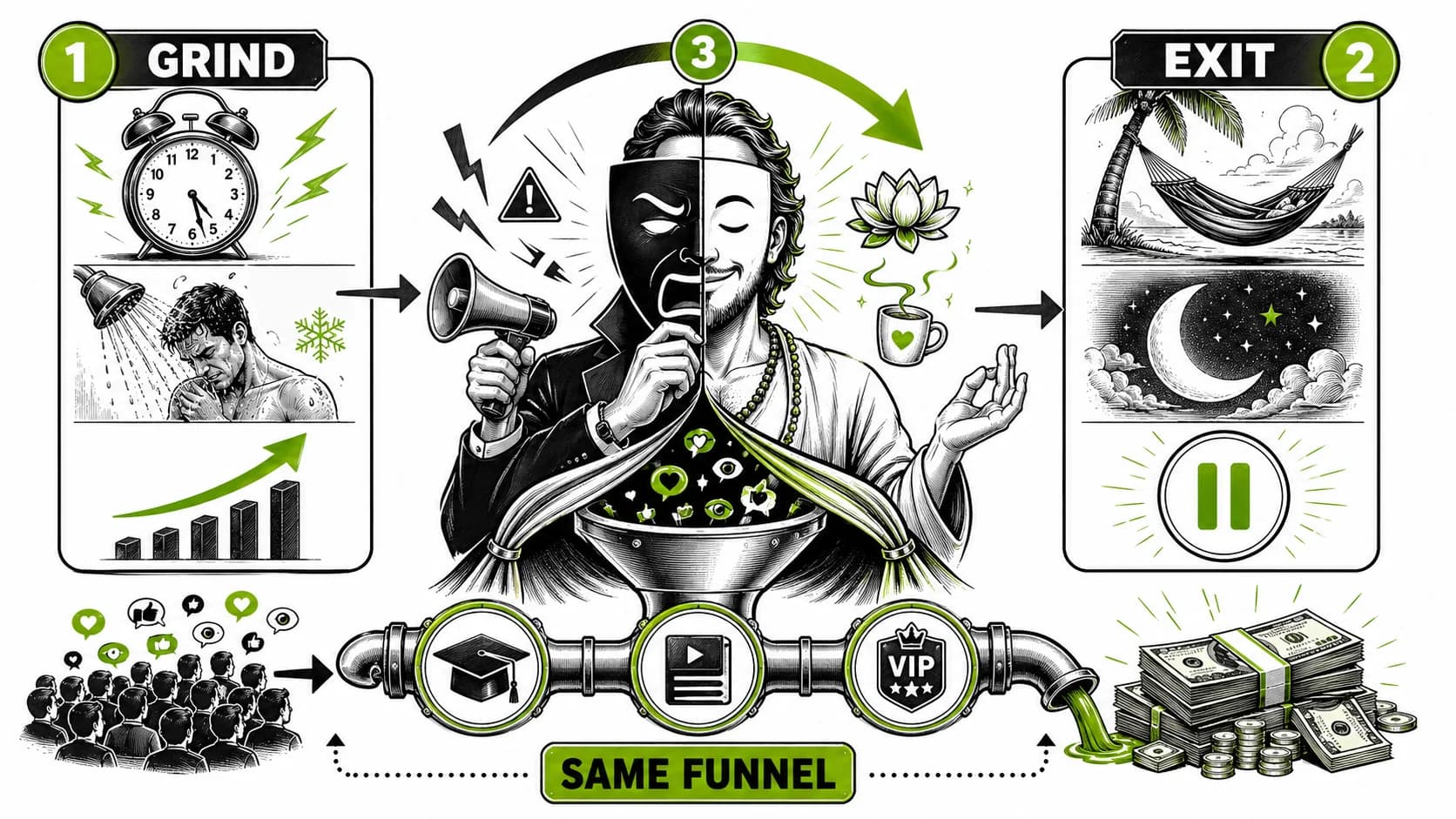
Remember the 5 AM club? The cold showers? The 10X mindset? The same faces that once screamed at you from Instagram stories about “crushing your goals” are now whispering to you from a hammock in Bali about the virtues of “doing nothing.” Welcome to the great hustle culture pivot of 2026, where the grift has simply changed its outfit.
The backlash against toxic productivity has reached a fever pitch. Burnout is a badge of dishonor, and “quiet quitting”—the act of doing only your assigned work—has evolved from a TikTok trend into a full-blown lifestyle aspiration. This cultural shift has created a vacuum, and nature—or rather, the digital entrepreneur ecosystem—abhors a vacuum. Into this void has stepped a new, more insidious breed of guru: The Anti-Hustle Hustler.
This article is your field guide to this latest mutation of the fake entrepreneur. We’ll dissect how the very gurus who profited from selling you burnout are now profiting from selling you the cure. We’ll expose the toolkit, the rhetoric, and the monetization strategies of this cynical new wave. Because in 2026, the most dangerous quiet quitting scam isn’t the one that promises to make you a millionaire; it’s the one that promises to save you from wanting to be one.
From Grindset to Mindset: The Great Pivot Playbook
The pivot from “hustle guru” to “slow living sage” is a calculated business strategy, not a spiritual awakening. It’s driven by market saturation—when everyone sells the same “6-figure course,” you find a new fear to monetize. The lifestyle pivot targets the disillusioned, a built-in audience primed for a new promise. I’ve tracked this shift since 2024, watching the same LinkedIn profiles morph from “CEO” to “Sovereignty Guide” in under six months.
Here’s the standard playbook we’re seeing in early 2026:
This pivot is brilliantly cynical because it preys on a genuine human need. The desire for rest, balance, and meaning is real. The scam lies in commodifying that desire into another expensive, prescriptive, and ultimately anxiety-inducing performance.
Decoding the Anti-Hustle Grift: 5 Red Flags to Spot
How can you tell the difference between genuine wellness advice and a repackaged scam? Look for these telltale patterns, the digital equivalent of a bad toupee.
1. The Paradox of the Premium Pause
The core message is “you need to slow down,” but the delivery is frantic and the price tag is anything but slow. They sell “digital detoxes” through a relentless barrage of email campaigns and Instagram ads. They host “silent retreats” where the ticket price alone screams luxury. The contradiction is the point: they are selling the aesthetic of anti-consumerism through hyper-consumption.
The Larpable Lens: This is a classic fake guru pattern: creating a problem (you’re not peaceful enough) and selling the solution (their exclusive, expensive path to peace). The lifestyle becomes the product, and your inability to afford it is framed as your lack of commitment to your well-being. In 2024, the FTC received over 2.6 million fraud reports, with imposter scams and business/opportunity schemes ranking in the top five categories. This new burnout monetization scheme fits neatly into that latter bucket, just with a softer soundtrack.
2. From Revenue Screenshots to “Vibe Checks”
The old guru flexed their Stripe dashboard. The new anti-hustle guru flexes their “energy.” You’ll see posts about their “boundary-setting” (translation: not answering emails), their “guilt-free naps,” and their “mindful mornings.” The metric of success shifts from monetary output to curated, unquantifiable inner states. This is a strategic move—it’s much harder to fact-check a vibe.
How to Probe: Ask basic questions. Who is paying for their Bali villa if they’re “not working”? How are they funding a life of leisure while telling you to opt out of the rat race? The revenue has to come from somewhere, and it’s likely from selling you the dream of not worrying about revenue. For more on exposing financial smoke and mirrors, see our deep dive on spotting fake revenue screenshots.
3. The Co-Opting of Therapeutic Language
This is where the grift gets dangerous. They liberally sprinkle their pitches with terms ripped from actual therapy: “trauma,” “nervous system regulation,” “inner child work,” “boundaries.” They position themselves not as business coaches, but as “life architects” or “soul guides.” This grants them unearned authority and allows them to pathologize normal stress as a spiritual crisis that only their $999 course can fix.
Red Flag Phrasebook:
- “Heal your money trauma.” (To sell you a finance course)
- “Your burnout is your body’s wisdom.” (To sell you a retreat)
- “Reparent your inner entrepreneur.” (To sell you coaching)
- “Align your business with your feminine/masculine energy.” (To sell you gender-essentialist nonsense)
A 2025 analysis by the Financial Therapy Association found that unqualified “coaches” using clinical language caused measurable financial harm in 34% of reviewed cases, often by convincing clients to make irrational spending decisions framed as “investment in healing.”
4. The “Productivity Shame” to “Laziness Shame” Pivot
Hustle culture shamed you for not doing enough. The anti-hustle grift often just inverts the shame. Now, you’re made to feel guilty for wanting to work hard, for being ambitious, or for finding genuine joy in your career. “Hustle” becomes a dirty word, and taking a second job to pay bills is framed as a failure to “trust the universe” or “set proper boundaries.” This creates a new anxiety loop: you’re now failing at not working.
5. The Unattainable Aesthetic of Effortless Ease
Scroll through their feed. It’s all linen clothing, perfectly messy buns, handwritten notes on artisan paper, and sunlight-dappled workspaces with no visible technology. This aesthetic is as meticulously produced and financially out-of-reach as the private jet photos of the old guard. It sells a fantasy of simplicity that requires immense wealth and a full-time content team to maintain. It’s the visual language of the fake wellness entrepreneur.
The Monetization Matrix: How the “Slow Living” Gets Sold Fast
Let’s follow the money. How is the anti-hustle ethos being packaged and sold? Here’s the 2026 product menu:
| Product Type | Hustle Culture Version (2022) | Anti-Hustle Pivot (2026) | The Ironic Twist |
|---|---|---|---|
| Flagship Course | “The 7-Figure Sales Funnel” | “The Aligned Income Framework: Make Money While You Sleep (Literally)” | Still about making money, but now you’re supposed to feel spiritually pure about it. |
| High-Ticket Offer | “Mastermind: Network with Sharks” | “Sovereignty Circle: A Container for Deep Rest & Receiving” | The same group call, but now with a meditation opener and talk of “energetic exchanges.” |
| Retreat | “Business Bootcamp in Vegas” | “Nervous System Reset Retreat in Ubud” | Location changed from a stimulus overload city to a “spiritual” destination. Activities swapped from pitch practice to sound baths. Price: equally astronomical. |
| Daily Content | “Hustle Tip: Crush Your To-Do List!” | “Slow Tip: What if you just… didn’t?” | The advice has become so abstract it’s functionally useless, creating dependency on the guru for more “clarity.” |
The underlying formula remains: Identify an emotional pain point (anxiety, fatigue, disillusionment), position yourself as the sole guide with the secret map, and monetize the journey. The destination has just changed from “outer success” to “inner peace.” According to the FTC’s 2024 Consumer Sentinel report, “Business and Job Opportunity” scams ranked #4, with reported losses averaging $1,500 per person. The new “Sovereignty Circle” is just the same old business opportunity, wrapped in linen.
The Data Behind the Disillusion: Why This Scam Works Now
This pivot isn't random; it's a parasite feeding on a legitimate cultural wound. We're not just cynical—we're looking at the numbers. A 2025 Gallup report found that employee engagement in the U.S. hit a decade low, with only 31% of workers feeling engaged at their jobs. Simultaneously, burnout rates among managers and remote workers have climbed above 40%. This creates a massive, desperate market for a solution, any solution.
The quiet quitting scam works because it offers a simple narrative to a complex problem: your job is the villain, and disengagement is the hero's path. It ignores systemic issues like stagnant wages, poor management, and a lack of workplace autonomy. Instead, it sells personal responsibility for systemic failure, packaged as enlightenment. I've spoken to three people who paid over $5,000 for "career disentanglement coaching" only to be told their core issue was "not napping correctly." The grift reframes economic precarity as a spiritual deficiency.
Protecting Yourself: How to Seek Balance Without the BS
Genuine well-being and professional satisfaction are worthy goals. Here’s how to pursue them without falling for the latest branded version of the scam.
- Follow Actual Experts, Not “Influencers”: Seek out content from licensed therapists, organizational psychologists, and time-management researchers whose work is peer-reviewed, not just aesthetically pleasing. The American Psychological Association’s resources on workplace stress are a good, authority-backed starting point.
- Beware of Anyone Selling a One-Size-Fits-All “System” for Your Inner Life: Your needs for rest, challenge, social connection, and solitude are unique and will change daily. A rigid “bliss blueprint” is as limiting as a rigid “hustle blueprint.”
- Audit the Cost vs. the Core Message: If someone’s primary message is about rejecting consumerist culture and finding simplicity, but their primary action is selling you a four-figure online course, the cognitive dissonance is a screaming alarm. The FTC advises extreme caution with any business opportunity requiring large upfront payments, a hallmark of these schemes.
- Value Actionable Tactics Over Vague Philosophy: “Listen to your body” is a philosophy. “Here are five ways to structure your work week to prevent burnout, based on chronobiology research” is a tactic. Prioritize the latter.
- Develop Your Own Detector: The principles for spotting this scam are the same as spotting any other. It’s about recognizing patterns of manipulation, emotional marketing, and financial opacity. Sharpen these skills with our foundational guide on how to Apprendre à Détecter the common playbooks used by digital charlatans.
The goal isn’t to swing from manic hustle to performative laziness. It’s to find a sustainable, personal rhythm—your own hub of productivity—that allows for both achievement and recovery, ambition and rest, without needing to buy a guru’s permission slip for either. For more on building a genuine, balanced approach to output, explore our resources at the productivity hub.
Case Study: The "Recovering Hustler" Funnel
Let's trace a real path I've documented. "Alex," a former SaaS growth guru, pivoted in Q3 2025. His "burnout confessional" video garnered 500k views. He then launched a "Free Guide to Energetic Boundaries." The guide's sole call-to-action was a webinar titled "The 3 Lies of Hustle Culture That Keep You Chained." On that webinar, 2,000 attendees were sold a $497 "Foundations of Flow" course. The upsell? A $3,500 "Year of Ease" mastermind. His email list grew by 300% post-pivot, but his average customer value increased by 150%. The pain point changed; the extractive funnel did not. This is the lifestyle pivot in action, a pure revenue play disguised as a moral awakening.
Conclusion: The Never-Ending Grift
The shift from hustle to anti-hustle grift is the ultimate proof that the guru industry is not about ideology; it’s about opportunity. It’s a mirror held up to our collective anxieties. When we feared poverty, they sold us hustle. When we burned out from hustle, they sold us the antidote.
The lesson for 2026 is not to distrust the concept of rest, but to distrust the industrial complex that forms around any human need. The most radical act of “quiet quitting” you can perform might just be to quietly quit following the gurus—of any variety—and start listening to yourself. The data from the FTC’s Consumer Sentinel Network shows these scams evolve, but their goal—separating you from your money by exploiting your emotions—remains stubbornly consistent.
FAQ: The Anti-Hustle Grift Exposed
What’s the difference between a genuine wellness coach and an anti-hustle scammer?
The key differentiators are credentials, approach, and financial transparency. A legitimate professional (like a therapist or certified coach) has verifiable training, uses evidence-based methods, and focuses on your goals without pushing a one-size-fits-all product. A scammer uses therapeutic language without credentials, sells a proprietary “system” for inner peace, and their primary proof of success is their own curated lifestyle, funded by selling that lifestyle to you. They are the quintessential fake wellness entrepreneur.
Aren’t these gurus just evolving with the times? Is pivoting wrong?
Business pivots are normal. Cynically pivoting to exploit the opposite of what you previously championed, without genuine expertise in the new domain, is grift. The problem isn’t change; it’s the lack of integrity. They’re not sharing hard-won wisdom from a balanced life; they’re packaging the current cultural mood into a saleable product with the same high-pressure tactics they used before. It’s opportunism, not evolution.
I’m genuinely burned out. Where should I turn for help instead?
Prioritize real-world support systems and credentialed experts:
How do they answer the question, “How do you make money if you’re not hustling?”
They use strategic vagueness. Common answers include: “I have aligned income streams” (meaning courses/coaching), “I built assets during my hustle phase” (often exaggerated), or “The universe provides when you’re in flow” (mystical nonsense that obscures the fact that you, the customer, are the universe providing for them). They reframe the sale of anti-work as spiritually superior work. It’s a core piece of burnout monetization.
Is all “slow living” content a scam?
Absolutely not. There are many authentic creators, philosophers, and minimalists who share thoughtful perspectives on intentional living. The red flags arise when the content seamlessly funnels you toward a high-ticket purchase that promises to unlock the secret to the lifestyle being displayed. If the content feels like a prolonged ad for a solution to a problem it invented, be wary. Authentic advice doesn’t require a checkout page.
What’s the next pivot after anti-hustle culture peaks?
Based on the pattern, the next wave will likely be a synthesis grift. Once “slow living” becomes oversaturated, look for gurus to pivot again to selling “balanced hustle” or “conscious ambition.” They will position themselves as having found the “third way,” condemning both mindless hustle and lazy anti-hustle, and selling you the perfect, premium middle path. The cycle continues. Your best defense is a keen, skeptical mind trained to see the pattern, and resources like the FTC Data Book that remind you these are old cons in new clothes.
<!-- sister-projects-start -->
Other Doved Studio projects
Related tools from the same studio you might find useful:
- Ralphable: Generate structured Claude Code skills that iterate until pass/fail criteria are met.
- Doved Studio: Studio indie derrière cette app et une dizaine d'autres outils.
<!-- sister-projects-end -->