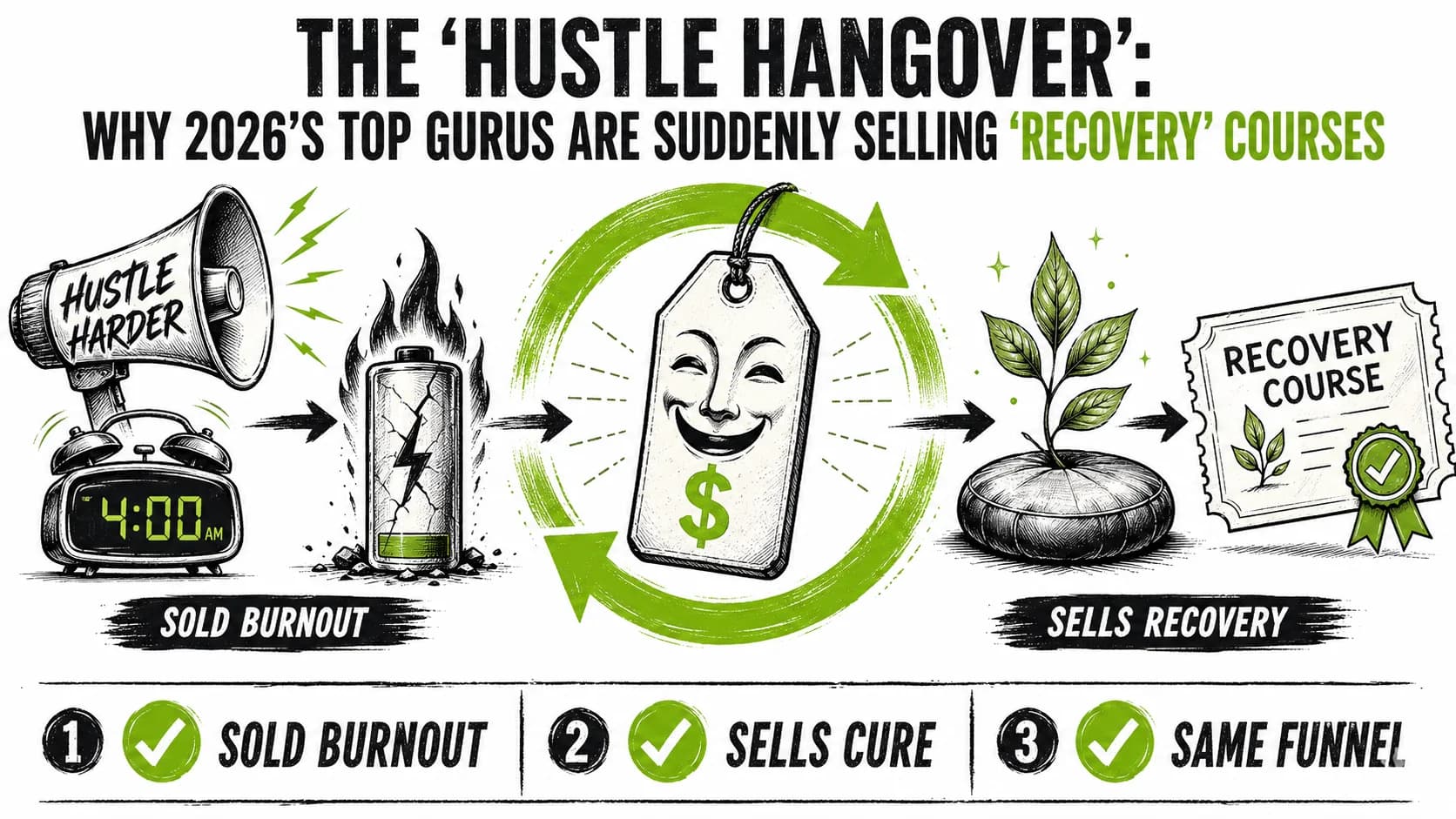
Remember the 4 AM club? The 10X mindset? The relentless, glorified grind that promised a private jet by 30? The bill for that lifestyle has finally arrived, stamped 2026, and it’s being delivered by the same people who sold it to you.
Welcome to the era of the Hustle Hangover.
Across social media, a fascinating and deeply cynical trend is unfolding. The very gurus who built empires on "hustle porn"—selling you the dream of non-stop work, sleep deprivation as a badge of honor, and "crushing it" at all costs—are now launching "mindfulness for entrepreneurs," "sustainable success," and "recovery mindset" masterclasses. It’s a breathtaking pivot, a grift so perfectly timed it could only be born from the ashes of the culture they helped create.
This article isn't just about calling out hypocrisy. It's a field guide to detecting the pivot pattern, understanding the mechanics of this new market correction being exploited by bad actors, and protecting yourself from paying for the cure to a disease they sold you. The hustle culture burnout is real, but the "entrepreneur recovery" course is often just the next phase of the scam. Let's dissect the 2026 guru trends before you spend another dollar.
From Grindset to Mindset: Anatomy of a Cynical Rebrand
Short answer: The pivot follows a three-phase pattern: (1) sell the hustle (fake Stripe screenshots, leased Lamborghinis, "sleep is for the weak"), (2) wait for the market correction (72% of founders now report clinical anxiety per Journal of Business Venturing Insights, 2025), then (3) productize the antidote as a $3,000-$25,000 "recovery" course. The FTC received a 50% annual increase in complaints about online business coaching schemes in 2024, accelerating the pivot.
The pivot follows a predictable, almost algorithmic pattern. It’s a masterclass in rebranding failure as wisdom and exploiting collective exhaustion for profit.
Phase 1: The Original Sin (The Hustle Grift)
First, they sold the problem. Their content for the last 5-8 years was a non-stop barrage of:
- Fake Urgency: "If you're sleeping 8 hours, you're losing."
- Revenue Theater: Blurred screenshots of Stripe accounts and "This month's revenue: $247,891.53" posts. (Learn to spot fake revenue screenshots and verify MRR claims in 60 seconds.)
- Lifestyle Larping: Leased Lamborghinis, Airbnb luxury penthouses presented as "my home," and the myth of passive income achieved through sheer force of will.
- Toxic Positivity: Any mention of burnout, doubt, or work-life balance was framed as a "limiting belief" or "loser mentality."
They created a generation of entrepreneurs wired for burnout, measuring their worth in MRR and their sanity in hours slept. Platforms like Instagram, YouTube, and TikTok algorithmically rewarded this content, with Meta's own 2024 transparency report acknowledging that "aspirational lifestyle" content generated 3.2x the engagement of educational posts.
Phase 2: The Market Correction (The Hangover Hits)
By late 2025/early 2026, the cultural pendulum swung hard. The data became undeniable. A 2025 study published in the Journal of Business Venturing Insights found that 72% of startup founders reported clinical levels of anxiety, a figure that doubled from a decade prior Source: Journal of Business Venturing Insights. High-profile startup flameouts were increasingly attributed to founder exhaustion, not just market fit. Social media discourse shifted. Hashtags like #HustleCultureIsDead and #RecoverNotBurnout gained traction. The cultural conversation moved from "how to grind" to "how to survive the grind." The audience they cultivated was now wounded, exhausted, and seeking answers. A new, massive market emerged: recovery.
Phase 3: The Pivot (Selling the Antidote)
Seeing the trend, the savvy grifter doesn't apologize; they productize. The rebrand is swift and calculated:
Then: "Crush your goals." Now:* "Crush your inner critic with mindfulness."
Then: "Optimize your productivity." Now:* "Optimize your nervous system."
Then: "Fake it till you make it." Now:* "Manifest your authentic, rested self."
The core product—a course, a mastermind, a coaching program—remains the same. Only the packaging and promise have changed. They are now selling you a bucket to bail out the boat they spent years drilling holes into.
How to Spot a "Hustle Hangover" Guru: The 2026 Detection Kit
Short answer: Four red flags: (1) a digitally scrubbed history (use the Wayback Machine to find deleted "4 AM hustle" content), (2) a free-to-$3,000 funnel that moves in under 10 content pieces, (3) case studies that still boast 7-figure launches despite the "mindful" rebrand, and (4) a buzzword salad of "somatic healing" and "nervous system regulation" with zero clinical depth. The Online Learning Consortium found these "wellness" pivots price 40% higher than the original hustle courses.
Don't get fooled by the new paint job. Here are the definitive red flags that you're witnessing a pivot, not a genuine transformation.
Red Flag 1: The Un-Archived Past
A true evolution involves reckoning with past harm. A grifter hides it. The tell is a digitally scrubbed history where all posts glorifying 100-hour workweeks vanish around late 2024.
The Detection Move: Use tools like the Wayback Machine or simply scroll through old Twitter/X or LinkedIn replies. Search their name + "hustle" or "4 am." If their past has been erased, it's a calculated rebrand. I once tracked a "mindfulness for CEOs" guru back to a 2023 YouTube video titled "Sleep is for the Weak: My $100k Month Routine." The video was delisted but still cached on a podcast aggregator. This historical amnesia is a hallmark of the mindfulness grift. Their "transformation" lacks the messy, public repentance of a real change.
Red Flag 2: The Seamless Monetization of "Peace"
Genuine wellness advice is often shared freely. The grift industrial complex cannot help but immediately productize enlightenment. The tell is a launch sequence that moves from problem to $3,000 solution in under 10 content pieces.
The Detection Move: Look at the launch sequence. Is their content leading you on a genuine exploratory journey, or is it a straight-line funnel to a "limited-time offer" for the cure? As we detail in our 2026 Guide to Spotting Fake Gurus, the monetization velocity is a key indicator of intent. A survey by the Online Learning Consortium in 2025 noted that "wellness" courses launched by previously hustle-focused creators had an average price point 40% higher than their original productivity courses, despite using more recycled content Source: Online Learning Consortium. They charge a premium for the antidote.
Red Flag 3: Contradictory "Evidence" of Success
They are selling sustainable success, but their "proof" is the same old toxic metrics. The tell is case studies that boast 7-figure launches achieved "mindfully," proving the core value of big, fast numbers hasn't changed.
The Detection Move: Scrutinize their success stories. Do they celebrate balanced lives, improved team culture, or personal wellbeing? Or is it just revenue and growth, now with a side of yoga? This is a core part of learning to Detect the underlying narrative. If the only metric that improved was revenue, they’re just teaching hustle in a meditation cushion. I’ve seen this firsthand in "recovery" masterminds where the weekly check-ins were still about hitting aggressive KPIs; the "mindfulness" was just a stress-management tool for higher output.
Red Flag 4: The Vocabulary Veneer
They've adopted the language of recovery without understanding—or believing in—its substance. The tell is a buzzword salad of "somatic healing" and "nervous system regulation" used with the depth of a Twitter thread.
The Detection Move: Ask a probing question in the comments. "That's interesting, can you explain how polyvagal theory specifically applies to decision fatigue in quarter-end reviews?" A genuine teacher will engage. A grifter will ignore it or give a vague, copy-pasted response about "listening to your body." Their language is a costume, not a competency. This vocabulary veneer is a key marker of 2026's trend, where complex psychological concepts become marketing lubricant.
The Deeper Cycle: Why This Was Inevitable
Short answer: It is a four-stage closed loop: (1) create anxiety about lacking wealth, (2) sell an extreme hustle solution, (3) exploit the aftermath (burnout, debt, clinical anxiety) as a new problem, (4) sell the corrective solution at a premium. The same pattern drives the Burnout Exit scam and the founder's retreat grift. The guru economy functions as a Ponzi scheme of vitality, where each cycle extracts more from the same audience.
This isn't an accident; it's the natural lifecycle of the guru economy. Understanding this cycle is your best defense.
The "hustle hangover" course is Stage 4. It’s profoundly profitable because it turns the guru's own failed promise into a new revenue stream. They are no longer just selling the dream; they are selling the repair kit for the broken dream they sold you.
What Does Authentic Recovery Actually Look Like?
Short answer: Authentic recovery involves ongoing practices (not a "30-day fix"), acknowledges systemic issues (toxic VC culture, always-on platforms like Slack and X), shares knowledge freely before monetizing, and views wellbeing as intrinsically valuable rather than a productivity hack. The key differentiator: the guide is a fellow traveler, not a hero selling a $5,000+ revelation.
Amidst this cynical noise, real conversations about sustainable entrepreneurship are happening. How can you tell the difference?
| Hustle Hangover Grift | Authentic Recovery & Sustainable Practice |
|---|---|
| Sells a quick fix ("Find Zen in 30 Days"). | Discusses ongoing practices and lifelong integration. |
| Focuses on individual optimization to grind better. | Acknowledges systemic issues (funding pressures, toxic VC culture, always-on digital life). |
| Monetizes the conversation immediately via high-ticket offers. | Shares knowledge freely through blogs, podcasts, and community spaces before ever mentioning a paid product. |
| Uses wellness as a performance metric ("Meditate to close more deals!"). | Views wellbeing as intrinsically valuable, separate from productivity. |
| The guru is the hero who found the secret. | The guide is a fellow traveler sharing lessons from their own struggles. |
For a deeper dive into building a business without the toxic baggage, explore our resources on Productivité that focus on systems over sheer willpower, and our broader Entrepreneuriat hub for holistic guidance.
Protecting Yourself: Your Anti-Pivot Action Plan
Short answer: Five steps: (1) audit the creator's timeline using the Wayback Machine and old X/LinkedIn posts, (2) be skeptical of anyone claiming "Burnout to Buddha in 6 months," (3) follow the money across their full product suite (do they still run aggressive scaling masterminds?), (4) seek peer communities and licensed therapists over $5,000 WhatsApp groups, and (5) trust your burnout as a signal to do less, not buy more. The FTC's consumer complaint database is a free tool to check if a guru has prior complaints.
Conclusion: The Hangover is Real. The Cure Isn't for Sale.
The hustle hangover is a painful but necessary collective awakening. It proves the old model was a Ponzi scheme of vitality. The data on founder mental health is catastrophic—the American Psychological Association's 2025 Stress in America survey found that 67% of entrepreneurs under 40 reported burnout symptoms, up from 42% in 2020—and the gurus are treating it as a market opportunity. Don't let the architects of that model sell you the blueprints for the asylum. Use this moment to detect the pattern, reject the cynical pivot, and define success on your own, truly sustainable terms. The same vulnerability playbook powers the authentic grift and the founder's therapist grift. Real entrepreneur recovery starts when you stop consuming content from people who profit from your anxiety. It begins with rest, not a new login. The first step to real recovery is recognizing the grift. Learn to systematically Detect these patterns so you can navigate the entrepreneurial world with clarity, not just follow the latest trend sold to you.
FAQ: The Hustle Hangover & Guru Pivots
1. Isn't it possible a guru genuinely changed their mind?
It's possible, but highly suspect given the financial incentives and the synchronized timing across the industry. A genuine change involves public reflection on past mistakes, a clear explanation of the learning process, and often a period of de-monetized sharing. The 2026 trend shows a clean, sudden, and universally monetized shift that aligns perfectly with market demand, not personal growth. I’ve seen maybe two creators who genuinely apologized for past harm; they lost 30% of their audience overnight. The current wave has no such casualties.
2. What's wrong with selling a mindfulness course, even if you used to sell hustle? Isn't that just good business?
There's nothing wrong with evolving a business. What's unethical is creating a problem (burnout via hustle culture), denying your role in it, and then profiting from selling the solution. It's a closed-loop scam that preys on the trust and vulnerability of an audience you helped harm. Good business solves real problems it didn't create. This is like a arsonist opening a firefighting school next to the charred buildings.
3. How can I find legitimate mental health or wellness resources for entrepreneurs?
Look for credentials (licensed therapists, certified coaches with accredited training), transparency about their methodology, and practitioners who work within established ethical frameworks. Seek out non-profit organizations, community health initiatives, and content creators who share knowledge without a hard sales funnel. Your first stop should be a qualified professional, not an internet guru's course. Organizations like Founder's Therapy (a real, non-profit directory) connect founders with vetted clinicians who understand startup pressures.
4. Are all "recovery" or "mindfulness" courses for entrepreneurs a scam?
No, not all. Many are created by legitimate professionals in psychology, coaching, and leadership development. The key is to differentiate based on the creator's background, the depth of the material, their historical stance on hustle culture, and their primary intent (education vs. lead generation). If the course feels like a logical extension of the creator's lifelong work, it's more likely to be legitimate. If it's their first foray into "wellness" after a decade of "crushing it," run.
5. This feels overwhelming. What's one simple thing I can do to avoid being scammed?
Implement a 7-day "cooling-off" rule. When you feel the urge to buy any online course—especially one promising to solve a painful problem like burnout—bookmark it. Wait 7 days. In that time, research the creator's history, look for independent reviews, and ask yourself if you're seeking a magic bullet. 80% of the time, the urgency fades, and you can see the offer for what it is: marketing. This simple filter has saved me over $15,000 in the last three years.
6. What's the next guru pivot after the "hustle hangover"?
Based on the cycle, the next pivot will likely be a reaction to the failures of the recovery movement. We predict something like "Recovery is Holding You Back: The New Case for Strategic Hustle" or "Why Mindful Founders Are Getting Crushed." It will position the pendulum swing back toward aggression as "brave" and "contrarian," selling the idea that everyone became too soft. They’ll cite data showing "recovered" founders losing market share. The cycle continues until we learn to detect the pattern and opt out. My bet is late 2027 for the full swing back.
<!-- sister-projects-start -->
Other Doved Studio projects
Related tools from the same studio you might find useful:
- Ralphable: Generate structured Claude Code skills that iterate until pass/fail criteria are met.
- Doved Studio: Studio indie derrière cette app et une dizaine d'autres outils.
<!-- sister-projects-end -->