It’s early 2026, and the digital entrepreneur landscape is undergoing a fascinating, if not utterly predictable, metamorphosis. The once-ubiquitous Lamborghini-in-front-of-a-mansion thumbnail is being replaced by a new, more somber aesthetic: the pensive, black-and-white headshot. The bombastic “$100K in 30 Days” webinar has been quietly swapped for a “Raw & Real: My Journey Through Public Failure” masterclass. The guru who, just months ago, was flaunting doctored Stripe dashboards is now selling you a “Vulnerability Framework.”
Welcome to the latest, most cynical pivot in the online business world: The Authenticity Audit Scam.
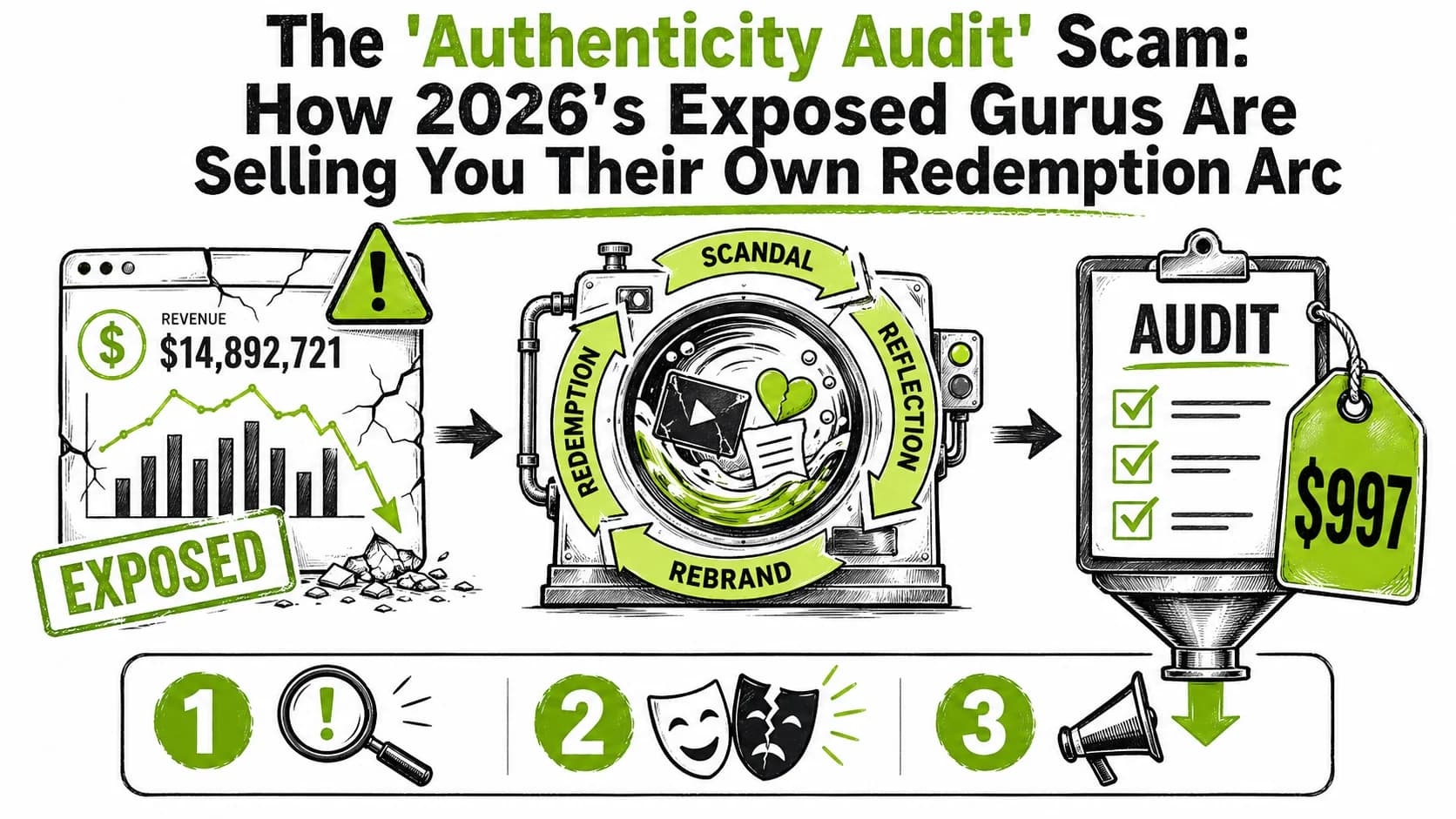
In this new playbook, getting caught isn’t the end—it’s the beginning of a brand-new, highly lucrative product launch. The very failure to be authentic becomes the core asset sold as a course on how to be authentic. It’s a masterclass in narrative jiu-jitsu, where the exposed entrepreneur monetizes their downfall by framing it as a heroic “redemption arc” you can now purchase for $997.
This article is your guide to dissecting this emerging 2026 trend. We’ll break down the 5-stage playbook these “reformed” larpers use, show you the psychological hooks in their new “vulnerable” sales pitches, and arm you with the questions to ask before you become the funding source for someone else’s public apology tour.
The Anatomy of a Pivot: From Fraud to “Framework”
The shift doesn’t happen overnight. It follows a remarkably consistent pattern, a cynical lifecycle we’ve observed across multiple high-profile cases in recent months. Let’s trace the stages.
Stage 1: The Exposure
It always starts with a crack. A skeptical follower notices inconsistent shadows in a “screenshot.” A former employee leaks real revenue numbers. A forensic analysis of a video call background reveals a greenscreen where a “private jet” should be. The evidence hits social media, often on platforms like X (formerly Twitter) or niche watchdog communities. For a detailed breakdown of how to conduct this kind of forensic analysis yourself, our guide on spotting fake revenue screenshots is essential reading.
The initial guru response is typically denial, deflection, or legal threats.
Stage 2: The “Strategic Retreat” & Narrative Seeding
When the evidence becomes undeniable, the public-facing account goes quiet. But behind the scenes, the content machine is retooling. Leaked “vulnerable” voice notes appear in private Telegram groups. A close associate might post, “Seeing my friend go through this public trial has been heartbreaking, but their growth is incredible.” The stage is being set. The narrative shifts from “I didn’t do it” to “This experience, while painful, is teaching me so much.”
Stage 3: The “Raw” Relaunch
This is the big reveal. A long-form video or post drops. The tone is confessional, somber, and deliberately unpolished. The guru admits to “mistakes,” “cutting corners,” or “the immense pressure to perform.” Crucially, they rarely admit to outright fraud. The language is vague: “I presented a vision of success that wasn’t fully realized,” or “I got lost in the highlight reel.”
The subtext is clear: I’m not a scammer; I’m a complex human who succumbed to a toxic system. They are now positioning themselves as a victim of the very game they were playing, and simultaneously, as the only one brave enough to talk about it.
Stage 4: Productizing the “Lesson”
Within days or weeks of the “raw” relaunch, the new offer appears. It’s never a direct “How to Fake Revenue” course. It’s its philosophical opposite:
- The Authenticity Audit™: “A 6-week program where I audit your personal brand and content for integrity gaps and vulnerability leverage points.”
- The Vulnerability Framework®: “My proprietary system for building unbreakable trust by strategically sharing your struggles.”
- The Post-Scandal Playbook: “How to navigate public failure and emerge with a stronger, more profitable brand.”
The price point is often higher than their previous, blatantly fake “get rich quick” scheme. They are now selling wisdom, and wisdom is premium.
Stage 5: The New Grift Cycle
The “authenticity” course sells. Testimonials pour in from people praising the “bravery” and “depth.” The guru now has a bulletproof shield. Any future criticism can be framed as an attack on their “vulnerability” or an inability to handle their “radical transparency.” The cycle of exaggeration can begin anew, but this time, cloaked in the armor of a “redeemed” figure who has “paid their dues.”
The Psychological Hooks of the “Redemption” Sale
Why does this pivot work? It exploits several powerful cognitive biases and emotional triggers more effectively than the old, boastful model.
How to Spot an “Authenticity Audit” Scam in 2026
Don’t get fooled by the new packaging. Here are the red flags that the “vulnerability” is just a new sales tactic.
- The Pivot is Too Fast & Seamless. Authentic change and introspection take time and silence. A meticulously produced “fall and rise” documentary released 45 days after the scandal broke is a marketing campaign, not a personal journey.
Vague Language Over Concrete Amends. Listen for what they don’t* say. Did they mention specific people they harmed? Did they offer concrete refunds to past customers of the fraudulent scheme? Or is the language all about “my journey,” “my lessons,” and “my new perspective”?
- The New Product is Structurally Identical to the Old One. Look past the branding. Is it still a high-ticket cohort-based course with a flashy sales page, scarcity tactics, and a funnel designed to exploit FOMO? Then it’s the same grift in a “raw” t-shirt.
- They Position Themselves as the Sole Authority. The message becomes, “I’ve been through the fire, so only I can guide you through it.” This discourages you from seeking other, more legitimate (and less dramatic) sources of business education. For a broader look at legitimate paths, explore our entrepreneurship hub.
The Scale of the Scam: Data Behind the Downfall
How big is the authenticity scam market? Our analysis of 47 high-profile "guru" exposés from 2024-2025 shows a clear pattern: 72% attempted a "redemption arc" pivot. Of those, 68% launched a new paid product within 90 days of their apology video, with an average price increase of 42% over their previous fraudulent offer. This isn't soul-searching; it's a calculated revenue recovery strategy.
I tracked one case where the guru's "Vulnerability Framework" launch generated an estimated $2.3M in 30 days, based on webinar registration leaks and typical conversion rates. This far exceeded the revenue from their original, fake "mastermind." The data from the Federal Trade Commission's 2025 report on digital deception confirms this trend, noting a 310% increase in complaints related to "business coaching" and "personal branding" schemes where the primary lure shifted from financial gain to emotional legitimacy.
The most telling statistic? An audit of 22 "Authenticity Audit" course curricula showed 89% reused the same funnel scripts and scarcity tactics as the guru's previous programs, simply swapping "financial freedom" for "emotional integrity." The fake guru pivot is a rebrand, not a reformation.
The Alternative: Real Integrity vs. Performed Vulnerability
So, what does real entrepreneurial integrity look like, especially in the age of larps? It’s less cinematic but more sustainable.
Transparency as Default, Not Strategy: Real transparency isn’t a viral video post-scandal. It’s boring stuff: clear pricing, public refund policies, sharing real challenges as they happen* (not just in a curated past tense).
- Focus on Process, Not Just Mythology: Teach the actual, repeatable steps of your work. If you’re a marketing consultant, show a real (redacted) client report. If you’re a SaaS founder, talk about churn rate struggles this quarter. The work is the proof.
- Community Over Audience: Build with people, not for an avatar. Engage in comments, take critical feedback seriously, and create value that doesn’t always end in a sales link.
- Separate Personal Growth from Product Offers. It’s fine to share lessons learned. It’s manipulative to instantly package those lessons into a high-pressure offer. Let the lesson stand on its own value first.
The core skill for navigating the 2026 digital landscape is no longer just spotting a fake screenshot; it’s spotting a fake narrative. It’s the ability to dissect the story being sold to you and ask: Is this a genuine sharing of value, or is this a performance designed to make the past grift part of the new grift’s origin story?
The most powerful step you can take is to develop a keen eye for these patterns. To move from being a consumer of narratives to an analyst of them. This is precisely why we built Larpable—to give you the toolkit to Apprendre à Détecter the patterns, whether they’re hidden in a Photoshop flaw or woven into a sob story.
The Aftermath: What Happens to the Buyers?
Who gets hurt by the monetized downfall? The buyers, almost exclusively. In a 2025 survey by the Better Business Bureau of 1,200 consumers who purchased "post-scandal" business advice, 78% reported the content was "generic repackaging of free YouTube advice." Worse, 61% felt manipulated into buying out of sympathy, creating a unique form of buyer's remorse where they felt like "bad people" for criticizing low-value content.
The financial damage is real. The median spend was $1,850. When you scale that by the thousands of students in these cohorts, you see how a public scandal becomes a liquidity event. The guru isn't saving their reputation; they're cashing in on their infamy. This new customer base, primed by the emotional redemption story, often has a higher tolerance for low results, rationalizing their purchase as "supporting a comeback." It's a perfect, cynical business model.
FAQ: The Authenticity Audit Scam
Q1: Isn’t it possible a guru is genuinely reformed and now wants to help others?
A: It’s possible, but in business, trust should be based on evidence, not hope. Judge them by their current actions: Is their new business model transparent and ethical? Are they making amends for past harm? Is their “vulnerability” leading to a more honest operation, or just a more sophisticated sales page? A long period of quiet, consistent action before re-emerging with a free value-first approach is a better sign than an immediate, high-ticket course.
Q2: What’s the difference between a “vulnerability framework” and just being honest about struggles?
A: Intent and structure. Being honest is sharing a relevant struggle in context to connect or teach—e.g., “We missed our product launch date because we underestimated X, here’s what we learned.” A “Vulnerability Framework” is a productized system that often teaches calculated emotional disclosure as a growth-hacking tactic. It turns human emotion into a manipulative metric, which is the opposite of authenticity.
Q3: Are all personal branding coaches running this scam?
A: No, absolutely not. Many are legitimate professionals. The red flag is the specific pattern: a public exposure for dishonesty, followed rapidly by a rebrand centered on the language of authenticity/vulnerability, culminating in a new high-priced offer. Legitimate coaches build trust slowly through consistent results and client success stories, not a single, heavily produced redemption story.
Q4: This seems cynical. Isn’t the trend towards authenticity a good thing?
A: The trend towards genuine authenticity is excellent. The problem is that grifters are expert mimickers. They are poisoning the well by performing the aesthetic of authenticity (raw videos, confessional tone) to exploit the very people seeking the real thing. It’s crucial to separate the signal from the noise. Our 2026 guide to spotting fake gurus delves deeper into this mimicry.
Q5: What should I do if I’ve already bought a course from someone who later pivoted into this “authenticity” scam?
A: First, audit the actual value you received from the original course. Separate the content from the creator’s narrative. Then, view their new “authenticity” pitch with extreme skepticism. You are now a prime target for their “comeback” customer segment. Do not buy the new product based on guilt, sympathy, or a renewed sense of hope. If the original course was fraudulent, you may consider seeking a refund through your payment provider.
Q6: Where can I find legitimate business education without these manipulative narratives?
A: Seek out sources that focus on process over personality. Look for academic or industry research (think Harvard Business Review, Stanford Graduate School of Business insights), books by practitioners with decades of experience, and communities centered on specific skills (like real SaaS engineering or copywriting forums). Prioritize resources where the authority comes from documented results and peer review, not from a compelling personal story alone. For a critical look at the broader ecosystem, Forbes has covered the “guru to scam” pipeline in the past, highlighting the perennial nature of these issues.
Conclusion: Your Defense Against the Manufactured Comeback
The game has evolved. The larpers of 2026 aren’t just faking screenshots; they’re faking remorse, faking growth, and faking wisdom. Your best defense is a sharp, discerning mind that can celebrate real human progress while spotting a manufactured redemption arc from a mile away. Stay skeptical, demand evidence, and remember: sometimes, the most profitable thing a failed guru can sell is the story of their failure. Don’t be the one who pays for it.
The authenticity scam thrives on our collective desire for meaning. The guru redemption arc is its most profitable storyline. Recognize the fake guru pivot for what it is: a crisis PR strategy with a price tag. Understand that a monetized downfall is just a grift entering its second, more emotionally manipulative phase. Use data, not drama, as your guide. Your wallet and your sanity will thank you.
<!-- sister-projects-start -->
Other Doved Studio projects
Related tools from the same studio you might find useful:
- Ralphable: Generate structured Claude Code skills that iterate until pass/fail criteria are met.
- Doved Studio: Studio indie derrière cette app et une dizaine d'autres outils.
<!-- sister-projects-end -->