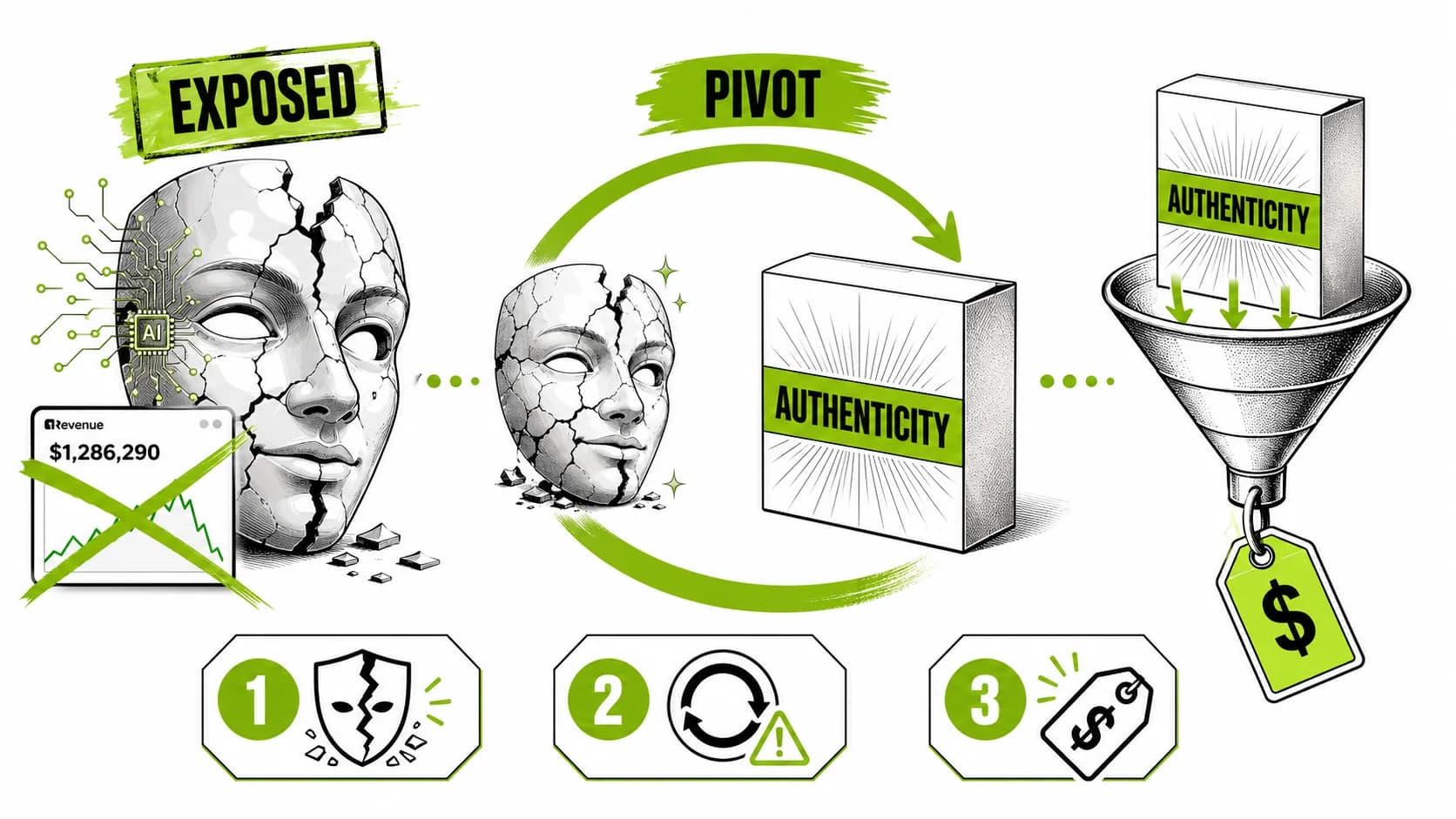
If you’ve scrolled through LinkedIn or X (formerly Twitter) in the last six months, you’ve witnessed a curious mass extinction event. The sleek, AI-generated avatars promising "$50k/month with one prompt" have vanished. The endless carousels of impossible revenue screenshots have gone quiet. The "7-Figure Agency in 90 Days" playbooks have been archived.
In their place, a new, more somber archetype has emerged. Meet the "Post-Scam Founder."
These are the same faces, but the tone has shifted from aggressive conquest to reflective wisdom. The Lamborghini keys have been replaced by a well-worn journal. The private jet backdrop is now a humble home office. The caption no longer screams "GRIND"; it whispers, "I lost it all... and here’s what I learned."
Welcome to the Authenticity Pivot—the most sophisticated, emotionally manipulative, and profitable rebrand in the history of online grift. Having been exposed for fake teams, fabricated results, and predatory courses, the gurus of 2025 didn't slink away in shame. They executed a coordinated, boardroom-level strategy to monetize their own deceptions. They are now selling their greatest liability—their exposed lies—as their core asset: vulnerability as a product.
This article is your field guide to this new playbook. We’ll dissect the five-stage "Vulnerability Grift" cycle, teach you the linguistic red flags, and show you how to spot when a "powerful comeback story" is just Phase 2 of the scam. Because in 2026, the most dangerous guru isn't the one selling you a dream; it's the one selling you their nightmare.
The Great Unmasking: Why the Pivot Was Inevitable
To understand the pivot, you must first understand the pressure that caused it. The "AI Agency" gold rush of 2023-2025 created a perfect storm for larping (Live Action Role-Playing). Low barriers to entry (a ChatGPT subscription and a Canva account), combined with a market hungry for AI solutions, allowed anyone to posture as a mogul.
The playbook was simple:
For a detailed breakdown of this specific deception, see our guide: The 2026 Guide to Spotting Fake Revenue Screenshots.
This house of cards was bound to collapse. Investigative threads on X, led by skeptical technologists and burned former "students," began connecting the dots. They found:
- Ghost Teams: "Agencies" with 20+ "employees" that were just aliases managed by one person.
- Fake Clients: Case study companies that didn't exist or had never heard of the guru.
- Stolen Content: "Original" frameworks that were verbatim copies from older, legitimate business books.
The exposure wasn't a slow leak; it was a dam break. Public trust, the currency of all gurus, evaporated overnight. The old product—"my fake success"—was now worthless. They needed a new one. And they found it in the wreckage itself.
The 5-Stage "Vulnerability Grift" Playbook
The Authenticity Pivot is not an organic, heartfelt journey. It is a calculated, five-stage marketing campaign. Recognizing these stages is your first line of defense.
Stage 1: The Strategic Disappearance (The "Dark Night of the Soul" Launch)
The first move is always to vanish. Not in a "caught fleeing the country" way, but in a deliberate, dramatic pause.
- The Action: All promotional posts stop. The LinkedIn profile might go quiet for 4-6 weeks. The podcast goes on "hiatus."
- The Narrative: This is framed as a voluntary, profound retreat. In reality, it's a crisis management holding pattern. The guru's team is inside, strategizing the comeback narrative, scrubbing the most damning evidence, and preparing the new "raw" content.
Stage 2: The Controlled Leak (Seeding the "Truth")
You can't pivot to authenticity if no one knows you were inauthentic. So, they must confess—but on their own terms.
- The Action: A long-form post, video, or podcast episode drops. The title is always some variation of: "I Lied To You," "The Cost of My Ego," or "What I Built Was a Facade."
The Tell: The confession is always about past actions, framed as a singular* mistake they've now overcome. It never acknowledges an ongoing pattern of deception or the systemic harm to customers. The goal is to appear brave for confessing, not accountable for the damage.
Stage 3: The Alchemist's Rebrand (Turning Shame into Currency)
This is the core of the pivot. The exposed lie is not a liability; it's the unique selling proposition (USP) for the new product.
- The Action: Launch of new branding. The "AI Agency King" becomes the "Vulnerable Founder." Social bios change to "Helping leaders build with integrity | Recovering perfectionist." The color palette shifts from aggressive neon to muted earth tones.
- The New Product Suite:
* "Radical Transparency" Course: Teaching how to build a "flawed and profitable" business. The irony of selling a course on transparency after being exposed for opacity is apparently lost.
* "Raw Founder" Podcast: Interviews with other "reformed" gurus, creating a mutual-aid society of rebranded grifters.
The Tell: The core transactional model does not change*. It's still "Pay me for my secret knowledge." The only thing that changed was the nature of the "secret"—from "how I succeeded" to "how I failed."
Stage 4: The Linguistic Weaponization (The New Guru Lexicon)
The language of the grift evolves. Out are the words "scale," "leverage," and "dominate." In are the new buzzwords of manufactured authenticity.
| Old Guru Speak (2025) | New "Authentic" Guru Speak (2026) | What It Actually Means |
|---|---|---|
| "I closed $500K in 30 days." | "My relationship with money was broken." | I spent the money I scammed from you poorly. |
| "My team of 25 rockstars." | "The loneliness of leadership almost broke me." | I had no team; it was just me and my guilt. |
| "Here's my exact blueprint." | "I'm still figuring it out, and that's okay." | I have no system, but I'll charge you to watch me try. |
| "DM me 'PROOF' for my case study." | "My DMs are open for anyone struggling." | My DMs are open for qualified leads for my new mastermind. |
Stage 5: The Gatekeeping of Pain (Creating Scarcity)
Finally, they must establish that their new "authentic" wisdom is even more valuable than their old fake success wisdom.
The Action: They begin to speak in vague, quasi-therapeutic terms about "shadow work," "integration," and "post-traumatic growth." They position their specific experience of being exposed as a unique form of enlightenment that only they* can translate for you.
- The Narrative: "You can't understand true branding until you've had your brand torn down." They create a hierarchy of suffering where their public humiliation is the highest credential.
- The Tell: They actively dismiss "unproven" newcomers. "Don't listen to that hotshot with the Lambo; he hasn't paid the price I have." This frames their past fraud not as a disqualifier, but as the ultimate qualifier. It's a brilliant rhetorical trap.
How to Spot a "Vulnerability Grift" in the Wild: Your 2026 Detection Kit
Knowledge of the playbook is useless without application. Here are actionable checks to perform the next time you encounter a "powerful comeback story."
1. The Timeline Test:
- Ask: How long passed between the exposure and the rebirth? A genuine period of reflection and restitution takes years, not weeks.
- Red Flag: A 60-day "dark night of the soul" that culminates in a meticulously produced documentary-style comeback video and a new course landing page.
2. The Restitution Audit:
- Ask: What did they do to make it right with the people they harmed? Did they offer refunds? Did they publicly apologize to specific individuals they defrauded?
3. The Product Paradox:
- Ask: Is their new solution fundamentally different from their old one, or just re-skinned?
- Red Flag: They've swapped "Fake It Till You Make It: The Course" for "The Authenticity Advantage: The Course." The structure (video modules, community Discord, weekly Q&A) is identical. Only the PowerPoint template changed.
4. The Language Decoder:
- Listen for the buzzwords from Stage 4. When you hear "sacred space," "unfiltered journey," or "beautiful mess" used to describe a business coaching program, your scam detector should ping. Authentic people don't describe their lives in branded marketing slogans.
5. The Peer Review:
- Check: Who is celebrating their comeback? Is it a circle of other recently-exposed gurus doing the same pivot? This is a classic "circle jerk of credibility," where discredited figures vouch for each other's new, "deeper" credibility.
- Green Flag: Acknowledgement from legitimate, long-respected figures in the space who have no product to sell alongside them. This is rare.
For a broader framework on evaluating any entrepreneurial figure, integrate these checks with our comprehensive 2026 Guide to Spotting Fake Gurus.
Why This Grift Is So Effective (The Psychology of the "Wounded Healer")
This pivot works because it exploits a profound human vulnerability: our empathy and our own insecurity.
A study on influencer marketing and perceived authenticity, like those published in the Journal of Interactive Marketing, often finds that perceived vulnerability increases trust. The grifters have simply read the same literature and are now manufacturing the vulnerability to trigger that trust algorithmically.
The Antidote: Cultivating Real Skepticism in the Age of Manufactured Authenticity
So how do you protect yourself? The answer isn't cynicism—it's informed skepticism. Here’s how to practice it:
Separate Story from Substance: It is possible for someone to have a real, transformative failure and have genuinely useful insights. The key is to evaluate the substance of their current work independently of the story of their past*. Does their new advice stand on its own? Is it actionable, testable, and devoid of mystical jargon? If the story is the primary product, walk away.
- Value Consistency Over Epiphanies: Real change is slow and granular. Be wary of people whose entire worldview and business model undergo a total, photogenic transformation overnight. Authentic growth is a messy, non-linear process you rarely see on social media.
The core mission of Larpable is to equip you with this very toolkit—to see past the narrative and examine the machinery. Whether you want to Learn to Detect these patterns to protect yourself and your network, or to understand the mechanics for satire or analysis, the principle is the same: look for the playbook behind the performance.
Conclusion: The Grift That Never Ends
The "Authenticity Pivot" reveals the ultimate truth about the fake entrepreneur industry: it is not in the business of success or failure. It is in the business of selling narratives about success and failure.
The product was never the AI agency blueprint. The product was the fantasy of easy wealth. Now, the product is no longer the fantasy of easy wealth; it's the fantasy of easy redemption. It's the promise that even your most shameful, deceptive failures can be packaged, polished, and sold for a premium.
The cycle will continue. When the "Vulnerability Grift" becomes saturated and exposed (as it inevitably will), the smartest grifters will pivot again. Perhaps to "Quiet Leadership" or "Anti-Hustle Minimalism." The labels will change, but the engine—the exploitation of hope, fear, and insecurity for financial gain—remains the same.
Your power lies in recognizing the engine, no matter what body kit it's wearing. See the pattern, decode the language, audit the actions, and always, always follow the money. In 2026 and beyond, that is how you spot the larper—even when they're larping as a saint.
FAQ: The Authenticity Pivot Unpacked
1. Isn't it possible for someone to genuinely learn from failure and teach valuable lessons?
Absolutely. The issue isn't with failure or redemption stories themselves. The issue is with the pattern, timing, and commercial packaging. A genuine transformation involves sustained change, often away from the spotlight, and a focus on making amends. The "Vulnerability Grift" is characterized by a rapid, strategic rebrand that immediately monetizes the failure story with the same high-pressure sales tactics as the original scam. It treats the failure as a marketing hook, not a personal reckoning.
2. What's the difference between a "vulnerability grift" and legitimate content about entrepreneurial mental health?
Intent and framing. Legitimate mental health or burnout content focuses on shared human experience, offers general coping strategies, and points to professional resources. It rarely positions the creator's specific personal failure as a unique credential to sell a business solution. The grift always ties the vulnerability directly to a new, expensive product that promises business results ("Build a resilient business by healing your trauma").
3. I was scammed by one of these gurus in their "AI agency" phase. Now they're back with this new authentic brand. Should I call them out?
This is a personal decision with pros and cons.
- Pros: It can warn others, provide catharsis, and challenge their new narrative.
- Cons: It can draw you into draining public conflict and be framed by them as "harassment from my past."
4. Are all "post-failure" coaches scammers?
No. There are credible executive coaches and business advisors who have experienced very public business failures (e.g., a failed startup covered in TechCrunch) and now advise others. The key differentiators are:
- Transparency: The facts of their failure are a matter of public record, not a curated confession.
- Time: Significant time has passed between the failure and their advisory role.
- Focus: Their advice is based on general business acumen and strategy, not primarily on psychoanalyzing their own past fraud.
- Restitution: They likely fulfilled their legal and financial obligations from their failure.
5. This all feels exhausting. How can I find actually trustworthy business advice?
This is the core question. Shift your focus:
From Personalities to Principles: Seek out timeless business principles (from books like The Lean Startup, Traction*, etc.) rather than the "latest method" from a trending personality.
- From Online Gurus to Local Networks: Engage with local incubators, industry associations, or peer advisory groups (like EO or YPO for qualified entrepreneurs).
- From "Secrets" to Systems: Trust advice that is systematic, repeatable, and focused on fundamentals (product, market fit, customer service) over "secret hacks" or mindset magic.
- Use Tools for Detection: Platforms like Larpable exist to help you Learn to Detect these patterns, so you can spend less time vetting gurus and more time building your business.
6. What's the next pivot after "authenticity" gets played out?
Prediction is tricky, but based on historical cycles, the next wave will likely position itself as the antidote to the current wave. If "authenticity" becomes associated with oversharing and emotional manipulation, the next grift will be about "sovereignty," "silent competence," or "data-driven, emotionless building." It will mock the "therapy-speak" of the vulnerability gurus while selling an equally hollow, hyper-rational fantasy. The core advice for detection will remain the same: be wary of any narrative that is too clean, too perfectly opposed to the last trend, and too quickly monetizable. For ongoing analysis of these patterns, explore our Entrepreneurship Hub.
<!-- sister-projects-start -->
Other Doved Studio projects
Related tools from the same studio you might find useful:
- Ralphable: Generate structured Claude Code skills that iterate until pass/fail criteria are met.
- Doved Studio: Studio indie derrière cette app et une dizaine d'autres outils.
<!-- sister-projects-end -->