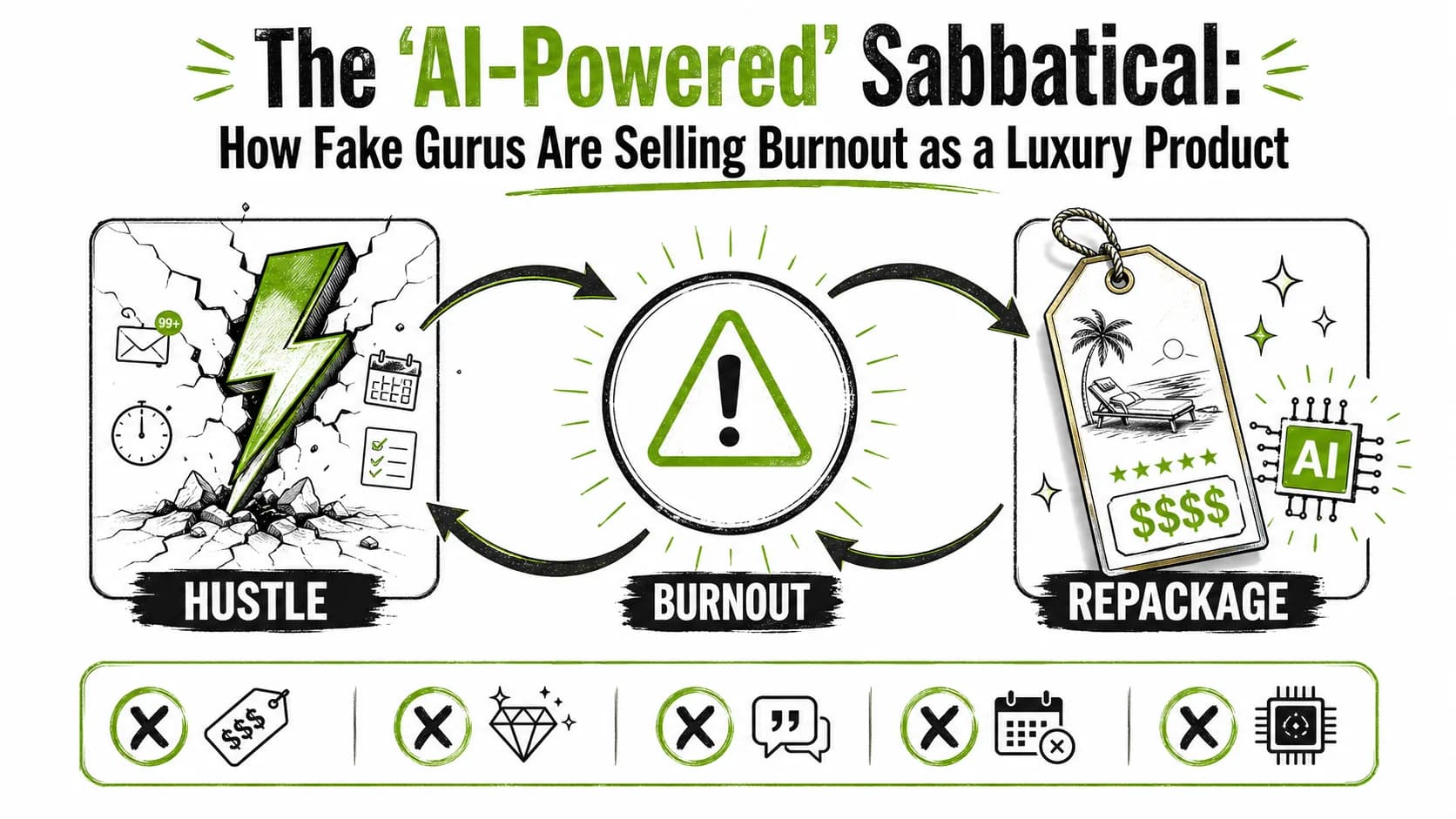
If you’ve spent any time on entrepreneurial social media in early 2026, you’ve seen the pivot. The same faces that were once screaming “GRIND OR DIE” and “SLEEP IS FOR THE WEAK” from their rented Lamborghinis are now posting serene, sun-drenched photos from a Balinese villa. Their captions have morphed from revenue screenshots to profound quotes about “listening to your body” and “the power of strategic stillness.”
Welcome to the latest, most cynical grift in the guru ecosystem: The AI-Powered Sabbatical.
After a decade of glorifying unsustainable hustle, the consequences are in. A generation of founders and freelancers is burnt out, anxious, and disillusioned. The public critique of toxic productivity culture has reached a fever pitch. So, what’s a grifter to do when the product they’ve been selling (relentless hustle) is now widely recognized as poison?
Simple. You start selling the antidote. At a 5000% markup.
This article dissects how exposed “hustle gurus” are rebranding burnout—a direct consequence of their own dogma—as an exclusive, AI-curated “biohacking” experience. We’ll expose the playbook, show you how to spot the scam, and explain why this isn’t wellness; it’s a luxury product built on the wreckage they helped create.
From Grind to “Grounding”: The 2026 Guru Pivot Explained
The narrative shift is almost comical in its predictability. Let’s trace the arc of a typical fake guru, whom we’ll call “Brad.”
- 2019-2023: The Grindset Apostle. Brad built his brand on 4 AM wake-up calls, cold plunge TikToks, and courses on “How I Made $50K in 30 Days Dropshipping.” His content was a barrage of manufactured urgency and fake revenue screenshots.
- 2024: The Cracks Appear. Followers start asking where the real results are. Critics point out his “course” is just a repackaged PDF. The “lifestyle” is clearly rented. The market gets wise. (This is where learning to detect fake gurus becomes crucial).
- 2025: The “Vulnerability” Play. Facing exposure, Brad pivots to “raw, authentic” content. A tearful video about “the loneliness at the top.” Posts about his “mental health journey.” It’s damage control framed as leadership.
- 2026: The Sabbatical Savior. Now, Brad announces he’s “stepping back.” But not before he launches his magnum opus: “The Neuro-Sync AI Sabbatical: A 12-Week Protocol to Reverse Entrepreneurial Burnout and 10X Your Creative Output.” Price: $12,000. Location: “A private villa in Costa Rica.”
He’s not quitting; he’s monetizing the backlash. The very burnout his previous teachings likely exacerbated is now his hottest new product.
The Core Contradiction: Selling Rest as a Performance Hack
This is the grift’s darkly brilliant core. They can’t just sell “rest.” That’s free. That’s unproductive. Their audience, trained on a diet of optimization and ROI, wouldn’t buy it.
So, they must commodify and optimize rest itself. Enter the buzzword salad: AI-powered, data-driven, bio-hacked, neuro-synchronized, strategic disconnection.
It’s not a break; it’s an “output optimization protocol.” It’s not sleeping in; it’s “circadian rhythm recalibration.” It’s not lying on a beach; it’s “somatic grounding in a geo-biologically aligned environment.” They’ve taken a human need and turned it into a complex, exclusive, high-ticket performance tool.
Deconstructing the “AI-Powered Sabbatical” Sales Pitch
Let’s break down the marketing language you’ll see in their launches and see what it actually means.
| They Say (The Sizzle) | It Means (The Truth) |
|---|---|
| “AI-Curated Daily Protocols” | A basic chatbot sends you a generic schedule (meditate, walk, journal) that changes slightly based on your sleep data from a cheap wearable. This is rebranded as “proprietary machine learning.” |
| “Cohort-Based Healing with High-Net-Worth Individuals” | You’re locked in a villa with 20 other desperate, burnt-out people who also paid $12k. The “healing” is just group therapy led by an unqualified guru. |
| “Personalized Nootropic and Supplement Stack” | You get a branded bag of overpriced vitamins (ashwagandha, magnesium) that you could buy for 1/10th the price online. The “personalization” is a 3-question quiz. |
| “Digital Detox in a Blue-Zone Environment” | No WiFi (but the organizers have it). You’re in a pretty location. The “blue zone” claim is almost always exaggerated. |
| “Post-Sabbatical Integration Coaching” | Two group Zoom calls after the retreat where they try to upsell you on their next $15k mastermind. |
The goal is to make something simple (rest) sound so scientifically complex and exclusive that it justifies an exorbitant price tag. It’s the Emperor’s New Chill Pill.
The 5 Red Flags of a Sabbatical Scam
How do you spot a cynical pivot from a genuine wellness retreat? Look for these patterns, straight from the larper’s toolkit.
The Real Cost: Beyond the $12,000 Price Tag
The financial loss is obvious. But the deeper cost is psychological and cultural.
- It Commodifies a Human Right: It frames deep rest as a luxury for the elite, not a biological necessity for all. This creates a new, unhealthy aspirational goal: “sabbatical envy.”
- It Perpetuates the Cycle: By framing the sabbatical as a “strategic reset” for greater productivity, it reinforces the very “hustle -> crash -> buy solution -> hustle harder” cycle that caused the burnout. You’re not exiting the system; you’re paying for a premium pit stop.
- It Delays Real Healing: Someone experiencing severe burnout may need real therapy, medication, or a significant lifestyle change—not a 3-week pseudo-scientific retreat. This scam can divert people from seeking legitimate, affordable help.
What to Do Instead: An Actual Antidote to Burnout
You don’t need an AI or $12,000 to heal from hustle culture. You need permission, simplicity, and often, professional help. Here’s a real, actionable framework:
* A year of weekly therapy with a licensed psychologist.
* A legitimate, nature-based retreat run by actual wellness professionals (research their credentials deeply).
* A genuine sabbatical where you save up and cover your living expenses to do… nothing with a purpose. Read, travel cheaply, volunteer, learn a fun skill with no monetization goal.
The goal is to build a life where you don’t need to purchase a “crash recovery protocol” because you’re no longer living in a way that causes you to crash.
Conclusion: Don’t Buy the Cure from the Poison Peddler
The “AI-Powered Sabbatical” is the ultimate hustle culture rug pull. It’s the grift that keeps on grifting. First, they sell you the gasoline and the matches. Then, when you’re on fire, they roll up in a branded fire truck and charge you a fortune to put you out—using a proprietary, algorithmically-optimized hose they’ll call “Aqua-Sync.”
Your burnout is not a luxury product. Your need for rest is not a software glitch to be patched with a premium upgrade. It’s a signal. A signal that the “hustle at all costs” model is broken.
The real rebellion in 2026 isn’t buying a more expensive form of recovery. It’s rejecting the premise that you need to break in order to be valuable. It’s learning to detect the patterns of manipulation so clearly that you see this “pivot” for what it is: a desperate, cynical money grab from an industry that has run out of honest ideas.
Protect your peace. Protect your wallet. And for god’s sake, take a nap—you don’t need an AI to tell you how.
FAQ: The AI Sabbatical Scam
1. Isn't this just a natural evolution? Maybe these gurus genuinely changed their minds?
While personal growth is possible, a genuine transformation doesn’t follow a predictable, profit-driven timeline shared by dozens of other exposed influencers. When the “evolution” involves launching a $10k+ product within weeks of the public turning against your old message, it’s a business pivot, not a philosophical awakening. Look for a long, unmonetized period of authentic exploration before they start selling the solution.
2. What if the retreat has real doctors and scientists involved?
This is a common tactic to add legitimacy—a “medical advisor” or “neuroscientist in residence.” Scrutinize their involvement. Is their name and credential prominently displayed, or hidden in small print? Are they actively leading sessions, or just lending their name? A single credentialed person on a brochure does not validate the entire program, especially if the core leadership are known grifters. Always verify the primary facilitator’s background.
3. How is this different from a legitimate wellness retreat?
Legitimate retreats are transparent about their staff’s qualifications, focus on holistic well-being without tying it directly to financial ROI, don’t rely on tech jargon to justify their cost, and aren’t run by people with a recent history of selling contradictory, harmful lifestyles. They sell an experience, not a “performance protocol.” The vibe is healing, not hustling.
4. I’m severely burnt out. Where should I actually go for help?
Start with your primary care physician. They can rule out underlying medical issues and refer you to mental health professionals. Look for therapists specializing in burnout, anxiety, or occupational stress. Organizations like the American Psychological Association offer resources. Consider a digital detox first: delete social media apps, especially those filled with guru content, for 30 days. The relief can be immediate and free.
5. Are all “sabbatical” or “retreat” offers scams?
Absolutely not. The key is in the intent and execution. A genuine offer comes from a place of service, has clear and honest pricing, is run by qualified individuals, and doesn’t promise to “fix” you in order to make more money. It encourages disconnection for its own sake. Do deep due diligence: read unbiased reviews, ask for past participant contacts (not just curated testimonials), and trust your gut if it feels salesy or too good to be true.
6. This all feels overwhelming. What’s the first step to protect myself?
The first step is always awareness. You’ve just taken it by reading this. The next step is to build your skepticism muscle. When you see an ad for an “AI-Optimized Recovery,” pause. Ask: “Who is selling this? What were they selling 18 months ago?” Bookmark our guide on spotting fake gurus. Learning to see the pattern is your best defense.
<!-- sister-projects-start -->
Other Doved Studio projects
Related tools from the same studio you might find useful:
- Ralphable: Generate structured Claude Code skills that iterate until pass/fail criteria are met.
- Doved Studio: Studio indie derrière cette app et une dizaine d'autres outils.
<!-- sister-projects-end -->