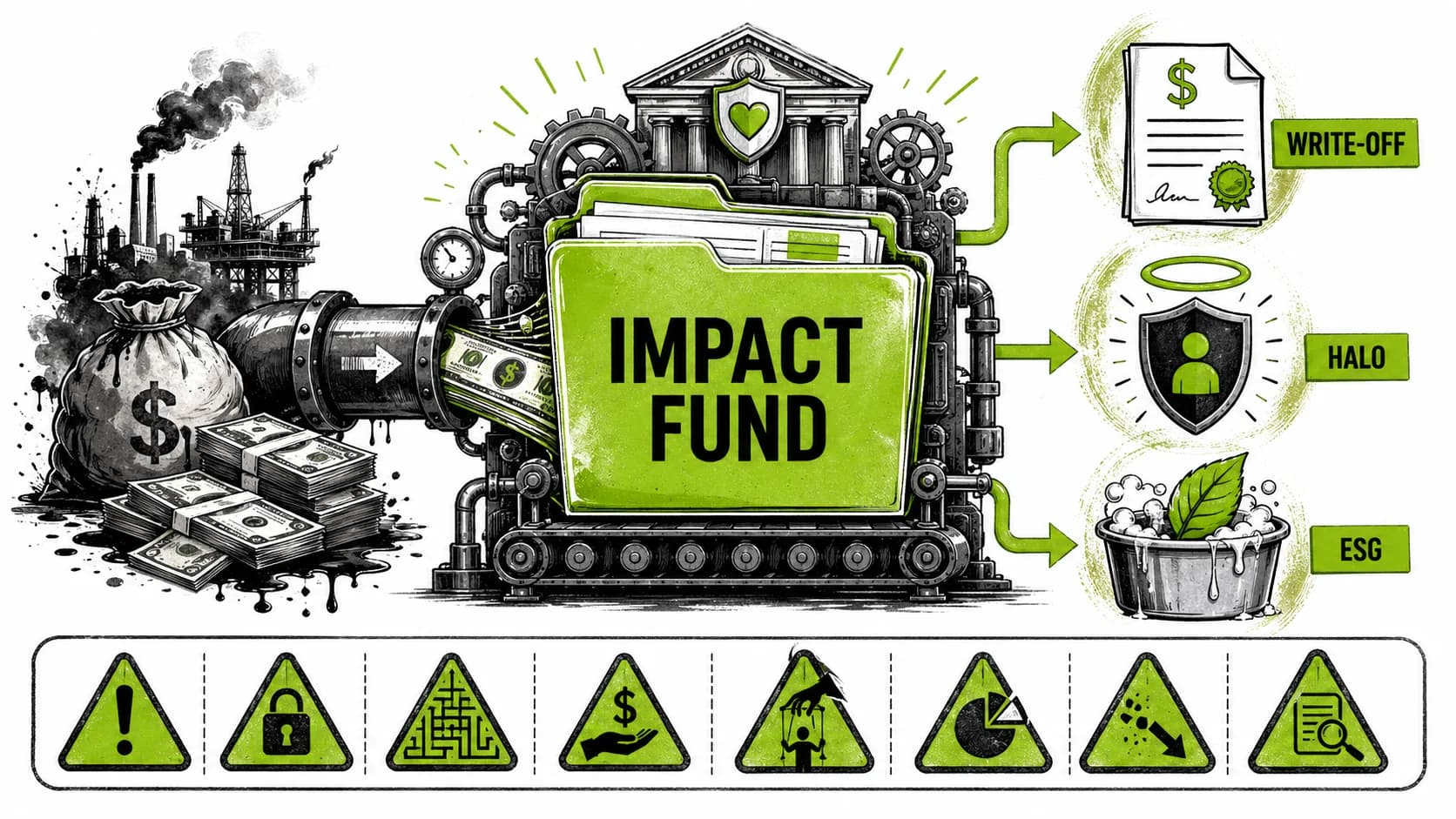
It’s Q1 2026 and your LinkedIn feed is a hospice for failed founders seeking redemption. The crypto grifter whose exchange vaporized $200M is now “empowering the unbanked.” The SaaS bro who built a surveillance tool for managers launched a “worker wellness” non-profit. This isn’t coincidence; it’s a calculated pivot. The modern entrepreneur tax write-off isn't a yacht—it’s a 501(c)(3). They’ve upgraded from selling courses to selling conscience. Welcome to impact washing, where philanthropy is the ultimate reputational shield and the IRS foots the bill. Let’s dissect this social impact grift.
Why Is This Impact Investing Scam Exploding Now?
Short answer: The convergence of loose IRS oversight on 501(c)(3) filings, a 34% spike in post-scandal foundation launches (per The Economist, 2025), and $715 billion in global ESG fund inflows (Morningstar, 2025) created a perfect storm where reputation laundering is cheaper and more effective than any PR firm.
The convergence of soft tax laws, scandal fatigue, and ESG mania created a perfect storm for reputation laundering disguised as charity. Financial alchemy meets narrative control.
The reputation reset is cheaper than a PR firm. After a scandal, a traditional comeback tour is expensive and often fails. An “impact venture” does the heavy lifting: it generates positive headlines (“Disgraced Founder Finds Purpose”), taps into ESG funding pools tracked by Bloomberg and Morningstar, and reframes gross negligence as a “transformative learning journey.” It’s a three-in-one deal. The SEC’s 2024 enforcement actions included 784 cases totaling $8.2 billion in penalties, yet philanthropic pivots remain largely unscrutinized because they sit in a regulatory gray zone between the IRS, FTC, and state attorneys general.
The financial engineering is absurdly favorable. Charitable donations of overvalued or illiquid assets (like worthless IP or private shares) can create massive deductions. Complex fund structures defer capital gains and obscure money trails. The IRS allows deductions of up to 30% of adjusted gross income for appreciated capital assets donated to qualifying 501(c)(3) organizations, with a five-year carryforward. One fund attorney told me, off the record, “We call it the ‘virtue vault.’ You park capital no one can criticize while deciding your next grift.” This mirrors patterns seen in the phantom exit scam, where financial opacity is the primary tool.
The ‘post-profit’ narrative is the ultimate flex. In a market tired of raw extraction, claiming “purpose over profit” is the new status symbol. For the larper, it’s a narrative upgrade from “get rich quick” to “enlightened steward.” A 2025 analysis by The Economist found that 34% of new impact funds launched in the US were founded by individuals with a recent public controversy or failed venture, suggesting a strategic rebrand rather than a genuine pivot.
Five Red Flags of a Fake Philanthropy Tax Write-Off
Short answer: Look for a scandal-to-savior timeline under 90 days, opaque multi-entity structures (Caymans holding companies, for-profit subsidiaries), founder-centric marketing that eclipses the cause, a free-to-paywall funnel leading to $5,000-$25,000 offers, and pledges of illiquid assets (failed startup IP) instead of cash. The FTC and SEC filings are your best verification tools.
Spotting a social impact grift requires moving past the glossy mission statement. Here are the five fail-proof signals that the “impact” is a financial and reputational firewall.
1. Is the Scandal-to-Savior Timeline Suspiciously Short?
If a new impact venture appears 30-90 days after a major controversy, it’s a calculated rebrand, not a moral awakening. Real philanthropic drives have organic roots; tax-and-PR strategies are calendared.
Map the dates. Column A: controversy date. Column B: impact venture announcement. A short gap is a giant red flag. I’ve seen this pattern repeat: a founder is exposed for fraudulent marketing in Q4, and by early Q1—coinciding with tax season and a fresh news cycle—they’ve launched a “foundation for ethical entrepreneurship.” The language is always the same: “humbled,” “learned,” “giving back.” It’s damage control on a schedule. According to data tracked by ProPublica’s Nonprofit Explorer, new foundation filings spike by approximately 22% in the first quarter, closely following annual scandal cycles in tech and finance.
2. Does the Structure Prioritize Opacity Over Transparency?
Real impact organizations obsess over transparency. Fake ones hide behind legal complexity and vague language. Ask for a simple capital flow diagram. If you get jargon, run.
The shell game. The venture is often a Russian doll of entities: a holding company in the Caymans, a US non-profit, a for-profit subsidiary. Money flows in circles designed to be untraceable. Vague disbursement is another tell. Websites tout “systemic change” and “empowering communities” with zero concrete metrics. Ask: “What percentage of last year’s budget went directly to end beneficiaries?” A 2025 investigation by CharityWatch found that over 30 suspect foundations spent more than 80% of funds on internal salaries, “awareness campaigns,” and contracts with the founder’s other companies. That’s not charity; it’s a closed-loop financial ecosystem.
3. Is the Founder the Perpetual Hero of the Story?
In real philanthropy, the cause is the hero. In a grift, the founder never leaves center stage. The initiative is merely an extension of their personal brand rehabilitation.
Ego-driven marketing dominates. Every keynote, profile, and social post features the founder’s “awakening.” The impact venture’s Instagram is just their personal feed with a #givingback filter. Synergistic deals complete the circle. The “fund” invests in the founder’s friends, existing investors, or their own ventures. The charitable arm buys overpriced services from the founder’s for-profit companies. It’s a reputation-laundering scheme with a built-in customer base. The FTC notes that schemes involving circular financial arrangements are a hallmark of sophisticated frauds, moving beyond simple consumer scams into areas like charitable trust abuse.
4. Is the “Impact” Just a Lead Magnet for a Paid Scheme?
The philanthropic venture isn’t the end product—it’s the top of a funnel. Its primary purpose is to build credibility and harvest leads for high-ticket offers.
Watch for the pivot to paywalls. The foundation offers “free resources,” but the “advanced toolkit” or “certification” costs $5,000. The founder launches an “impact mastermind” for $25,000 to teach “purpose-driven investing.” The non-profit builds an email list of idealistic followers, then sells them coaching, consulting, or investment “opportunities.” It’s a social impact grift that turns goodwill into a sales pipeline. This model is rampant in the online “expert” space, where the charity is merely a credibility-prop for the real business: selling the dream of being like the founder.
5. Does the Founder Have No Real Skin in the Game?
How the venture is funded reveals its true purpose. If the founder risks little but stands to gain much, it’s a entrepreneur tax write-off in narrative clothing.
Beware the “pledge” versus the transfer. Headlines scream “Founder Pledges $50M!” Dig deeper. Is it a cash transfer, or a promise of future stock options? Is it a donation of illiquid assets (like IP from a failed company) given an inflated valuation? Many pledges never fully materialize but generate permanent positive press. Other people’s money (OPM) is key. The founder acts as the “visionary” General Partner but commits minimal personal capital. The fund raises from outside Limited Partners. The founder’s contribution is their “brand” and “network,” for which they take a 2% management fee and 20% carried interest. They risk little and gain regardless of actual impact. The FTC’s 2024 Data Book highlights that investment fraud, including schemes misrepresenting the use of funds, resulted in a median loss of $15,000 per report, indicating high financial stakes in opaque ventures.
Case Study: The Anatomy of an Impact Investing Scam
Short answer: A fictional founder ("Alex Sterling") executes every red flag: launches a 501(c)(3) within 90 days of a scandal, funnels 95% of $2M to a connected contractor, donates worthless IP at inflated valuations for tax deductions, and uses the foundation as a consulting lead magnet. This mirrors patterns the SEC has flagged in Form D filings and the IRS tracks via Form 990 disclosures.
Let’s apply these rules to a fictional but painfully familiar archetype: Alex Sterling.
Q4 2025: Alex’s ed-tech startup “MentorSphere” implodes. An investigation reveals 90% of its “success stories” were fabricated. Lawsuits pile up. Personal brand: ashes.
February 2026: Alex announces the “Sterling Foundation for Authentic Education.” Press release copy: “My journey taught me vital lessons about integrity. I’m channeling those lessons to fight for underprivileged youth.” The structure is a 501(c)(3). The first initiative is a “Digital Literacy Open-Source Curriculum.”
The Red Flags, Mapped:
Alex didn’t build a charity. Alex built a reputational shield with a tax write-off and a built-in consulting funnel. This is the impact investing scam blueprint.
How to Perform Your Own Due Diligence
Short answer: Pull IRS Form 990 from ProPublica’s Nonprofit Explorer and check if over 40% of expenses are internal. Search SEC EDGAR for Form D filings to verify fund claims. Cross-reference the founder’s name with "scandal," "lawsuit," and "SEC" on Google. Check the Board of Directors for independence. These steps take 2-3 hours and expose most grifts.
You don’t need a forensic accounting degree. A few hours of skeptical digging will reveal the truth.
Follow the Paper Trail.
- For US Non-Profits: Pull the IRS Form 990 from ProPublica’s Nonprofit Explorer. This is public. Look at Part IX: Functional Expenses. What percentage goes to “Program Services” (the actual work) versus “Management & General” and “Fundraising”? If over 40% is spent on internal costs, be very skeptical.
- For Private Funds: Search SEC filings for Form D (notice of exempt offering of securities). It won’t show details, but it confirms they’re raising money. If they claim to be a “fund” but have no filing, that’s a red flag.
Decode the Language.
Vague: “Creating ecosystem change,” “driving systemic impact.”
Measurable: “Placing 500 low-income graduates into tech jobs with $75k+ average salary by 2027, verified by third-party audit.”
Demand the latter.
Google the Founder + Specific Terms.
Run these searches: “[Founder Name] scandal,” “[Founder Name] lawsuit,” “[Founder Name] SEC.” Then search “[Founder Name] impact fund.” The timeline that appears in your search results is often the confession.
Analyze the Network.
Look at the Board of Directors. Is it a circle of yes-men, existing business partners, and family? Or does it include independent experts with actual credibility in the field they claim to serve? A closed network suggests a private club, not a public good.
How to Protect Yourself from Social Impact Grifts
Short answer: Demand the IRS Form 990 and a capital flow diagram before engaging. Vet whether the founder’s "impact" work predates their scandal or appeared conveniently after it. Prioritize local, metrics-driven organizations over vague "global initiatives." Apply the same skepticism you’d use on a fake revenue screenshot or a synthetic success story.
If you’re considering donating, investing, or even just amplifying one of these ventures, take these steps.
Demand Transparency First.
Ask directly via email: “Can you share your most recent IRS Form 990?” “What percentage of last year’s budget reached end beneficiaries?” “Can you provide a simple diagram of your legal and capital structure?” Legitimate organizations have this information ready. Grifts will deflect, delay, or drown you in jargon.
Vet the ‘Why,’ Not Just the ‘What.’
Is this impact work a lifelong thread, or a sudden, convenient new chapter? Check old tweets, early blog posts, and past interviews. A founder who spent a decade tweeting about “crushing competitors” and “blitzscaling” and now claims a deep, lifelong passion for cooperative economics is probably lying. The truth is in the timeline.
Think Local and Unglamorous.
Genuine impact is often boring, hyper-local, and hard to monetize for personal brand growth. A fund supporting single mothers in a specific city with clear job placement metrics is harder to fake than a vague “global education initiative.” The scale of the claim is often inversely proportional to the legitimacy.
Apply Your Existing Skepticism.
The skills you use to spot a fake guru are the same here: pattern recognition, financial skepticism, and a refusal to be swayed by emotional narrative over evidence. This lens is also critical for seeing through corporate ESG reports and influencer activism.
Conclusion: Discerning the Real from the Laundered
The goal isn’t to become cynical about all philanthropy. It’s to become ruthlessly discerning. The impact investing scam thrives in the gap between our desire for good news and our reluctance to do boring paperwork. Real impact investors and philanthropists operate with clear metrics, embrace transparency, and often do unsexy work. The best way to honor them is to expose the frauds co-opting their language.
This grift works because it offers a triple win for the perpetrator: a polished reputation, a favorable tax write-off, and a new revenue stream—all under the halo of virtue. By learning these patterns, you protect not only your capital but also the integrity of the social good ecosystem. Your most powerful tool is a simple question: “Show me the numbers.” The same skepticism applies to greenwashing startups and philanthropic foundation scams. Stay curious, stay skeptical, and demand that those claiming to change the world are willing to open their books.
Ready to sharpen your detection skills? This is one pattern in a larger manipulation ecosystem. Dive deeper in our hub for startup skepticism.
FAQ: Untangling the Impact Investing Scam
What’s the concrete difference between a legitimate impact investor and an impact washer?
Legitimate investors use established frameworks like IRIS+ metrics or the UN SDGs from day one. They report transparently on successes and failures. An impact washer uses impact language primarily as marketing. Social good is a secondary benefit or a fiction. Their reports are glossy brochures, not data sheets. Transparency is low, metrics are vague, and the founder’s brand is always central.
Are all ventures started by controversial people automatically scams?
No. People can genuinely grow and make amends. The red flag isn’t a controversial past—it’s the pattern and lack of substance around the pivot. Key questions: Is there demonstrable, sustained behavior change? Is the venture structured for transparency and substantive work, separate from personal brand monetization? Judge the current structure and actions, using history as context, not a verdict.
How can I check the financials of a private impact fund?
For private funds, transparency is a choice. If you’re a potential Limited Partner, you must demand information during due diligence. Legitimate funds have a detailed Private Placement Memorandum (PPM) and should answer tough questions about fee structures, portfolio construction, and impact methodology. If they are evasive, that’s your answer. For the public, assume the primary impact is private gain if the structure is secretive.
Isn’t some positive outcome better than none, even if the motives are selfish?
This is the “ends justify the means” trap, and it’s dangerous for three reasons. First, inefficiency: capital funneled through ego-driven, opaque structures achieves far less impact per dollar than proven, transparent organizations. Second, market corruption: the noise and subsequent cynicism they generate crowd out genuine actors. Third, moral hazard: it rewards bad behavior, teaching that scandals can be erased with a well-timed philanthropic announcement.
What are trustworthy resources for vetting charities and impact claims?
- US Charities: CharityNavigator, GuideStar (Candid), ProPublica’s Nonprofit Explorer.
- Impact Frameworks: Global Impact Investing Network (GIIN), B Lab (for B Corps).
I think I donated to a grift. What should I do now?
First, don’t blame yourself—these operations are designed to be convincing. 1) Request information on how your donation was used. Their response (or lack thereof) will be telling. 2) Report concerns to your state’s Attorney General’s office of charities or the IRS if you suspect fraud. 3) Redirect future giving to local, transparent organizations where you can see the impact firsthand. 4) Share your knowledge tactfully to warn others in your network. Your experience is a data point for the community.
<!-- sister-projects-start -->
Other Doved Studio projects
Related tools from the same studio you might find useful:
- Ralphable: Generate structured Claude Code skills that iterate until pass/fail criteria are met.
- Doved Studio: Studio indie derrière cette app et une dizaine d'autres outils.
<!-- sister-projects-end -->