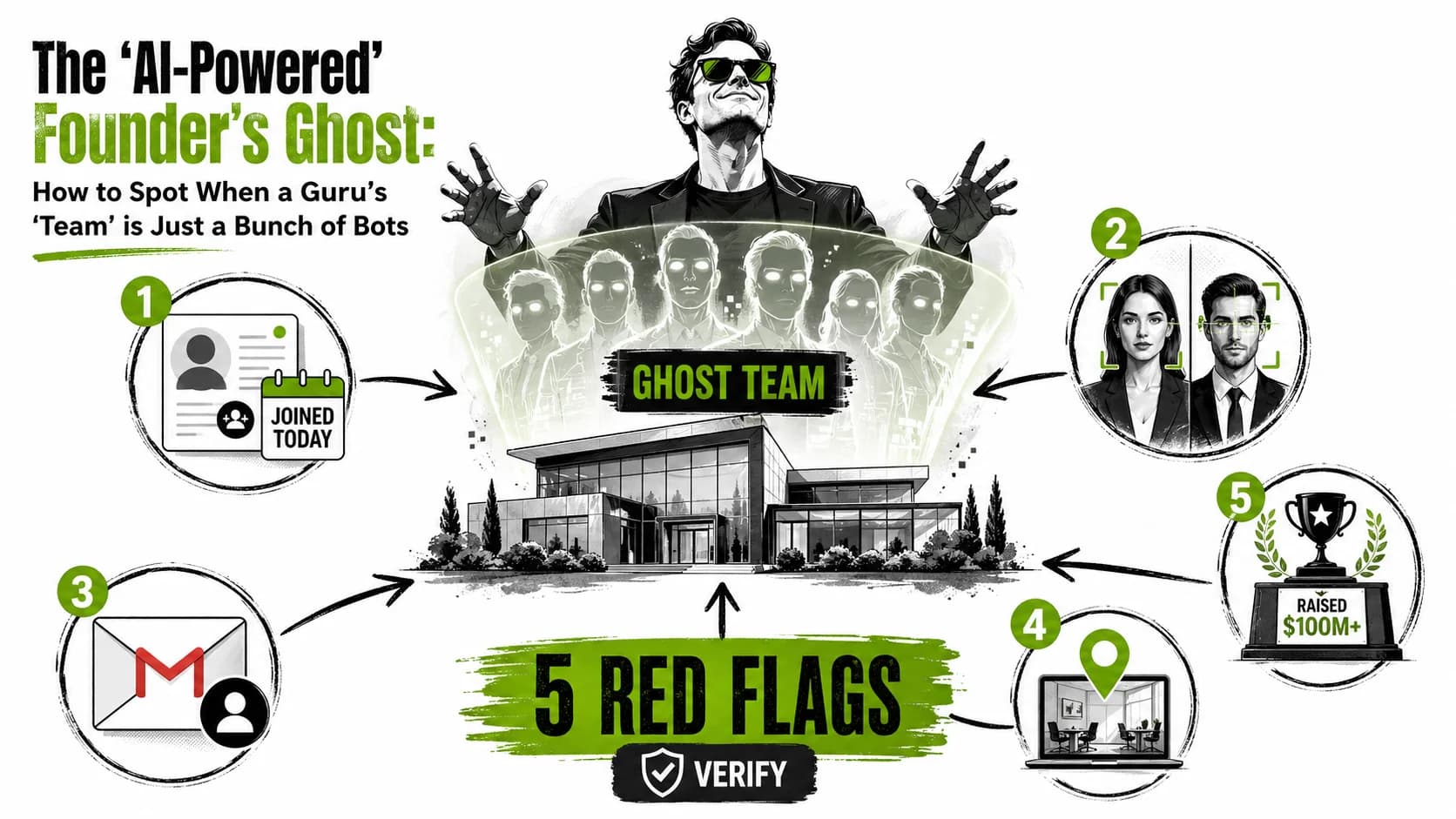
In February 2026, a startup called "NexusFlow AI" made headlines for raising a $15 million Series A round. The pitch was compelling: a revolutionary AI agent platform, a charismatic founder with a Stanford background, and a sleek website featuring a diverse, photogenic team of 25 engineers, designers, and executives. There was just one problem. When a curious investor decided to cold-email the "Head of Engineering," the reply came from a Gmail account. A deeper dig revealed that the LinkedIn profiles of the entire "leadership team" were created within days of each other, their headshots bore the telltale, uncanny perfection of AI generation, and the company's listed "global HQ" was a virtual office service in Delaware. NexusFlow AI was a ghost. Its team was a collection of digital puppets, and its founder was the latest in a new breed of "AI-powered" larper.
Welcome to the 2026 legitimacy scam. As skepticism around solo founders and revenue claims has grown (thanks partly to guides like our own on spotting fake revenue screenshots), the fraudsters have evolved. They've moved beyond faking metrics to fabricating the entire organizational structure. Why sell a course as a lone wolf when you can sell it as the "proven playbook from a scaling unicorn's CMO"? The illusion of a team provides social proof, distributes blame, and creates a facade of operational sophistication that is incredibly seductive to aspiring entrepreneurs.
This article is your forensic toolkit. We'll dissect the anatomy of the ghost company scam, teaching you how to spot the digital fingerprints of AI-generated employees and separate real ventures from elaborate puppet shows. Because in the age of AI, if you can't verify the humans, you're just funding someone's prompt engineering hobby.
The Rise of the Phantom Team: Why "We" is the New "I"
The shift from "I" to "we" in guru marketing is a direct response to market pressure. Audiences are savvier. A single founder claiming eight-figure revenues triggers immediate suspicion. But a "founding team" with specialized roles (a "techie," a "hustler," a "visionary") feels more legitimate. A "customer support team" suggests real users. A "content team" explains the constant stream of polished posts.
This fabricated legitimacy serves multiple purposes for the fake guru:
A recent exposé by TechCrunch highlighted this trend, detailing several "AI-native" startups that secured funding based on pitches featuring teams that later proved untraceable. The tools are accessible: AI headshot generators, LinkedIn profile builders, and even voice-cloning for podcast "interviews" with non-existent co-founders.
The 5 Forensic Red Flags of a Ghost Company
Detecting a phantom team requires moving from passive consumption to active investigation. Here are the five key areas to audit.
Red Flag 1: The Uncanny Valley of the "About Us" Page
The company website's "Team" page is ground zero for investigation. In 2026, the flaws are often subtler than obvious glitches.
- The Generic Bio Paradox: Read the bios. Do they sound like they were written by the same person (or the same AI)? Look for repetitive sentence structures, overuse of buzzwords ("synergy," "disrupt," "leveraging blockchain-AI convergence"), and a lack of specific, verifiable achievements. A real engineer might list a former employer like "Google" or a specific open-source project. A ghost profile says "10+ years of experience in scalable cloud architecture."
- The Missing Digital Paper Trail: A real professional has a digital footprint that extends beyond one company page. The absence of this trail is a massive red flag.
Red Flag 2: The LinkedIn Ghost Town
LinkedIn is the social network of record for professionals. A phantom team's LinkedIn presence is a house of cards.
- The Synchronized Creation Date: Use tools or manually check profile URLs. If the "CEO," "CTO," and "CMO" all created their LinkedIn profiles in the same month—or worse, the same week—of 2025 or 2026, alarm bells should ring. Real founding teams rarely meet and all create professional profiles simultaneously years into their careers.
- The Echo-Chamber Network: Click on their connections. Do they only connect with each other and a handful of other suspiciously new or generic profiles? Is their activity solely limited to liking and commenting on the founder's posts? A real executive will have a network spanning previous jobs, universities, and industry events.
- The Sparse Activity History: A profile with a headline at "NexusFlow AI" but zero posts, zero articles, zero recommendations from past colleagues, and an "Experience" section containing only that one role is a ghost. It's a prop, not a profile.
Red Flag 3: The Voice That Never Speaks
In the audio-visual world of modern content, the absence of a human voice is telling.
- The Podcast That Never Was: A guru claims to have a "brilliant CTO" who is "too busy building" to do calls. Yet, in 50 podcast interviews, the founder has never once been joined by this co-founder. The excuse is always the same: "He's heads-down on the product."
- The Pre-Recorded "Live" Demo: Watch for product demos or "team meetings" shared on social media. Are the other "team members" ever on camera live? Or are their contributions limited to pre-recorded video clips, Slack message screenshots, or a voiceover? Tools like Descript and HeyGen can easily fabricate these.
- The Text-Only Communication: You sign up for a product with a "dedicated support team." Every interaction is via text (email, chat). You ask for a quick call to troubleshoot. The request is perpetually deflected. A real, small company might be busy, but a complete refusal to ever hop on a voice or video call is a pattern of a solo operator hiding behind text-based AI chatbots.
Red Flag 4: The Physical Address That Isn't
A company is a legal entity. It exists somewhere.
- The Virtual Office Shuffle: The company's contact page lists a prestigious address: "One Embarcadero Center, San Francisco" or "WeWork, 5th Ave, NYC." A quick search reveals this is a virtual office provider like Regus or Davinci. While legitimate startups sometimes use these, it should be combined with other verification. A "50-person team" operating solely from a virtual office suite is highly suspect.
- The Residential Address (or PO Box): Sometimes, the brazenness is stunning. The "incorporated headquarters" might be the founder's apartment or a local UPS Store PO Box. You can find this through public incorporation records (like Delaware's Division of Corporations website for US companies).
Red Flag 5: The Inconsistent Narrative & Timeline
Fabrication is hard to keep consistent. The story will have cracks.
- The Founding Story Shifts: In one interview, the founder met the CTO at Stanford. In another, they met at a hackathon in Berlin. The timeline of when the company was founded, when key hires joined, and when major milestones were hit will waver under scrutiny.
- The "Team Member" Who Morphs: You might notice that the "Head of Product" on the website in January goes by "Alex Kim," but in a screenshot of an internal Slack channel shared in March, the same role is held by "Jordan Patel." The larper forgot which fake profile they assigned to which screenshot.
- The Lack of Third-Party Validation: Does any credible third party—a real news outlet, a known investor, a reputable partner company—ever mention interacting with anyone at this company besides the founder? A press release from the company itself quoting its own "VP of Marketing" is meaningless.
Your Actionable Due Diligence Checklist
Before you buy that course, invest in that "startup," or trust that guru's organizational advice, run through this checklist:
whois lookup for the website domain registration date (was it registered last month?). Search public business registries for the legal entity name and registered agent address.The goal isn't to be paranoid, but to be rational. In an era where spotting fake gurus requires new tools, verifying the existence of a team is a fundamental step.
The Bigger Picture: Why This Scam Works (And How to Immunize Yourself)
This scam preys on our deeply ingrained bias towards social proof and institutional legitimacy. We are conditioned to trust things that look established. A beautiful website with a full team page taps into that conditioning, bypassing our logical skepticism.
To immunize yourself:
- Value Outputs Over Ornaments: Focus on the actual work, code, content, or customer results. Can you independently verify the product exists and works? A real team produces tangible, complex outputs. A ghost team produces only marketing.
- Decentralize Your Trust: Don't let one source (the founder) be the sole validator of their own story. Look for corroboration from unrelated, credible parties.
- Embrace the "Solo" Truth: There is no shame in being a solo founder or a small team. The desperate need to fake scale is, in itself, a red flag. Many of the world's most trusted experts and builders operate with transparency about their size.
The toolkit for building a real business is more accessible than ever. The toolkit for faking one is, too. Your most important skill in 2026 is no longer just coding or marketing—it's digital forensics. It's the ability to Detect or Create. You can either learn the patterns of deception to protect yourself, or understand the mechanics well enough to see through the illusion. The choice, as always, is yours.
For more on building real ventures instead of spotting fake ones, explore our startup hub.
FAQ: Phantom Teams & AI-Generated Employees
Q1: Are all companies that use virtual offices or are fully remote ghost companies?
Absolutely not. Virtual offices and remote work are standard, cost-effective practices for many legitimate early-stage startups and small businesses. The red flag is not the use of these services in isolation, but when they are combined with multiple other signals: AI-generated team photos, newly created LinkedIn profiles for all "executives," and a complete absence of any third-party verification or live human interaction from anyone besides the founder. Context is key.
Q2: What's a good first step if I'm suspicious of a company's team?
Start with the simplest forensic tool: LinkedIn. Look up the named team members. Pay close attention to:
- Profile creation date.
- Depth of the "Experience" section (is this their only job ever?).
- Endorsements and recommendations (are they only from each other?).
- Their network (do they have 500+ connections including people from various industries, or just 50 connections all within the same suspicious company?).
Q3: I found an employee's profile, and it seems real with a long history. Does that mean the team is legitimate?
Not necessarily. This is an advanced tactic. A larper might use the real, public profile of an unrelated person (a practice called "catfishing" or "profile borrowing") or even a deceased individual. Cross-reference carefully. Does the employment history on the profile actually list the company you're investigating? Does the person's own activity or posts ever mention working there? A single seemingly-real profile among a sea of ghosts can be a deliberate tactic to add a layer of credibility.
Q4: Couldn't a very private or stealth-mode startup look like a ghost company?
Yes, and this is the critical nuance. Genuine stealth-mode startups exist, often in deep tech or biotech. The difference is intent and audience. A genuine stealth company isn't publicly marketing courses, selling "growth playbooks," or building a guru brand on social media. They are quietly building a product. If a "company" is highly public and sales-oriented regarding its advice or courses but completely opaque and unverifiable regarding its actual operations and team, the likelihood of it being a ghost scam is exponentially higher.
Q5: What are the legal implications of creating fake employee profiles?
This can venture into serious legal territory, depending on jurisdiction. Potential implications include:
- Fraud: If used to secure investment, loans, or customer contracts under false pretenses.
- Identity Theft: If using the name/image of a real person without consent.
- Violation of Platform Terms: All social media and professional networks prohibit fake accounts, leading to bans.
- Civil Liability: Could be sued by investors or customers for misrepresentation.
Q6: As a small, real founder, how can I build trust without falling into the trap of looking like a "ghost"?
Transparency is your greatest asset. Be honest about your size.
- Use real photos of yourself and any actual team members.
- Say "I" instead of "we" if it's just you.
- List a personal LinkedIn and be active on it.
- Consider a simple "About" page that says, "Founded by [Your Name], currently a team of one building [X]." This honest scarcity can build more authentic trust than a fabricated scale. Your audience respects real progress over fake perfection. Focus on demonstrating your expertise through valuable content and a real product, not a fabricated org chart.
<!-- sister-projects-start -->
Other Doved Studio projects
Related tools from the same studio you might find useful:
- Ralphable: Generate structured Claude Code skills that iterate until pass/fail criteria are met.
- Doved Studio: Studio indie derrière cette app et une dizaine d'autres outils.
<!-- sister-projects-end -->