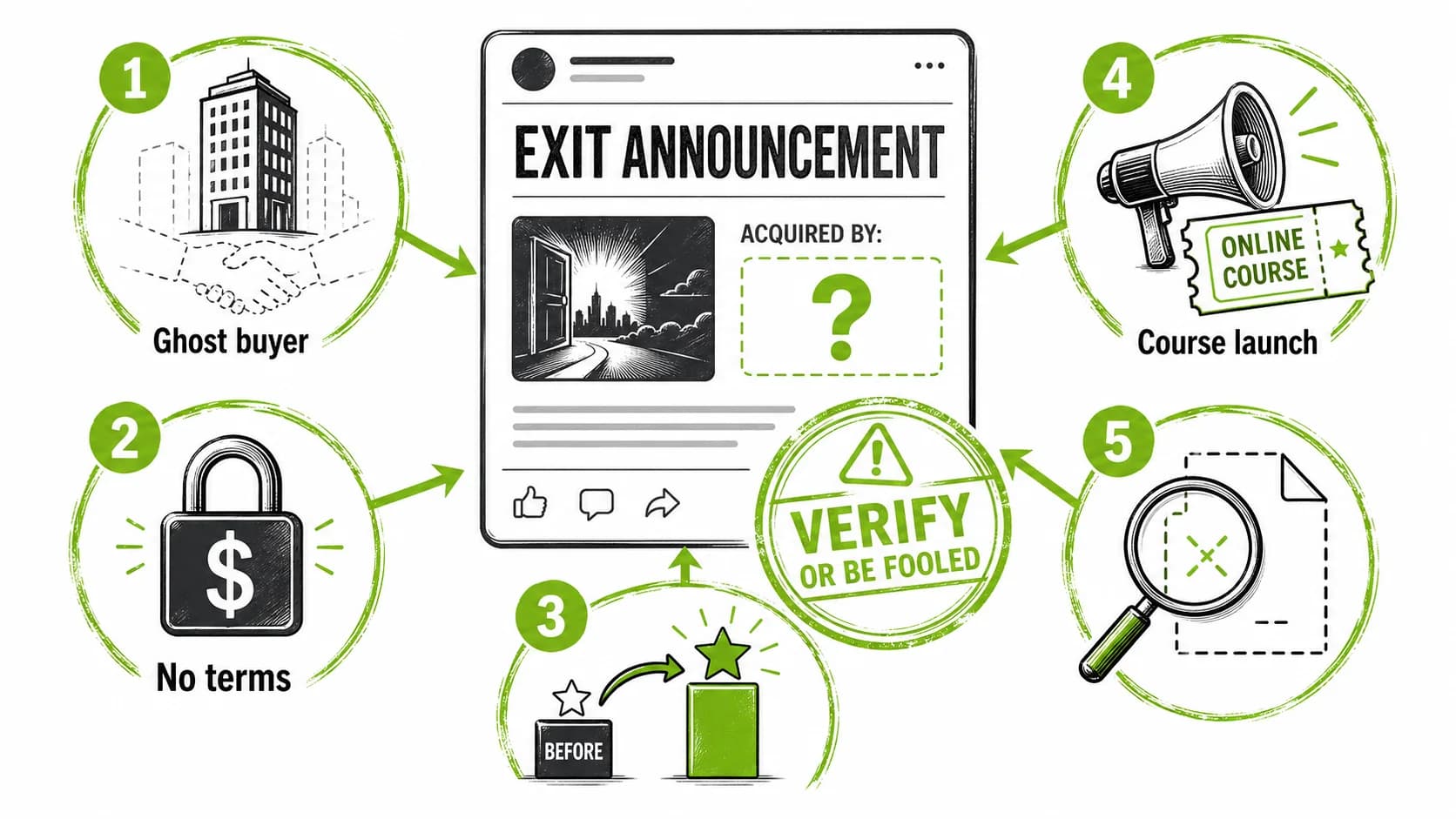
The LinkedIn post is a masterpiece of modern myth-making. A grainy, heroic headshot. A caption dripping with faux humility and coded triumph: "After an incredible 3-year journey, I'm thrilled to announce that [Vague AI Startup Name] has been acquired. Can't disclose details yet, but the team and I are so grateful. Onwards!" The comments section is a festival of emoji-fueled congratulations—the digital equivalent of a standing ovation for a play that was never performed.
Welcome to the "Phantom Exit," the latest and most sophisticated pivot in the entrepreneurial larper's playbook for 2026. It’s no longer just about faking monthly recurring revenue (MRR) screenshots; it’s about faking the endgame. In the wake of the "AI-Powered Exit Scam" pattern, a new cluster of founders—particularly in the oversaturated AI wrapper space—are claiming multi-million dollar acquisitions by "undisclosed" or entirely fictional buyers. The goal? To instantly vault from "struggling founder" to "validated exit expert," creating the ultimate social proof to sell you a high-ticket "Exit Blueprint" mastermind or "Post-Exit Life" coaching program.
This article is your forensic toolkit. We’ll dissect the five unmistakable red flags of a phantom exit scam, teaching you to separate the rare, genuine quiet acquisition from the increasingly common, strategically manufactured guru origin story. Because in 2026, the most profitable product a fake founder can ship isn't software—it's the story of their own fictional success.
1. The "Ghost Acquirer" & Strategic Ambiguity
The cornerstone of the phantom exit is the complete lack of a verifiable buyer.
The Pattern: The announcement never names the acquiring company. You’ll see phrases like:
- "Acquired by a major strategic partner in the space."
- "Joined forces with a leading [Industry] conglomerate (details confidential)."
- "Bought by a private equity group you'd definitely recognize."
Why This is a Red Flag: While some legitimate acquisitions have short periods of confidentiality (e.g., before a formal press release), they are never permanently shrouded in mystery. A real acquisition is a significant corporate event. The acquirer wants credit. They issue a press release, update their "Acquisitions" page, announce it to their shareholders, and often file with the SEC. The deal creates value for them, and they publicize it.
How to Investigate:
- Check the "Acquirer": Search for any news, PR wires (Business Wire, PR Newswire), or SEC filings mentioning the supposed acquiring company and an acquisition. If it's a "major" player, the financial press (TechCrunch, Bloomberg) would have at least a whisper.
- LinkedIn Sleuthing: Look at the "founder's" and their small team's LinkedIn profiles. After a real acquisition, profiles are updated to show "Acquired by [Company]" or new positions at the parent company. In a phantom exit, their profiles either don't change or vaguely state "Founder & CEO - Acquired in 2026."
- The Domain Test: What happens to the startup's website? A real acquisition usually redirects to the acquirer's site or hosts a "We've been acquired!" landing page with the acquirer's logo. A phantom exit often leaves the site languishing unchanged, because there's no real company to redirect to.
If you can't find a single piece of corroborating evidence from the buyer's side, you're likely looking at a ghost.
2. The Complete Absence of Financial or Structural Details
Real exits have numbers and structure. Phantom exits have vibes.
The Pattern: The announcement is utterly devoid of concrete information. There is no mention of:
- Purchase Price: Not even a vague range ("eight-figure deal").
- Deal Structure: Was it cash? Stock? Earn-out? A combination?
- Leadership Transition: Is the founder staying on? For how long? What happens to the team?
- Product/Asset Fate: Will the product be integrated, shut down, or run independently?
Instead, the language is purely emotional and narrative-driven: "a dream come true," "validation of our vision," "the right partner for the next chapter."
Why This is a Red Flag: Acquiring a company is a complex legal and financial transaction involving term sheets, due diligence, and integration plans. Even in a confidential deal, the founder knows these details. Their deliberate omission is because making up plausible specifics is the fastest way to get caught. Saying "it was an all-cash deal" invites questions about treasury allocations. Mentioning an "earn-out" invites questions about future performance metrics. Silence is the safest form of deception.
Actionable Tip: Ask a simple, polite question in the comments or a DM: "Congratulations! That's huge. Was it primarily a cash or stock deal? Always curious how these things are structured." A genuine founder might say they can't share specifics but will hint at the structure. A phantom exit scammer will ignore it, give a non-answer ("It was a fantastic deal for everyone involved!"), or block you.
3. The Blitz-Scale "Post-Exit" Guru Pivot
This is the most glaring, profit-motivated red flag. The grift begins almost before the "deal" is "closed."
The Pattern: Within 30-90 days of the "exit" announcement, the founder's personal brand undergoes a radical transformation:
* "The Exit Blueprint" Mastermind: ($10,000 - $25,000)
* "From Startup to Exit" 1:1 Coaching: ($5,000/month)
* A "Limited-Time" Webinar: "How I Negotiated an 8-Figure Acquisition (And How You Can Too)."
Why This is a Red Flag: A genuine founder who has just gone through the exhausting, multi-year process of building a company and the intense, 6-12 month process of selling it typically does one of two things: 1) They take a long vacation and disconnect, or 2) They dive into the integration work at the new company or start planning their next actual startup. They don't immediately pivot to teaching the thing they just did. The mental and emotional bandwidth isn't there. The immediate guru pivot reveals that the "exit" was not the conclusion of a business journey, but the opening act of a new sales funnel. The exit is the product.
For more on the lifecycle of a fake guru, from fake metrics to fake expertise, explore our hub on startup larping patterns.
4. Fabricated or Unverifiable "Pre-Exit" Metrics
To make an exit plausible, the scammer first has to make the company seem plausible. This is where older larper tactics are retrofitted as backstory.
The Pattern: In the lead-up to the phantom exit announcement, or in the "how I did it" content that follows, the founder will cite impressive—but unverifiable—business metrics:
- "We were doing $200K MRR with a 5-person team."
- "Had 95% gross margins with zero marketing spend."
- "Our proprietary AI model had a 99.8% accuracy rate, which is what attracted the acquirer."
Why This is a Red Flag: These metrics serve as the foundational "proof" that the company was acquisition-worthy. However, they are almost never backed by evidence. There are no audited financials, no credible customer case studies, and no technical validation. They rely on the same trust-me-bro energy as the fake revenue screenshots of yesteryear, simply scaled up to exit-level numbers.
How to Investigate:
- Ask for Corroboration: Were there any known customers? Any tech blogs that reviewed the product? Any data on platforms like G2 or Capterra?
- Analyze the Timeline: Does the claimed growth rate defy physics? Going from $0 to $200K MRR in 18 months with a tiny team in a crowded market is a heroic claim that requires heroic proof.
- Use the Tools: This is where honing your skills in spotting fake revenue screenshots and larper metrics pays off. The principles are the same—extraordinary claims require extraordinary evidence.
If the pre-exit business looks like a ghost ship, the exit was likely a ghost story.
5. The Circle of Verification: Only Within the Guru Ecosystem
In a phantom exit, "proof" becomes a circular reference within a closed network of fellow larpers.
The Pattern: The only people who "confirm" the exit are:
- Other "exited founders" from the same mastermind or coaching circle.
- Podcast hosts who have the founder on to talk about the exit (but ask no hard questions).
- "Business news" outlets that are actually just content aggregators or paid-for PR platforms.
You will see a flood of congratulatory posts from these individuals, all using similar language. It feels orchestrated because it is. They are all participating in a mutual credibility ponzi scheme, where each fake exit validates the others.
Why This is a Red Flag: Genuine credibility is conferred by disinterested third parties. Real acquisitions are reported by objective journalists, analyzed by industry analysts, and discussed by a wide range of people in the sector—including skeptics. If the only voices affirming the deal are those who are financially or socially incentivized to do so (e.g., they sell similar courses, they were "coaches," they need reciprocal praise for their own future phantom exit), the verification is worthless.
Actionable Tip: Look for validation outside the circle. Has anyone with a reputation for skepticism (a known industry analyst, a critical tech blogger) commented? Or is the conversation a perfectly manicured garden of praise? The absence of any critical or even curious questioning is a major warning sign.
The Real Cost of Believing the Phantom
Falling for a phantom exit scam isn't just about losing $15,000 on a mastermind. The cost is multidimensional:
The antidote is a combination of cynical curiosity and methodical verification. Before you buy the "exit blueprint," demand the exit proof.
Ready to sharpen your detection skills beyond just exit scams? Our comprehensive guide teaches you how to spot fake gurus and find real alternatives.
The best way to inoculate yourself against these patterns is to understand them deeply. At Larpable, we don't just point out the fakes; we deconstruct the toolkit they use, so you can see the strings on every puppet. Learn to Detect the patterns before they cost you.
FAQ: Phantom Exit Scams
Q1: Couldn't a silent acquisition just be a private deal between two companies?
Absolutely. Private acquisitions happen all the time. The difference is in the evidence trail. Even in a private deal, there are legal filings (like SEC Form D for certain transactions), domain WHOIS changes, and LinkedIn profile updates for the team. The acquirer, while perhaps not doing a press blitz, still integrates the asset. The phantom exit has no evidence trail from the acquirer's side—it's a one-person announcement with no downstream changes to the business's assets or operations.
Q2: What if the founder is bound by an NDA and legally can't share details?
This is the scammer's favorite shield. While NDAs are common, they typically cover specific financial terms and negotiation details, not the existence of the deal or the identity of the acquirer. An NDA that permanently forbids someone from saying who bought their company is highly unusual and a major red flag in itself. Furthermore, an NDA doesn't prevent the acquirer from publicizing the deal. If the buyer is a real entity, they are not bound by the seller's NDA.
Q3: Are there any legitimate reasons a founder would start coaching after an exit?
Yes, but timing and focus are key. A legitimate exited founder might become a venture capitalist or an advisor to other startups years later, drawing on a deep well of real experience. The immediate pivot (within weeks) to selling the methodology of the exit itself is the red flag. It suggests the exit was not an outcome, but a marketing asset created for that very purpose.
Q4: What's the first thing I should do when I see an exit announcement from a founder I follow?
Pause the congratulations. Open a new browser tab and start a simple investigation:
Apply the five filters from this article. A few minutes of skepticism can save you years of misguided effort.
Q5: How are these phantom exits different from the "We-Faked-It-Till-We-Actually-Made-It" startups of the past?
The old "fake it till you make it" approach was about using bluster and exaggeration to attract real customers, real investment, and build a real business—the faking was a (risky) means to a legitimate end. The phantom exit is different. The exit itself is the fake product. The business doesn't need to become real; it just needs to be plausible enough for long enough to sell the story of its sale. The end goal isn't a company; it's the authority to sell guru services.
Q6: Where can I find reliable, verified information on real startup acquisitions?
Stick to primary sources and established, credible business journalism:
- SEC Edgar Database: For U.S. public company acquisitions or larger deals involving public entities.
- Official Press Release Wires: Business Wire, PR Newswire, GlobeNewswire.
- Reputable Tech & Business Media: TechCrunch, The Information, Bloomberg, Reuters. Be wary of "news" sites that simply republish press releases verbatim or have a history of publishing sponsored "articles."
- LinkedIn Updates from Multiple Parties: When a deal is real, you'll see updates not just from the founder, but from multiple team members, and sometimes from the acquiring company's leadership.
<!-- sister-projects-start -->
Other Doved Studio projects
Related tools from the same studio you might find useful:
- Ralphable: Generate structured Claude Code skills that iterate until pass/fail criteria are met.
- Doved Studio: Studio indie derrière cette app et une dizaine d'autres outils.
<!-- sister-projects-end -->