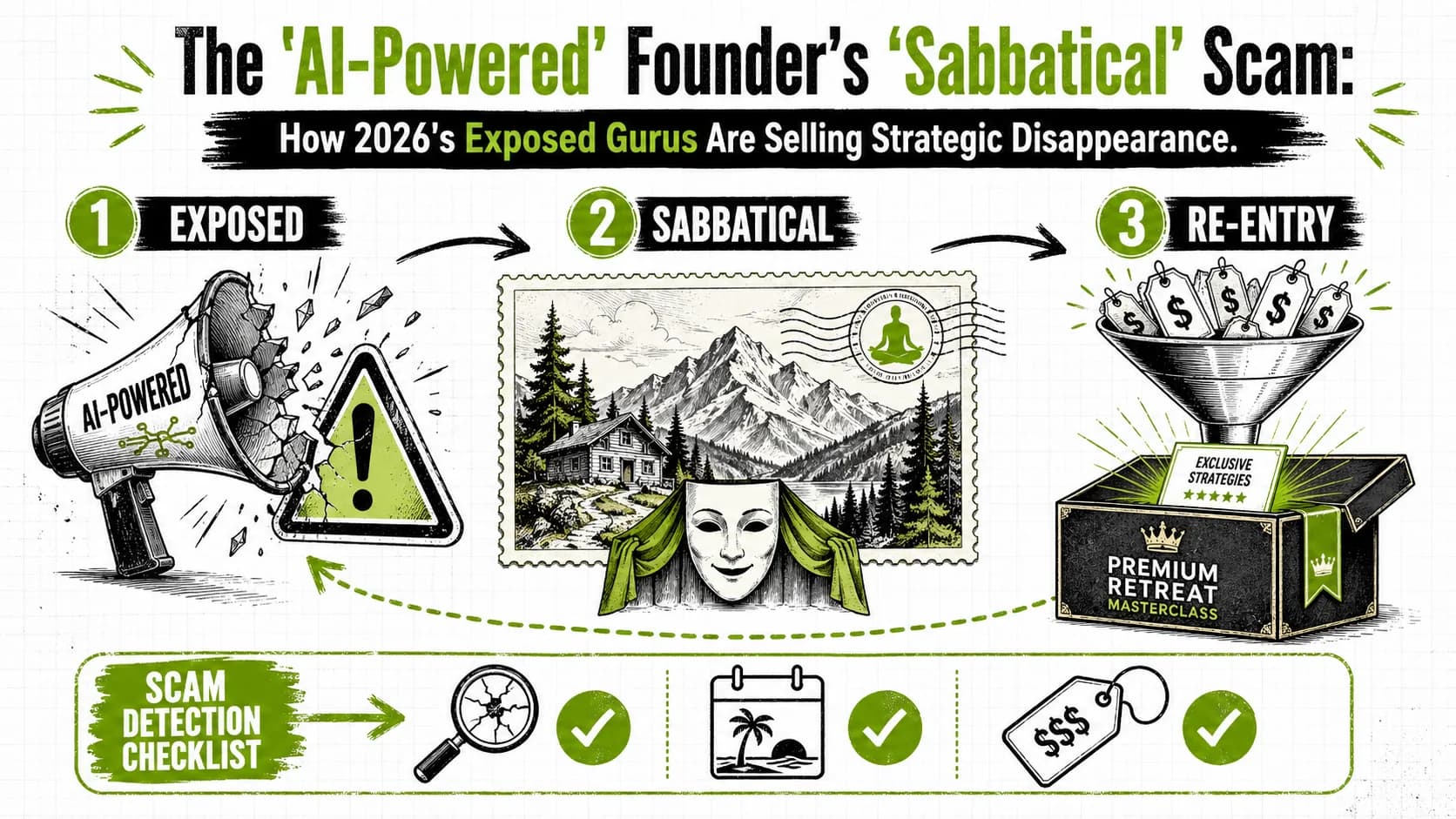
In early 2026, a curious silence fell over certain corners of the internet. The once-deafening roar of "AI-powered" founders, "solopreneurs" scaling to seven figures in 90 days, and "thought leaders" promising algorithmic enlightenment began to fade. But it wasn't a collective moment of self-awareness. Instead, a new, softer sound emerged: the gentle, curated whisper of the "strategic sabbatical."
One week, a guru is facing an FTC inquiry for unverified AI revenue claims. The next, they're posting a black-and-white photo of a misty mountain, captioned: "After 10 years of non-stop building, I'm taking a step back. A digital detox. A journey inward to reconnect with my true purpose." The comments flood with support: "So brave," "Self-care is the ultimate productivity hack," "Can't wait for the wisdom you'll bring back!"
A month later, the "wisdom" arrives—in the form of a $5,000 "Re-entry Retreat" or a $997 "Sabbatical-to-Scale" masterclass. The forced retreat, it turns out, was just a product development cycle.
Welcome to the latest, most insidious evolution in the guru playbook: The Sabbatical Scam. It's where public scrutiny gets repackaged as premium personal development, and a calculated PR pivot is sold as enlightened burnout. This article is your guide to spotting the difference between a genuine human needing a break and a larper executing a crisis management flowchart.
The 2026 Pressure Cooker: Why Disappear Now?
To understand the scam, you must first understand the pressure. The first quarter of 2026 has been a reckoning for the "build in public" and "AI founder" spheres.
- Regulatory Spotlight: The FTC and other bodies have significantly increased scrutiny on unsubstantiated claims of AI efficacy and revenue, particularly from solo "experts" selling courses. A public inquiry is a death knell for a business built on perceived infallibility. According to the FTC's 2024 Consumer Sentinel Network Data Book, consumers reported losing over $10 billion to fraud in 2023, a 14% increase over 2022. The agency is now actively targeting deceptive AI claims.
- Community Backlash: Audiences are savvier. Tools to spot fake revenue screenshots are widespread. When a founder's "$100K/month AI agent" story unravels on a forum like Indie Hackers, the credibility hemorrhage is instant and severe.
Disappearing the old-fashioned way—ghosting, a defensive tweetstorm—looks guilty. But disappearing strategically? That looks like wisdom. It's reputation laundering for the digital age.
The Anatomy of a Strategic Disappearance: A 5-Stage Playbook
The fake sabbatical isn't a spontaneous breakdown; it's a meticulously planned product launch. Here's the stage-by-stage breakdown of the strategic disappearance 2026 playbook.
Stage 1: The "Crisis Catalyst" & Narrative Seeding
It never starts with the sabbatical. It starts with the prelude.
- The Catalyst: A damning thread on X/Twitter, a legal letter, a key employee publicly quitting, or a failed product launch that can't be spun.
- The Seed: Days or weeks before the announcement, the guru begins posting subtle content. Quotes about "silence" from Rumi. Reflections on the "toxicity of constant output." They might share an old, vulnerable story (often fabricated) to prime their audience for an emotional pivot. The goal is to retroactively frame the coming crisis as a conscious choice for growth.
Stage 2: The Grand "Letting Go" Announcement
This is the masterstroke. The announcement post is a genre of its own, with unmistakable hallmarks:
- The Aesthetic: A minimalist, often monochrome visual. A closed laptop, a passport, a single tree. It screams "I've transcended your material digital world."
- The Vague Timeline: "Indefinitely." "For the foreseeable future." "Until I'm called back." Specificity is the enemy of flexibility. They need the option to return in 6 weeks if the new course sells out.
Stage 3: The Curated Absence (The "Dark" Social)
They don't truly disappear. They pivot to "dark social" and niche platforms.
- Private Communities: Their paid Discord or Telegram group becomes more active. "Sharing raw, unfiltered reflections from the road just with my inner circle."
The Ghost Follower: Their social media accounts might go quiet, but they are actively* watching, often using alt accounts to monitor the narrative and seed supportive comments.
Stage 4: The Monetized Return (The "Re-Entry" Scam)
This is the payoff. The sabbatical was merely R&D for a new product line: their own transformation.
- The Teaser: A simple post. "Back. Changed. Words fail. Let's talk soon." The engagement explodes.
- The Offer: Within 72 hours, the launch begins.
The "Sabbatical Code" Course: A digital course ($997-$2,500) on "designing your own strategic pause" to "unlock unprecedented clarity and growth." The irony of selling a course on not working* is lost on them.
* The "1:1 Crisis-to-Clarity" Coaching: Ultra-high-ticket packages for other founders "on the brink," to guide them through their own "strategic disappearance."
- The New Narrative: They are no longer just a "growth hacker" or "AI expert." They are now a "Transitions Guide," a "High-Performance Alchemist," or a "Founder Shaman." The past scandal is now just "Chapter 1" in their heroic journey of enlightenment, which they will now teach to you—for a fee.
Stage 5: The Legacy Rewrite
Finally, the history books are edited. All past content is filtered through the new "sage" lens. The old, cringey sales webinar is now a "relic of my pre-awakening era, a lesson in what not to do." The entire sabbatical arc becomes the central, defining myth of their brand, inoculating them against past and future criticism. To question them is to question a spiritual journey.
How to Spot a Fake Sabbatical: The Larpable Detection Kit
Genuine burnout is real, tragic, and requires support. A fake sabbatical is a cynical marketing campaign. Here's how to tell the difference.
| Genuine Burnout / Sabbatical | Fake "Strategic" Sabbatical | |
|---|---|---|
| Trigger | Gradual exhaustion, health issues, personal loss. Often private. | Acute public crisis (legal, exposure, scandal). |
| Communication | May be abrupt or quiet. Apologetic to clients/community. Focuses on health. | Highly produced announcement. Focuses on philosophical reasons, not practical ones. |
| Monetization | No direct monetization of the break itself. Income streams may pause. | The break becomes the lead-up to a new product. Frames the "wisdom gained" as a new IP. |
| Digital Presence | Truly steps away. Delegates communications. Account activity drops to zero. | "Dark" activity continues. Nurtures inner circle. Uses absence as a content hook. |
| Return | Returns when recovered. May share lessons, but not as a structured product. | Return is a coordinated launch event. New title/offering is ready on Day 1. |
The 24-Hour Test: When the sabbatical announcement drops, ask one question: Is there a paid community, mastermind, or existing product suite that remains active? If the answer is yes, you are not witnessing a departure. You are witnessing a product pivot. The "retreat" is just a new feature.
This pattern is a sophisticated form of entrepreneur reputation laundering. It takes the heat (FTC, community anger) and uses time and spiritual language to launder a damaged brand into something more resilient and untouchable. For more on deconstructing these personas, see our broader guide to spotting fake gurus.
The Deeper Damage: Why This Scam Hurts Everyone
This tactic isn't just annoying; it's corrosive.
What to Do When You See It: From Spectator to Skeptic
Your awareness is your power. Don't just consume the story; analyze the pattern.
- Audit the Timeline: Map the public events leading up to the announcement. Was there a scandal? Use tools to spot fake metrics they might have been caught on.
- Follow the Money: Before the announcement, were they launching a lot? Are their payment links still active? Is their team still selling?
- Listen to the Silence: Is it absolute, or is it a curated whisper? Check niche forums and communities.
- Wait for the Pivot: The most telling part is the return. Is their first post back a heartfelt "thank you," or a link to a waitlist?
The goal isn't to become cynical about everyone who takes a break. It's to develop the critical skill of pattern detection—separating human experience from manipulative performance. This is the core skill we teach at Larpable: to Apprendre à Détecter the script behind the spectacle.
The Antidote: Real Resilience vs. Performance
So what does authentic crisis management or a real sabbatical look like?
- Transparency Over Mystique: "I made a mistake with X claim. I'm pausing to audit my work and make it right." Not: "I'm journeying inward to heal my masculine energy."
- Amends Over Absence: Genuine actors address the harmed party directly and privately before making a public show of their retreat.
The modern entrepreneurial landscape, explored in our entrepreneurship hub, is challenging enough without having to decode spiritualized exit scams. By recognizing the founder sabbatical scam, you protect not just your wallet, but your own sense of what's real and what's performance.
Conclusion: The Real Cost of Fake Burnout
The sabbatical scam isn't just a clever marketing trick. It's a symptom of a broken system where accountability is optional and vulnerability is currency. When a guru disappears to "find themselves" only to return selling a course on the experience, they're not healing—they're rebranding.
The real tragedy is that genuine burnout sufferers get lost in the noise. According to the FTC's Consumer Sentinel Network, investment-related scams alone cost Americans $4.6 billion in 2023, with many victims targeted by "gurus" promising quick wealth. The sabbatical scam adds insult to injury by weaponizing the language of mental health.
So next time you see a misty mountain post with a vague caption about "energetic realignment," ask yourself: Is this a human being in pain, or a product launch in disguise? The answer matters—not just for your wallet, but for the integrity of the entire entrepreneurial ecosystem.
FAQ: The Sabbatical Scam Decoded
Q1: Isn't it possible a guru is genuinely burned out and later decides to teach about it?
Absolutely. The difference is in the sequence and intent. Genuine recovery is non-linear and private. The scam is characterized by a pre-planned monetization pathway that is evident from the start (e.g., the "digital detox" course is hinted at or launched within weeks of returning). The genuine person discovers teaching as an option after healing; the scammer designs the sabbatical as the teaching product.
Q2: What are the biggest red flags in a sabbatical announcement post?
The holy trinity of red flags: 1) Vague, spiritualized language that avoids mentioning any concrete, recent trouble. 2) A professional, aesthetic photo accompanying the "raw" news (a true breakdown rarely has perfect branding). 3) Humblebrags woven into the struggle ("After helping 10,000 people, I'm empty"). It frames the break as a luxury of the successful.
Q3: How long does a typical "strategic disappearance" last?
The sweet spot seems to be 6-12 weeks. This is long enough to create scarcity ("Where's X?"), let a scandal cool down, and build mystery, but short enough that their audience doesn't fully move on and their revenue streams don't completely dry up. It's a product development sprint, not a retirement.
Q4: Are there legitimate coaches who help with founder burnout?
Yes, absolutely. Licensed therapists, executive coaches with psychology backgrounds, and legitimate wellness retreats provide critical support. The key is to vet their credentials: do they have independent, verifiable certifications? Is their focus on health outcomes for the client, or on business outcomes (like "returning to scale")? Legitimate help doesn't use your crisis as its primary marketing case study.
Q5: What should I do if I've already paid for a "re-entry retreat" from a guru I now suspect?
First, document everything: the sales page promises, communication, and what was delivered. Request a refund citing the difference between the advertised experience and what was provided. If it's a substantial amount and refunds are denied, consider a chargeback with your credit card company (if applicable) and report the business to relevant consumer protection agencies. Sharing your experience (factually) in trusted communities can also warn others.
Q6: This all feels exhausting. How do I find real entrepreneurial advice?
Focus on sources that prioritize transparency over triumph. Look for people who share detailed, verifiable processes—including failures—not just inspirational results. Seek out peer communities (like serious indie hacker or builder forums) over lone guru figures. Prioritize resources that teach you how to think, not what to think. And always, learn to detect the underlying patterns before buying the story.
<!-- sister-projects-start -->
Other Doved Studio projects
Related tools from the same studio you might find useful:
- Ralphable: Generate structured Claude Code skills that iterate until pass/fail criteria are met.
- Doved Studio: Studio indie derrière cette app et une dizaine d'autres outils.
<!-- sister-projects-end -->