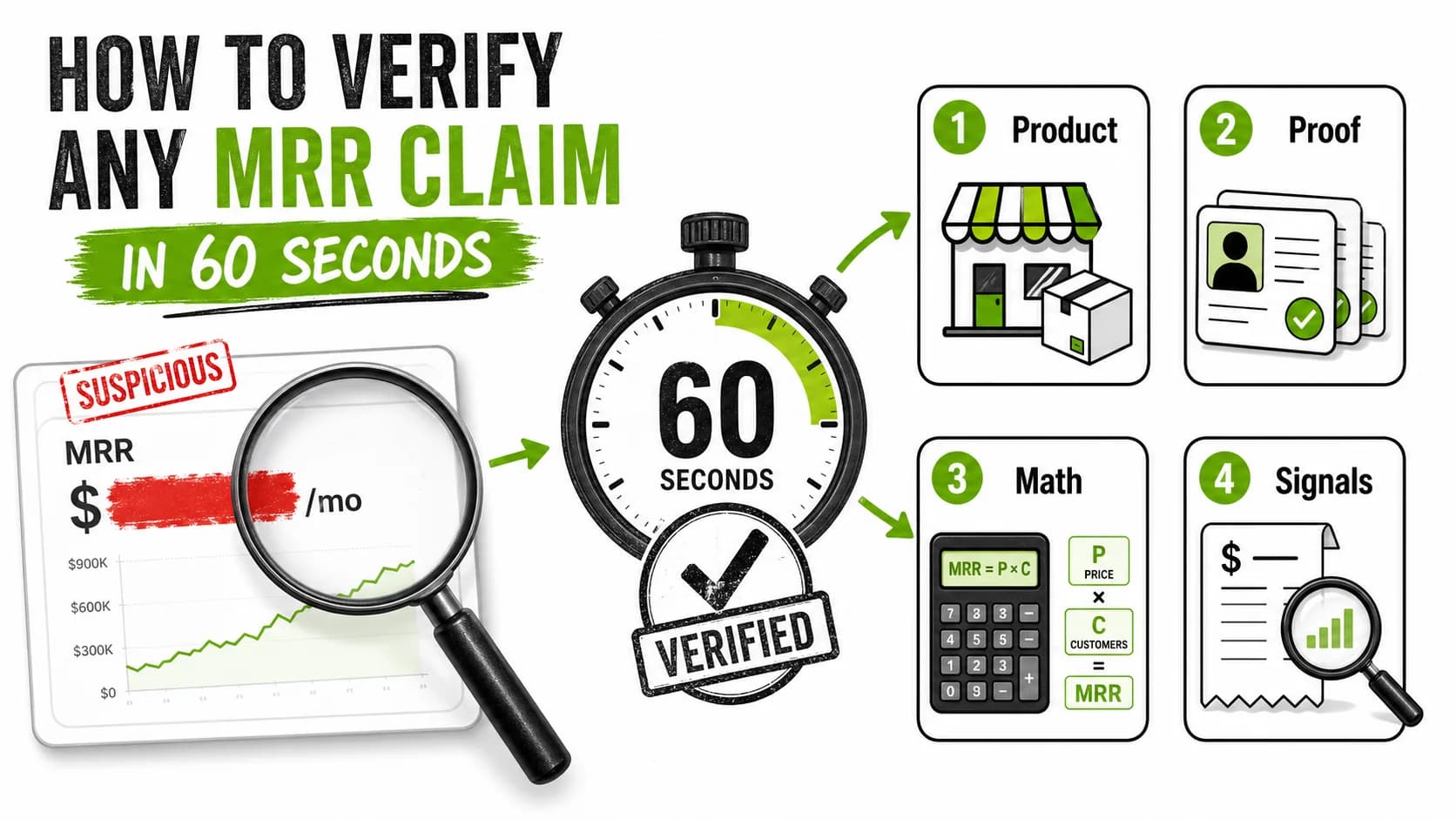
How to Verify Any MRR Claim in 60 Seconds
The Trust Problem
Someone on Twitter just posted a screenshot showing $47,000 MRR. Their thread is going viral. People are asking for their course link. Before you bookmark that thread or—worse—spend money on their "method," you have 60 seconds to perform a basic sanity check.
This guide gives you a practical verification framework. You won't be able to prove fraud definitively (that's not the goal), but you will develop a calibrated skepticism that protects you from the most obvious fabrications.
The 60-Second Framework
Step 1: The Product Check (15 seconds)
Open their website in a new tab. Answer these questions:
- Is there a real product? Can you sign up, see pricing, or use a demo?
- Is there social proof from identifiable customers? Not screenshots—actual named companies or people you can verify.
- Does the product justify the claimed revenue? A simple Notion template generating $47K MRR requires extraordinary proof.
Red Flag: The website is a landing page with no actual product, or the product is in "private beta" that's been "launching soon" for months.
Step 2: The Math Test (20 seconds)
Do the basic arithmetic:
MRR = Paying Customers × Average Revenue Per User
If they claim:
- $47,000 MRR
- Product priced at $49/month
- You'd need ~960 paying customers
Now ask: Does this person have evidence of reaching 960 real customers? Can you find 10 real people who use this product? 5? Even 1?
Red Flag: The claimed revenue requires more customers than there is evidence of users existing.
Step 3: The Timeline Audit (15 seconds)
Check their Twitter/X history using Advanced Search:
- When did they first mention this product?
- What was their claimed revenue 3 months ago? 6 months ago?
- Does the growth trajectory make sense?
Example calculation: If they claimed $5K MRR in October and $47K MRR in January, that's 840% growth in 3 months. Possible? Yes. Common? No. Worth scrutiny? Absolutely.
Red Flag: The revenue growth is impossibly steep, or there's no historical record of gradual building.
Step 4: The External Verification (10 seconds)
Search for the product name + "review" on Google. Check:
- Product Hunt (if applicable)
- G2/Capterra (for B2B SaaS)
- App Store/Play Store reviews
- Reddit mentions
- Independent blog reviews
Red Flag: A product generating $47K MRR has essentially zero external footprint. No reviews, no mentions, no community—nothing but the founder's own tweets.
Deep Verification (When You Have More Time)
The Social Blade Test
For creators claiming income from YouTube, TikTok, or similar platforms, use Social Blade:
Social Blade's estimates aren't perfect, but they're based on public view counts. If someone claims $50K/month from YouTube and Social Blade estimates $500-5,000/month, you have a significant discrepancy.
The Wayback Machine Test
Use the Internet Archive to check:
- When was their website first indexed?
- What did it look like?
- Does the timeline match their "build in public" narrative?
Someone claiming "3 years of bootstrapping" whose domain was registered 8 months ago has some explaining to do.
The LinkedIn Cross-Reference
For B2B founders claiming enterprise success:
- Check their LinkedIn connections
- Look for employees (or lack thereof)
- Verify claimed customers follow or engage with them
A "7-figure B2B SaaS founder" with no LinkedIn presence and no visible customer relationships is performing, not operating.
The Customer Interview Request
The nuclear option: politely ask if you can speak to one of their customers. Real founders usually accommodate this (it's free marketing). Fabricators deflect with "privacy" concerns or simply ignore the request.
Common Deflection Scripts (And What They Mean)
When you ask verification questions, fabricators follow predictable deflection patterns:
"Why do you care?"
Translation: I don't want to answer but don't have a credible reason to refuse.
"I don't owe you proof"
Translation: I don't have proof to offer.
"Check my threads/content for the journey"
Translation: My proof is the story I've told, not external verification.
"Haters gonna hate"
Translation: Reframing legitimate questions as personal attacks to avoid answering.
"DM me if you're serious"
Translation: Moving to private channels where there are no witnesses to inconsistencies.
The Verification Mindset
Verification isn't about being cynical—it's about being appropriately skeptical. Consider:
- Real founders welcome scrutiny. They're proud of what they've built and have nothing to hide.
- The burden of proof is on the claimant. Extraordinary claims require extraordinary evidence.
- Asking questions is not negativity. It's due diligence.
What Passes Verification
For contrast, here's what credible MRR claims typically look like:
- A public product you can sign up for
- Verifiable customers (named testimonials, case studies)
- Consistent historical record of gradual growth
- Founder engages with product-related questions substantively
- External validation (reviews, press, community discussion)
- Revenue claims include appropriate caveats ("before fees," "including annual contracts," etc.)
FAQ
Q: What if I don't want to be rude?
A: Asking polite verification questions isn't rude. "That's impressive! What's driving most of the growth?" is a normal business conversation. How they respond tells you everything.
Q: Can't screenshots be faked easily?
A: Yes. Screenshots alone are never proof. They're supporting evidence at best, theater at worst. Always look for external corroboration.
Q: What if they're legitimately private?
A: There's a difference between privacy and unverifiability. You can run a profitable business privately. You can't publicly claim $47K MRR for social capital while simultaneously refusing all verification.
Q: Should I call them out publicly?
A: That's your choice. Often, simply asking questions publicly is enough—their response (or lack thereof) speaks for itself.
Conclusion
You don't need forensic accounting skills to develop healthy skepticism. The 60-second framework—Product Check, Math Test, Timeline Audit, External Verification—catches the majority of fabricated claims.
The goal isn't to prove fraud. It's to protect your attention, your money, and your time from people who've optimized for the appearance of success rather than its substance.
The next time someone's revenue screenshot goes viral, take 60 seconds. It might save you from following fiction.
Learn more red flags with our FREE Pattern Recognition Guides. Share this framework to help others verify before they trust.
<!-- sister-projects-start -->
Other Doved Studio projects
Related tools from the same studio you might find useful:
- Ralphable: Generate structured Claude Code skills that iterate until pass/fail criteria are met.
- Doved Studio: Studio indie derrière cette app et une dizaine d'autres outils.
<!-- sister-projects-end -->