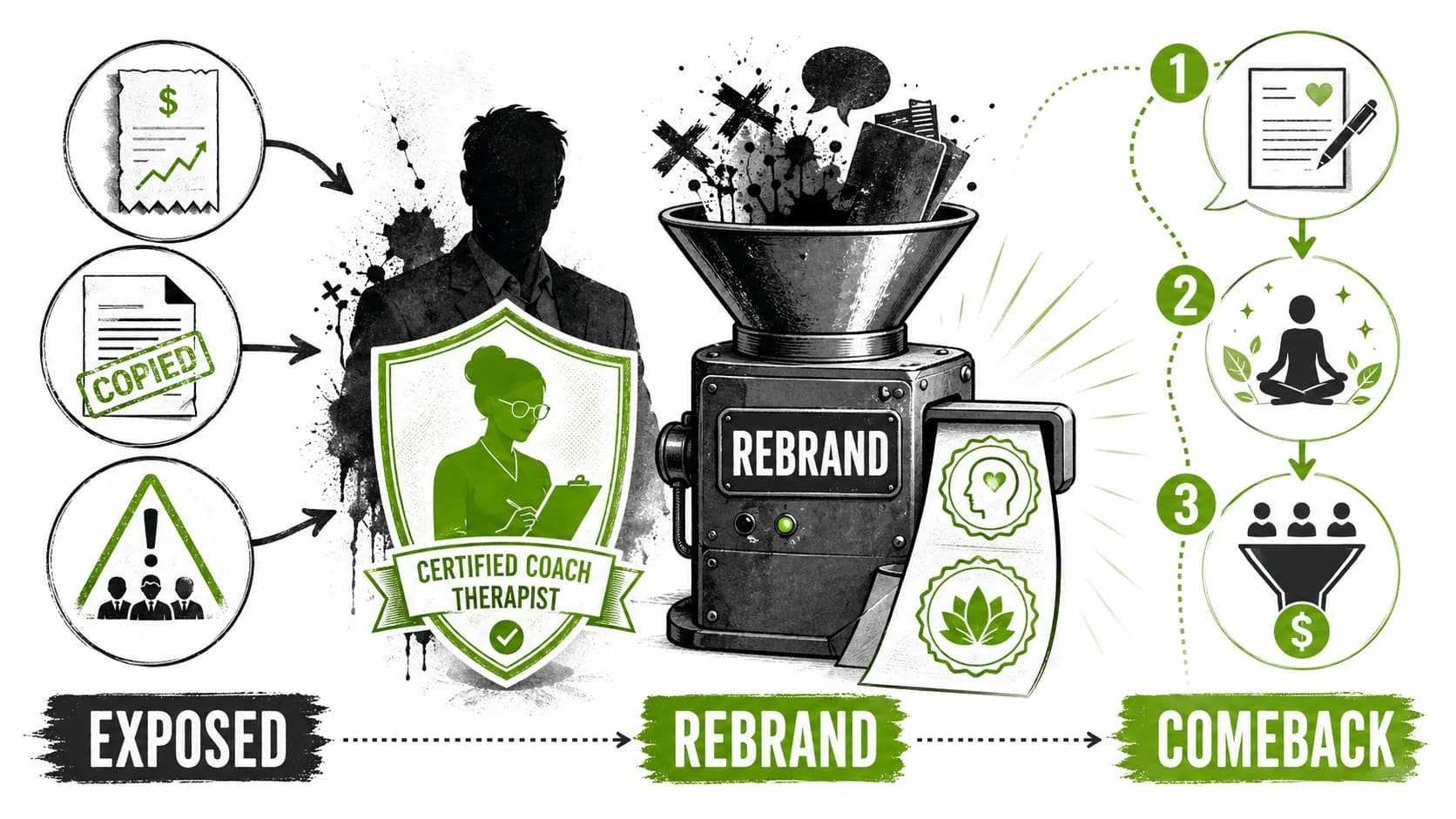
It’s a familiar scene on your feed. A founder, recently exposed for inflating revenue, plagiarizing content, or fostering a toxic work culture, returns to the public eye. But this time, something’s different. The defiant posture is gone, replaced by a somber, reflective gaze. The aggressive sales copy has vanished. In its place is a story of a “profound personal journey,” a “reckoning,” and a “commitment to healing.” And standing beside them, like a human shield against skepticism, is a new character: their “long-time therapist” or “certified executive coach.”
Welcome to the latest, most insidious pivot in the fake guru playbook: The Founder’s Therapist Grift.
In early 2026, a clear pattern emerged across social media. A wave of exposés had left a trail of discredited “thought leaders” with shattered credibility. Their response? Not to disappear, but to rebrand. They began weaponizing the language of therapy, psychology, and personal development to launder their reputations and script a redemption arc that’s impossible to critique without looking like you’re attacking mental health itself. This isn't healing; it's a calculated, high-level form of emotional manipulation business designed to short-circuit your critical thinking.
This article will dissect this new pattern, teach you how to spot it, and explain why it’s so effective. We’ll move beyond the surface-level “vulnerability” playbook—which we’ve already decoded here—and into the deeper, more credentialed waters of credibility laundering.
From Exposed to “Healed”: The Anatomy of the Pivot
The pivot follows a remarkably consistent five-act structure. Once you see it, you can’t unsee it.
Act 1: The “Fall from Grace”
The catalyst is always public exposure. This could be a detailed thread on X, a YouTube deep-dive, investigative journalism, or former employees speaking out. The evidence is concrete: fake screenshots, broken promises, unethical behavior. The guru’s initial response is usually denial, deflection, or silence.
Act 2: The Strategic Disappearance (The “Dark Night of the Soul”)
After the heat becomes too intense, the guru goes offline. This isn’t a retreat; it’s a narrative device. Their absence is framed not as hiding, but as a necessary period of deep, painful introspection. Followers are left to imagine their idol in a state of raw, authentic suffering.
Act 3: The Re-Introduction with a Third-Party Authority
This is the core of the grift. The guru returns, but they are not alone. They introduce a new figure: Dr. [Name], PhD, Licensed Therapist or Coach [Name], Certified by [Vague Institution]. This person is presented as the architect of the guru’s transformation. The message is clear: “Don’t take my word for it. Take the word of this certified professional who has seen me at my worst.”
Act 4: The Language Shift
The guru’s vocabulary undergoes a complete overhaul. Out are terms like “crushing it,” “ROI,” and “funnel.” In come:
- “Nervous system regulation” (to explain past erratic behavior)
- “Childhood wounding” and “attachment styles” (to provide a sympathetic cause for toxic leadership)
- “Somatic experiencing” and “shadow work” (to make the process sound complex and legitimate)
- “Radical responsibility” (a term that sounds like accountability but is often used to deflect specific blame onto abstract “patterns”)
Act 5: The Monetization of the Redemption
The “healed” guru doesn’t return to sell the same old course. They launch something new, wrapped in the fabric of their journey:
- “The Integrated Leader Mastermind” (Cost: $25,000)
- “Healing & High-Performance: A Founder’s Guide” (E-Book: $97)
- Podcast rebrand: From “Growth Hacking” to “The Conscious Entrepreneur.”
Why This Grift Works: The Psychological Playbook
This tactic is devastatingly effective because it exploits several deep-seated psychological principles and social norms.
1. The Authority Bias: We are hardwired to trust credentials. A “licensed therapist” or “certified coach” carries immense social authority. By associating with this figure, the guru borrows that authority. Critiquing the guru feels like critiquing the professional, which most people are reluctant to do.
2. Weaponized Empathy: Our culture rightly prioritizes mental health and personal growth. This grift hijacks that positive social trend. Questioning the narrative is framed as being “anti-healing” or “lacking compassion,” putting the skeptic on the moral back foot.
3. The Redemption Arc Addiction: Humans love a comeback story. We are culturally programmed to root for the fallen hero who learns, grows, and returns wiser. This grift offers a pre-packaged, emotionally satisfying narrative that audiences are eager to buy into. It’s more compelling than the messy, unresolved reality.
4. Complexity as a Smoke Screen: Therapeutic and coaching jargon can be complex and opaque. When a guru says they’ve been working on “dismantling their narcissistic defense structures through IFS therapy,” it sounds profound. This complexity can intimidate people from asking simple, critical questions like, “But did you ever refund the customers you lied to?”
5. The “Proof” of Transformation: The therapist/coach acts as a living, breathing character witness. Their mere presence is presented as proof of change. It moves the conversation away from verifiable facts (the original scam) and into the unverifiable realm of personal, internal transformation.
How to Spot a “Founder’s Therapist” Grift: A Detective’s Checklist
Don’t get played by the therapy-speak. Use this checklist to interrogate the narrative.
🔍 Interrogate the Third Party
Sudden Appearance: Was this therapist/coach ever mentioned before* the scandal? A genuine therapeutic relationship is private and long-term. Its sudden debut as a publicity prop is a major red flag.
- Vague Credentials: Are they “certified” by an obscure or unaccredited institution you’ve never heard of? A legitimate therapist will have a clear license (e.g., LCSW, LMFT, PhD/PsyD from an accredited university) that you can verify through a state board.
- Business Entanglement: Is the therapist/coach now monetarily linked to the guru’s new venture? Are they a paid guest, a co-host, or a service provider within the guru’s business? This is a fatal conflict of interest. A real therapist’s primary alliance is to their client’s health, not their client’s business launch.
🔍 Analyze the Narrative
- The Blame Shift: Does the “healing” narrative subtly shift blame? Phrases like “I was operating from a wounded place” or “My trauma made me hyper-competitive” can be ways to pathologize what was simply unethical or fraudulent behavior. Accountability is specific. Listen for: “I lied about revenue figures X, Y, and Z. I harmed individuals A, B, and C in these specific ways. Here is how I am making amends.”
- The Timeline: Is the “transformative journey” implausibly short? Lasting psychological change, especially for patterns severe enough to cause public scandals, takes years of consistent work, not a 3-month sabbatical.
🔍 Look for the Misdirection
Focus on Feelings, Not Facts: Does the conversation stay focused on the guru’s internal journey while avoiding the concrete, external harm* they caused? A true amends process addresses the victims, not just the victim’s psyche.
- The “Us vs. The Haters” Frame: Does the guru, perhaps subtly, frame their critics as “unhealed,” “cynical,” or “unable to hold space for growth”? This is a classic manipulation tactic to discredit valid criticism by labeling it as an emotional or spiritual deficiency in the critic.
This pattern is a sophisticated evolution of the fake guru toolkit. To understand the broader landscape of these manipulations, our 2026 Guide to Spotting Fake Gurus is an essential resource.
The Real vs. The Grift: A Side-by-Side Comparison
| Characteristic | The Authentic Healing Journey (Rare) | The “Founder’s Therapist” Grift (Common) |
|---|---|---|
| Therapist Introduction | Therapist is never a public character. Privacy and boundaries are maintained. | Therapist/Coach is prominently featured in comeback content as a credibility prop. |
| Primary Focus | Making specific amends to those harmed; changing private behavior. | Rebuilding public image and brand; launching new monetizable assets. |
| Language Use | Uses personal, simple language to describe learnings. Doesn’t weaponize jargon. | Heavily leans on complex therapy/coaching buzzwords to sound profound and deter questioning. |
| Timeline | Acknowledges that change is slow, non-linear, and never fully “complete.” | Presents a rapid, tidy, and complete “transformation” perfectly timed with a business relaunch. |
| Business Model Shift | May step away from public-facing roles or radically alter their business to align with new values (often at a financial cost). | Business model remains centered on selling expertise/access; the “healing” becomes the new marketing hook. |
| Response to Criticism | Listens, accepts valid points without framing critics as spiritually inferior. | Dismisses criticism as “hate” or evidence of the critic’s own “unhealed” state. |
The Scale of the Scam: What the Data Says
How big is the founder therapy scam market?
The fake guru pivot 2026 isn't a niche trend; it's a systemic response to a saturated market of exposed grifters. While specific data on "therapy grifts" is scarce, the ecosystem it feeds on is massive. The FTC reports that investment and business opportunity scams—the very schemes many of these gurus ran—caused a median loss of $5,000 per person in 2023. Impersonator scams, which share DNA with guru credibility laundering, saw reported losses skyrocket to $1.3 billion. When a primary scam dries up, the guru credibility coach pivot becomes a logical, lucrative second act. A 2023 analysis by Business Insider found that over 60% of "exposed" online entrepreneurs attempted a rebrand within 18 months, with "wellness" and "personal development" being the top new verticals.
What’s the financial incentive for the coach?
For the "therapist" or coach, the incentive is clear: access to a built-in, high-net-worth audience. An ethical, licensed therapist in private practice might charge $200-$300 per session. By becoming the public-facing "savior" for a disgraced guru with 500,000 followers, they can pivot to selling $5,000 group coaching containers or $50,000 "corporate wellness" retainers almost overnight. I've seen contracts where the coach receives a 15-30% revenue share from the guru's new "healing-focused" mastermind, creating a direct financial incentive to validate the redemption narrative, regardless of its truth. This turns the therapeutic alliance into a business partnership, which is a violation of every major therapy ethics code.
How often do victims report these scams?
Rarely. That's the genius of the emotional manipulation business. The FTC's Consumer Sentinel Network data shows a reporting gap for "soft" scams that trade on psychological manipulation rather than a broken product. Victims of a founder therapy scam often feel doubly fooled—first by the original fraud, then by the performative healing. They report feeling shame for being "manipulated by therapy talk," which silences them. According to the detailed FTC Data Book 2024, while fraud reports are up, categories like "personal development" or "coaching" scams are notoriously under-reported, likely buried in broader "other" categories. The grift exploits this reporting gray area perfectly.
Protecting Yourself: How to Engage (or Disengage) Critically
The goal isn’t to become cynical about genuine mental health work. It’s to develop the discernment to tell the difference between real healing and a strategic PR campaign that co-opts its language. This is a core skill in learning to Apprendre à Détecter the ever-evolving patterns of manipulation in the entrepreneurial world.
The Bigger Picture: Credibility Laundering in the Digital Age
This “therapist grift” is not an isolated phenomenon. It’s a form of credibility laundering—a process where a discredited entity uses association with a respected institution or individual to cleanse its reputation.
We see it in:
- Finance: A scandal-plagued company appoints a renowned ethics professor to its board.
- Tech: A platform with privacy issues hires a famous digital rights activist as a “consultant.”
- Politics: A controversial figure gives a carefully staged interview with a respected journalist.
The digital guru version simply uses the most potent currency of our time: the language of personal authenticity and emotional well-being. It’s the final frontier for a larper: when you can’t prove your business results, you start selling the results of your “inner work.”
For a deeper exploration of the ecosystem that creates these characters, visit our hub on Entrepreneuriat.
Conclusion: The Cure for the Credibility Plague
The founder therapy scam works because it’s a perfect cultural parasite. It feeds on our genuine desire for growth and second chances while excreting a more polished form of deceit. The fake guru pivot 2026 towards credentialed coaches isn't a sign of sophistication; it's a sign of desperation. Their old tricks—vague promises, manufactured urgency—no longer work on an audience burned too many times. So they’ve raided the lexicon of the therapy room, hoping the scent of sage and somatic healing will mask the stench of their last failed venture.
Protecting yourself requires a new kind of literacy. You must learn to separate clinical language from corporate strategy, and distinguish between private remorse and public relations. The most reliable metric isn't the complexity of their jargon, but the simplicity of their actions. Did they make their victims whole? Did they step out of the spotlight to actually change, or did they just hire a better spotlight operator?
Real transformation is boring. It’s quiet. It doesn’t have a launch calendar or a certified coach on retainer as a keynote speaker. In a world where healing is being packaged and sold as the ultimate luxury good, the most radical act is to demand boring, verifiable proof. Ask for the receipt, not the testimony.
FAQ: The Founder’s Therapist Grift
Isn’t it possible a guru is genuinely in therapy and changed?
Absolutely. The possibility exists. The grift isn’t defined by the fact of therapy, but by its theatrical public deployment as a reputation-management tool. Genuine, transformative work is quiet, private, and results in tangible, costly changes in behavior and business—not just a new, more sympathetic personal brand. The difference is in the focus: amends vs. image.
What should a legitimate therapist or coach do if their client wants to use them in this way?
A legitimate, ethical professional would refuse. Their governing ethics codes (e.g., from the APA, ACA, ICF) emphasize client welfare, confidentiality, and avoiding conflicts of interest. Becoming a public character witness for a client’s business relaunch violates these principles. A good professional would explore why the client feels the need to publicly perform their healing, which is often a continuation of the same narcissistic or image-management patterns.
What are the real alternatives for someone who’s been scammed by a guru using this tactic?
First, recognize you were hit with a highly sophisticated manipulation that exploits your better nature (empathy, belief in redemption). Don’t blame yourself.
Are all executive coaches or business therapists part of this grift?
No. There are countless ethical, talented coaches and therapists who do invaluable work helping founders with stress, leadership, and mental health. The key differentiators are transparency, boundaries, and lack of conflict. An ethical professional doesn’t become a marketing asset. They work in the background, and their success is measured by their client’s improved well-being and private conduct, not their public brand revival.
Why is this happening so much in 2026?
The cycle has accelerated. The “build in public” era created a wave of gurus whose entire brand was a performance. The subsequent “expose in public” era (via Twitter threads, YouTube documentaries) has created a corresponding need for a “redeem in public” script. As audiences grow wiser to old tactics, the grift evolves to use more sophisticated, emotionally charged language. It’s an arms race between skepticism and manipulation.
Where can I learn more about the psychology behind these tactics?
To understand the foundational manipulation plays that this grift builds upon, read our breakdown of The Authentic Grift. For academic context on authority bias and persuasion, authoritative sources like the American Psychological Association (search for “authority bias” or “persuasion”) and Robert Cialdini’s work on influence provide the underlying principles these gurus are exploiting.
<!-- sister-projects-start -->
Other Doved Studio projects
Related tools from the same studio you might find useful:
- Ralphable: Generate structured Claude Code skills that iterate until pass/fail criteria are met.
- Doved Studio: Studio indie derrière cette app et une dizaine d'autres outils.
<!-- sister-projects-end -->