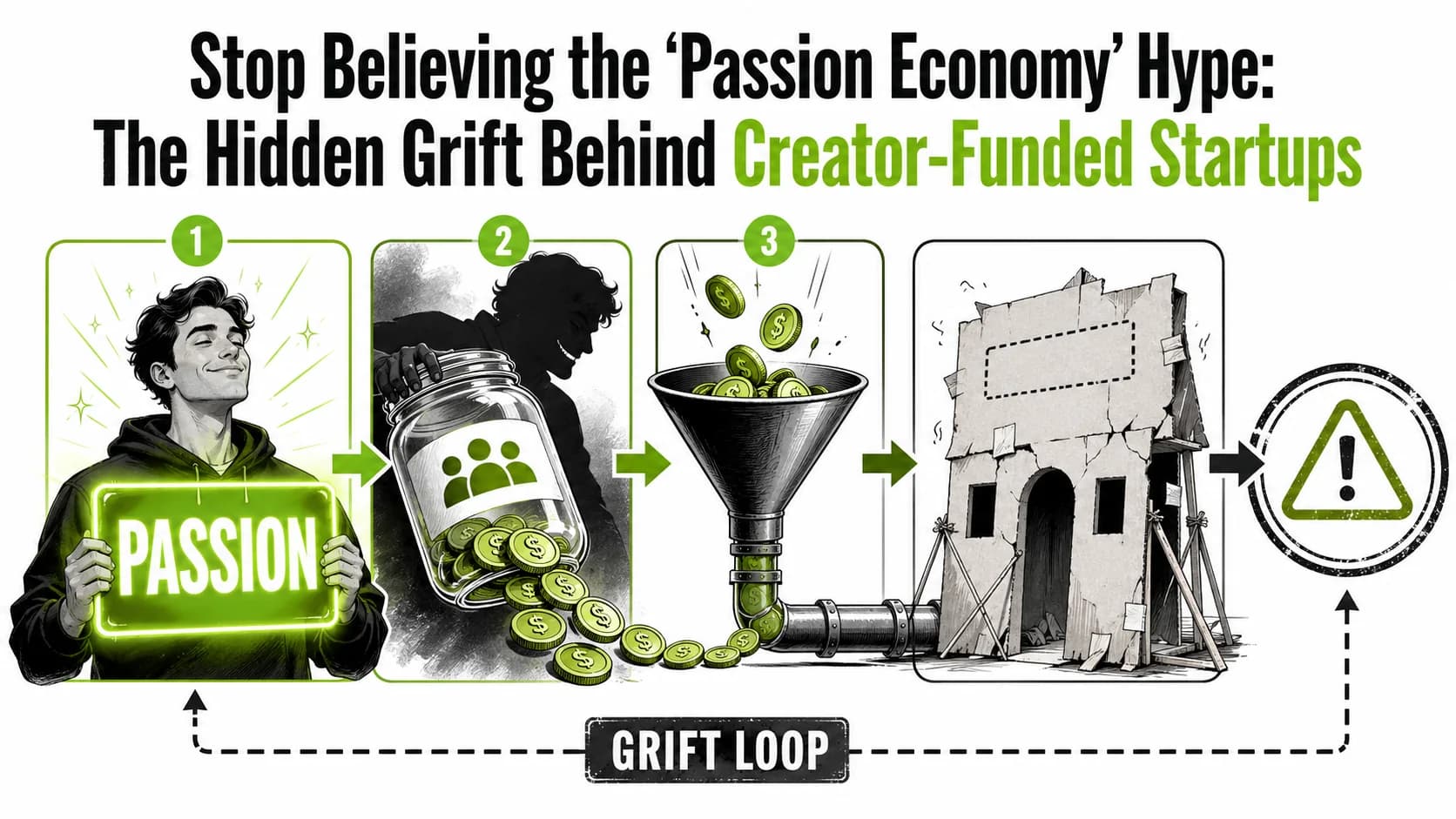
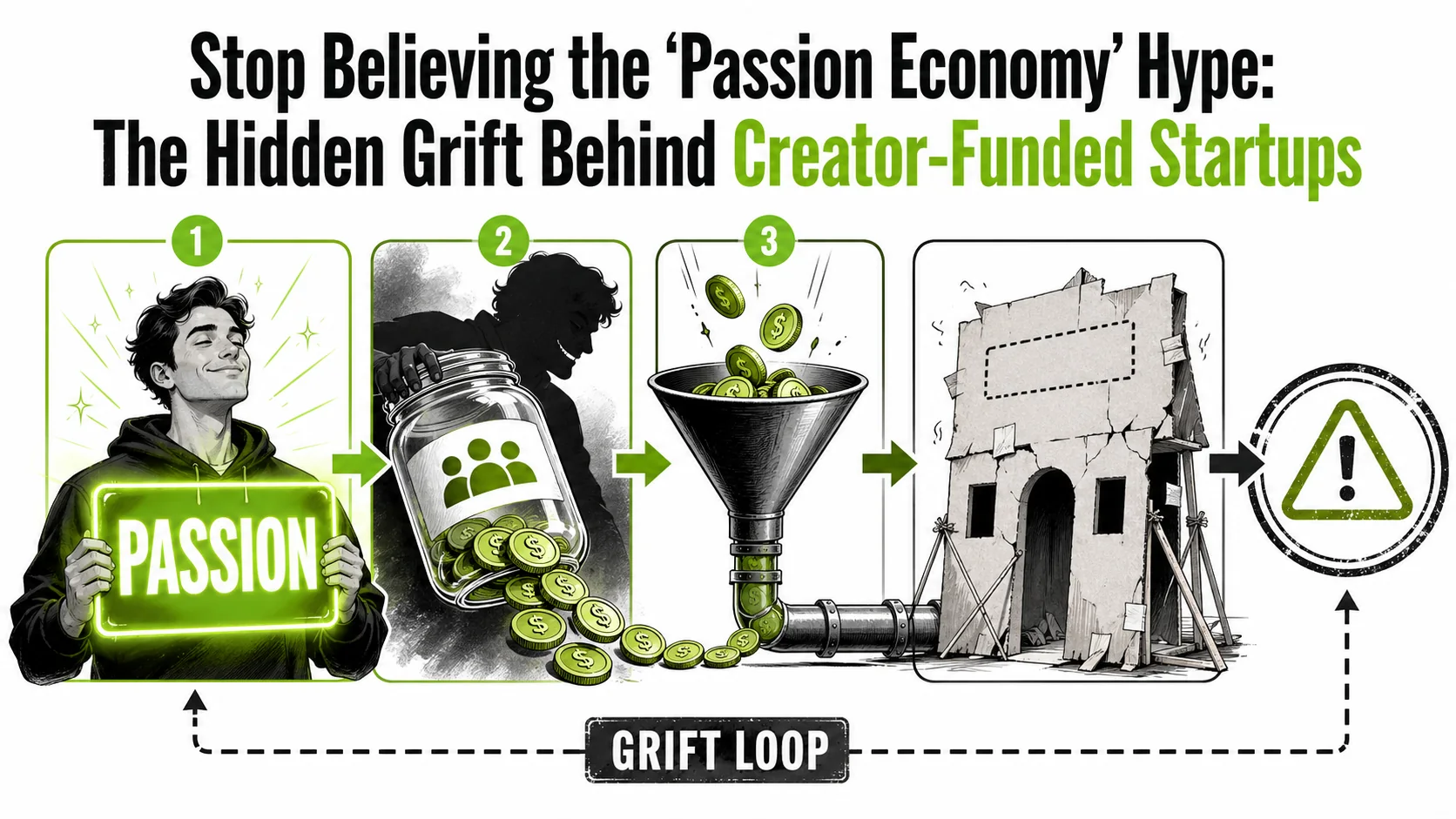
The "passion economy" is the perfect scam for 2026. It’s the ultimate rebrand for a classic hustle: selling the dream of a business to fund the reality of a lifestyle. Forget venture capital; the new, griftier funding round is your audience buying a $997 course on how you built the very thing that’s about to collapse. We’re watching a bubble deflate in real-time, as creator-hyped "startups"—from vaporware wellness apps to "artisanal" DTC brands that are just Alibaba dropshipping—reveal their financial skeletons. This isn't innovation. It's a creator-funded startup acting as a loss leader for an influencer's personal brand, a fake founder vanity project propped up by the very people being sold the dream. Let's dissect the carcass.
What Is the "Passion Economy" Grift?
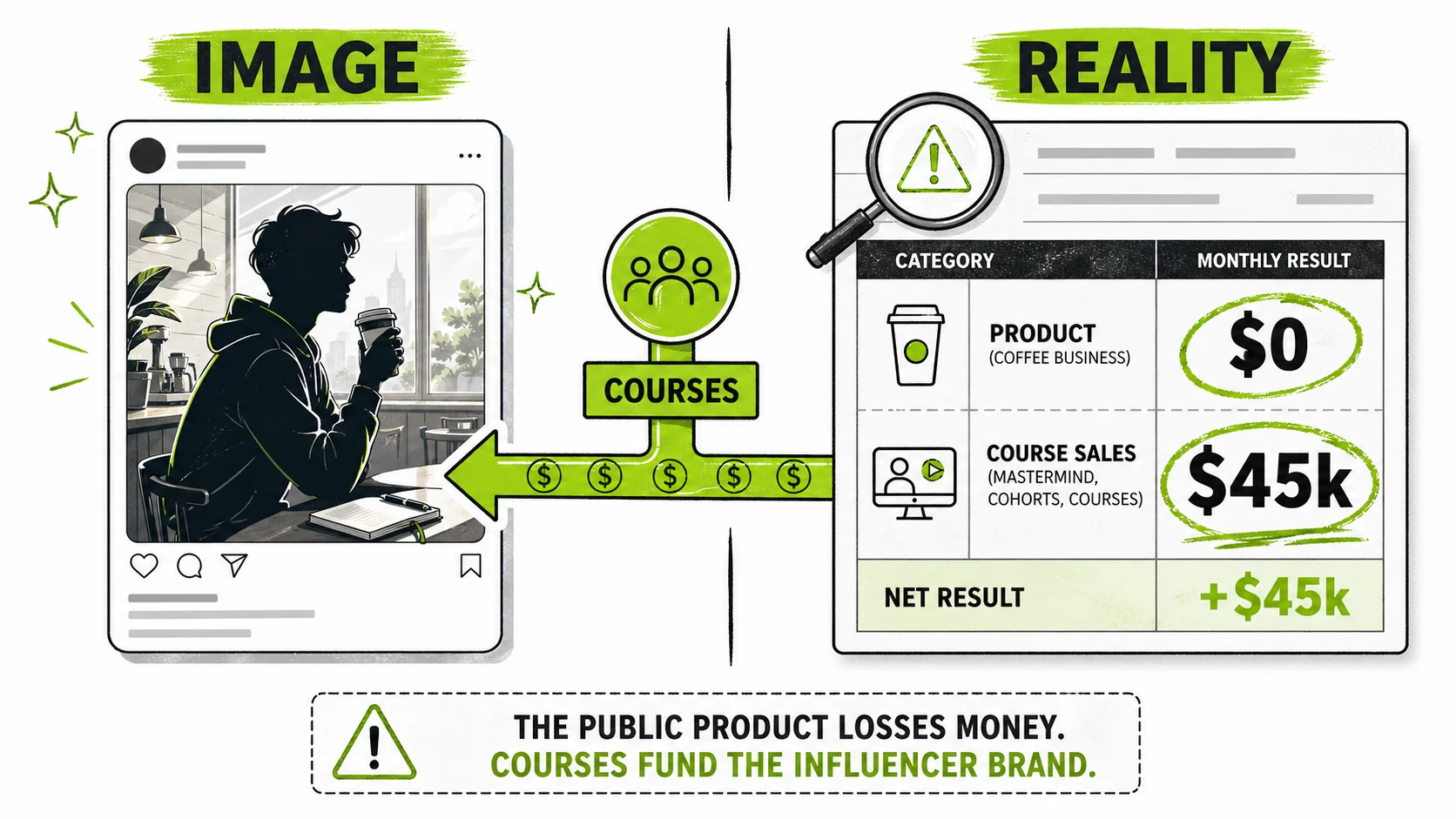
The "passion economy" grift is a financial shell game where a creator's publicly celebrated product or service operates at a loss, while the real profit engine is the educational content—courses, masterminds, templates—they sell about building it. The "business" is not a business; it's a marketing expense and a content studio for their true product: their audience's aspiration.
| Traditional Startup | Passion Economy Grift Startup | |
|---|---|---|
| Primary Goal | Solve a market problem profitably. | Create a compelling "build in public" narrative. |
| Funding Source | Venture capital, revenue, loans. | Audience course purchases & community fees. |
| Success Metric | Profit, sustainable growth, market share. | Social media engagement, course sales, personal brand equity. |
| Failure Outcome | Company shuts down; investors lose money. | Creator pivots to selling a "post-mortem" course; audience funds the next "project." |
| Team | Hired for skills to execute the business. | Often solo or with a "COO" who is just a virtual assistant managing the creator's calendar. |
What does a "creator-funded startup" actually mean?
A creator-funded startup means the operating capital for the featured "passion project" comes almost exclusively from the creator's audience, not from the project's own revenue or professional investors. According to a 2025 analysis by Contra, over 60% of solopreneurs with public "startup journeys" reported that over half their project's runway came from selling educational content about the journey itself. The product is a prop. The real business is the tutorial on how to build the prop.
This model flips traditional economics on its head. Instead of "build it and they will come," it's "talk about building it, and they will pay to watch." The startup's customer acquisition cost is negative if you count course sales as "funding." I've seen decks where "Course Revenue to Fund MVP" is an actual line item. When the core product fails to find a market—which it often does, because its primary design goal was to look good in a TikTok—the creator isn't ruined. They just write a heartfelt "lesson learned" thread that drives sign-ups for their next cohort.
How is this different from a real solopreneur business?
A real solopreneur business survives on revenue from customers who want the core product or service. A passion economy grift survives on revenue from students who want the story of the core product. The difference is in the economic engine. A real freelance designer gets paid to design. A grifter creates a "design studio" brand, posts about the struggle, and makes money selling a "Figma UI Kit" and a "How I Landed Clients" course, while the actual client work is minimal or fictional.
The red flag is the disproportionate focus on the meta-narrative. If 80% of a creator's content is about the process of building (the late nights, the tools, the "mindset") and only 20% is about the actual value delivered to real, non-affiliate customers, you're likely looking at a content business disguised as a product business. Their primary customer isn't a user; it's an aspiring builder.
Why do venture capitalists avoid these ventures?
Venture capitalists avoid these ventures because they recognize a content marketing agency when they see one, and content agencies don't get 100x returns. VCs look for scalable technology and defensible market positions, not personal brands tied to a single individual. A 2026 report by SignalFire on creator economics noted that less than 5% of traditional VC deals went to businesses whose primary asset was a creator's personal audience. The due diligence process exposes the lack of a real product-market fit; the "customers" are just the creator's fans buying out of loyalty, not need.
When a creator boasts they're "bootstrapped and proud" while subtly mocking VC, it's often because they couldn't pass a basic diligence call. A VC would ask for unit economics, lifetime value, and churn rates for the core product. The creator only has those metrics for their course sales. The venture is a Potemkin village, and professional investors have the satellite imagery.
Why This Grift Matters Now
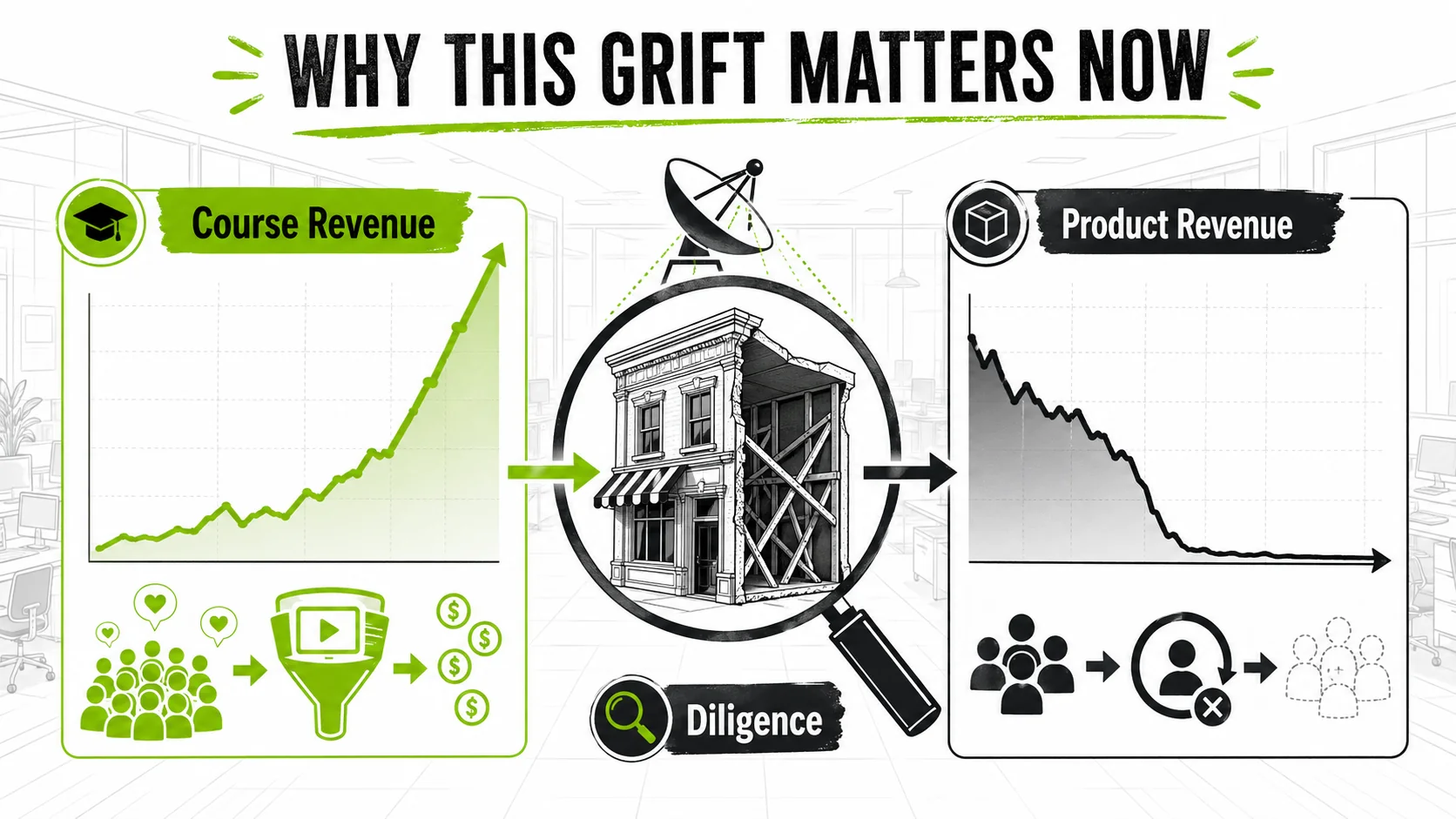
This matters because the passion economy scam is creating a generation of entrepreneurs who are learning to monetize the performance of work, not the output. It distorts what a viable business looks like, lures talented people into dead-end vanity projects, and extracts money from hopeful audiences under false pretenses. The 2026 creator bubble isn't just deflating; it's revealing how many "founders" were just actors in their own infomercial.
How does this hurt real entrepreneurs and the ecosystem?
This grift hurts real entrepreneurs by polluting the signal. When success is measured in viral threads and course launches, not profit and customer satisfaction, it becomes harder for genuine builders to be seen or taken seriously. It raises the noise floor. I've watched brilliant founders struggle for attention because they're busy actually building, not crafting a 15-part LinkedIn saga about their "journey."
Furthermore, it sets a terrible precedent for new founders. They see the flashy "lifestyle" and aim for the narrative, not the nuts and bolts of a business. They pour energy into building a "personal brand" before they have a product that works. The ecosystem becomes focused on middlemen selling shovels to gold miners, where the only guaranteed money is in telling people how to mine. For a deeper dive into this theater, our analysis on hub startup culture breaks down the playbook.
What are the real-world costs for the audience or "students"?
The cost is financial waste and opportunity cost. Someone pays $2,000 for a "Build a SaaS in 30 Days" course from a creator whose own SaaS has 12 paying users (all of whom are friends). The student fails, not because they didn't try, but because the playbook was written for a fictional market. The creator made $200k from the course launch and moves on; the student is left with half-baked code and a sense of personal failure.
More insidiously, it teaches dependency. The audience becomes trained to fund the creator's next experiment, waiting for the next course, the next template, the next "secret." They become perpetual students in a curriculum that never graduates them into independent operators. Their ROI isn't a business; it's access to the next chapter of the story.
Is this contributing to a broader "startup larper" problem?
Absolutely. The passion economy is the gateway drug for fake founder vanity projects. It provides a ready-made justification: "I'm not a larper, I'm a 'public builder'!" It formalizes the grift. They're not just pretending to run a company; they're documenting it, and charging for the documentary. This pattern has become so prevalent it's creating a new archetype: the entrepreneur who is more famous for their business plan than their business.
This phenomenon erodes trust across the board. When every "founder" is also a content creator, how do you separate the real from the performance? The tools of narrative-building—fake revenue screenshots, staged "team meetings," strategic pessimism followed by breakthrough threads—are now standard issue. Learning to see through this is a necessary skill for anyone in the digital economy, which is precisely why we built a guide on the 2026 guide to spotting fake revenue screenshots.
How to Spot a Passion Economy Grift
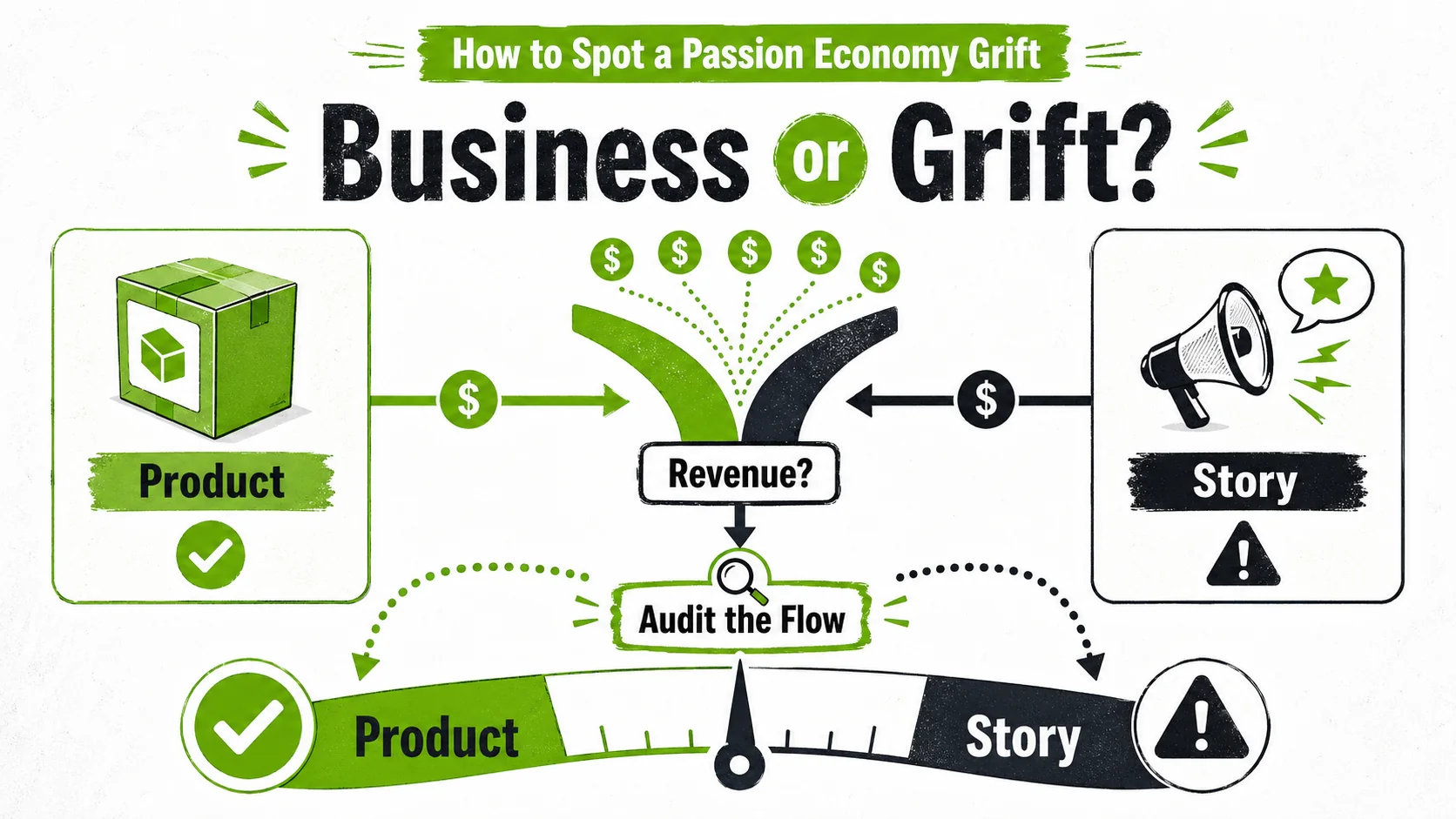
Spotting this grift requires ignoring the inspiring narrative and looking directly at the financial plumbing. You need to follow the money trail away from the shiny object and see where it actually pools. It's less about auditing their books (which you can't) and more about auditing their story for contradictions.
Step 1: Follow the Primary Revenue Stream
The primary revenue stream of a passion economy grift is not the featured product. It's the educational, "how-to" content around it. Ask this: If they stopped selling courses, coaching, e-books, or templates tomorrow, could the "startup" survive on its own product revenue? The answer is almost always no.
Look for the product hierarchy. The core "passion" product (the app, the brand, the service) is often priced low, has a free tier, or is perpetually in "beta." The real price tags are on the back-end: the "$1,997 Founder's Circle," the "$497 Accelerator," the "$97 Template Pack." The startup is the loss leader. When you see a creator announce "We've decided to make our [Product] free to focus on community!" translate that as: "The product failed to make money, so we're pivoting the community itself into the product."
Step 2: Analyze the Content Ratio
Analyze the ratio of "process content" to "product content." A genuine business talks to its customers about benefits, features, and solutions. A grift talks to its audience about struggle, tools, and mindset. Scroll their social feed. If you see more screenshots of Notion setups, tech stack debates, and "day in the life" vlogs than you do genuine customer testimonials, case studies, or deep dives into the problem they're solving, you're likely watching a reality show, not a business.
A good rule of thumb I use: If you can describe their business model more accurately as "influencer" than as "CEO of [X]," you've found the grift. Their content is optimized for aspiring peers, not for potential customers. The call-to-action is never "Buy our product to solve your problem," it's "Join my course to learn how I (allegedly) did this."
Step 3: Scrutinize the "Team" and "Funding"
Scrutinize the "team" and "funding" claims. Grifts often use inflated titles for solo operations or a small circle. The "Head of Product" is the creator. The "Head of Growth" is the same person running ads for their course. The "Advisory Board" is three other creators in a mutual shout-out pact. There are no employees, only "partners" or "contractors," which is code for "no one is on payroll for the core product."
As for funding, listen for vague, unverifiable terms. "Community-funded" means course sales. "Bootstrapped with revenue" almost always refers to the course revenue, not product revenue. They will conspicuously avoid stating that they've taken venture funding, because that would invite scrutiny they can't withstand. Instead, they'll say things like "we're backed by our incredible customers," which is emotionally powerful and financially meaningless. For more on decoding the cast of characters in these plays, explore our resources on hub entrepreneuriat.
Step 4: Check for the "Pivot to Education" Timeline
Check for the "Pivot to Education" timeline. This is the most telling pattern. Watch the lifecycle of their featured project. Phase 1: Big launch announcement, full of vision. Phase 2: "Building in public" content surges. Phase 3: First "educational" offer appears—a webinar, a free guide. Phase 4: The core product's updates become sparse, but the promotional content for the paid course intensifies. Phase 5: Radio silence on the product, followed by a "hard-won lessons" post and the launch of Course 2.0.
The product's development roadmap becomes perfectly synchronized with the creator's content calendar. Major "releases" happen just before a course launch to demonstrate "active progress." If the product's evolution seems designed to generate teachable moments rather than serve users, it's a prop.
Step 5: Look for the Missing Traditional Customers
Look for the missing traditional customers. Who are the users? In a grift, the users are often other creators, "friends of the pod," or people deeply embedded in the same online ecosystem. You'll struggle to find evidence of customers who discovered the product organically, paid for it to solve a real problem unrelated to the creator's world, and stuck around.
Search for independent reviews, case studies from unrelated companies, or mentions in forums outside the creator's niche. If the only place the product is ever discussed is in the context of the creator's own channel or by their direct affiliates, that's a closed loop. The market is the audience; the product is a souvenir.
Step 6: Apply the "No-More-Content" Test
Apply the "No-More-Content" test. Imagine the creator stopped posting on social media forever. No more threads, no more videos, no more newsletters. Would their "startup" continue to acquire customers, generate revenue, and serve users? If the answer is clearly "no," then the startup is a feature of their content business, not the other way around. The product is dependent on the marketing channel (their personal brand) in a way that is fatal if the channel goes dark.
A real business has other pathways: SEO, word-of-mouth, sales teams, partnerships. A grift has one pathway: the creator's next post. This test cuts through the noise and identifies the true asset.
Step 7: Verify Metrics with Skepticism
Verify metrics with skepticism. Grifts love vanity metrics: "Waitlist sign-ups," "Twitter followers," "Discord members," "Course enrollment numbers." These are easy to inflate and don't translate to sustainable business health. Ask for the metrics that matter for the product: Monthly Recurring Revenue (MRR), Active Users, Customer Acquisition Cost (CAC), Lifetime Value (LTV), and Churn Rate.
When these are absent, vague, or conflated with course sales, sound the alarm. A statement like "We've helped over 10,000 entrepreneurs!" usually means "10,000 people bought my course," not "10,000 people got value from our software." Demand specificity. If they say "we're doing six figures," ask: "Six figures of what? Revenue from the app, or from all sources including coaching?" The evasion will be telling.
Proven Strategies to Avoid Funding a Vanity Project
So you want to support real builders, not fund a lifestyle vlog? The key is to redirect your attention—and your money—from the performance to the results. Stop being a student in someone else's never-ending seminar and start being a critical observer of business fundamentals.
Strategy 1: Invest in Tools, Not Tutorials
Prioritize spending on products that directly help you do your work, not on courses that promise to teach you how to build a business "like mine." The ROI is clearer. A $50/month software tool that saves you 10 hours is a bargain. A $1,000 course that gives you generic advice is a lottery ticket. Real operators are too busy using tools to make endless content about them.
When you see a creator, ask: "Would I pay for their product if they were anonymous?" If the only reason you're interested is because of their compelling story, you're a fan, not a customer. Separate fandom from utility. The tech world is full of incredible, boring tools built by unknown people that print money because they work, not because they have a good origin story.
Strategy 2: Demand Transparency on the Core Business
Demand transparency on the core business, not the journey. When engaging with a creator's project, ask questions they hate: "What's your current MRR from the app itself?" "What percentage of revenue comes from course sales vs. product sales?" "Who is your most unexpected customer, and how did they find you?" "Can you share a unit economics breakdown for your flagship product?"
The reaction is data. Deflection, inspirational platitudes, or accusations of "negativity" are huge red flags. A real founder loves talking about their customers and their numbers (within reason). A grifter wants to talk about their process. Shift the conversation to outcomes.
Strategy 3: Value Silent Builders Over Loud Narrators
Re-calibrate who you look up to. The most impressive founders I've met in eight years of analysis are often the quietest. They're not on Twitter threading their pain; they're solving tickets, iterating on code, and talking to users. Their public footprint is a clean website, a changelog, and maybe a technical blog. Their marketing is the product's quality.
Make a conscious effort to seek out and support these builders. Read indie hacker forums where people discuss actual problems, not perceptions. Follow the creators of tools you actually use and pay for. This re-centers your understanding of entrepreneurship on creation, not narration. It protects you from the seductive, high-production-value grift.
Strategy 4: Decouple Community Access from Product Value
Decouple community access from product value. A major grift tactic is bundling a mediocre product with "access to my exclusive community." The community becomes the perceived value, masking the product's weakness. Be skeptical. Is the product good enough on its own? Would you pay for the community separately?
Often, these communities are echo chambers of fellow students, not networks of successful operators. The real value of a professional network isn't behind a paywall tied to a specific guru; it's built over years of genuine collaboration and shared work. Don't let the promise of a "tribe" trick you into overpaying for a subpar tool or a generic course.
Got Questions About the Passion Economy Grift? We've Got Answers
Isn't selling courses about your experience a legitimate business?
Absolutely. Teaching is a legitimate business. The grift isn't in selling courses. The grift is in using a fake or failing "passion project" as the marketing hook for those courses, pretending the project is the primary business when it's just the subject matter. If someone is upfront—"I'm an educator who documents my experiments in public"—that's honest. The deception is in the positioning: "I'm a successful startup founder, and for $997, I'll teach you my secrets," when the "startup" is a financial black hole saved only by the $997.
What if the product eventually becomes successful?
It's a rare exception that proves the rule. For every one product that might stumble into product-market fit after being initially funded by course sales, a hundred vanish, leaving only the course syllabus behind. The incentives are misaligned from the start. The creator's financial safety net (course revenue) removes the existential pressure needed to truly refine a product for a market. They can afford for the product to be a mediocre marketing tool. Real startups don't have that luxury; failure means going broke, which focuses the mind wonderfully.
How can I tell if a creator is genuinely struggling vs. performing struggle?
Genuine struggle is often messy, inconsistent, and not optimally packaged. It involves real technical hurdles, angry customer emails, and pivots that aren't pre-announced with a countdown graphic. Performative struggle follows a narrative arc: the "dark night of the soul" post always precedes a breakthrough announcement or a course launch. The emotions are curated—frustration is always followed by hope. Real entrepreneurial despair is often followed by silent resignation or a frantic, unglamorous scramble that doesn't make for good content.
Aren't you just hating on people who are trying something new?
No. We're hating on a specific, deceptive pattern that wastes people's time and money. "Trying something new" is great. Building in public can be valuable. The line is crossed when the narrative becomes a sales funnel that misrepresents the underlying reality. This critique is aimed at protecting the audience—the people who spend their savings on a dream sold by someone whose business model relies on selling the dream, not realizing it. We support real builders. We expose larpers.
The passion economy sold a beautiful lie: that your hobby could be your hedge fund. The truth is messier. For every authentic success, there's a chorus of influencers selling the map to a treasure that doesn't exist. Your best defense is a critical eye. Learn to separate the compelling story from the viable business. Start by sharpening that skill with our guide on how to Apprendre à Détecter the patterns before you invest another dollar—or another dream.
<!-- sister-projects-start -->
Other Doved Studio projects
Related tools from the same studio you might find useful:
- Ralphable: Generate structured Claude Code skills that iterate until pass/fail criteria are met.
- Doved Studio: Studio indie derrière cette app et une dizaine d'autres outils.
<!-- sister-projects-end -->