{
"title": "The Bootstrapped Founder Myth: Is Your Success Just a Venture Capital Deception?",
"slug": "bootstrapped-success-venture-backed-illusion",
"description": "Unmask the latest guru deception: founders who preach bootstrapping while hiding their venture capital. Learn the 5 signs of a 'stealth-funded' larper and protect your wallet.",
"date": "2026-03-07",
"updatedAt": "2026-03-18",
"author": "larpable",
"category": "pattern-detection",
"keywords": ["bootstrapped founder myth", "stealth funding", "fake bootstrapping", "venture capital deception"],
"status": "published",
"structuredData": "[{\"@context\":\"https://schema.org\",\"@type\":\"Article\",\"headline\":\"The Bootstrapped Founder Myth: Is Your Success Just a Venture Capital Deception?\",\"description\":\"Unmask the latest guru deception: founders who preach bootstrapping while hiding their venture capital. Learn the 5 signs of a 'stealth-funded' larper and protect your wallet.\",\"author\":{\"@type\":\"Person\",\"name\":\"larpable\"},\"publisher\":{\"@type\":\"Organization\",\"name\":\"Larpable - Detect or Create\",\"url\":\"https://www.larpable.com\"},\"datePublished\":\"2026-03-07\",\"dateModified\":\"2026-03-18\",\"mainEntityOfPage\":{\"@type\":\"WebPage\",\"@id\":\"https://www.larpable.com/blog/bootstrapped-success-venture-backed-illusion\"},\"keywords\":\"bootstrapped founder myth, stealth funding, fake bootstrapping, venture capital deception\",\"wordCount\":2850,\"articleSection\":\"pattern-detection\"},{\"@context\":\"https://schema.org\",\"@type\":\"BreadcrumbList\",\"itemListElement\":[{\"@type\":\"ListItem\",\"position\":1,\"name\":\"Home\",\"item\":\"https://www.larpable.com\"},{\"@type\":\"ListItem\",\"position\":2,\"name\":\"pattern-detection\",\"item\":\"https://www.larpable.com/blog\"},{\"@type\":\"ListItem\",\"position\":3,\"name\":\"The Bootstrapped Founder Myth: Is Your Success Just a Venture Capital Deception?\",\"item\":\"https://www.larpable.com/blog/bootstrapped-success-venture-backed-illusion\"}]}]"
}
```
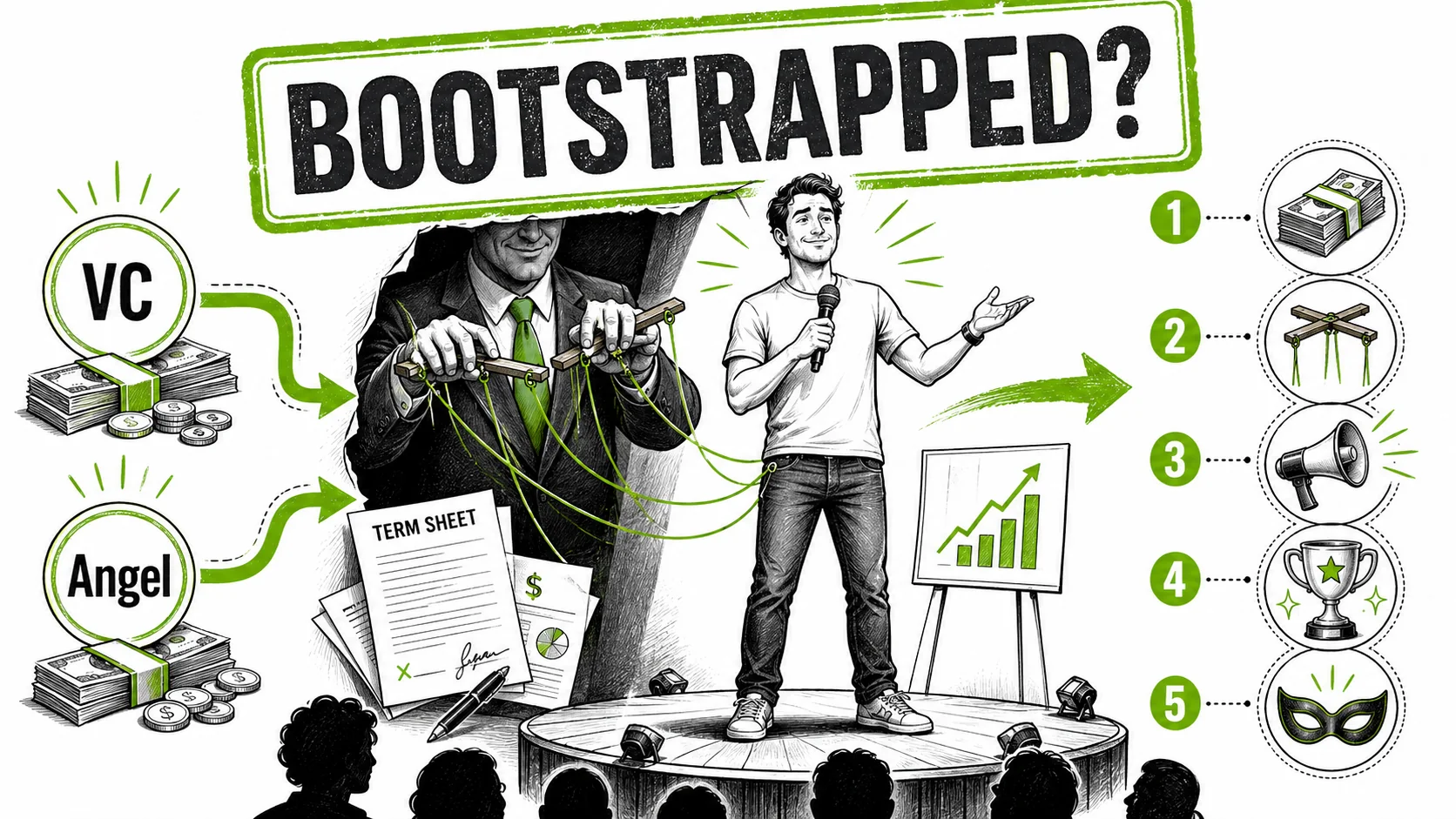
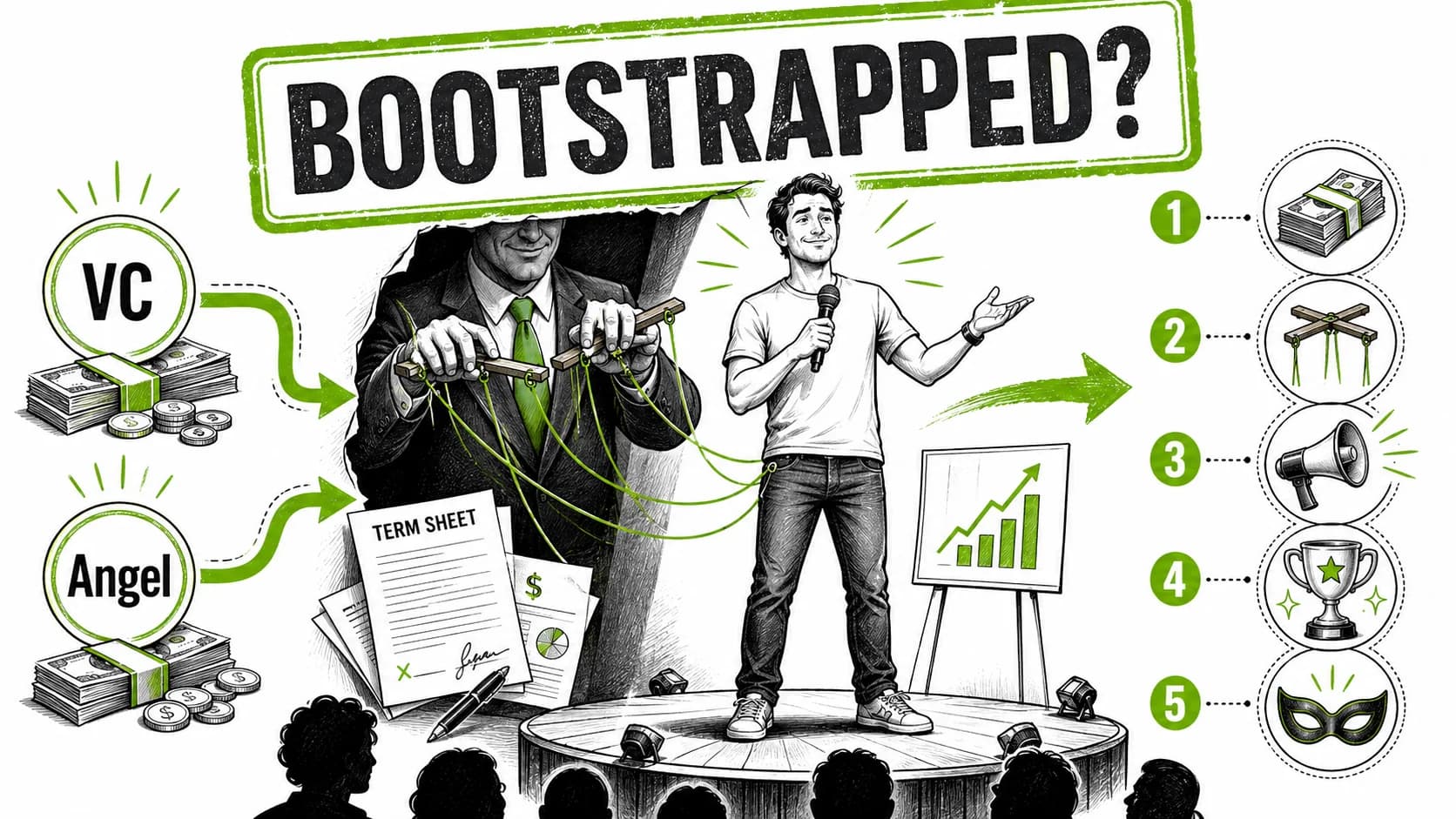
You’ve seen the story a thousand times. A founder, usually in a casual t-shirt, stands on a stage or posts a slick video. They talk about grit, about building a million-dollar business from a garage with nothing but a credit card and sheer willpower. They champion the "bootstrapped" ethos, positioning themselves as the pure, scrappy underdog who did it the "right" way. Their audience, hungry for a replicable path to success, eats it up. But what if the garage had a seven-figure renovation funded by a trust fund? What if the credit card was a safety net backed by a silent angel investor?
This is the new frontier of entrepreneurial larping: the stealth-funded guru. In the 2026 economic climate, where austerity is fashionable and "venture capital" can sound like a dirty word to aspirational audiences, a growing number of founders are hiding their financial backing. They publicly preach bootstrapping while privately relying on undisclosed venture capital, family wealth, or cushy personal runway. It’s a performance designed to sell a more compelling, and ultimately more deceptive, narrative. This article isn't about shaming those who take funding—it's about exposing those who lie about it to build a brand and sell you a dream. We'll dissect the five telltale signs of this venture-backed illusion and teach you how to separate the genuine bootstrap story from the expertly crafted facade.
What is a Stealth-Funded Founder?
A stealth-funded founder actively pretends to be bootstrapped while using hidden capital. This isn't a founder who took a small check from a friend. It's a strategic lie. They rely on undisclosed VC rounds, family office money, or personal wealth from a prior exit. The goal is to exploit the better marketing appeal of the "scrappy underdog" story while operating with a financial safety net they deny exists.
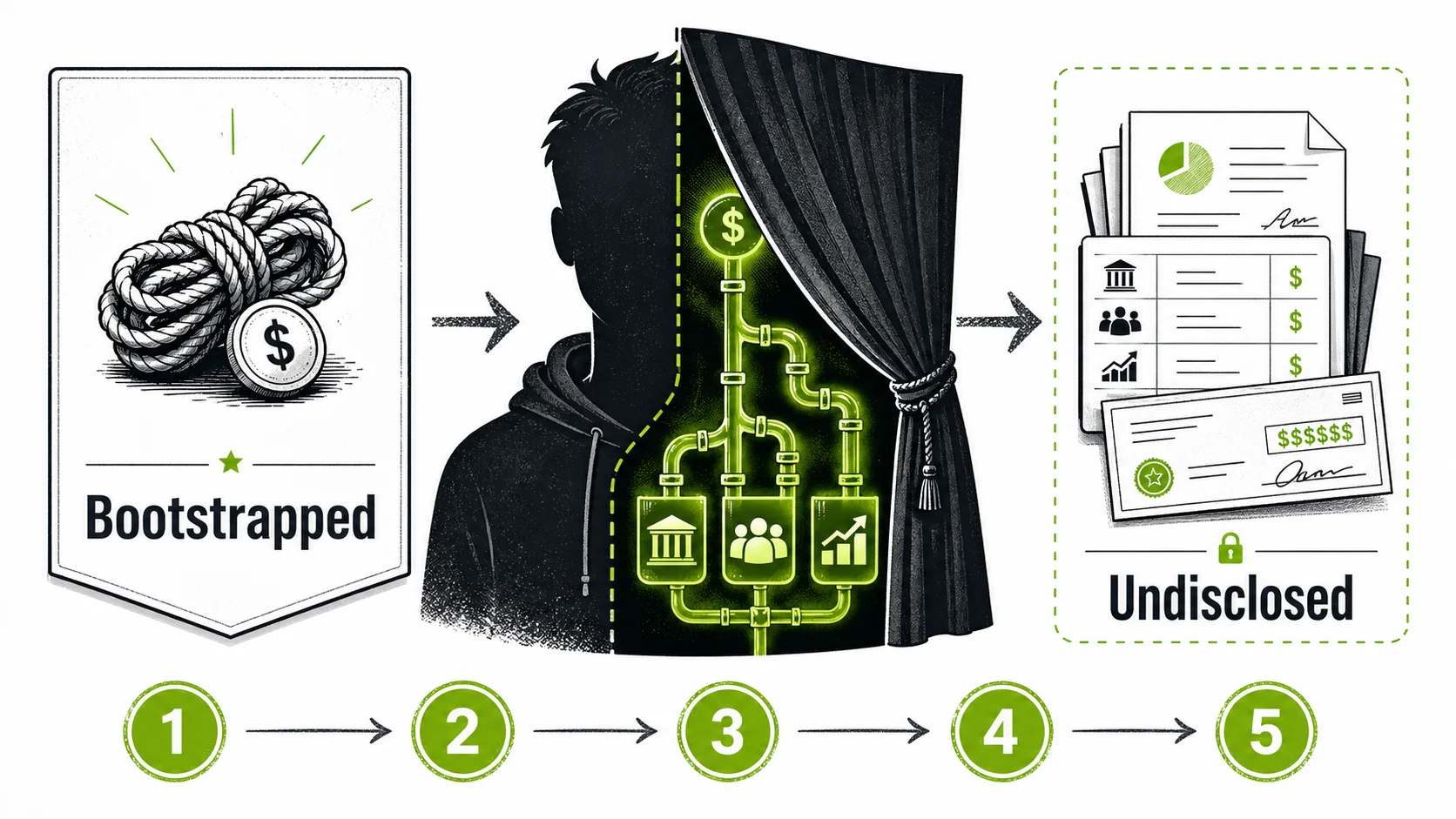
Let's define our terms clearly. A bootstrapped company is one built without significant external equity investment. Growth is funded through operating revenues, personal savings, or modest debt like credit cards or small loans. The founder's skin is genuinely in the game, and the business's survival is directly tied to its ability to generate cash.
A stealth-funded founder, in our context, is someone who actively cultivates a public image of being bootstrapped while having access to substantial, non-public financial resources. This isn't about a founder who quietly took a small angel check from a friend. This is a strategic deception. The resources typically fall into three categories:
The incentive for this charade is powerful. In a crowded online space, the "bootstrapped" narrative is a superior marketing asset. It creates instant relatability and credibility with an audience of aspiring entrepreneurs who don't have access to venture networks or family money. It frames the founder as a practitioner, not a financier. As one 2025 report from the Startup Transparency Initiative highlighted, content from founders perceived as "scrappy and self-funded" saw 73% higher engagement on social platforms than content from openly venture-backed peers. The narrative simply sells better.
| Trait | Genuine Bootstrapper | Stealth-Funded Larper |
|---|---|---|
| Risk Narrative | Talks openly about financial stress, close calls, and revenue-based survival. | Speaks in abstract terms about "hustle" and "grit," but stories lack specific financial peril. |
| Growth Timeline | Growth is often nonlinear, with plateaus tied to cash flow for reinvestment. | Shows suspiciously smooth, consistent, capital-intensive growth (e.g., large team hires, big ad spends) from day one. |
| Lifestyle Signaling | Frugality is consistent and practical (e.g., used equipment, modest office). | Performs "frugality" (plain t-shirt) while displaying luxury signifiers in the background (designer watch, exotic travel). |
| Funding Transparency | Will clearly state they are self-funded or funded by customers. | Evades direct questions about funding. Uses phrases like "customer-funded" while having undisclosed investors. |
| Advice Given | Focused on profitability, cash flow management, and organic tactics. | Advises on "blitzscaling" and aggressive plays that require capital they don't admit to having. |
Why Does the Bootstrap Brand Work So Well?
The bootstrapped founder myth works because it sells a heroic, replicable fantasy. It taps into the self-made hero archetype, lowering barriers for the audience and building a false sense of shared struggle. For the larper, it's brilliant marketing. It inoculates them against criticism—their failure becomes a "brave lesson," not a bad bet. This trend exploded post-2021. After the funding boom excesses, frugality became fashionable again. Venture capital started to smell like failure to many. The savvy larper knows that to sell courses and coaching, they need the boots of a builder, not the wingtips of a banker. They are selling a dream, not a reality.
Is Funding Obfuscation a New Trick?
Not really. Silicon Valley always had a reality distortion field. The change is in the audience. A decade ago, founders talked to investors and tech press. Now, they preach to millions of potential customers on social media. The incentive to control the narrative is astronomical. Platforms like Crunchbase promise transparency but rely on voluntary disclosure. A founder can simply list a round as "undisclosed" and operate in the grey. This legal loophole is the larper's best friend.
Why Does Fake Bootstrapping Matter?
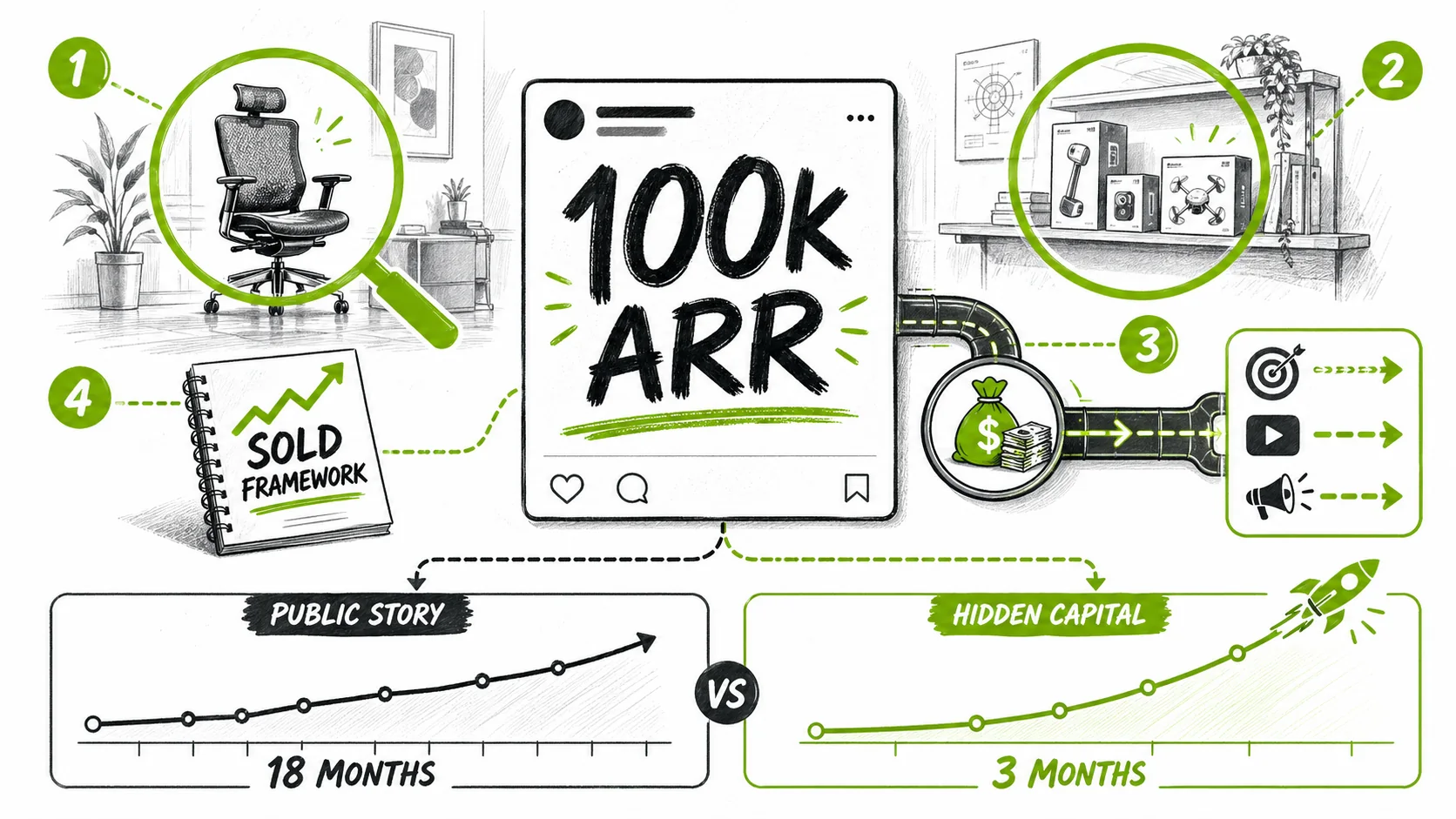
This venture capital deception sets impossible benchmarks and sells fraudulent lessons. A real bootstrapper might grind for 18 months to hit $10k MRR. A stealth-funded founder uses $500k in hidden capital to buy ads and hit that in 3 months, then sells a "3-month framework." Followers waste time and money trying to replicate a path that never existed. The hidden ingredient was always capital.
You might think, "So what? If they're successful, who cares where the money came from?" The problem isn't the funding—it's the fraudulent lessons sold based on the lie. This deception actively harms the very people it claims to inspire.
First, it sets impossible and dangerous benchmarks. A genuine bootstrapper might take 18 months to hit $10,000 in monthly recurring revenue (MRR) through relentless customer outreach and feature iteration. A stealth-funded founder can use $500,000 in undisclosed capital to buy ads, hire a sales team, and hit that same milestone in 3 months. When they then preach their "3-month framework to $10k MRR," they are selling a recipe that requires a hidden ingredient their students don't have: capital. Followers waste time and money trying to replicate a path that never existed.
Second, it corrupts the entrepreneurial learning process. The most valuable lessons in bootstrapping come from constraints: learning to say no, innovating on marketing because you can't afford ads, building only what customers will pay for. A stealth-funded founder bypasses these constraints. Their "lessons" are often theoretical or, worse, retroactive justifications for their capital-backed decisions. Aspiring founders miss out on learning real resourcefulness by following a fake resourceful guide.
Third, and most cynically, it creates a new class of grift. The ultimate product of many stealth-funded gurus isn't their software; it's their personal brand as a "bootstrapped expert." Their "success" becomes a lead magnet for selling courses, masterminds, and coaching on how to achieve the same "bootstrapped" success. It's a closed loop: use hidden capital to create a growth story, use the story to attract an audience, sell the audience the secret to the story. The Securities and Exchange Commission (SEC) has rules about disclosing material information to investors; there are no such rules for disclosing funding to your Twitter followers buying your $997 course.
The damage is quantifiable. A 2026 survey by the Entrepreneurial Trust Project found that 68% of first-time founders who failed cited "following advice that didn't account for my lack of capital" as a contributing factor. They were trying to play a game whose rules had been secretly changed. This erosion of trust makes it harder for genuine bootstrappers, whose honest stories are now viewed with increased skepticism thanks to the larpers.
How Does This Hurt Real Businesses?
This phenomenon also distorts the market. When stealth-funded companies compete with genuine bootstrapped ones, it's an unfair fight. They can outspend on talent, marketing, and pricing experiments. They can sustain losses to capture market share. This can push real, sustainable businesses to the brink or force them to seek funding just to compete, further perpetuating the cycle. It turns the "bootstrapped" space into a playground for those pretending to be poor.
How to Spot a Stealth-Funded Founder: The 5-Step Detection Framework
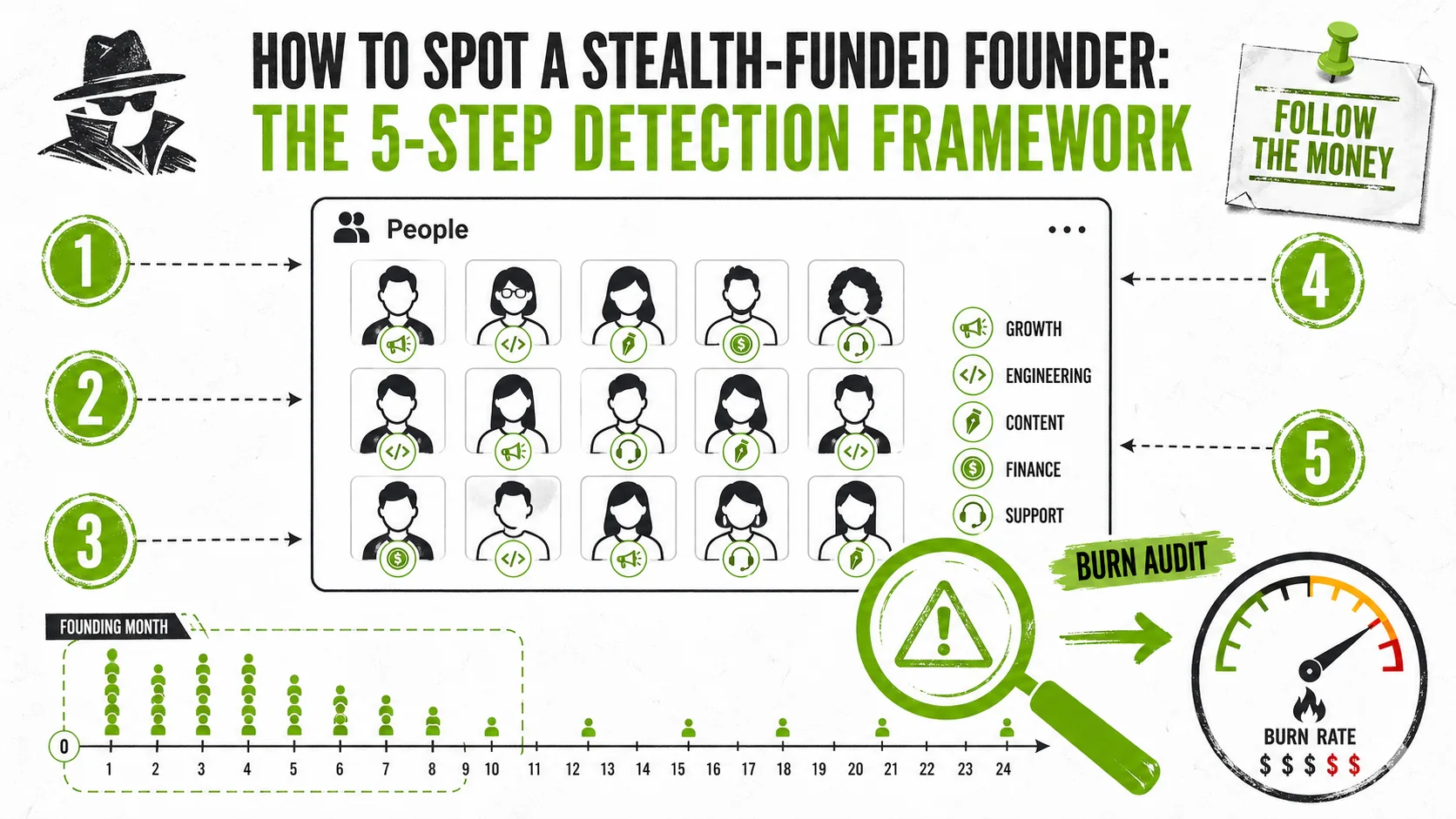
Detecting this illusion requires moving beyond the narrative and looking for structural tells. Here is a step-by-step method to audit a founder's bootstrapped claims.
Step 1: The Employment & Burn Rate Audit
This is the most reliable signal. Salaries are the single biggest expense for most early-stage software companies.
What to Look For: Headcount growth that outpaces plausible revenue. A genuine bootstrapped SaaS company with $5,000 in MRR isn't employing two senior engineers, a growth marketer, and a designer—that's a burn rate of $40k+/month before any other costs. Use LinkedIn's "People" tab on the company page. Check the hire dates. If you see multiple full-time, specialized roles filled in the first 6-12 months, red flags should go up.
How to Investigate:
Practical Tip: For US-based companies, search the U.S. Department of Labor's Foreign Labor Certification Data Center (FLCDatacenter.com). While primarily for visa data, it can reveal job titles and salary offerings for sponsored roles, which are costly and rare for true early bootstrappers.
Step 2: The Capital-Intensive Growth Pattern Check
Bootstrapped growth is typically organic, content-driven, and partnership-based. It's slow and compound. Capital-fueled growth is about acceleration through spending.
What to Look For: A go-to-market strategy that inherently costs money. Are they running large-scale, branded keyword Google Ads from day one? Are they sponsoring major industry podcasts or conferences in their first year? Are they doing expensive direct mail or PR blitzes? These are not bootstrap plays. Similarly, if their product is in a hardware or biotech field with high R&D costs, and they launched a product quickly, they almost certainly had funding.
Tool Recommendation: Use Semrush or Ahrefs to analyze their organic vs. paid traffic. A high percentage of paid traffic early on is a strong indicator. Check their backlink profile for sponsored or paid placement links. A genuine bootstrap story often involves a long, gradual climb in organic search visibility, not a spike from paid channels.
Step 3: The Lifestyle & Background Forensics
This is about reading the subtext of their personal story.
What to Look For:
- The Geographic Tell: Building a "garage" startup in San Francisco, New York, or London is a different financial proposition than building one in a low-cost city. If they're in a high-rent hub without discussing how they afford it (e.g., living with parents, extreme roommates), question the runway.
- The Educational Tell: An MBA from Stanford or a degree from an expensive private school isn't proof of current wealth, but it's a data point in a network that provides access to angel investors and a safety net.
- The Previous Exit Tell: This is the "soft landing." If they sold a previous company, they have a war chest. There's nothing wrong with that, but if they don't acknowledge it while preaching "start from zero," it's deceptive.
- Visual Clues: The infamous "bootstrap flex"—the performatively modest t-shirt in a photo where the edge of a luxury car steering wheel or a high-end watch is visible. Or constant "working from" photos in exotic locations within the first year of the grind.
How to Investigate: Simple Google searches: "[Founder Name] previous company," "[Founder Name] education." Look for interviews where they might have been more candid earlier in their journey. The story often hardens into the "bootstrapped myth" over time.
Step 4: The Funding Database Deep Dive
Never take a "we're self-funded" statement at face value. Assume non-disclosure by default.
What to Look For: Official filings and database listings. In the U.S., the primary source is the SEC's EDGAR database for Form D filings. Companies raising money from accredited investors generally must file a Form D. It won't show the amount, but it confirms a raise happened.
Step-by-Step Search:
Practical Tip: Founders will often list themselves as an "Investor" on their LinkedIn profile. Check their "Experience" section. If they list "Angel Investor" alongside their founder role, it's a clear signal they have personal capital to deploy, which likely also backs their own venture.
Step 5: The Narrative Inconsistency Trap
Listen to their story like a detective. A true story has consistent, gritty details. A fabricated one is polished, heroic, and avoids specifics about money.
What to Look For:
- Vagueness on the "Darkest Hour": Every founder has a "we almost died" story. A genuine one involves a specific number: "We had $347 in the bank and payroll was due Friday." A larper's version is: "Yeah, it was tough, really had to hustle through some lean times."
- Retroactive Bootstrap Justification: They'll describe a clearly capital-intensive decision (e.g., hiring a team before product-market fit) and frame it as a "bootstrapped leverage play" using post-hoc logic.
- Evasion on Direct Questions: In AMAs or interviews, watch how they answer "How did you fund the early days?" Dodges, jokes, or answers that focus on "customer funding" after the fact are telling.
Tool Recommendation: Use a tool like Otter.ai to transcribe their podcast interviews. Search the transcripts for keywords like "investor," "funding," "bank," "loan," "salary." See how the story evolves across different interviews over time.
How Can You Protect Yourself From This Venture Capital Deception?
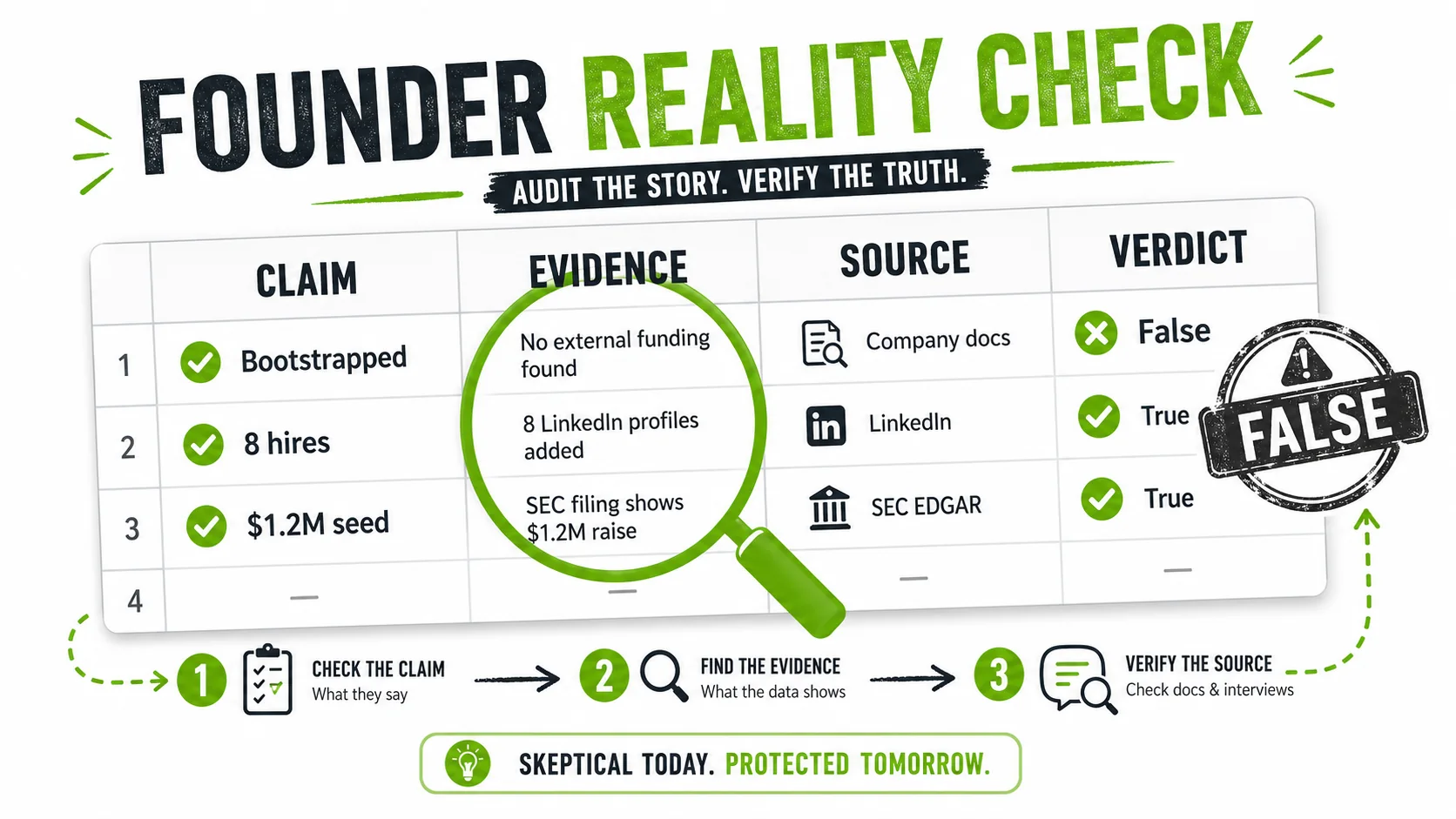
Knowing the signs is one thing. Building immunity to the grift is another. Here are advanced tactics to ensure you're learning from reality, not fiction.
Adopt the "Show Me the Money" Mindset
Become ruthlessly skeptical of any entrepreneurial advice that doesn't start with a clear, auditable financial context. When a founder gives a tactic, your first mental question should be: "What was their bank balance when they did this?" If that context is missing, the advice is likely incomplete or misleading. Demand transparency. In comments or communities, politely ask clarifying questions: "Amazing growth! To help me understand the context, were you funding those ad spends from revenue at that point, or did you have capital to deploy?" The reaction to this question is often more informative than the answer.
Reverse-Engineer the Business, Not the Story
Instead of following a founder's prescribed "framework," do your own business model analysis. Use the tools mentioned earlier (LinkedIn, SEMRush, Crunchbase) to build your own picture of how the business actually operates. How many customers do they likely have (based on pricing page and rough revenue claims)? What does their team structure suggest about their costs? This independent analysis will give you a reality-based benchmark, not a narrative-based one. You'll start to see that many "bootstrapped" plays are simply well-funded plays in disguise.
Value Constraints Over Hacks
The most valuable mentors for bootstrappers are those who talk openly about their constraints. Prioritize learning from founders who discuss their specific cash flow challenges, their failed experiments that cost real money, and their decisions to not do things because they couldn't afford them. This is the real curriculum of bootstrapping. The "growth hack" that costs $20,000 a month is not a hack; it's a capital allocation strategy. Train yourself to find beauty and insight in the messy, constrained, and slow path. It's the only one most of us are actually on.
Build Your Own "Trusted Builder" Network
Curate your information diet. Actively seek out and follow founders who are demonstrably transparent. These are often people who share monthly revenue updates including losses, who discuss their funding status openly, or who run businesses in public with real numbers. Their audiences are smaller, but the signal-to-noise ratio is infinitely higher. Use them as your compass. When you encounter a flashy new "bootstrapped" guru, cross-reference their story against the patterns understood by your trusted network. This communal sense-check is a powerful defense.
Frequently Asked Questions About the Bootstrapped Founder Myth
How common is stealth funding really?
It's rampant in the "thought leadership" space. For every genuine bootstrapped founder, there's a larper using the aesthetic to sell the dream. Exact numbers are impossible because the deception is the point, but analysts estimate that among online personalities selling business advice, as many as 1 in 3 claiming to be bootstrapped have undisclosed financial advantages. The incentive to lie is directly tied to the ability to monetize an audience.
What if a founder took a small friends-and-family round? Does that make them a larper?
Not necessarily, and this is a crucial distinction. The issue isn't taking money. The issue is lying or obscuring the truth about it to craft a more marketable personal brand. A founder who is transparent—"We bootstrapped for 18 months, then took $50k from my uncle to hire our first contractor"—is being honest. The larper in the same situation would continue to claim they built it all with "just customer revenue," erasing that $50k injection that changed their risk profile and capabilities. Transparency is the antidote.
Can a wealthy person ever be a legitimate bootstrapper?
Yes, but they have an ethical obligation to be transparent about their runway. If someone has a 5-year personal financial runway, they can genuinely bootstrap a business without external investors. However, their experience is fundamentally different from someone with 3 months of savings. The legitimate founder in this position would acknowledge their advantage: "I'm able to take this risk because I have personal savings that give me a long runway." This context is everything. Pretending that building with a 5-year safety net is the same as building on the edge of ruin is the deception.
What's the biggest mistake people make when following these founders?
The biggest mistake is accepting the narrative as a complete blueprint. They see the end result—a successful company—and assume the publicly stated path is the real one. They don't audit the gaps. They don't ask about the hidden variables (capital, network, prior wealth). This leads to applying tactics without the underlying resources, which is a recipe for frustration and failure. The lesson is to always deconstruct the conditions for success, not just the actions.
Conclusion: See Through the Facade
The bootstrapped founder myth is a powerful marketing tool, and that's precisely why it's so frequently faked. This venture capital deception isn't a victimless crime—it sells false hope and faulty blueprints to aspiring entrepreneurs. The damage is real: wasted capital, misapplied effort, and eroded trust.
Protecting yourself requires a shift from passive consumption to active investigation. Use the five-step framework. Audit headcount. Check for Form D filings. Question slick growth timelines. Embrace the stories that talk about specific dollars in the bank, not abstract "grit."
Remember, the goal isn't to vilify venture capital. It's to condemn dishonesty. A founder who is open about their funding is giving you an honest baseline. A founder who hides it is building their brand on a lie, and their advice is built on the same foundation.
The real bootstrapping journey is messy, slow, and constrained. Its lessons are earned, not curated. Seek out those authentic stories. Value transparency over theatrics. Your business, and your sanity, will thank you.
Larpable - Detect or Create helps you dissect the narratives of online entrepreneurs to separate genuine insight from performance art. Stop following fairy tales and start analyzing the real mechanics of business. Learn to detect the signs for yourself at Apprendre à Détecter. For more on narrative analysis, see our guide on why your favorite bootstrapped founder probably has a secret sugar daddy.
<!-- sister-projects-start -->
Other Doved Studio projects
Related tools from the same studio you might find useful:
- Ralphable: Generate structured Claude Code skills that iterate until pass/fail criteria are met.
- Doved Studio: Studio indie derrière cette app et une dizaine d'autres outils.
<!-- sister-projects-end -->