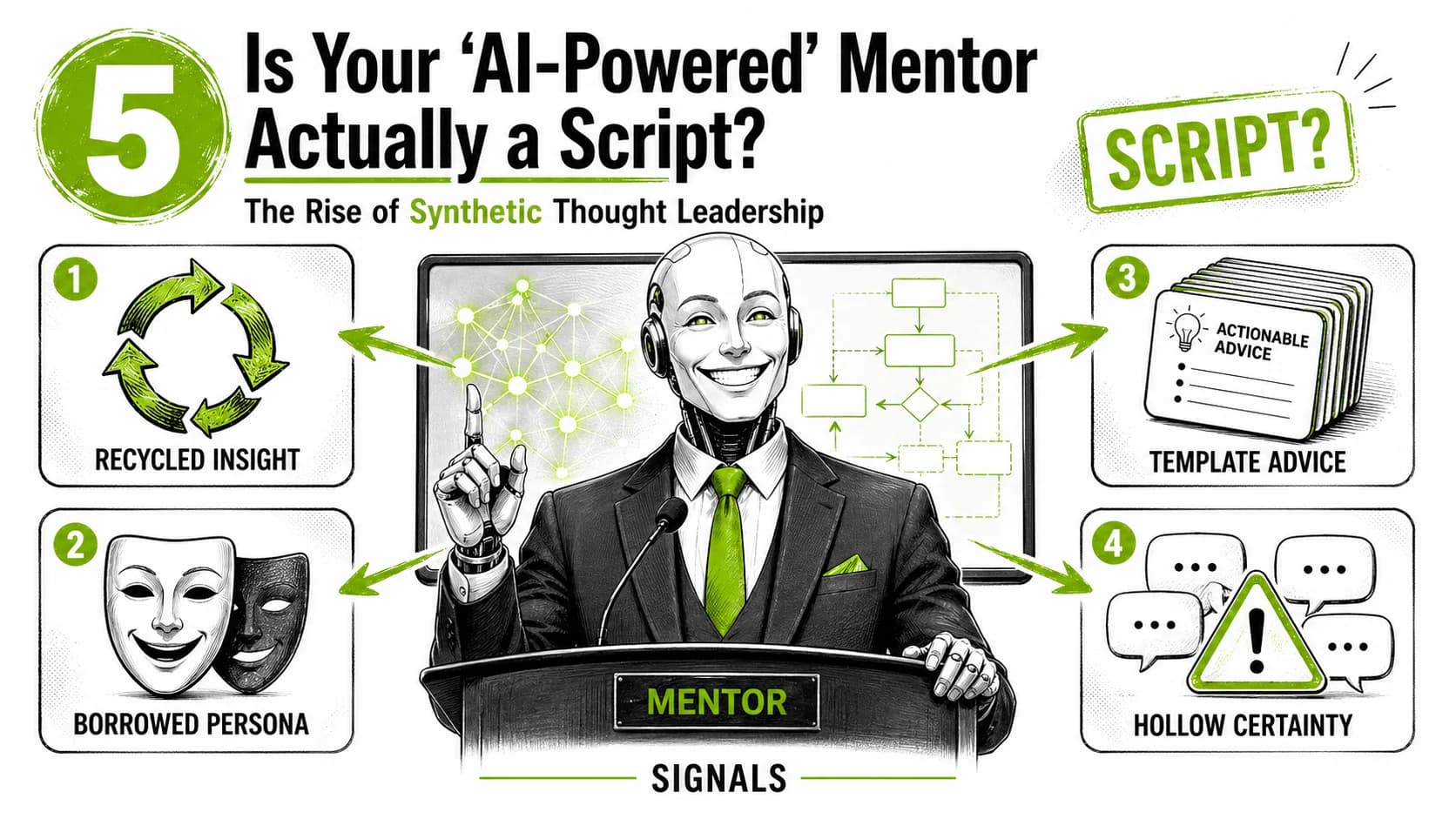
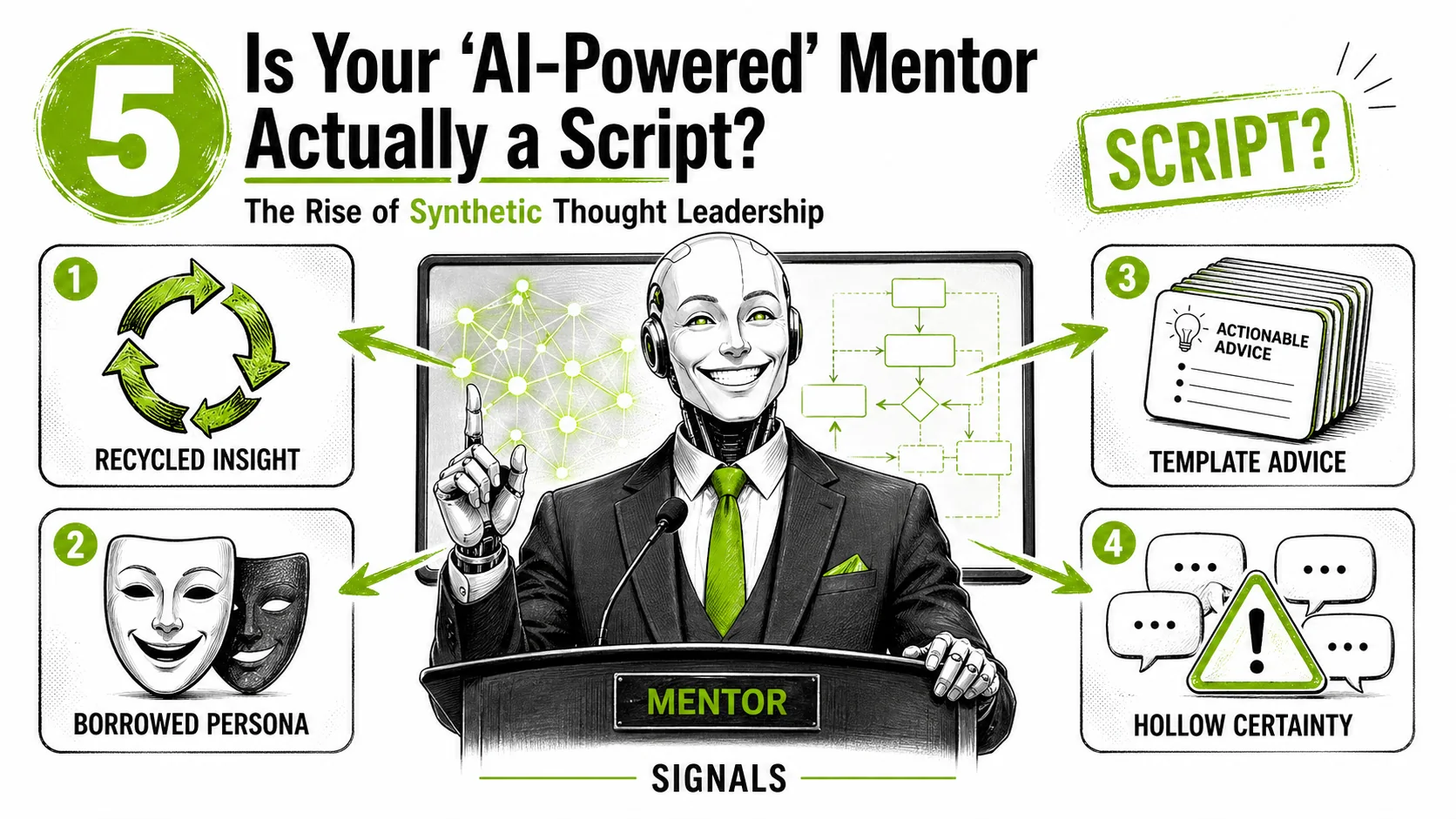
You’re scrolling through your feed, and a post catches your eye. It’s from a founder you vaguely follow. The insight is sharp, the prose is polished, and it perfectly articulates a problem you’ve been wrestling with. You feel a flicker of that old feeling—the one where you think, “This person gets it.” You click their profile. The content is relentless: a daily cascade of LinkedIn wisdom, perfectly threaded tweets, a newsletter that lands like clockwork. They’re building an audience, a brand, a movement. They’re a thought leader.
But what if the thought isn’t theirs? What if the leader is a ghost in the machine?
Welcome to the era of synthetic thought leadership. This isn't just about AI writing a few tweets. It's the creation of entire, convincing online personas—gurus, mentors, founders—whose every public utterance, from their motivational quotes to their $2,000 course modules, is generated, optimized, and scheduled by artificial intelligence. The fake guru playbook has been digitized, scaled, and weaponized with a tool that never sleeps. As an entrepreneurship analyst who has spent the better part of a decade dissecting online business culture, I’ve watched this evolution in real-time. The grift has always been about perceived authority. Now, the authority can be entirely synthetic, and the cost of production has plummeted to near zero. Your critical new skill isn't just spotting a fake revenue screenshot; it's detecting a fake mind.
What Is Synthetic Thought Leadership?
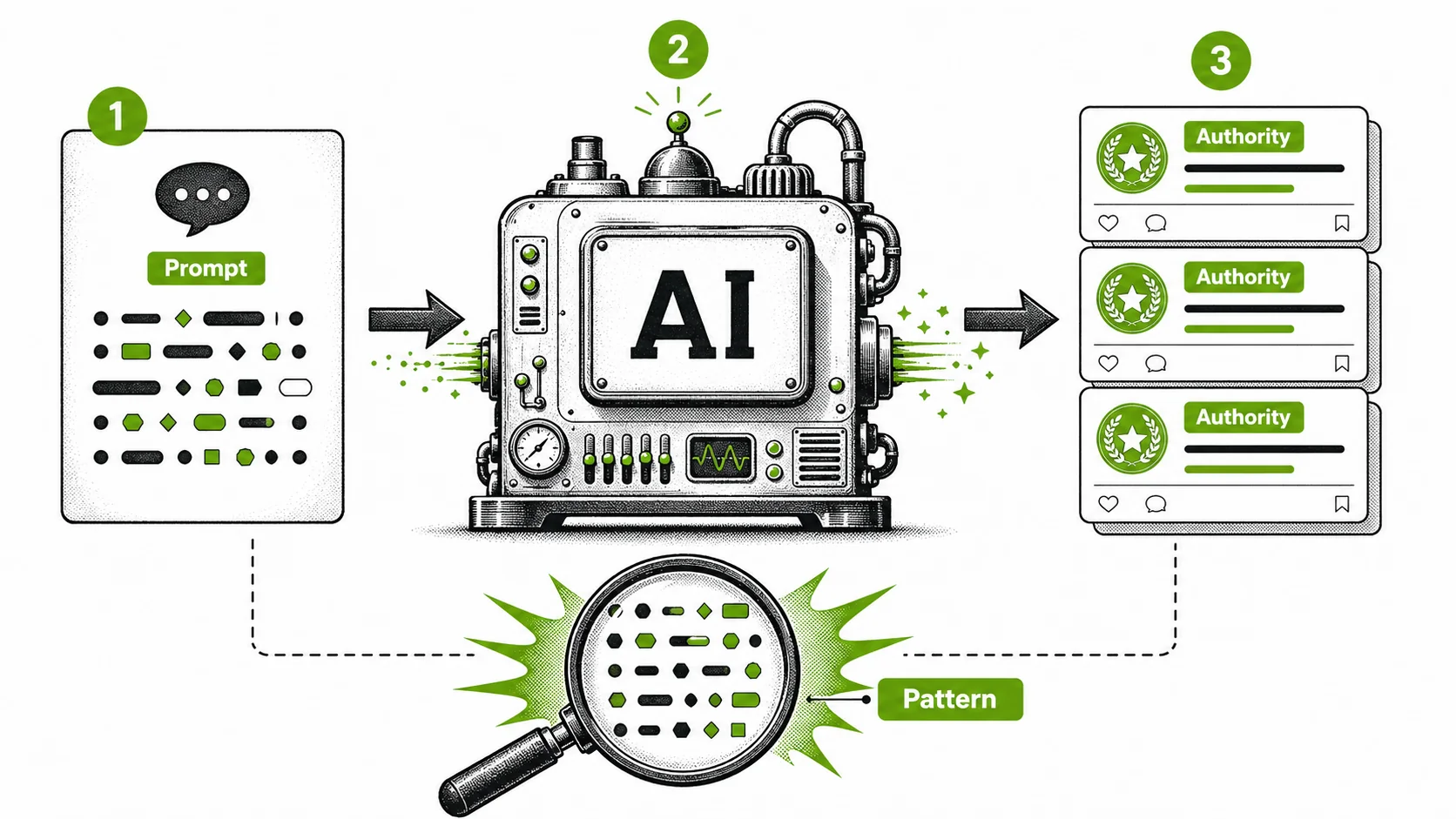
Synthetic thought leadership is the practice of using artificial intelligence to generate the core intellectual output—the "thought"—that forms the basis of an individual's or brand's perceived authority and expertise. The "leader" part is a human face (often a stock photo or a lightly animated avatar) attached to a content pipeline that is fundamentally algorithmic.
Think of it as the next logical step from the content farm. Instead of a website churning out low-quality "10 Best Blenders" articles, you have a digital persona churning out high-quality "10 Paradigm-Shifting Business Frameworks" posts. The goal is identical: capture attention, build trust, and monetize an audience. The method is just more sophisticated and personally targeted.
In my analysis, these synthetic entities typically manifest in three tiers:
The table below breaks down the key differences between traditional, human-driven expertise and its synthetic counterpart.
| Aspect | Authentic Thought Leader | Synthetic Thought Leader |
|---|---|---|
| Origin of Ideas | Personal experience, experimentation, failure, original synthesis. | Aggregation and rephrasing of existing public data, trends, and successful formats. |
| Content "Voice" | Evolves over time, contains quirks, occasional contradictions, emotional resonance. | Remarkably consistent, overly polished, often lacks identifiable personal nuance or humor. |
| Response to Nuance | Can handle complex, off-script questions in real-time, admits uncertainty. | Struggles with deep, specific, or novel queries outside trained data; defaults to vague generalities. |
| Proof & Backstory | Specific, verifiable anecdotes, named colleagues, messy real-world examples. | Generic, non-falsifiable stories ("a client once..."), jargon-heavy frameworks without implementation scars. |
| Evolution | Ideas change and mature publicly; old content may look naive in hindsight. | Content is evergreen and context-less; the "thinking" doesn't deepen, it just expands laterally. |
The engine of this phenomenon is, unsurprisingly, the rapid advancement of large language models (LLMs). A 2025 Stanford Institute for Human-Centered AI report noted that the fluency and coherence of text from models like GPT-5 have reached a point where, for general discourse, detection by humans is often at chance level. These models aren't creating new knowledge; they're performing a high-stakes version of predictive text on the entire corpus of the internet, including every business book, keynote speech, and blog post from actual thought leaders. They're mimicking the pattern of insight without the substrate of experience.
This creates a dangerous illusion. As the TechCrunch exposé from March 2026 highlighted, these 'AI content farms' are no longer targeting search engines with keyword-stuffed pages. They're targeting human psychology on social platforms, building rapport and authority through a firehose of relatable, seemingly profound content. The business model is simple: authority → audience → monetization through courses, coaching, or affiliate deals. The product is empty, but the sales funnel is fully automated.
Why Synthetic Authority Is the Ultimate Entrepreneurial Scam
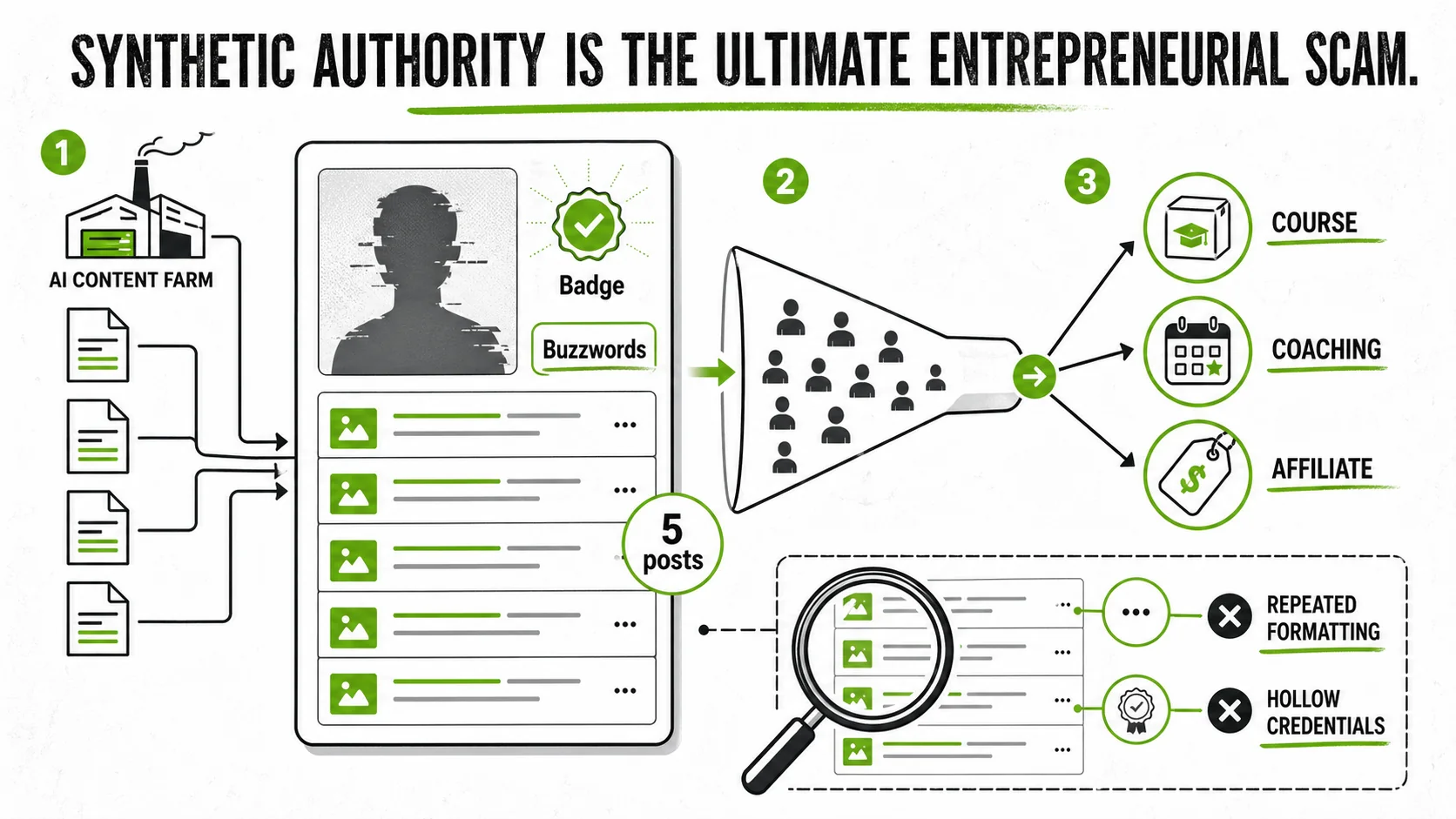
The danger of the old-school fake guru was largely financial. You'd buy a dropshipping course that taught you nothing, or invest in a crypto "mastermind" that evaporated. The damage from a synthetic thought leader is more insidious: it corrupts your thinking, wastes your most precious resource (time), and hollows out the very idea of expertise.
First, it creates a feedback loop of bad ideas. AI models are trained on what is popular and prevalent online. In the entrepreneurial sphere, this means they amplify survivorship bias, get-rich-quick mentalities, and oversimplified frameworks. When a synthetic persona posts "The 1-Minute Framework for Viral Growth," it's not sharing hard-won truth; it's regurgitating the average of every vapid growth-hacking thread that has ever trended. If you follow this advice, you're not learning from a master; you're being programmed by the crowd's lowest common denominator. This is why developing a keen eye for spotting fake gurus and their modern alternatives is more critical than ever.
I've reviewed the content output of several suspected synthetic accounts, and the pattern is unmistakable. They champion "hustle porn" without discussing burnout, preach "fail fast" without detailing the emotional and financial wreckage, and promote "automation" as a panacea without addressing the complexity of real systems. It's entrepreneurship as a aesthetic, stripped of all risk, doubt, and gritty reality.
Second, it devalues genuine expertise and experience. When the market is flooded with perfectly packaged, AI-produced "wisdom," the signal-to-noise ratio collapses. The founder who spent five years painfully iterating on a product feels they must shout to be heard over the chorus of synthetic voices preaching "overnight success." This pushes real experts to either disengage or, worse, start using the same synthetic tools to compete, further polluting the ecosystem. A study by the Reuters Institute for the Study of Journalism found that 58% of professionals now struggle to trust online expertise, a direct consequence of this pollution.
Third, it preys on ambition and loneliness. The entrepreneurial journey can be isolating. A synthetic mentor, available 24/7 with a stream of encouraging, confident-sounding advice, can feel like a lifeline. They build parasocial relationships at scale. The scam isn't just the $497 course; it's the months or years spent pursuing a phantom strategy designed by a machine to be engaging, not effective. It's opportunity cost on a grand scale.
The platforms themselves are ill-equipped to handle this. Their algorithms reward engagement, consistency, and polarity—all things an AI can optimize for perfectly. A synthetic persona doesn't get sick, have a creative block, or need to spend time actually running a business. It can post on 12 platforms, 18 hours a day, in 6 languages. It will always win the visibility game against a human who needs to sleep and do real work. This isn't a future problem; as the LinkedIn surge in AI-generated "insight" posts shows, it's the current reality.
How to Spot a Synthetic Thought Leader: The 5 Telltale Signs
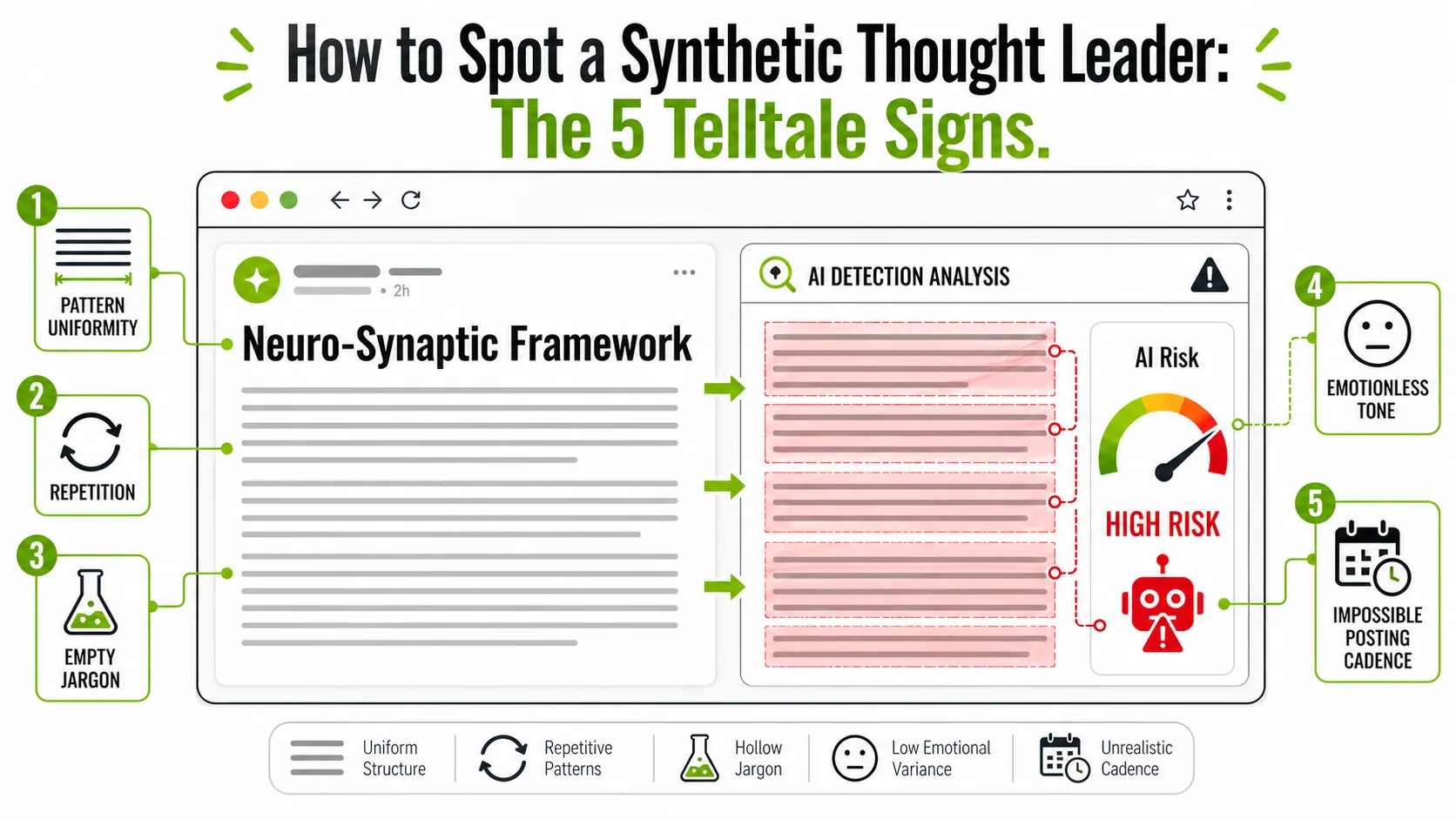
Detecting synthetic thought leadership requires moving beyond gut feeling to forensic observation. You're not looking for bad writing; you're looking for writing that is too good, too consistent, and too devoid of humanity. Here is a step-by-step method I've developed and tested across hundreds of suspect profiles.
1. Audit the Content Cadence for Robotic Consistency
Humans are messy. We have good days and bad days. Our output fluctuates with energy, travel, and the demands of our actual work. A synthetic persona has no such limitations.
What to do: Scroll through their primary platform feed (LinkedIn, Twitter) for the past 90 days. Use a simple spreadsheet or even just visual inspection.
The Red Flags:
- Superhuman Output: Multiple long-form posts (500+ words) per day, every day, without fail. Humans who write this much, this well, are typically full-time writers, not "active founders."
- Temporal Perfection: Posts go live at exact, algorithmically-optimal times (e.g., 10:04 AM, 3:17 PM) across time zones, with no weekend or holiday drop-off.
- Formatting Rigidity: Every post follows an identical template: Hook > Numbered List > Metaphor > Call-to-Action. The sentence length and paragraph structure are eerily uniform.
Tool Tip: While manual review is best, social media analytics platforms like Hootsuite or Buffer can show you posting patterns. A perfectly flat, high-frequency line is a machine's signature.
2. Interrogate the "Proof" and Backstory
This is the most powerful test. Synthetic personas are built on generic data. They fail the specificity test.
What to do: When they share a lesson or framework, ask yourself: Can this be verified? Dig into their past.
The Red Flags:
- The Nameless, Placeless Anecdote: "A founder I advised was struggling with churn..." Which founder? What company? When? If every story is anonymized to the point of being a fable, it's likely because it never happened.
- Vague or Unverifiable Credentials: "Helped scale 100+ startups..." Where's the list? "Exited my first company for 8-figures..." What was it called? Who acquired it? A lack of concrete, Google-able details is a major warning sign.
- Contradictions Over Time: Compare their current messaging with their digital footprint from 2-3 years ago. A human's views evolve. A synthetic persona's "past" is often generated retroactively and may not align. Use the Internet Archive's Wayback Machine to check old versions of their website or profiles.
3. Test for Depth and Real-Time Nuance
LLMs are brilliant at surface-level patter but often collapse when pushed beyond their training data into novel, complex, or deeply specific territory.
What to do: Engage. Ask a thoughtful, detailed question in the comments or via a direct message. Ask for clarification on a point that would require niche, experiential knowledge.
The Red Flags:
- The Deflection: Instead of answering, they respond with a compliment ("Great question!") and then pivot to rephrasing their original point or promoting a resource (like their course).
- The Vague Generalization: The answer is correct in a textbook sense but lacks any tangible, actionable detail or personal insight. It feels like a Wikipedia summary.
- The Lag: If they're purportedly a one-person show yet respond to complex DMs with essay-length, perfectly structured answers in under 5 minutes, repeatedly, it's suspect. Humans need time to think.
4. Analyze the "Voice" for Emotional Sterility
This is subtler but telling. AI-generated text often lacks authentic emotional cadence, humor, and vulnerability. It aims for inspirational or analytical tones but misses the connective tissue of real human experience.
What to do: Read their content aloud. Does it sound like a person talking, or a corporate manifesto?
The Red Flags:
- Perfect Adversity: Their stories of "failure" are always neatly packaged, lesson-learned, and ended in success. Real failure is messy, embarrassing, and sometimes without a clear redemption arc.
- Absence of Doubt: They never say "I don't know," "I was wrong about that," or "This is just my current hypothesis." Synthetic certainty is a sales tactic, not a marker of wisdom.
- Generic "Pain Points": The problems they describe are the ones every listicle mentions: "finding product-market fit," "scaling a team," "managing burnout." They rarely drill into the uniquely weird, industry-specific, or emotionally charged problems real founders face.
5. Employ Technical Detection as a Final Check
While not foolproof, AI detection tools can provide supporting evidence, especially for longer-form content like newsletters, ebooks, or course materials.
What to do: Take a substantial sample of their writing (a full blog post or a series of tweets) and run it through a detector.
Tool Recommendation: Use a tool like Originality.ai or Copyleaks. These are trained on the latest models and can give a probability score. Don't rely on this alone—a smart human can "humanize" AI text—but a consistent score above 90% is a glaring red flag.
Important Caveat: These tools can produce false positives, especially on highly structured or technical writing. Use them as part of your holistic investigation, not as the sole judge.
By applying these five filters, you move from a passive consumer to an active investigator. You start to see the seams in the simulation. The goal isn't to become a paranoid cynic, but to reclaim your attention and trust for voices that offer something real: the friction, the scars, and the hard-earned clarity that no algorithm can yet fake. For a broader toolkit on navigating this new landscape, our entrepreneurship hub compiles essential resources.
Proven Strategies to Build Immunity and Find Real Insight
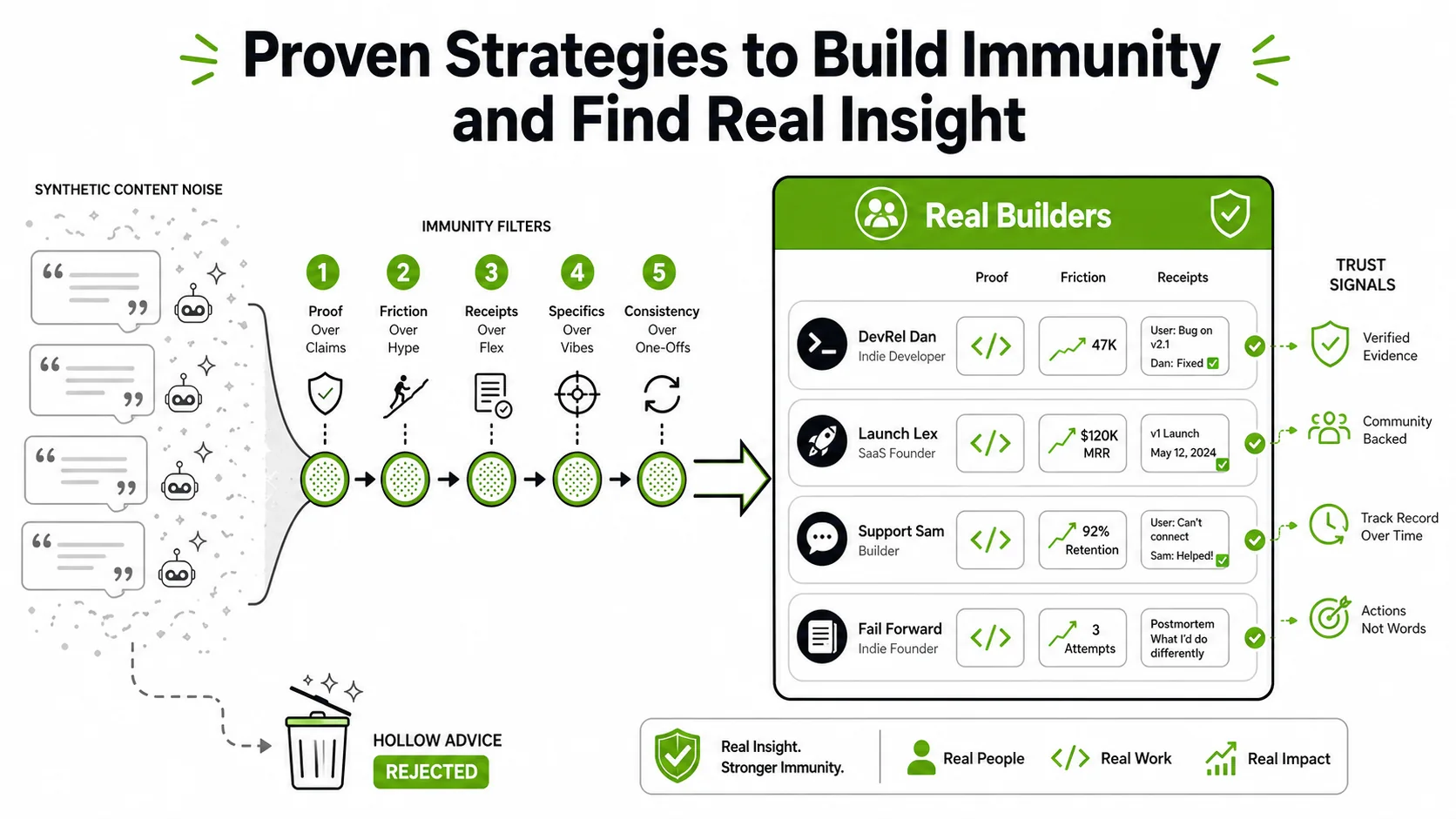
Knowing how to spot the fake is only half the battle. The other half is actively cultivating an information diet rich in authentic insight. This is a proactive strategy to inoculate yourself against synthetic influence.
Strategy 1: Prioritize "Proof of Work" Over "Proof of Talk."
Shift your criteria for credibility. Value output over commentary. Who is building in public, not just talking about building?
- Follow the Doers: Seek out founders who share actual metrics (with context), code snippets, product iterations, and customer conversations (with permission). The messiness is the proof.
- Demand Transparency: When someone teaches a strategy, ask for the raw data. A real expert can usually show you a spreadsheet, a screenshot of analytics, or a before/after of their work. A synthetic one can only give you the polished "after" slide.
- Use Platforms That Show Work: Spend less time on broad-topic social media and more in niche communities like Indie Hackers, specific Subreddits for your industry, or Discord servers where people collaborate on real projects. The signal-to-noise ratio is often better.
Strategy 2: Develop a Taste for Intellectual Friction.
Synthetic content is designed to be smooth and easily digestible. Real insight often comes with rough edges.
- Seek Out Contrarians: Deliberately follow people who challenge the dominant narrative in your field. Their arguments may be less polished but are more likely to contain original thought.
- Value the "I Don't Know": An expert comfortable with uncertainty is a far more reliable guide than one who has a slick answer for everything. Pay attention to how people handle complexity and nuance.
- Read Older Content: Go back 5-10 years and read the blogs and books from that era. You'll see which ideas have stood the test of time and which were just trendy noise. This calibrates your BS detector for today's hype cycles.
Strategy 3: Engage in "Deep Dive" Verification.
Don't be a passive scroll-er. Pick one or two people you find genuinely insightful and invest time in a deep background check.
- Trace the Journey: Can you map their career path through LinkedIn, Crunchbase, news articles, and their own archives? Does it make sense, with logical progression and verifiable milestones?
- Check for Peer Recognition: Do other respected people in their field mention them, collaborate with them, or debate them? Or is their audience primarily composed of anonymous aspirants?
- Consume Long-Form Content: A 280-character tweet or a LinkedIn post is easy to fake. A 90-minute podcast interview, a live Q&A, or a technical workshop is exponentially harder. Listen for spontaneity, humor, and the ability to think on their feet.
Strategy 4: Support and Create Human-Scale Media.
The economic incentive for synthetic content is volume and virality. We can counter it by supporting media that values depth and humanity.
- Pay for Newsletters: Subscribe directly to the newsletters of individual practitioners you trust. The direct relationship and smaller audience often foster more authentic communication.
- Join Small Communities: Participate in paid communities or masterminds with high barriers to entry (not just monetary, but based on application). The conversation quality is typically higher.
- Create Your Own Authentic Content: The best way to understand the process is to do it. Write from your own experience, share your real struggles, and contribute to the pool of genuine insight. You'll quickly learn to spot the difference between that and synthetic output.
By implementing these strategies, you do more than protect yourself. You help re-calibrate the market for ideas, rewarding depth, authenticity, and real value over synthetic volume. It's a conscious choice to be a harder target for the next wave of scams, which will inevitably evolve beyond what we can imagine today.
Got Questions About Synthetic Thought Leadership? We've Got Answers
How can I tell if a popular business influencer is using AI?
Look for the consistency paradox. If their output is superhuman in volume and polish but their backstory is vague and unverifiable, that's the biggest clue. Engage them with a highly specific, nuanced question about their claimed expertise. If the response is a deflective, generic rehash of their public content, or if there's a noticeable lag followed by a perfectly structured essay, AI assistance is likely involved. The absence of any "off-script" moments, doubts, or deeply personal anecdotes over a long period is another strong indicator.
What should I do if I've already bought a course from a synthetic guru?
First, don't blame yourself. The deception is sophisticated. Review the course material with your new detection skills. Is it full of generic, actionable-sounding steps without real implementation details or case studies? If you paid with a credit card, you may have grounds for a chargeback if the product was materially misrepresented (e.g., promised "personal mentorship" that is just AI-generated emails). Most importantly, conduct an audit of the advice you've implemented. If it's leading nowhere, cut your losses, document the lessons learned, and re-allocate your time and resources toward verified, evidence-based learning.
Are there any legitimate uses of AI for thought leadership?
Absolutely, but the line is defined by transparency and human primacy. Using AI as a tool for brainstorming, editing for clarity, or overcoming writer's block is no different than using a calculator for math. The problem arises when the AI becomes the source of the thought, and the human is merely the curator or face. A legitimate use is, "I have a complex idea from my experience; help me structure this blog post." An illegitimate use is, "Write me 10 thought leadership posts about blockchain innovation." The former augments human expertise; the latter replaces it.
Will platforms like LinkedIn and Twitter be able to stop this?
In the short term, no. Their fundamental business models are built on engagement, and synthetic content is hyper-optimized for engagement. They may introduce labels for AI-generated content (Meta is experimenting with this), but these are easy for bad actors to bypass. The long-term solution is not primarily technological; it's cultural. As users become more discerning and start to value authenticity over volume—and as that preference influences the algorithms—the incentive to create synthetic personas will diminish. But that requires a critical mass of people learning to detect the signs, which is why education on this topic is so urgent.
Ready to see through the algorithm?
Larpable - Detect or Create helps you cut through the noise of synthetic gurus and hollow advice. We give you the forensic toolkit to separate real insight from algorithmic regurgitation, protecting your time, money, and intellectual integrity. Stop following scripts and start recognizing patterns. Apprendre à Détecter.
<!-- sister-projects-start -->
Other Doved Studio projects
Related tools from the same studio you might find useful:
- Ralphable: Generate structured Claude Code skills that iterate until pass/fail criteria are met.
- Doved Studio: Studio indie derrière cette app et une dizaine d'autres outils.
<!-- sister-projects-end -->