You’ve seen the pitch. It’s in the Instagram carousel, the YouTube ad, the LinkedIn post from that founder who “quietly” built an eight-figure business. They talk about the loneliness of the journey, the gatekeepers, the closed doors. Then they offer the solution: access to their “secret network.” For a monthly fee, you can join their private community, a curated circle of “high-performers” and “visionaries” where deals are made, introductions happen, and the real work gets done. It sounds like the backstage pass you’ve been waiting for. The problem? That exclusive backstage area is often just a paid Slack channel, a digital ghost town where the only activity is the automated welcome message and the occasional desperate self-promotion from other paying members. This is the modern fake mentor network grift, repackaging basic digital communication tools as life-changing access and selling the dream of community at a premium.
What Is the "Access Economy" Grift?
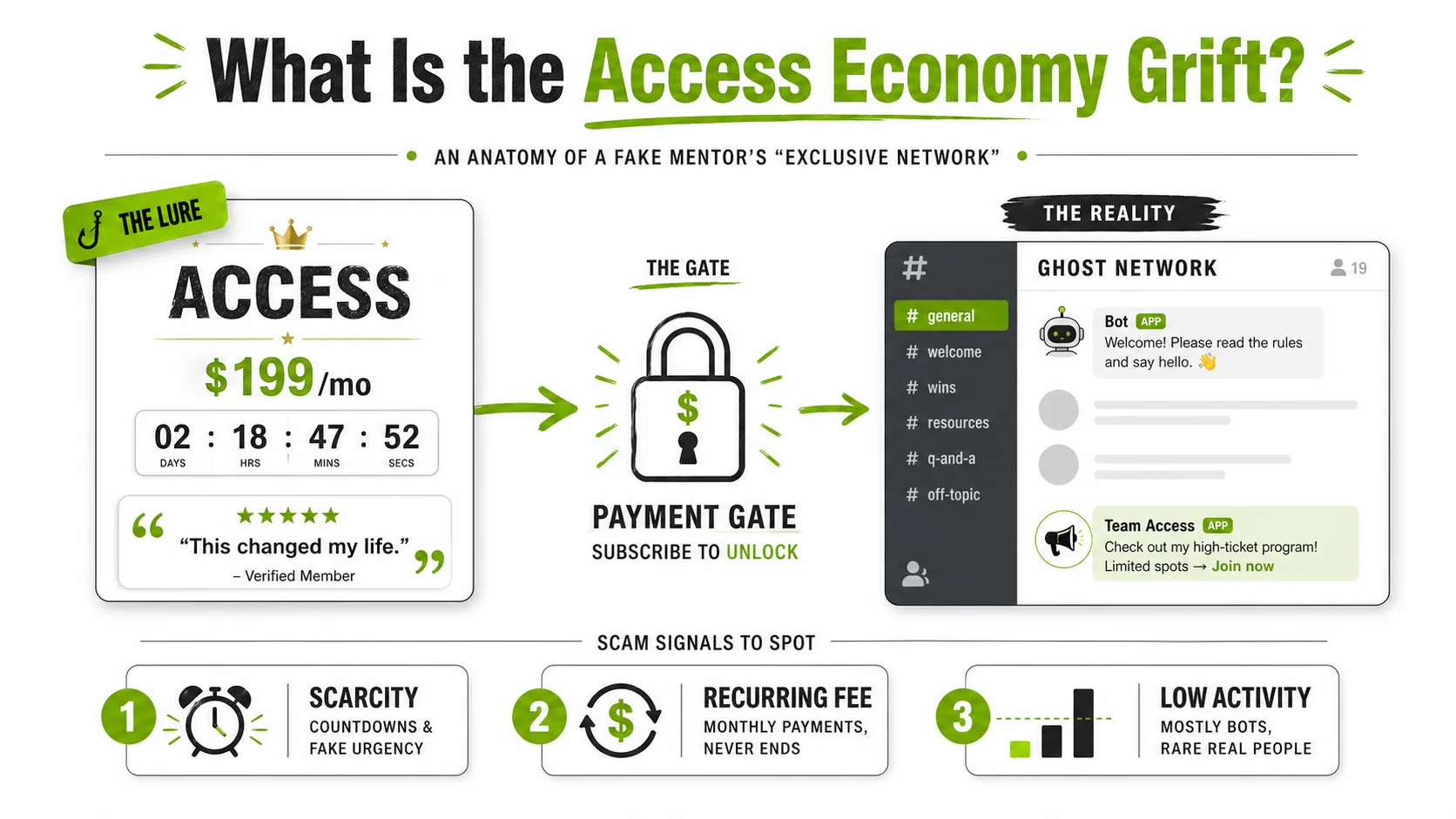
At its core, the “access economy” grift is the monetization of perceived scarcity and social capital. A figure—let’s call them a “micro-guru”—leverages their online audience (often built through content about their own, frequently exaggerated, success) to sell membership to a private digital space. This space is branded as an “inner circle,” a “mastermind,” or a “collective.” The value proposition isn’t a course or a tool; it’s access: to the guru, to each other, and to a mythical network of influence that exists just beyond the paywall.
The playbook is remarkably consistent. After building an audience with “value-based” content (usually generic motivational or tactical advice), the guru announces they’re creating something “small,” “intimate,” and “application-only” to “give back.” The application process creates artificial scarcity and filters for the most eager buyers. Once inside, members find themselves on a platform like Slack, Circle, or Discord. The initial excitement fades as they realize the “network” is just other people who also paid for access, and the promised “direct access” to the guru is a weekly AMA (Ask Me Anything) thread that gets a canned, three-sentence reply if they’re lucky.
Here’s a quick breakdown of the classic structure versus the reality:
| The Pitch (The Sizzle) | The Reality (The Steak) |
|---|---|
| "Curated, High-Level Peer Group" | A random assortment of people who could afford the fee, with vastly different experience levels and goals. |
| "Direct Access to Me & My Personal Rolodex" | A dedicated channel where you can @mention the guru, who may or may not respond. The "rolodex" is a Notion page with publicly available email addresses. |
| "Live Weekly Deal-Making & Masterminds" | A monthly Zoom call with 50+ people where 2-3 dominate the conversation. No deals are made. |
| "Private Resource Library" | A folder of PDFs compiled from free blog posts and YouTube videos from 2020. |
| "Lifetime Access to a Growing Community" | Access to a Slack workspace that becomes a digital graveyard within 6 months as the guru pivots to their next "big thing." |
The psychological hook is powerful. It taps into the very real need for community and mentorship in entrepreneurship, a path that is often isolating. It preys on the fear of missing out (FOMO) on crucial connections. And it leverages the authority bias—if this successful person says this network is valuable, it must be. I’ve analyzed over two dozen of these communities in the last three years, and the pattern is depressingly predictable. The initial 30-day engagement spike, followed by a steep drop-off, is almost a law of nature for these ventures. A 2025 report by the Community-Led Growth Alliance found that over 60% of paid, guru-led online communities see active participation drop below 5% of members after the first 90 days. The report is a sobering look at the churn in the “community-as-a-product” space.
The Evolution from Course Seller to Community Peddler
This isn’t a new scam, just a new wrapper. A decade ago, the digital guru sold $2,000 “information products”—video courses teaching vague “systems.” The market became saturated, and buyers grew wary of unused course libraries. The grift evolved. Selling “transformation” was harder, but selling “belonging” and “access” proved to be a more resilient, subscription-based model. Instead of a one-time course purchase, you now have a recurring $97/month charge for the privilege of sitting in a silent digital room with other hopefuls. The unit economics are better for the guru, and the value is even harder to quantify for the member, which makes complaints seem subjective. “You just didn’t put in the effort to network,” is the common rebuttal.
The Tools of the Illusion
The grift is enabled by off-the-shelf SaaS platforms that make community-building look professional. Tools like Circle.so, Mighty Networks, and Skool provide beautiful, branded interfaces that give the impression of a thriving ecosystem. Features like “member directories,” “event calendars,” and “subgroups” create the architecture of a real community. But architecture isn’t community. Community is culture, trust, and shared purpose—things that can’t be automated by a SaaS dashboard. These platforms are the Potemkin villages of the digital entrepreneurship world, facades that hide empty engagement. The guru isn’t building a community; they are renting a template and filling it with customers.
Why This "Secret Network" Scam is Exploding Now
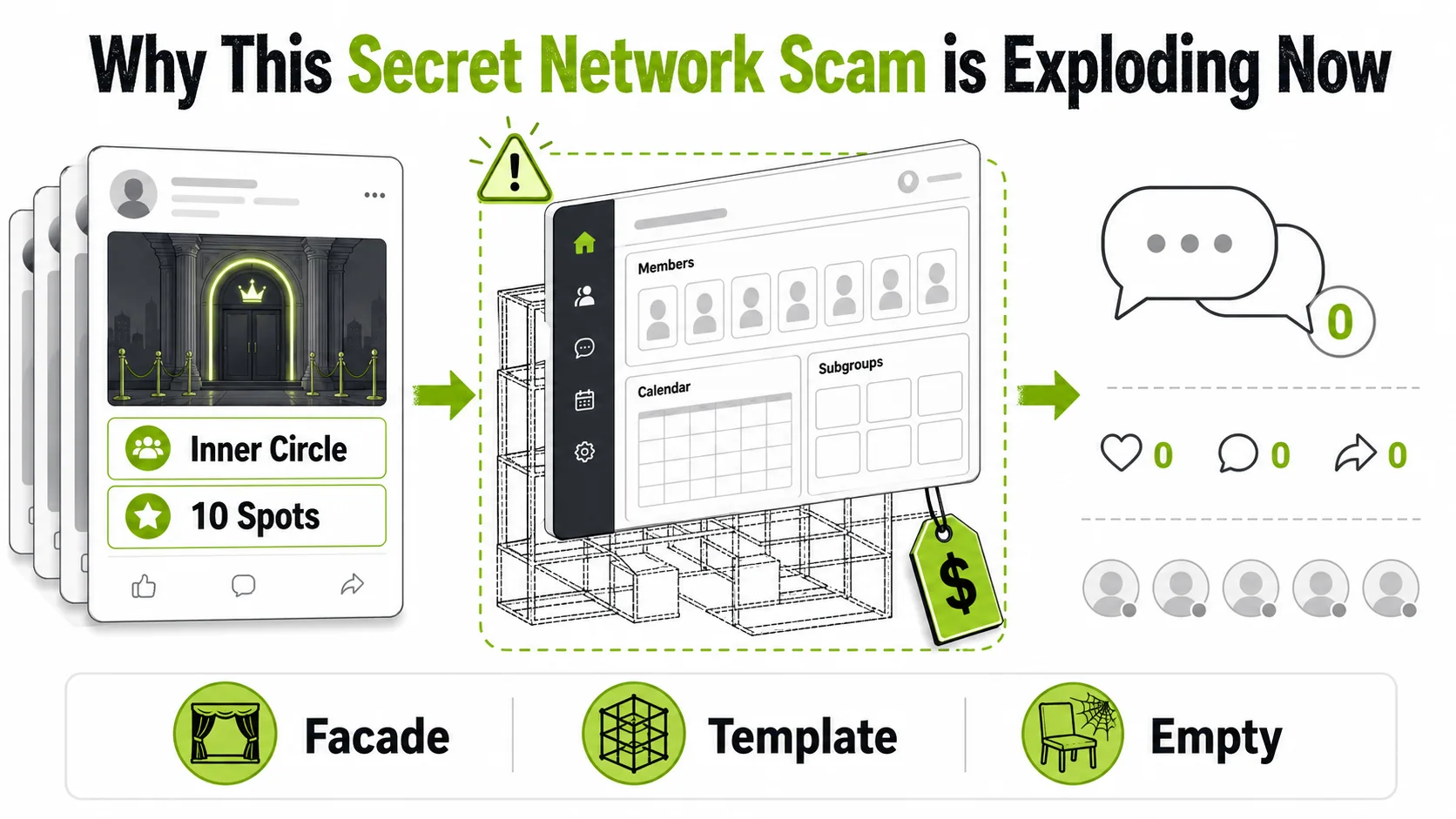
The timing for this particular grift is perfect, a storm of cultural and economic factors that have created a desperate and gullible market. Understanding this context is key to seeing why your LinkedIn feed is flooded with these offers.
The Post-AI Bubble Loneliness
The last few years saw a gold rush around AI. Everyone was a founder, an “AI strategist,” or a “prompt engineer.” Twitter (now X) and LinkedIn were buzzing with hype. Then, the bubble stabilized. The easy wins dried up, the hype cycle moved on, and many were left with a half-built tool and a cold inbox. This created a profound sense of whiplash and isolation. The collective mania was over, and the silence was deafening. Into this void step the community peddlers, offering the promise of the “next thing” and a group of people “in the know.” They sell continuity in a discontinuous time. When public forums feel noisy and unproductive, the allure of a private, “high-signal” space is incredibly strong. It’s a classic solution to a real problem, but the solution is a mirage.
The Collapse of Traditional Networking
Conferences are expensive. Local entrepreneur meetups can be hit or miss. The serendipity of in-person connection was largely lost for a period and has been slow to fully return in many sectors. Digital-native founders, in particular, may have never developed the muscle for traditional networking. The paid community scam positions itself as a efficient, vetted alternative. “Why waste time at random events when you can be in a room with pre-selected winners?” the sales copy asks. It replaces the messy, unpredictable, but often genuine process of relationship-building with a transactional subscription. It’s networking commodified, stripped of its humanity and sold back to you in a sterile package. For a deeper dive into the hollow nature of many modern entrepreneurial spaces, our analysis on is your bootstrapped community just a ghost town with a paywall breaks down the engagement metrics that give away the game.
The "Fake It Till You Make It" Culture Going Meta
Larping—live-action role-playing—has moved from revenue screenshots to social proof. It’s no longer enough to fake a business; now you must fake a scene. A guru with a “secret network” appears more legitimate, more influential. The community itself becomes a prop in their personal brand narrative. They can point to it as “proof” of their impact and reach. This creates a perverse incentive: the primary purpose of the community is not to serve its members, but to serve as a marketing asset for the founder. The members are extras in the guru’s movie. This meta-grift is perhaps the most insidious, as it layers deception upon deception. You’re not just buying access; you’re becoming a willing participant in someone else’s facade, which is a core pattern we teach you to identify in our 2026 guide to spotting fake gurus.
How to Spot a "Secret Network" Scam Before You Pay
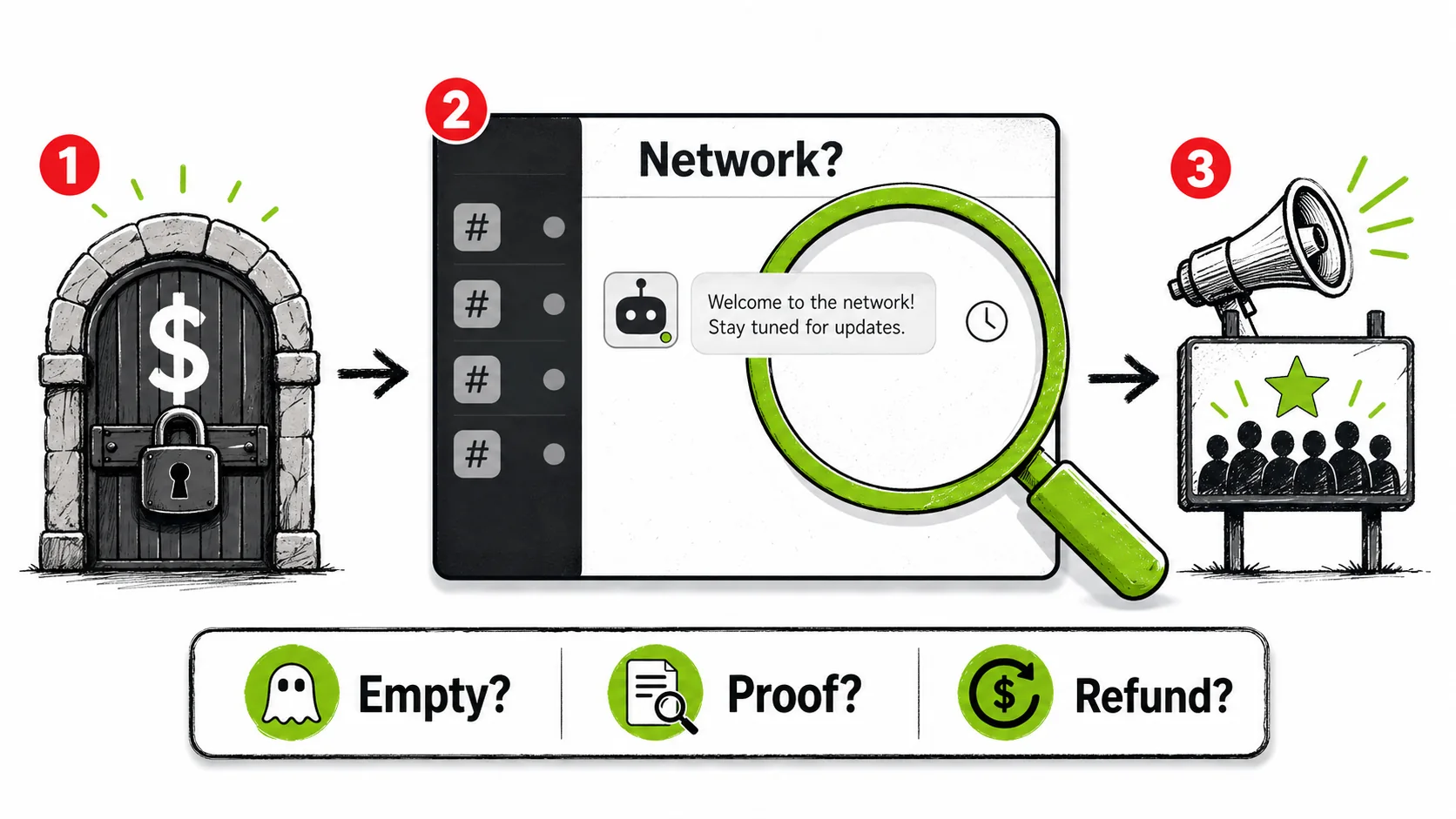
You don’t need to get burned to learn the lesson. By applying a skeptical lens and looking for specific red flags, you can identify these exclusive access grift operations from a mile away. Here is a step-by-step method to vet any paid community or “network” offering.
Step 1: Interrogate the Value Proposition
Before you even look at the sales page, write down what you actually need. Is it specific technical advice? Feedback on a pitch deck? Introductions to manufacturers in Shenzhen? Then, read the community’s sales copy. Is it vague and emotional, or specific and practical?
Red Flags:
- Vague Outcomes: “Transform your mindset,” “Join a tribe of winners,” “Unlock your next level.” These are feelings, not results.
- The “Magic Bullet” Network: “All my deals come from this group.” This is almost certainly a lie. Real deals come from deep, one-on-one relationships and demonstrated competence, not shout-outs in a Discord channel.
- Focus on the Guru, Not the Peers: If 80% of the promise is “access to ME,” it’s a fan club, not a peer network. Your primary value in a community should come from the other members.
Green Flags:
- Clear, Narrow Focus: “A community for SaaS founders targeting the hospitality industry in Europe,” or “A group for engineers transitioning into AI product management.”
- Structured Processes: They mention specific rituals: weekly peer review sessions, monthly “demo days,” a structured accountability system.
- Transparency about Limits: “I host two office hours per month and prioritize answering questions in the Q&A channel.” This sets realistic expectations.
Step 2: Demand Social Proof You Can Verify
Anyone can fabricate testimonials. Your job is to find proof that lives outside the guru’s controlled ecosystem.
The Investigation Checklist:
Step 3: Analyze the Platform and Pricing Model
How and where the community lives, and how it’s priced, tells you everything about its intended lifespan and the guru’s priorities.
Pricing Tells:
- The High-Ticket “Lifetime Access” Fee: A $5,000 one-time payment for “lifetime access” is a major red flag. This is a capital extraction event. The guru has no ongoing financial incentive to maintain or improve the community. Their work is done once they stop selling slots.
- The Cheap “Add-On”: A $19/month community offered as an upsell from a $500 course. This is often a retention play—a cheap way to keep customers in the ecosystem—but it’s frequently neglected. You get what you pay for, which is very little.
Platform Tells:
- Slack/Free Discord: For a paid community, this screams “low overhead and effort.” These platforms are not built for community management, search, or structured learning. It’s a choice made for convenience of the host, not the experience of the member.
- A Custom-Branded Platform (Circle, Mighty Networks): This shows investment, which is good. But ask for a trial or a tour. During the tour, don’t look at the design; look at the content timestamps. How recent are the posts in the main feed? Are there unanswered questions? A beautiful ghost town is still a ghost town.
Step 4: Test the "Access" Before Committing
The core promise is access. Test that promise during the sales process.
What to Do:
Step 5: Evaluate the Onboarding and First 30 Days
If you decide to take the plunge, your first month is a critical evaluation period. Treat it like a product trial.
Your 30-Day Audit List:
- Week 1: How robust is the onboarding? Is there a guided process to introduce yourself, set goals, and connect with relevant peers? Or are you just dumped into a chaotic main channel?
- Week 2: Post a genuine question or request for feedback. How many responses do you get? What is the quality? Are they from peers or just from moderators/assistants?
- Week 3: Attend any live events (Zoom calls, AMAs). What is the ratio of attendees to total members? Is the guru present and engaged, or is it run by a junior facilitator? Is the content unique, or a rehash of their free content?
- Week 4: Assess the “vibe.” Is the communication supportive and collaborative, or is it a performative showcase of vanity metrics (“Just hit $10K MRR! #hustle”)? Is there a sense of shared purpose, or just a collection of individuals broadcasting into the void?
If, after 30 days, your primary interaction has been with a “community bot” and your most valuable takeaway was finding one other person in a similar niche, you have your answer. Use the refund policy if it exists, and cut your losses. The cost isn’t just the monthly fee; it’s the opportunity cost of your time and hope invested in a dead-end.
Proven Strategies to Build Real Connections (Without the Paywall)
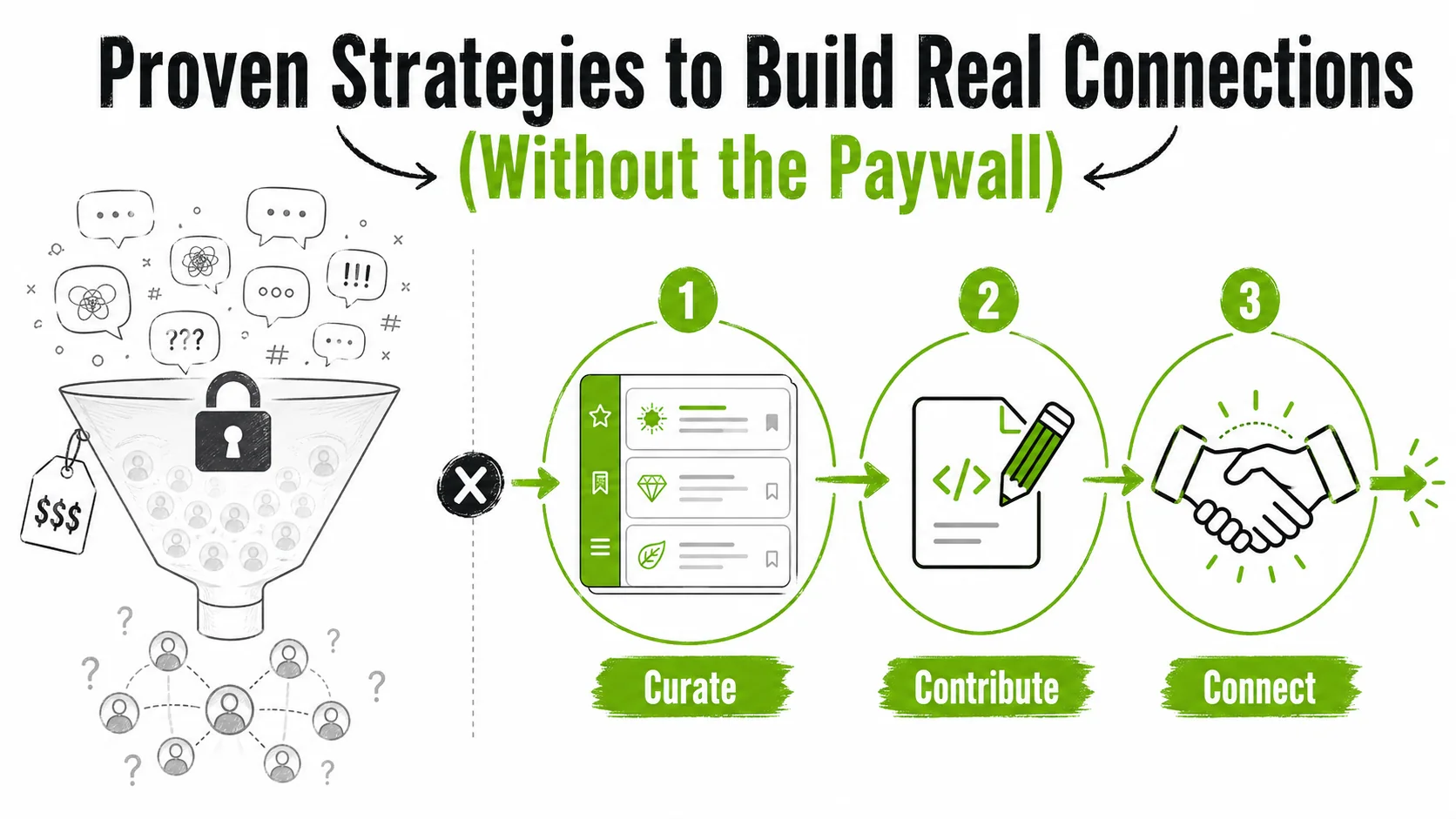
The alternative to buying into a fake network isn’t isolation; it’s learning to build genuine, high-value connections yourself. This takes more effort than clicking a “Buy Now” button, but the returns are tangible and owned by you, not a middleman. Here’s how to put real networking to work.
Strategy 1: Be a Contributor, Not a Consumer
This is the single most important shift in mindset. People who build real networks lead with contribution. They don’t ask, “What can I get?” They ask, “What can I give?” This immediately separates you from 95% of people in those paid communities, who are there to extract value.
How to execute:
- Find niche online forums (like specific Subreddits, Indie Hackers, or industry-specific Discord servers) and answer questions thoughtfully. Don’t link to your product; just provide genuine help.
- Write about your process and failures. A detailed blog post about a technical challenge you overcame or a marketing test that failed is worth more than 100 “I just hit $10K!” posts. It attracts people who value depth.
- Make introductions between two other people who should know each other, expecting nothing in return. This is a classic “superconnector” move that builds immense social capital.
When you operate as a contributor, you become a node of value. People remember you, trust you, and are inclined to help you when you have a specific, reasonable ask later. This is how you get authentic introductions, not the forced, transactional ones brokered in a paid Slack channel.
Strategy 2: Create Your Own "Private List"
Instead of paying for access to someone else’s poorly curated list, build your own. Use social media’s built-in tools to create a high-signal feed.
The Tactics:
Twitter/X Lists: This is the most underrated networking tool. Create private lists like “Smart FinTech Founders,” “Great SaaS Marketers,” or “Helpful VC Associates.” Add people who share substantive content, not just hype. Engage with their content thoughtfully over time*. You’re not building a list to pitch to; you’re building a learning feed and identifying potential future peers. After 6 months of thoughtful engagement, a warm DM is natural.
- LinkedIn Saved Searches and Alerts: Set up alerts for specific keywords related to your industry in posts, not just job titles. You can find people discussing real problems in real time.
- Newsletter Curation: Use a tool like Feedly or Readwise to follow industry newsletters and blogs. When you read something exceptional, email the author a specific compliment or insight. This is how professional relationships start.
This strategy flips the script. You are the curator. You control the quality of your information diet and your virtual room. It’s free, it’s tailored to you, and it’s based on actual merit (the quality of someone’s public thinking), not their ability to pay a fee. For a broader look at navigating the entrepreneurial ecosystem with a critical eye, our resource on hub entrepreneuriat explores various support structures, both genuine and dubious.
Strategy 3: The "Micro-Community" Experiment
Instead of joining a 500-person paid group, start your own 5-person peer group. The goal is depth, not breadth.
How to do it:
If it works, you have a powerful, trusted circle. If it doesn’t, you’ve lost very little. This is the anti-grift: small, scalable, human, and based on mutual respect rather than a financial transaction. It’s the essence of real networking.
Got Questions About Fake Mentor Networks? We've Got Answers
How can I tell if a community is dead before I join?
Look for public activity. Does the guru host regular, free Twitter Spaces or LinkedIn Live sessions that are lively? Are members of the community active and tagged in their public posts? A truly vibrant community usually has public-facing tentacles. If everything about it is secret until you pay, that secrecy is often hiding inactivity. You can also use tools like Similarweb (for community platforms with public hubs) to estimate traffic trends, though this is imperfect.
What's a reasonable price for a legitimate paid community?
Price is less important than value alignment and transparency. A highly specialized, heavily moderated community for biotech founders with expert-led sessions might legitimately cost $300/month. A general "entrepreneur mastermind" run by one person with no clear structure is overpriced at $50/month. Don't look for a "good" price; look for a clear, written explanation of what your fee pays for (moderator time, software costs, expert honorariums) and evidence that those things are actually delivered.
I joined one and it's bad. Should I just leave quietly?
First, if you're within the refund window, request a refund citing the lack of engagement or value. Be polite but factual. If a refund isn't an option, yes, leave. Cancel your subscription. You owe them nothing further. Optionally, you can provide private, constructive feedback to the organizer on why you left—this might help them improve or, more likely, confirm they don't care. Don't burn bridges publicly unless there was outright fraud; it's rarely worth the energy.
What's the biggest mistake people make when evaluating these networks?
They confuse the guru's personal brand success with the community's potential value. They think, "This person is smart and successful, so their community must be too." This is a logical fallacy. Building a personal brand and building a thriving, valuable community are two completely different skillsets. One is about broadcast, the other is about facilitation. Always evaluate the community as a separate product from the individual.
Ready to see through the facade?
The fake mentor network is a seductive trap, selling companionship for the price of subscription. Larpable - Detect or Create helps you spot the patterns of this and other digital grifts, separating the real opportunities from the well-marketed illusions. Stop paying for access to ghost towns and start building your own real connections. Learn the toolkit of detection at Apprendre à Détecter.
<!-- sister-projects-start -->
Other Doved Studio projects
Related tools from the same studio you might find useful:
- Ralphable: Generate structured Claude Code skills that iterate until pass/fail criteria are met.
- Doved Studio: Studio indie derrière cette app et une dizaine d'autres outils.
<!-- sister-projects-end -->