

You see the post. A founder, beaming, announces their "18-month journey" has culminated in a "life-changing 7-figure exit." The comments are a mix of applause and quiet desperation. "How did you do it so fast?" "I've been grinding for 3 years with nothing." "You're an inspiration!"
What you don't see is the five-year prequel. The failed LLC from college. The two other startups that quietly shuttered. The decade of industry experience they never mention. The 'overnight success' is the most seductive and damaging lie in entrepreneurship. It's a narrative shortcut that sells courses, builds personal brands, and preys on our collective impatience. In 2026, with a reported 40% surge in 'rapid scale' course sales targeting post-recession anxiety, this myth isn't just annoying—it's a lucrative business model for timeline larps.
This article isn't about preaching patience. It's a forensic toolkit. We'll dissect the curated founder story to find the seams, the edits, and the omitted chapters. You'll learn how to conduct a founder timeline audit, spotting the inconsistencies that separate a genuine multi-year grind from a cleverly constructed fairy tale. The goal isn't cynicism, but clarity. By understanding the real shape of success, you protect your own sanity, manage your expectations, and see through the smoke and mirrors of those selling the dream.
Understanding the Overnight Success Narrative
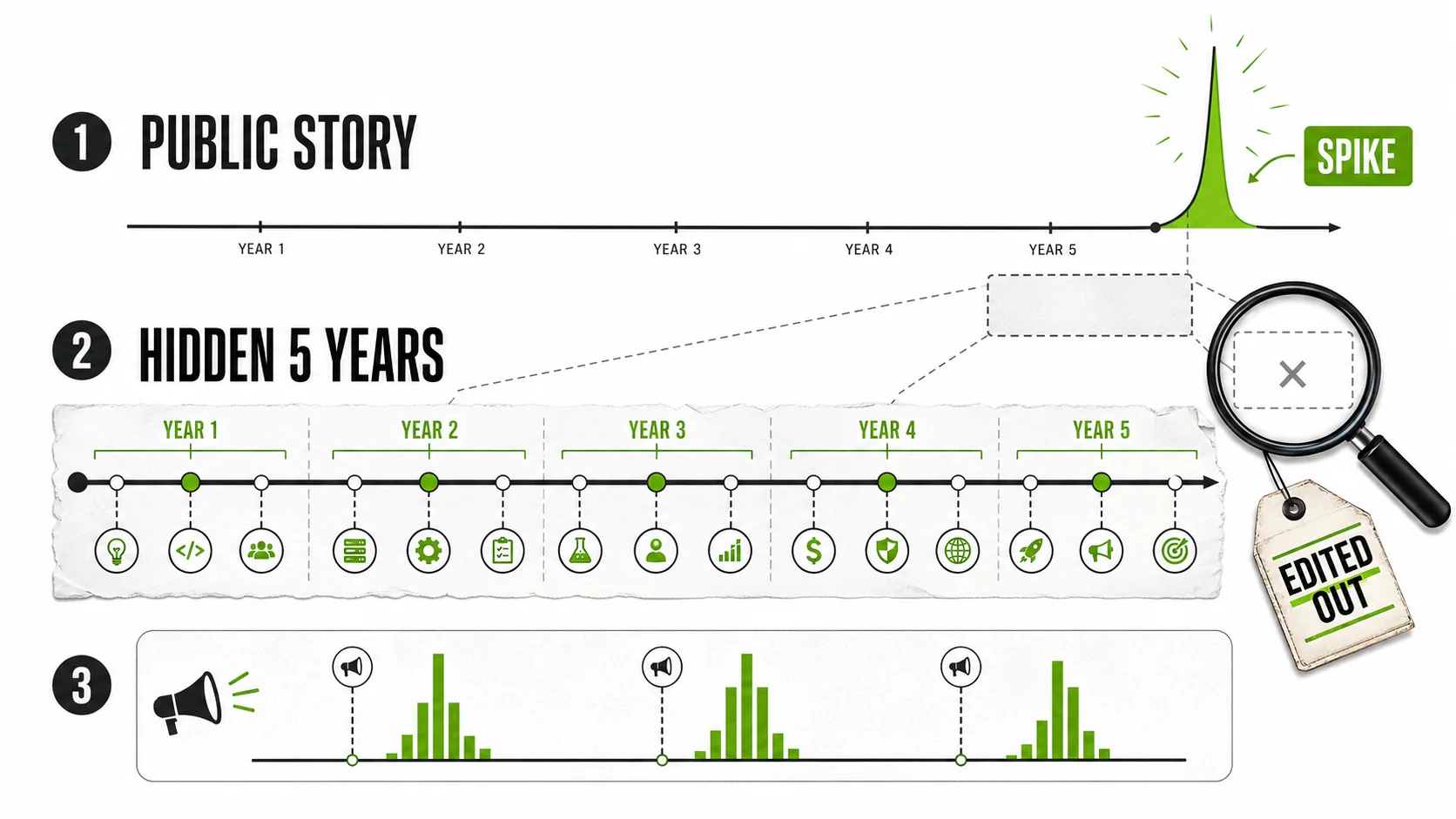
The "overnight success" story is a specific type of content. It's not an accident; it's a product. It follows a reliable three-act structure designed for maximum virality and personal brand leverage.
Act 1: The Humble, Relatable Beginning. "Two years ago, I was working a dead-end job, $50k in debt." This establishes empathy and sets a dramatic contrast.
Act 2: The Epiphany & Leap. "I had this crazy idea. I quit my job, built an MVP in 3 weekends." This creates the illusion of rapid, decisive action.
Act 3: The Exponential Rise & Payoff. "18 months later, we're profitable, have 10 employees, and just got acquired. Here's what I learned." This provides the satisfying conclusion and positions the founder as an authority.
The entire narrative compresses time. It cherry-picks the most dramatic moments—the quit, the launch, the exit—and erases the mundane middle: the 2 AM bug fixes on a Tuesday, the 100th unsuccessful cold email, the months where growth was a flat line. This compression isn't just storytelling; it's a psychological hack. Our brains love clear narratives with quick resolutions. A messy, five-year slog with ambiguous milestones is hard to package and harder to sell.
The economic incentive is clear. A founder who claims a rapid, replicable path to wealth can monetize that story through speaking, consulting, and most lucratively, selling the blueprint. The "overnight success" is the ultimate lead magnet for a "rapid scale" course. As noted in recent industry analyses, this model is booming precisely when aspiring entrepreneurs feel most economically vulnerable.
| The Curated Story vs. The Likely Reality |
|---|
| "We built it in 3 months!" |
| Curated: A sprint of genius. |
| Reality: Leveraged 5 years of prior coding experience and a pre-existing network of beta testers. |
| "I quit my job to go all-in." |
| Curated: A brave, binary leap of faith. |
| Reality: Had 2 years of runway saved, a working side-income, or a spouse with stable employment. |
| "Acquired after 18 months." |
| Curated: A meteoric rise to a logical conclusion. |
| Reality: The culmination of 7+ years in the industry, with multiple prior ventures building relevant skills and connections. |
The Anatomy of a Timeline Larp
A "timeline larp" is when someone intentionally misrepresents the duration and difficulty of their entrepreneurial journey. They aren't just being optimistic; they are strategically editing history to fit a more marketable narrative. Common tactics include:
The Calendar Reset: This is the most common. The founder declares their "start date" as the moment they had the idea for the successful venture, not the moment they began their entrepreneurial career. The five years of failed blogs, freelance work, and abandoned apps that taught them everything are conveniently filed under "personal growth," not "business history."
The Silent Pivot: The public story is about "Company X," but the founder's first iteration was "Company Y," a completely different product that floundered for two years. The assets, email list, or key technology from Company Y quietly became the foundation for Company X's "rapid" success. The timeline for Company X is technically accurate, but it's built on the uncredited graveyard of Company Y.
The Expertise Omission: The founder presents as a rookie who "figured it out." In reality, they spent a decade as a senior executive or consultant in the exact industry their startup disrupts. That deep domain knowledge—the regulatory landscape, the key players, the customer pain points—is the hidden engine, not the "3-weekend MVP."
Why This Narrative Persists
It persists because it works. On platforms like LinkedIn and Twitter, algorithmic rewards favor clean, inspirational, high-engagement stories. A complex, nuanced tale of incremental progress doesn't trend. A study by the Reuters Institute for the Study of Journalism on digital news consumption patterns highlights how simplified, emotionally charged narratives consistently outperform detailed reporting in social media shares. The entrepreneurial content ecosystem operates on the same principles.
Furthermore, we, the audience, are complicit. We want to believe the shortcut exists. Accepting that meaningful success requires a long, uncertain grind is psychologically taxing. The overnight success story is a painkiller for entrepreneurial anxiety. It lets us think, "Maybe I can skip the hard part, too."
Why the "Overnight" Myth is Actively Harmful
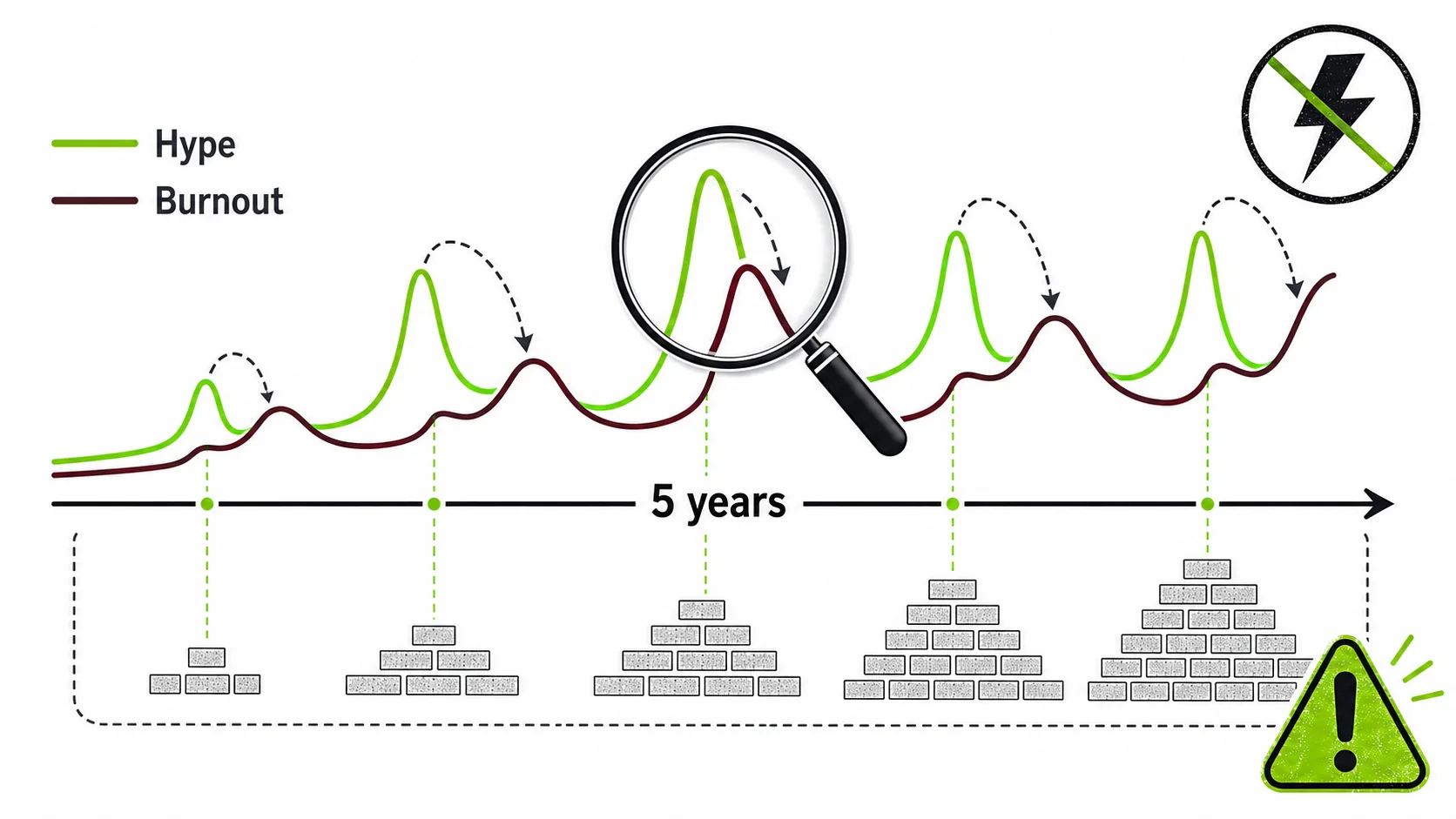
Believing in overnight success doesn't just set unrealistic expectations; it actively corrodes the foundation of a sustainable entrepreneurial mindset. The damage is both personal and cultural.
It Makes You Quit Too Early. This is the most direct harm. If you've been working on your business for 18 months and your progress looks nothing like the curated 18-month "exit story" on your feed, what's the logical conclusion? "I'm a failure. This doesn't work. I should quit." You benchmark your messy, early-stage reality against someone's highly edited highlight reel, and you inevitably fall short. You abandon a project that might have been 12 months away from a genuine breakthrough, simply because your timeline didn't match a fictional one. Learning to spot fake gurus and their unrealistic timelines is a core skill in protecting your own perseverance.
It Values Spectacle Over Substance. When rapid, visible growth is the only celebrated outcome, the essential, invisible work of building systems, nurturing culture, and developing deep expertise gets sidelined. Founders feel pressure to chase vanity metrics—social media followers, press features—that look like "growth" but don't translate to a healthy business. They optimize for the appearance of momentum rather than the reality of product-market fit. This is why a founder timeline audit often looks for substance behind the spectacle: real revenue, retained customers, technical depth.
It Fosters a Culture of Dishonesty. When everyone feels pressured to present a flawless, rapid ascent, honesty becomes a competitive disadvantage. Founders hide struggles, mask failures, and inflate numbers. This creates a feedback loop where the public-facing narrative becomes increasingly detached from the private reality of building a business. New entrepreneurs enter the ecosystem believing the curated stories are the norm, perpetuating the cycle. It becomes harder to find genuine advice about navigating the "trough of sorrow" because no one admits they're in it.
The data backs up the psychological toll. A 2025 report from the Global Entrepreneurship Monitor noted that while digital tools have lowered startup barriers, reported rates of entrepreneurial anxiety and perceived failure have increased in correlated markets. The constant exposure to curated success, the researchers suggest, creates a distorted baseline for "normal" progress.
It Enables Scammers. This is where the harm moves from psychological to financial. The perfected "overnight success" story is the primary marketing asset for bad actors. It's the proof-of-concept for their "system." If they can convince you they found a secret shortcut, you're more likely to pay for their course, mastermind, or coaching program that promises to replicate it. The story itself is the scam's foundation. By failing to critically audit these timelines, we directly fund the ecosystem that preys on our impatience. For a deeper dive into this ecosystem, our guide on spotting fake revenue screenshots is essential reading, as financial claims are the next layer of the larp.
In short, the myth doesn't just make you feel bad. It misdirects your effort, warps your priorities, and opens your wallet to charlatans. Deconstructing it is an act of strategic self-defense.
How to Conduct a Founder Timeline Audit: A Step-by-Step Method

Auditing a founder's timeline is detective work. You're piecing together a story from public fragments, looking for inconsistencies between the curated narrative and the digital paper trail. You don't need special access; you need curiosity and the right free tools. Let's walk through the process.
Step 1: Establish the Official Narrative
First, know what story you're checking. Collect the founder's own telling of their journey.
- Read their "About" page and company origin story.
- Watch their keynote talks or podcast interviews (the longer-form, the better).
- Scroll through their social media history, especially LinkedIn and Twitter, for milestone announcements (founding date, launch, funding rounds).
- Note the key dates and timeframes they emphasize. "Started in 2024," "Built in 6 months," "Exited in 18 months."
Write these down. This is your "control" story.
Step 2: Dig for the Digital Footprint (The "Prehistory")
This is where you find the years they edited out. You're looking for evidence of professional life and projects before their official start date.
- LinkedIn Deep Dive: Don't just look at the current position. Scroll to the very bottom of their experience section. Look for gaps. A profile that starts with "Founder & CEO at [Current Company]" is a red flag. Everyone had a life before this. Use tools like Hunter.io's Email Finder (or similar free browser extensions) to see if an email associated with a previous company is still active in their profile's metadata. Check endorsements and recommendations for skills that predate the current venture.
- Domain & Incorporation History: The company's website domain often holds clues. Use a WHOIS lookup tool (like ICANN Lookup) to find the original registration date. A domain registered in 2019 for a company "founded" in 2023 is a major clue. Similarly, search your local secretary of state's business registry (e.g., California's bizfile.gov) for the official incorporation date of the LLC or C-Corp. These legal dates rarely lie.
- The Internet Archive (Wayback Machine): This is your most powerful tool. Go to archive.org/web. Enter the company's website URL. Look for the earliest snapshot. What did the site look like 3 years before their "launch"? Was it a different business name? A personal blog? A holding page? You might find the "silent pivot" in plain sight.
Step 3: Cross-Reference with Third-Party Data
Now, check the founder's story against independent, often stale, databases.
- Crunchbase & AngelList: These platforms track funding rounds, acquisitions, and key team members. The dates listed here (especially for early funding) are often more reliable than a retrospective blog post. A "pre-seed" round listed in 2021 for a company that "started" in 2023 tells the real story.
- Patent & Trademark Filings: Search the USPTO's TESS database for trademarks filed by the founder or company. Trademark applications have filing dates that are hard to fudge. A trademark for an old product name or logo can reveal the true genesis of the business.
- GitHub & App Store Histories: For tech founders, their public GitHub commit history is an unforgiving ledger. When was the first commit to the repository? For app founders, the initial publish date on the Apple App Store or Google Play Store is a solid anchor point. These platforms don't allow retroactive date changes.
Step 4: Analyze the Gaps and Inconsistencies
You now have two timelines: the curated one (Step 1) and the excavated one (Steps 2 & 3). Lay them side-by-side.
- The "Expertise Gap": Does the official story portray a novice, but your digging reveals 10 years as a VP in the same industry? That's not an overnight success; that's a seasoned expert executing a plan.
- The "Calendar Gap": Is there a 2-3 year period between the domain registration/first trademark and the "founding story"? That's the grind. What happened during those years? Prototyping? Failure? Learning?
- The "Pivot Gap": Does the Wayback Machine show a completely different business model or product name at the same URL? That's a reset, not a start.
The goal isn't to "expose" someone as a fraud (unless they are actively scamming). It's to reconstruct the probable reality. A genuine founder's timeline will have a logical, if messy, progression. A larp's timeline will have jarring disconnects, erased chapters, and a narrative that seems to spring from a vacuum. For more on analyzing the metrics they do choose to share, our hub for startup analysis collects these investigative frameworks.
Step 5: Evaluate the "How" Behind the "What"
Finally, interrogate the substance of the success itself. A rapid exit isn't impossible, but it's rare. Your audit should ask:
- Was it a talent acquisition? Often, a "7-figure acquisition" of a tiny startup is actually a hiring bonus for the founder and their team. The product is shut down. This is a career move, not a business success story.
- What was the real scale? Search for actual revenue figures, customer counts, or traffic stats in old interviews or press releases before the exit. A company "acquired" after 18 months might have had 10 paying customers and $50k in revenue. The acquisition price might be low, or based on future potential, not current traction.
- Who was the acquirer? Was it a large strategic player, or a smaller company in a related space? The latter often suggests a deal based on specific technology or relationships, not market dominance.
This audit process turns you from a passive consumer of inspiration into an active analyst. You start to see patterns, not just stories.
Proven Strategies to Internalize the Long Game
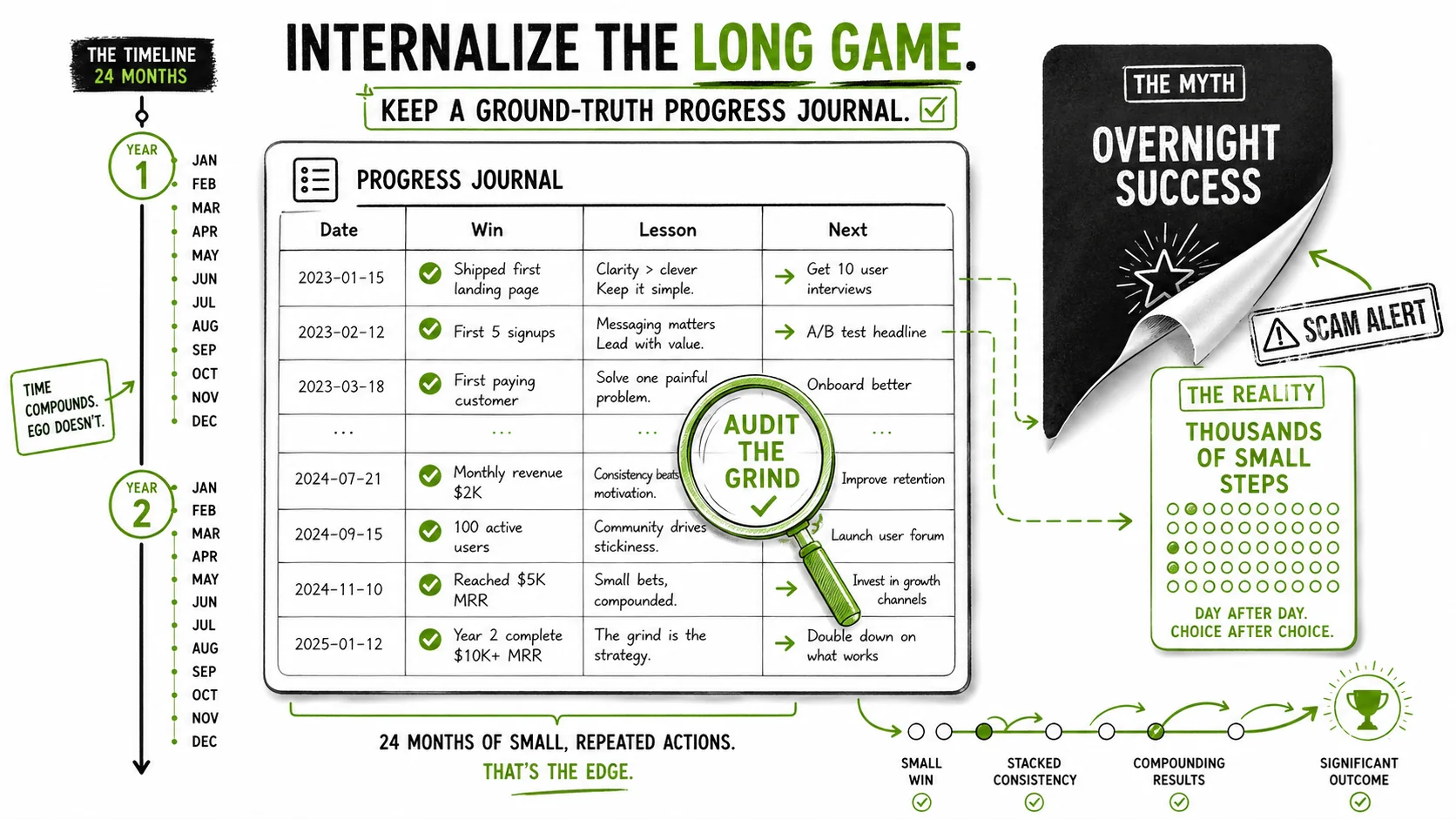
Knowing how to audit others is useful, but the real win is applying that clarity to your own journey. The goal is to inoculate yourself against the myth and build a mindset geared for the authentic, multi-year grind. Here are actionable strategies.
Strategy 1: Keep a "Ground Truth" Journal. Your own memory will betray you. In 18 months, you'll forget the brutal debugging session in month 3 or the first $5 customer in month 8. Start a simple log—a Google Doc, a Notion page, a physical notebook. Every week, jot down: 1) One concrete, tiny win (shipped a feature, wrote a blog post, had a useful conversation). 2) One lesson learned (even from a failure). 3) One next tiny step. This journal becomes your personal "Wayback Machine." When you feel like you've made no progress, you can look back at the unedited record of your actual climb. It provides objective evidence against the subjective feeling of stagnation.
Strategy 2: Reframe Your Benchmarking. Stop comparing your Chapter 3 to someone else's curated highlight reel from Chapter 20. Instead, benchmark backwards and sideways.
- Backwards: Compare yourself today to yourself 6 or 12 months ago. What skills have you developed? What mistakes are you no longer making? This measures real growth.
Strategy 3: Study the "Middle" Not Just the "End." We obsess over exit interviews and post-mortems. Instead, seek out stories from the messy middle. Read Indie Hackers interviews where founders share their current, incomplete MRR graphs with plateaus. Listen to podcasts where founders talk about their current challenges, not their polished past ones. This normalizes the struggle. It provides a more realistic map of the territory you're actually traveling through. Our guide on finding alternatives to getting scammed points to communities and resources that focus on this honest, mid-process sharing.
Strategy 4: Embrace "Timeful" Planning. Ditch the 12-month "get rich" plan. Adopt a 3-year vision with quarterly reviews. Break that vision down into annual themes (Year 1: Discovery & Foundation, Year 2: Validation & Traction, Year 3: Scaling & Systemization). Then, focus only on the quarterly objectives. This timeframe aligns more closely with the reality of building something meaningful. It reduces the panic of not hitting unrealistic monthly goals and creates space for the inevitable pivots and learning cycles.
Strategy 5: Cultivate Skeptical Curiosity. Apply your timeline audit skills as a reflex. When you see a dazzling story, don't just feel inspired—get curious. "That's interesting. I wonder what the 3 years before that looked like?" Do a quick 10-minute audit. Check the domain age, glance at their LinkedIn pre-history. This isn't about being a hater; it's about being a researcher. You're training your brain to see the structure behind the story, which makes you immune to its manipulative power. You start to appreciate the real craft—the years of skill-building—rather than being dazzled by the magic trick of a compressed timeline.
The long game isn't about working harder for longer. It's about working smarter, with clearer expectations, and deriving satisfaction from the process of growth itself, not just the distant, hypothetical payoff. It's about building a business that is an expression of your accumulated skill, not a lottery ticket you hope cashes in by next year.
Got Questions About the Overnight Success Myth? We've Got Answers
How long does it really take to build a successful business?
The data is clear, but unpopular. Research from sources like the Kauffman Foundation and analyses of Inc. 5000 companies consistently show a median timeframe of 7-10 years to build a business of significant scale and stability. For a sustainable, profitable lifestyle business or SaaS product, a 3-5 year horizon to meaningful traction is common. The "overnight" successes you see are almost always statistical outliers, or more often, misrepresentations of a much longer journey. The real metric isn't time to launch, but time to competence—and that takes years in any complex field.
What's the biggest red flag in a founder's story?
The single biggest red flag is a complete lack of visible professional history before their "overnight" venture. A LinkedIn profile that starts with "Founder & CEO" at the current company, with no prior roles, internships, or education listed, is highly suspect. Everyone has a past. The deliberate erasure of that past is a strong indicator of a narrative being manufactured. It suggests they are hiding the years of grind, failed attempts, or relevant expertise that actually enabled their current success.
Can a business ever grow quickly?
Absolutely. Viral products, freak timing, and exceptional execution can create rapid growth. But "rapid growth" is not the same as "overnight success." Rapid growth is an event that happens within a timeline. It's the hockey stick after a long, flat part of the curve. The myth lies in pretending the flat part didn't exist. Furthermore, rapid growth is often unstable. Scaling infrastructure, team, and culture to support that growth is a new multi-year challenge. Many "overnight successes" flame out just as quickly because they were events, not built on durable systems.
Should I avoid all inspiration from founder stories?
No, but change how you consume them. Don't look at them as blueprints. Look at them as case studies. Instead of asking, "How can I do this in 18 months?" ask, "What specific tactic did they use to get their first 10 customers?" or "How did they position their product against competitors?" Extract the tactical lessons, not the chronological fantasy. Assume a 5-year backstory was edited out, and focus on the one useful kernel of executional advice buried in the hype.
Ready to see through the curated stories and focus on your real progress?
Larpable - Detect or Create gives you the frameworks to dissect entrepreneurial narratives and build your business on a foundation of reality, not fairy tales. Stop benchmarking against illusions and start building your own authentic, multi-year journey. Learn to separate the signal from the noise with our core guide: Apprendre à Détecter.
<!-- sister-projects-start -->
Other Doved Studio projects
Related tools from the same studio you might find useful:
- Ralphable: Generate structured Claude Code skills that iterate until pass/fail criteria are met.
- Doved Studio: Studio indie derrière cette app et une dizaine d'autres outils.
<!-- sister-projects-end -->