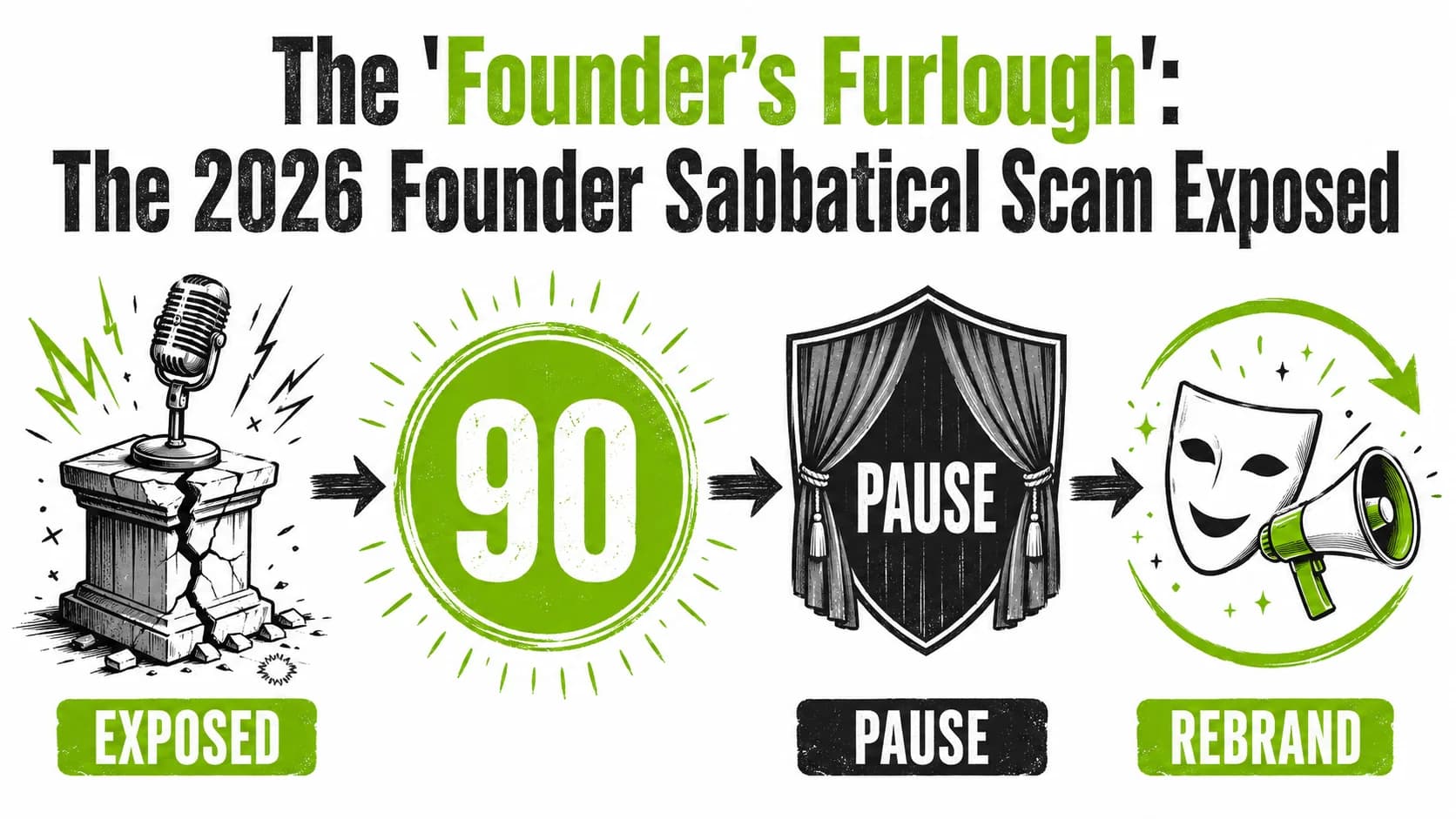
If you’ve scrolled through LinkedIn or X in the last few weeks, you’ve witnessed a curious, synchronized phenomenon. A cohort of mid-tier "coaches" and "thought leaders"—the same people who preached relentless hustle—are now announcing a sudden, collective need for a "mandatory pause." The language is uniform: "Taking a 90-day operational furlough," "Embarking on a mandatory founder's sabbatical." The timing, clustered in late February 2026, is too perfect. This isn't genuine burnout; it's a coordinated crisis PR playbook. Welcome to the Founder's Furlough, the latest scripted exit strategy for the exposed entrepreneur. When their facade cracks, the modern guru announces a pre-packaged "break" to let controversies cool, dodge direct accountability, and lay groundwork for a monetizable return. This article dissects this 2026 trend. Your skepticism is your greatest asset. Let's sharpen it.
The Anatomy of a Coordinated Retreat
A genuine sabbatical is a personal, often quiet decision. The Founder's Furlough is a public, performative spectacle. These are the signs you're witnessing a grift in hibernation mode, not a human needing rest.
The Scripted Announcement: A Masterclass in Vague Virtue
The announcement post follows a precise, five-part formula designed to evoke sympathy and silence critics.
Why Now? The 2026 Accountability Pressure Cooker
This synchronized retreat didn't happen in a vacuum. The early 2026 online business landscape has become hostile to unsubstantiated claims. I've watched this evolve since the "course launch" craze of 2022.
- The Rise of the Digital Detective: Tools and awareness for dissecting fake analytics are more accessible. Communities exposing larpers are growing.
- Platform Crackdowns (The Minimal Kind): Platforms face pressure to reduce financial misinformation. A pre-emptive "break" looks better than a forced takedown.
- Market Saturation & Skepticism: The "get rich quick" market is exhausted. Audiences are fatigued. Old playbooks yield diminishing returns, necessitating a "strategic pivot"—which first requires a strategic disappearance.
The Founder's Furlough is a tactical retreat from a battlefield where they are losing. It's not integrity; it's a threatened business model.
The 90-Day Playbook: What Really Happens During the "Furlough"
Contrary to the image of silent meditation, the furlough period is a highly active, behind-the-scenes operational phase. Think of it as "maintenance mode," where the public-facing app is down, but developers are frantically rewriting code.
| Public Persona (The Show) | Private Reality (The Grift) |
|---|---|
| "Complete digital detox" | Aggressive reputation management: Deleting comments, DMCA-ing negative videos, negotiating with unhappy clients under NDAs. |
| "Deep strategic reflection" | Product development sprint: Writing the "Return from the Abyss" masterclass, filming the "Sabbatical Secrets" documentary. |
| "Reconnecting with family" | Legal and financial restructuring: Dissolving old LLCs with bad reputations, forming new holding companies. |
| "Listening to the universe" | Market research & list segmentation: Analyzing which followers are most likely to buy the comeback story. |
The goal is to emerge as a reborn brand. The past controversies are not addressed; they are architecturally separated from the new entity.
How Widespread is This Guru Accountability Dodge?
Quantifying this exact trend is tricky because gurus rarely admit their breaks are strategic. However, we can look at related fraud data. The FTC's Consumer Sentinel Network received over 5.4 million fraud and identity theft reports in 2024, with imposter scams and business opportunity schemes being top categories. While not all are "gurus," this ecosystem thrives within these broader scam categories. The mandatory break grift is a sophisticated evolution of these classic schemes, designed to evade the very reporting that fills these databases. When a guru disappears for 90 days, active complaints often stall, artificially lowering their visible complaint footprint right before a rebrand.
The Inevitable Comeback: How to Spot the Rebrand Grift
Mark your calendars for late May 2026. As predictably as the swallows returning to Capistrano, the furloughed gurus will descend upon your feed once more. Their return is a masterclass in narrative manipulation.
The Triumphant Return Narrative
The comeback post will make the announcement post look blunt.
- The "Transformation" Reveal: They'll speak in vague, spiritual-entrepreneurial jargon about "clarity" and "a new operating system." The substance is zero, but the aesthetic changes—a new logo, a switch from suits to linen shirts.
- The "Lesson" Framed as a Product: The hardship of their "forced break" becomes your learning opportunity. "What I learned in my 90 days of silence can save you 10 years of burnout..." For only $2,997, you too can learn the secret of... taking a break.
- The Limited-Time "Re-Founding" Offer: To celebrate their "re-birth," they launch a new, exclusive offering. It's often their old flagship product, repackaged with a new name and a 300% price increase.
Your Detection Toolkit for the "Post-Sabbatical" Guru
When you see the return, don't get swept up. Arm yourself with these questions:
The goal of this entire cycle is to monetize the recovery. They've grifted the hustle, and now they grift the anti-hustle.
The Financial Scale of the Mandatory Break Grift
While individual course sales are private, the broader "business coaching" market is a multi-billion dollar arena ripe for exploitation. A 2023 analysis by Zippia estimated the US business coaching industry itself was worth over $15 billion. Fraud within this space is significant; the FTC's 2024 Data Book notes that consumers reported losing over $10 billion to fraud overall, a 14% increase from the previous year. The founder sabbatical scam operates within this lucrative, poorly policed intersection of "coaching" and fraud. A successful "comeback" launch after a furlough can easily generate six figures in 48 hours, incentivizing the entire cynical cycle.
How to Protect Yourself: Beyond Cynicism to Informed Action
Cynicism is a starting point, but action is power. Here’s how to navigate this trend without becoming a victim.
- Practice Temporal Discounting: When you see a dramatic "I'm leaving" post, mentally fast-forward 91 days. Picture the inevitable comeback sales page. This simple act breaks the emotional spell.
- Support & Amplify Real Accountability: Follow the watchdogs and critics who documented the issues that likely prompted the furlough.
- Invest in Fundamentals, Not Fairy Tales: The best antidote is competence. Instead of buying the "Sabbatical Secret" course, invest in a reputable accounting course or a professional certification. Real skills are immune to rebrands.
The most powerful step is to develop a systematic eye for these patterns.
Conclusion: The Furlough is a Feature, Not a Bug
The Founder's Furlough is not a sign the guru model is dying. It's a sign it's evolving. It has incorporated meta-criticism into its own sales narrative. It's a grift that has learned to grift its own failure. This 90-day break is the ultimate luxury for a fraud: a sanctioned period where they are praised for avoiding consequences while building the next scheme. For the authentic entrepreneur, a sabbatical is a vulnerable recalibration. For the larper, it's the most calculated product launch of their career. As we move through 2026, expect this playbook to be copied. Your task is to recognize it instantly, dissect it, and share that knowledge to inoculate others. The game is always changing. Now, you know the new rules.
FAQ: The Founder's Furlough
1. Couldn't some of these breaks be genuine?
Absolutely. The key differentiator is transparency and prior behavior. A genuine leader might step back for health or a real pivot. They will be specific ("pausing to rebuild our tech stack"), handle obligations, and their history won't be a trail of exaggerated claims. The "furlough" pattern is suspect due to its scripted vagueness, synchronized timing, and its role as a reset button after exposure.
2. What's the harm if they just come back and sell a new course?
The harm is multi-layered. First, it rewards deceptive behavior. Second, it financially exploits people buying the redemption narrative, often at a higher price. Third, it pollutes the informational ecosystem, making it harder for genuine experts to be heard. It turns business education into soap opera storytelling.
3. How can I verify if a guru's past success claims were real?
Start by going beyond their curated case studies.
Independent validation: Can any claimed "successful clients" be found publicly praising them outside* the guru's own ecosystem?
- Business documentation: Do they have a real, traceable business history (LinkedIn, proper filings) matching their claimed timeline?
- Financial claims: Scrutinize revenue screenshots for inconsistencies in UI, fonts, and unrealistic growth curves.
- Archived content: Use the Wayback Machine to see if their story or claimed results have changed over time.
4. What usually happens to the people who bought their programs before the "furlough"?
They are often the biggest casualties. Support typically halts. Community forums go unmoderated. Promised "lifetime updates" are abandoned. Some receive automated emails pushing them towards the new, more expensive comeback offer. Refunds become harder, as the old business entity may be dissolved during the break.
5. Is 90 days a magic number for this scam?
It's psychologically and practically optimal. It leverages the business quarter, feels substantial, and aligns with social media's attention span. It's long enough for outrage to fade but short enough that the audience doesn't fully move on. It's a manufactured, digestible story arc.
6. Where can I learn more about the tactics used by fake gurus?
This is our focus at Larpable. Start with our comprehensive 2026 Guide to Spotting Fake Gurus. For external context, the FTC's reports on fraud trends, like the Consumer Sentinel Network Data Book for 2024, provide hard data on the scale of these issues. The related Data Spotlight on imposter scams is also relevant, as guru fraud often uses similar psychological tactics of authority and false promise.
<!-- sister-projects-start -->
Other Doved Studio projects
Related tools from the same studio you might find useful:
- Ralphable: Generate structured Claude Code skills that iterate until pass/fail criteria are met.
- Doved Studio: Studio indie derrière cette app et une dizaine d'autres outils.
<!-- sister-projects-end -->