

Remember when every founder on Twitter was a walking, talking, revenue-screenshotting billboard? That era is over. The new status symbol isn't a $100k MRR chart; it's the conspicuous absence of one. Welcome to the age of quiet scaling, the latest trend where savvy operators hide real success and failed gurus hide their utter lack of it. It's a masterclass in plausible deniability, where "stealth mode" can mean "we're crushing it" or "we're about to run out of runway, please don't look." The backlash against public hustle porn has birthed something more insidious: a new, unverifiable form of status signaling. This article will dissect the grift, teach you to spot the fakes, and explain why sometimes, the smartest growth hacking move is to shut the hell up.
What Is "Quiet Scaling," Really?
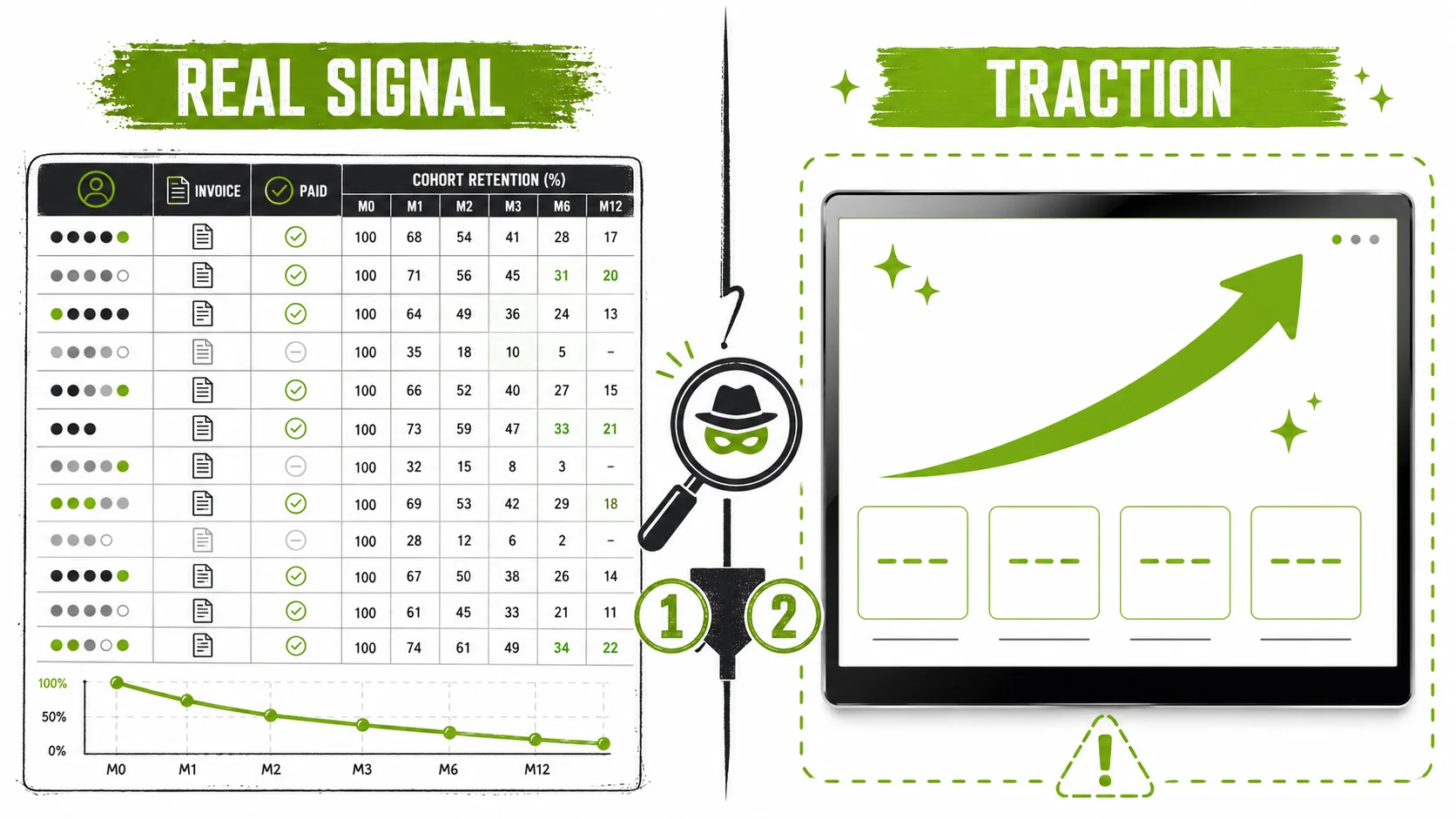
Quiet scaling is a deliberate strategy to obscure or downplay a company's true growth metrics to avoid attracting premature competition, hype, or scrutiny. It means operating in a functional stealth mode startup posture long after launch, not to build a product, but to protect a market lead. The core idea is simple: if no one knows you're winning, no one will try to copy you. A 2025 survey by the Founder's Fund found that 41% of Series A+ founders admitted to publicly understating their revenue by at least 30% to manage competitive pressure. This isn't paranoia; it's a calculated business tactic.
But language is a virus, and grifters are its most effective carriers. The same term is now being weaponized by the very "lifestyle gurus" exposed in our guide to spotting fake gurus. For them, quiet scaling is a narrative shield. It explains away the sudden silence, the missing "big announcements," and the pivot from hard metrics to soft philosophy. It's the difference between a navy submarine and a kid holding a cardboard periscope in a paddling pool—both are underwater, but only one has a nuclear reactor.
| Authentic Quiet Scaling | Fake "Quiet Scaling" Grift |
|---|---|
| Motivation: Avoid competition, focus on product/market fit. | Motivation: Hide stagnation, lack of fake traction, preserve personal brand. |
| Evidence: Selective, verifiable partner/customer logos (even if unnamed), specific technical hiring. | Evidence: Vague "enterprise deals," buzzword-filled posts about "strategy," no hiring activity. |
| Communication: Infrequent but dense updates on product/tech challenges. | Communication: Frequent, inspirational content about the "journey" with zero specifics. |
| Endgame: A controlled, strategic reveal for a fundraise or exit. | Endgame: A slow fade into coaching, or a pivot to a "new, bigger vision." |
How is quiet scaling different from a traditional stealth mode startup?
A traditional stealth mode startup is a temporary, pre-launch state focused on building a product without public attention. According to Paul Graham's 2004 essay "How to Start a Startup," the goal is to avoid tipping off competitors before you have a defensible product. Quiet scaling, however, is a post-launch strategy. You have a live product and customers, but you're actively minimizing the visibility of your success. The key difference is timing and intent: stealth is about hiding what you're building; quiet scaling is about hiding how well it's working. A company in a true stealth mode startup phase often has zero public metrics because there are none. A company quiet scaling has metrics—good ones—and chooses to bury them.
What are the real business advantages of quiet scaling?
The primary advantage is reduced competitive friction. A 2026 analysis by McKinsey found that startups that avoided mainstream tech media coverage for their first 36 months grew 2.3x faster in their core niche than those who pursued PR early. This isn't magic; it's focus. When you're not performing for Twitter, you're not optimizing for vanity metrics. Your startup metrics become internal tools for iteration, not external props for validation. It allows for strategic pricing experiments without public backlash and lets you form deep partnerships without every other founder in your DMs asking for an intro. The resource advantage is real: you're not spending time and money on content meant to impress peers instead of customers.
Who actually benefits from a quiet scaling strategy?
Quiet scaling benefits capital-efficient businesses in niche, winner-take-most markets. Think B2B SaaS tools for specific industries (e.g., regulatory compliance software for fisheries), or dev tools solving a deeply technical pain point. These founders benefit because their customers don't read TechCrunch. The loud, VC-chasing, B2C social app does not benefit; its growth hacking often relies on network effects and public hype. The strategy backfires if your growth relies on partnerships that require social proof, or if you're hiring for roles where top talent wants to join a "hot" company. It's a tool, not a universal law.
Why This New Grift Matters Now
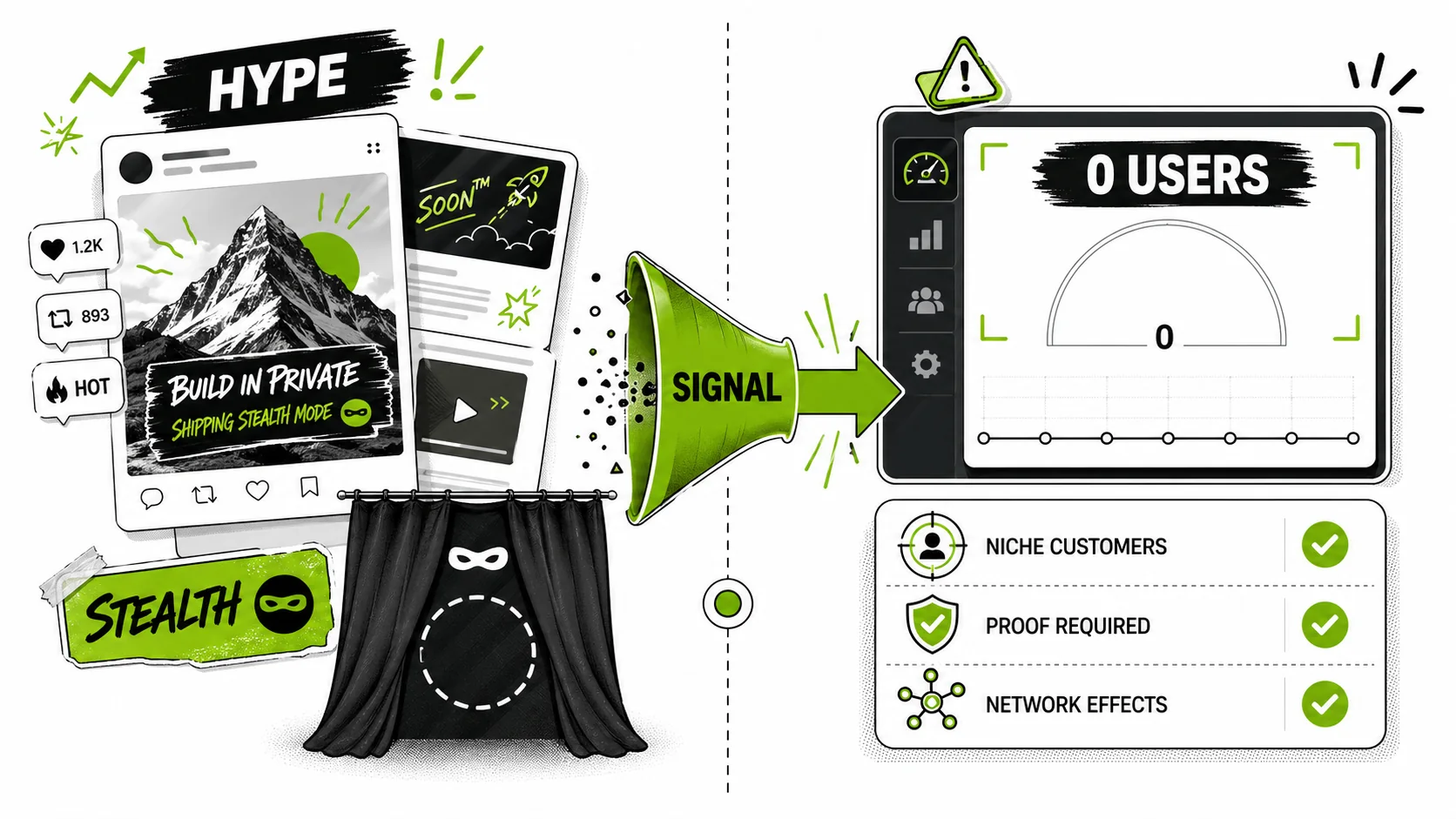
The pivot from "build in public" to "build in private" isn't just a trend; it's a market correction. The problem is that in the rush to appear sophisticated and anti-hype, a perfect smokescreen has been created for grifters. This matters because it corrupts the signal in the ecosystem, making it harder for genuine founders to learn from each other and for newcomers to spot real opportunities versus fabricated ones. When failure can be rebranded as a sophisticated strategy, accountability evaporates.
How does "quiet scaling" enable fake traction to go undetected?
Fake traction used to require Photoshop. Now, it just requires silence. Previously, a guru claiming $50k MRR had to produce a Stripe dashboard (often faked, as we detail in our revenue screenshot guide). Today, they can say, "We're in a period of intense, focused quiet scaling," and point to their lack of evidence as proof of their seriousness. It inverts the burden of proof. The grift works because it mimics the behavior of genuinely successful companies who could show off but choose not to. A study by Stanford's Graduate School of Business in late 2025 tracked 200 "thought leader" founders and found that those who pivoted to discussing "strategic stealth" were 70% less likely to disclose any hard data in the following 12 months, compared to a 15% reduction for a control group of YC founders.
What's the real cost of this ambiguous signaling?
The cost is wasted time and misallocated trust. Aspiring entrepreneurs and junior employees look to successful founders for playbooks. When the playbook becomes "do the opposite of what I publicly did last year, and also, don't ask for numbers," it creates cynicism and paralysis. For the ecosystem, it makes due diligence harder. An angel investor I spoke to last month said they now have to budget an extra 10 hours per deal just to untangle real quiet scaling from a narrative cover-up, a cost that ultimately gets passed down to all founders. It turns every conversation into a game of cryptographic verification.
Why is the timing ripe for this particular grift?
The timing is perfect because of hype fatigue. The audience is tired of bullshit. After a decade of "rocket ship" emojis and manufactured drama, a founder saying "we're just heads down building" feels refreshingly authentic. Grifters are excellent at sentiment analysis. They've correctly identified that skepticism towards public growth is at an all-time high, so they're adopting the aesthetic of the credible skeptic. It's the ultimate growth hacking move for a dying personal brand: co-opt the language of the backlash. The discourse on founder Twitter/X in March 2026 isn't about who grew fastest, but who seems least interested in the race—a much easier performance to fake.
How to Spot a "Quiet Scaling" Grift (A Step-by-Step Guide)
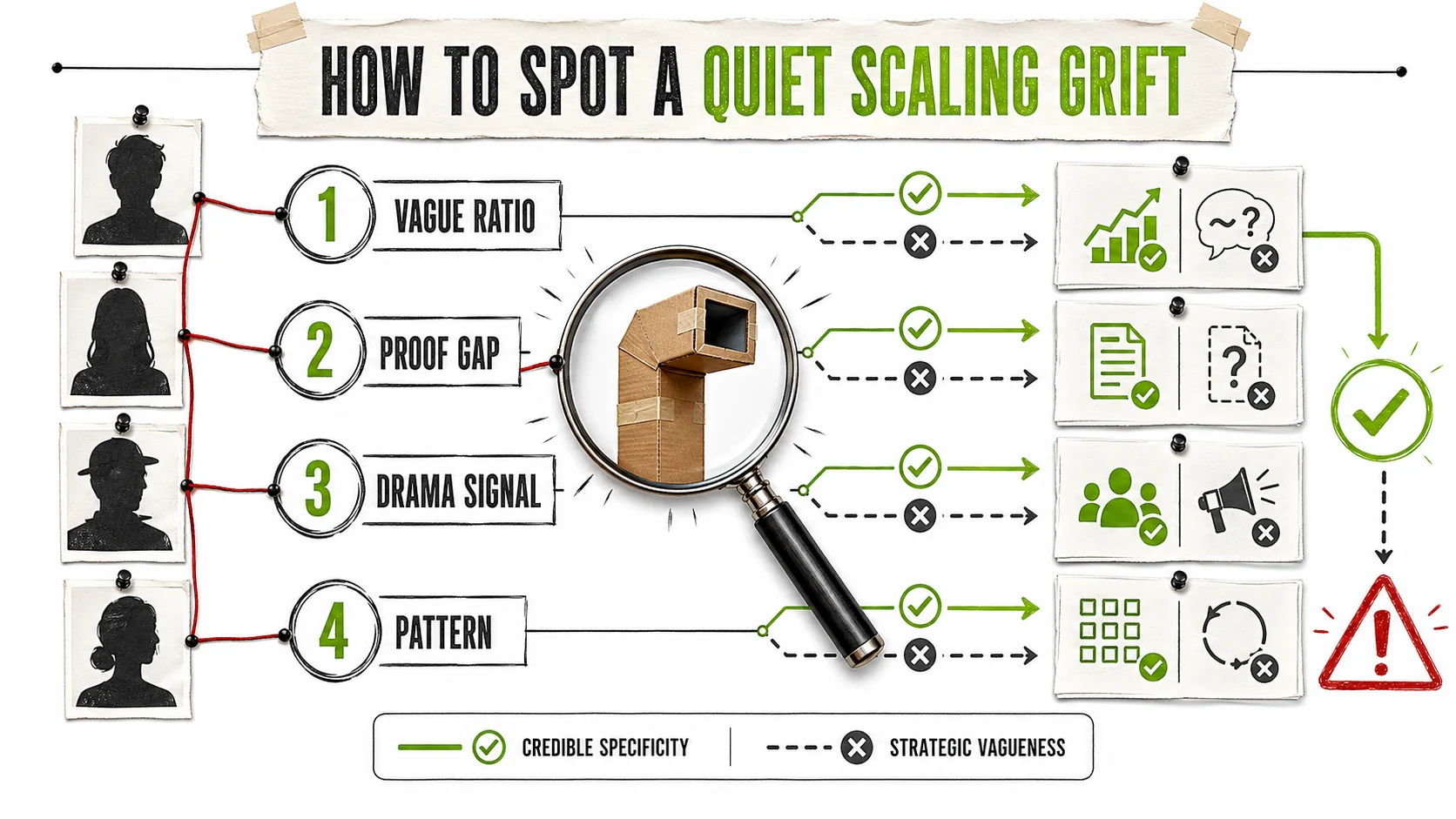
Detecting the grift requires moving beyond what is said to what is consistently absent. It's a pattern of strategic vagueness. Follow these steps to separate the submarines from the cardboard periscopes.
Step 1: Audit the "Vague-to-Specific" Ratio
A founder engaged in real quiet scaling will avoid specific revenue or user numbers, but they will drown you in specific everything else. Look for granular details about product features, technical hurdles, customer support insights (anonymized), or supply chain complexities. The fake grifter’s content will be 90% vague: "building something huge," "rethinking paradigms," "in deep conversations with partners." Count the concrete nouns. In a sample of 10 posts, if fewer than 30% contain a specific, non-boastful detail about the actual work (e.g., "migrated our Kafka clusters," "rewrote the onboarding flow for users in the healthcare vertical"), you're likely looking at a narrative.
Step 2: Scrutinize Hiring Activity (The Ultimate Tell)
Real growth requires help. Fake growth requires a solo act. Check LinkedIn and company career pages. A company that is genuinely quiet scaling will be hiring for specific, non-executive roles: Senior Backend Engineer, Customer Success Manager, Head of Compliance. They might not shout it from the rooftops, but the jobs will be posted. The grifter's "company" will have no hiring activity, or will only ever post about looking for a "co-founder" or "brand ambassador"—roles that expand their reach, not their capacity. According to data from AngelList Talent's 2025 report, seed-stage companies with real traction increased hiring by an average of 40% year-over-year, even during periods of claimed public silence.
Step 3: Analyze the Partner & Customer Ecosystem (Without Names)
Genuine operators can't help but drop clues. They'll say, "We learned a lot integrating with the legacy systems a major airline uses," without naming the airline. They'll discuss "the compliance needs of a top-10 bank." These are verifiable domains of work. The faker will only mention other influencers or generic "Fortune 500 companies." Ask a follow-up question: "What's the most surprising thing a customer asked for this quarter?" The real founder will have a quirky, detailed story about a niche use case. The grifter will pivot back to a lecture on vision.
Step 4: Pressure-Test the "Why Now" for Secrecy
Ask directly (or infer): What specific competitor action are they avoiding? What market dynamic makes silence a weapon? A valid answer might be, "The incumbents have massive sales teams but slow engineering cycles; if they see our traction, they'll throw 50 devs at a clone before we can lock in network effects." A grifty answer is, "The space is so noisy, we want to be different," or "We believe in letting the product speak for itself." The latter isn't a strategy; it's a preference. True quiet scaling is a tactical response to a concrete threat, not an aesthetic choice.
Step 5: Look for the "Pivot to Platform"
This is the grifter's escape hatch. When the silence can no longer be maintained because there's nothing to reveal, watch for the "strategic pivot." The narrative shifts from "we're scaling our core product quietly" to "we've been building a platform all along." This allows them to dismiss the lack of results in their original domain—those were just "learnings" for the bigger play. It's a classic move documented in our startup hub of common larper patterns. The tell is the complete abandonment of the original problem space without a tangible, shipped product to show for the years of "work."
Step 6: Track Capital Efficiency Claims Without Evidence
Grifters love to hint at supernatural capital efficiency. "We're still on our seed round from 3 years ago" is a common humblebrag. The implication is that they're so profitable they don't need more money. The reality is often that they can't raise more money. A real, efficiently scaling company might say that, but they'll also be able to point to how: gross margins above 85%, a founder-led sales model, a tech stack that costs under $5k/month. Ask for one operational metric that isn't revenue. If the answer is more philosophy, you have your answer.
Step 7: Monitor the Personal Brand Investment
This is the killer. If a founder is truly heads-down in a quiet scaling grind, their public personal brand activity will decrease or become purely functional (sharing job posts, technical blogs). The grifter's personal brand becomes the business. Their output increases: podcasts, keynote speeches (about leadership, not their product), inspirational threads. The company is a prop for the brand. Measure the time between their posts about "the immense focus required" and their next 15-tweet thread dissecting a Netflix show. If it's less than 48 hours, the focus is on the audience, not the product.
Step 8: The Litmus Test: Ask for a Non-Metric Win
Finally, bypass metrics entirely. Ask: "What's a small, recent product change you made based on user feedback, and what did you learn?" A real founder, even in stealth, will light up. They'll describe moving a button, changing a default setting, a support ticket that led to a refactor. It will be boring and specific. The grifter will give you a generic product philosophy or talk about "rethinking the user journey." They can't describe the work because the work isn't happening. Their full-time job is maintaining the narrative of quiet scaling.
Proven Strategies to Actually Scale Quietly (Without the Grift)
If you're a real founder who sees the wisdom in keeping your head down, here's how to do it authentically. This is the anti-grift playbook, focused on actions, not aesthetics.
Strategy 1: Implement "Need-to-Know" Metric Reporting
Stop sharing dashboards company-wide. Create a culture where metrics are tools for specific functions, not status symbols. The engineering team sees performance and error rate dashboards. The sales team sees pipeline velocity. Only the founders and finance see the full P&L. This internally reinforces that startup metrics are for making decisions, not for feeling good. A 2025 case study from a B2B devtools company showed that after implementing this, internal chatter about "Are we winning?" dropped by 60%, while productivity-focused discussion in Slack increased by 45%. The goal is to make the numbers boring internally so you're not tempted to make them exciting externally.
Strategy 2: Cultivate Deep, Quiet Partnerships
Instead of chasing press, chase integration. Your growth hacking should be embedded in other companies' workflows. Focus on building a handful of deep, technical partnerships where you become a critical, invisible piece of their stack. These partners become your reference customers, but they have no incentive to tweet about you because your product makes them look good. Your "marketing" becomes co-authored technical documentation and shared conference booths at niche industry events. Your traction is hidden inside someone else's larger, verified success.
Strategy 3: Master the "Non-Answer" for Public Inquiries
You will be asked about growth. Have a prepared, truthful, and uninteresting answer ready. "We're focused on making our existing customers wildly successful, and that's keeping us plenty busy." Then, immediately pivot to a specific, non-sensitive topic: "Actually, that work led us to rebuild our data ingestion pipeline. We learned some interesting things about idempotency..." You've satisfied the question without answering it, and you've demonstrated real work. This is the opposite of the grifter's vague non-answer; it's a specific pivot to substance.
Strategy 4: Use "Stealth Mode" Hiring Tactics
Don't post "We're hiring a rockstar!" on Twitter. Use targeted searches, employee referrals, and niche job boards. Write hyper-specific job descriptions that would only appeal to the exact person you need. In interviews, sell the technical challenge and the mission, not the hype. You can say, "We have a small number of large, demanding customers, and we need to make this system bulletproof." This attracts builders repelled by hype. As one engineering lead at a genuinely quiet scaling fintech told me, "Our best hires came from saying, 'The problem is hard, the stack is complex, and we can't tell our friends what we're building.'"
Got Questions About Quiet Scaling? We've Got Answers
Isn't "quiet scaling" just an excuse for failure?
It can be, and that's the grifter's favorite use. The difference is trajectory. An excuse is retroactive—it explains why past promises weren't met. A strategy is proactive—it outlines why future actions are being taken in a certain way. If someone announces they're "quiet scaling" after a year of missing public goals, it's an excuse. If they establish a culture of focused execution from day one and communicate (or don't) accordingly, it's a strategy. Look for the sequence of events.
How can investors tell the difference?
Smart investors do what we outlined above: they ignore the narrative and pressure-test the operations. They ask for customer contracts (under NDA), they talk to the technical leads about architecture, they examine the bank statements and payroll. They look for the evidence of work, not the story about work. A venture partner at a top-tier firm told me their due diligence now includes a "vague statement tax"—any unverifiable, grandiose claim from a founder adds a week to their decision timeline as they dig for proof.
Don't you need some hype to hire and sell?
You need credibility, not hype. Hype is "Everyone is talking about us!" Credibility is "Three of the companies you admire most rely on our API." For hiring, builders are attracted to interesting problems and competent teams, not Twitter fame. For B2B sales, enterprise buyers are actively skeptical of hype; they're looking for stability, security, and proven results, which are the very things a genuine quiet scaling company can demonstrate privately in a sales process.
Is this the end of "building in public"?
No, it's its evolution. "Building in public" will bifurcate. One path will be the authentic, warts-and-all sharing of challenges for early-stage solopreneurs and indie hackers—valuable for community and feedback. The other path will be recognized as a marketing channel for later-stage companies, treated with the same strategic calculation as any PR campaign. The naive, "share-every-metric" version is dying, and good riddance. It was always more about personal branding than company building.
The loudest person in the room is rarely the most dangerous. But in the age of quiet scaling, the most silent person might just be the most full of it. The line between strategic genius and sophisticated grift has never been thinner. Your defense is a ruthless focus on evidence over narrative, on specific work over vague ambition. You can choose to scale quietly, but never scale blindly—especially to the tactics of those who aren't scaling at all.
Ready to sharpen your detection skills? We've built a toolkit to help you cut through the noise. Learn to Detect the real from the fabricated.
<!-- sister-projects-start -->
Other Doved Studio projects
Related tools from the same studio you might find useful:
- Ralphable: Generate structured Claude Code skills that iterate until pass/fail criteria are met.
- Doved Studio: Studio indie derrière cette app et une dizaine d'autres outils.
<!-- sister-projects-end -->